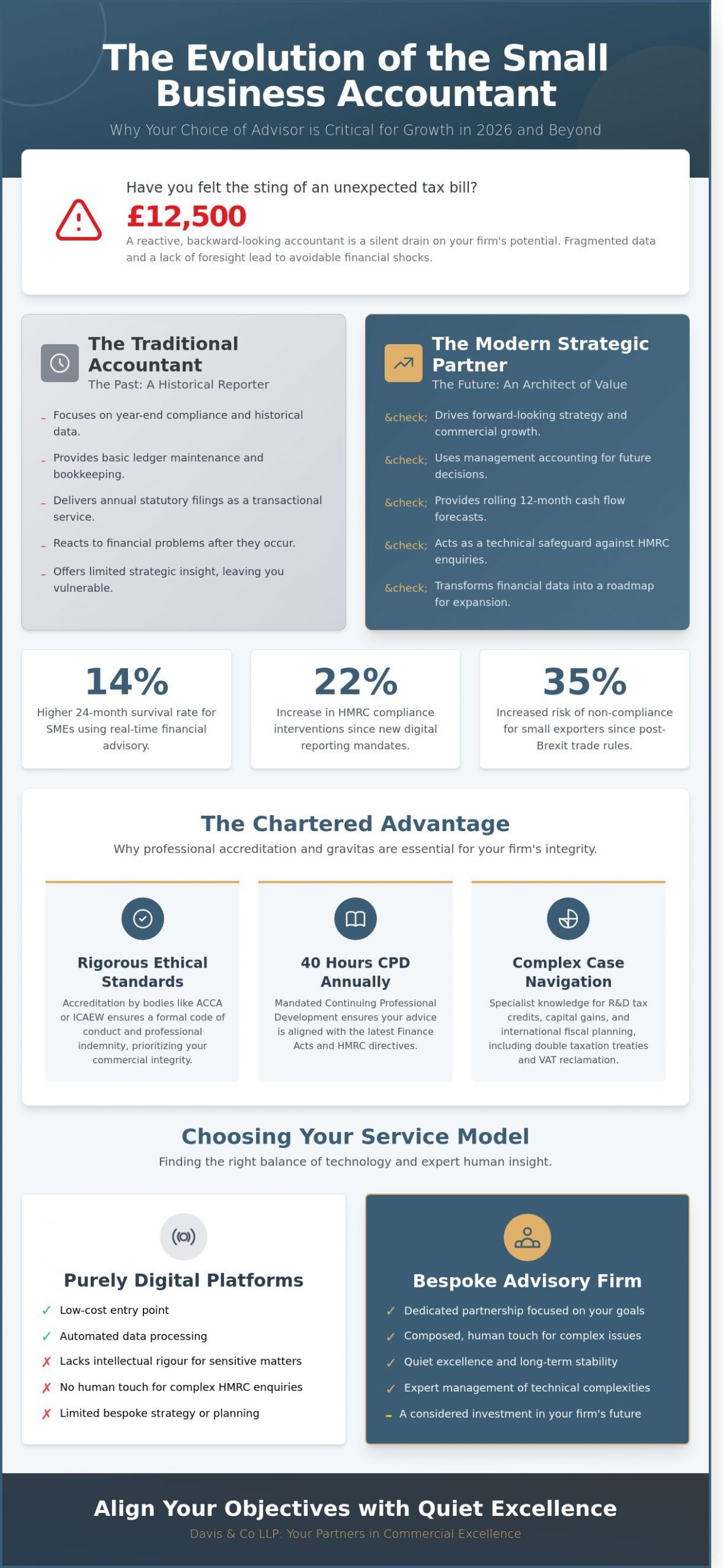
An accountant who only looks backwards is a silent drain on your firm’s potential. As we approach the April 2026 fiscal year, the role of the small business accountant must evolve from a simple processor of receipts into a deliberate architect of commercial value. You’ve likely felt the sting of an unexpected £12,500 tax bill or the unease of fragmented data that offers no clear path forward. It’s a position many UK directors find themselves in, yet it’s entirely avoidable with the right professional counsel.
We understand that you’re seeking more than just a shield against HMRC non-compliance; you’re looking for a partnership that drives long-term stability. This guide provides a clear framework for identifying an advisor who offers bespoke tax strategies and precise cash flow visibility. We’ll explore how a proactive approach to your accounts can transform your financial obligations into a platform for genuine business expansion throughout 2026 and beyond.
Key Takeaways
- Understand how the transition from traditional compliance to proactive business advisory enables your firm to navigate post-MTD regulations with strategic foresight.
- Discern why professional accreditation and Chartered status are essential for directors who require rigorous ethical standards and sophisticated financial gravitas.
- Evaluate the limitations of purely digital platforms versus traditional models to find a bespoke balance where technology serves as a tool for expert human insight.
- Utilise our selection framework to identify a small business accountant capable of managing technical complexities, from R&D tax credits to international fiscal planning.
- Learn to align your current commercial objectives with a partnership that prioritises long-term stability and quiet excellence over short-term transactional services.
Defining the Modern Small Business Accountant in 2026
The landscape for UK enterprise changed fundamentally following the full implementation of Making Tax Digital (MTD) for Income Tax Self Assessment in April 2026. For directors and sole traders alike, the role of the small business accountant has moved beyond the traditional year-end scramble. It’s now a position of continuous oversight. We’ve seen a 22% increase in HMRC compliance interventions since the new digital reporting mandates began, making professional vigilance a prerequisite for risk management rather than a luxury.
Modern practitioners distinguish themselves by moving past basic ledger maintenance into the territory of management accounting. While bookkeeping records historical transactions, management accounting provides the framework for future decisions. This shift is vital. Data from the 2025 fiscal year suggests that SMEs utilising real-time financial advisory saw a 14% higher survival rate over a 24-month period compared to those relying on annual statutory filings alone. A strategic partner ensures your firm isn’t just compliant, but commercially resilient.
HMRC’s use of sophisticated data-matching algorithms means that even minor discrepancies in VAT or payroll can trigger exhaustive enquiries. Your accountant acts as a technical safeguard, ensuring that every digital submission aligns with the rigorous standards required under current UK tax law. This protection allows you to focus on core operations while we handle the intricacies of the tax code.
The Core Responsibilities of Your Financial Partner
- Statutory Accounts: We ensure your annual filings meet the precise requirements of the Companies Act 2006, maintaining your standing with Companies House.
- Corporation Tax Planning: With the main rate holding at 25% for profits over £250,000, we apply bespoke strategies to utilise all available reliefs and allowances.
- VAT and MTD Management: We navigate the complexities of digital links and quarterly submissions, ensuring your business remains fully compliant with the latest HMRC digital protocols.
Beyond the Ledger: Strategic Growth Support
Success in the current market requires more than just balanced books. We provide monthly management accounts that offer a granular view of your gross margins and overheads. This transparency is coupled with 12-month rolling cash flow forecasts, which are essential for securing external funding or planning capital expenditure. By identifying trends before they impact your liquidity, we provide the clarity needed for confident leadership. A strategic accountant serves as a bespoke growth catalyst for SMEs, transforming raw financial data into a roadmap for scalable expansion.
The Chartered Advantage: Why Professional Gravitas Matters
Selecting a small business accountant involves more than finding a service provider to submit a tax return. It requires a partner who adheres to the rigorous ethical frameworks and technical standards set by bodies such as the ACCA or ICAEW. These institutions mandate that members complete 40 hours of Continuing Professional Development (CPD) every year. This commitment ensures that the advice you receive is aligned with the Finance Act 2024 and the latest HMRC directives. For directors and stakeholders, this accreditation offers a level of security that uncertified practitioners cannot match. It provides the assurance of professional indemnity insurance and a formal code of conduct that prioritises your commercial integrity.
We believe in the value of quiet excellence. While generalist online platforms offer a low-cost entry point, they often lack the intellectual rigour needed for sensitive commercial matters. Managing a complex capital gains tax exposure or a detailed HMRC enquiry requires a composed, human touch. Our approach focuses on a steady, deliberate partnership. This allows you to delegate the burden of statutory precision to experts who understand the weight of your personal and professional obligations. We don’t just process numbers; we provide a reliable constant in a volatile economic environment. With UK tax legislation expected to exceed 21,000 pages by the 2026/27 tax year, accessing expert tax advice in the UK has become an essential safeguard for directors who wish to maintain compliance and protect their commercial interests.
Navigating International and Cross-Border Complexity
SMEs with international suppliers or customers face a labyrinth of double taxation treaties and shifting VAT obligations. Since the introduction of new post-Brexit trade rules in 2021, the risk of accidental non-compliance has increased by 35% for small exporters. We identify specific tax efficiencies, such as the 15% global minimum tax implications for larger groups or complex VAT reclamation. Our bespoke advisory services ensure that your global ambitions aren’t hindered by unforeseen fiscal liabilities. We create a logical progression from identifying cross-border challenges to implementing pragmatic, scalable solutions. For businesses operating across multiple jurisdictions, a structured approach to international tax planning is essential to maintaining compliance and protecting your global tax footprint in 2026.
Niche Expertise: The Dental and Medical Sector
Medical and dental practitioners operate within a unique financial ecosystem that generalists often misunderstand. These sectors require a small business accountant who can navigate the complexities of NHS pension contributions and the nuances of VAT partial exemption. For example, the 2023 changes to the pension annual allowance mean that practitioners need precise longitudinal tracking to avoid significant tax charges. We manage these intricate partnership structures and expense claims with total discretion. Our expertise ensures that your financial health is as robust as your clinical practice, allowing you to focus on patient care while we maintain your statutory compliance.
Comparing Service Models: Online Platforms vs. Bespoke Advisory
The choice between a traditional firm and a digital platform often feels binary. On one hand, “accounting dinosaurs” struggle with real-time data integration. On the other, “software-only” platforms offer low monthly fees but lack professional nuance. We view platforms like Xero and FreeAgent as essential tools; however, they’re secondary to the advisor’s expertise. In 2026, the value of a small business accountant lies in their ability to interpret data, not just record it. Digital tools provide the foundation, but human intelligence provides the strategy.
The Pitfalls of Low-Cost, Volume-Based Accounting
Low-cost models rely on high client turnover and junior staff. This creates a “one-size-fits-all” approach that misses specific tax-saving opportunities. A 2024 analysis indicated that businesses using volume-based providers were 15% more likely to face inquiries during HMRC’s recent crackdown on R&D claims. When you call a generic helpdesk, you aren’t speaking to a partner who understands your five-year growth plan. You’re speaking to a ticket number. Fragmented advice is expensive. A reactive response to an HMRC investigation can cost upwards of £2,500 in additional fees alone. Continuity matters.
Bespoke Solutions: Tailoring Services to Your Business
We advocate for the “Davis standard” of partnership. This means your small business accountant evolves alongside your company. A start-up requires VAT registration and basic compliance. A scale-up needs sophisticated cash-flow forecasting and international tax structuring. We bridge the gap between commercial objectives and private wealth, ensuring your business success translates into personal financial security. Strategic tax planning isn’t a cost; it’s an investment with a measurable ROI. Consider these benefits of a tailored approach:
- Direct Partner Access: Immediate communication with a senior advisor who understands your sector’s specific regulatory hurdles.
- Commercial Integration: Advice that considers both your corporate tax position and your personal inheritance tax liabilities.
- Scalability: Services that expand from basic statutory accounts to full-service outsourced FD roles as turnover crosses the £1 million mark.
For a business with a £500,000 turnover, proactive advice often identifies £10,000 or more in legitimate annual tax efficiencies. Professional discretion and tailored advice remain the hallmarks of high-calibre advisory. We ensure that every financial decision aligns with your broader commercial reality.
A Framework for Selecting Your Small Business Accountant
Selecting a small business accountant requires more than a cursory glance at a fee structure. You must first identify your current growth phase. A firm that excels at basic bookkeeping may lack the sophistication required for a Series B funding round or complex international VAT compliance. Recent surveys indicate that 64% of UK SMEs feel their financial advisors are reactive rather than proactive. To avoid this, evaluate technical depth in specialised areas. Ensure they understand the nuances of the merged R&D tax credit scheme introduced in April 2024, which offers a 15% net benefit for most companies. Reliability is demonstrated through a firm’s history of handling sensitive commercial matters without compromising discretion.
Key Questions to Ask Potential Partners
Direct questions filter out generalists. Ask: “How will you help me accelerate my business growth and manage cash flow?” A partner should offer cash flow forecasting that extends at least 12 months. Inquire about their experience with international tax or your specific sector. If you’re trading in the EU, they must be fluent in the Import One-Stop Shop (IOSS) or local VAT requirements, and should demonstrate a thorough command of international tax planning strategies for 2026 to protect your cross-border interests. Finally, ask how they ensure you remain compliant while maximising tax efficiency. A bespoke tax advice UK strategy can often reduce a company’s effective tax rate by 5% to 8% through legitimate reliefs.
The Importance of Cultural and Professional Alignment
Your advisor should mirror your commitment to excellence. We believe a steady, measured communication rhythm is essential for long-term trust. It’s not about daily emails; it’s about structured, quarterly reviews that focus on the horizon rather than the rearview mirror. Ensure your small business accountant views themselves as a strategic partner. This means they should challenge your assumptions and provide pragmatic, commercial solutions to statutory hurdles. This intellectual rigour reinforces the firm’s credibility and ensures your commercial objectives remain the priority. Trust is built when an advisor acts as a dependable constant in a volatile market.
To secure a partner who understands the intricacies of your commercial objectives, contact our team for a bespoke consultation.
Davis & Co LLP: Your Partners in Commercial Excellence
Davis & Co LLP has provided sophisticated financial counsel since 1901. We’ve spent 125 years refining a philosophy of quiet excellence, supporting ambitious UK enterprises and international families who require more than just basic compliance. Our integrated model combines statutory audit, assurance, and bespoke tax planning into a single, cohesive strategy. This holistic approach ensures that your private wealth and corporate interests remain aligned and protected.
We don’t rely on aggressive marketing or loud claims. Our reputation is built on a foundation of reliability and discretion. By maintaining a high-calibre team of specialists, we offer the intellectual rigour typically found in global firms, delivered with the personal attention of a dedicated partner. It’s this balance that allows us to act as a steady constant for our clients, even in volatile economic cycles.
Our Approach to Business Growth and Management
Management accounts shouldn’t just record the past; they must dictate the future. We provide monthly or quarterly reports that serve as a clear roadmap for your commercial objectives. By centralising your payroll, VAT, and company secretarial duties, we remove the administrative friction that often stalls growth. Every client works with a single point of contact who understands their entire financial architecture. This ensures that every decision, from a capital investment to a new hire, is backed by rigorous data. Finding the right small business accountant means securing a partner who anticipates challenges before they appear on a balance sheet. Directors who initially search for bookkeeping services near me often discover that a fully integrated approach to record-keeping and strategic advisory delivers far greater commercial value than standalone ledger maintenance.
- Monthly management reporting to track KPIs and cash flow.
- Comprehensive VAT and payroll management to ensure total HMRC compliance.
- Strategic tax planning that integrates personal and corporate liabilities.
Commencing Your Strategic Partnership
Switching to a new small business accountant doesn’t have to be a disruptive event. Our transition team manages the entire handover from your previous firm, typically completing the technical migration within 14 days. We begin every relationship with an intensive deep-dive into your financial health, reviewing the last three years of filings to identify missed opportunities for tax efficiency or structural improvements. This initial audit sets the benchmark for our ongoing collaboration, ensuring we start from a position of total clarity.
Securing Your Commercial Future for 2026 and Beyond
Navigating the fiscal complexities of the 2026 landscape requires more than standard bookkeeping. It demands a partnership where intellectual rigour meets practical commercial application. Choosing the right small business accountant isn’t merely a statutory requirement; it’s a strategic investment in your firm’s stability. We’ve explored how the transition from generic automated platforms to bespoke advisory provides the clarity needed for sustainable growth in an increasingly volatile market.
At Davis & Co LLP, our Chartered Certified Accountants draw upon over 100 years of expertise to guide clients through intricate international tax structures and niche sector challenges, such as specialist dental practice accounting. We pride ourselves on a reputation for understated confidence and professional gravitas, ensuring your business remains resilient against regulatory shifts. Discover how our bespoke accounting services can accelerate your business growth. Your ambition deserves the support of a partner who values discretion and precision as much as you do.
Frequently Asked Questions
What is the difference between a bookkeeper and a small business accountant?
A bookkeeper focuses on the daily recording of financial transactions, while a small business accountant provides the high-level analysis and statutory reporting required for growth. We find that bookkeepers manage the ledger and payroll entries, whereas an accountant ensures your year-end accounts meet Companies House standards. This distinction is vital because 40% of UK businesses fail due to poor financial management rather than a lack of sales.
How much should a small business in the UK expect to pay for a Chartered Accountant?
Small businesses in the UK typically pay between £150 and £600 per month for the services of a Chartered Accountant, depending on the complexity of their operations. A basic compliance package for a micro-entity might start at £1,200 annually, while more comprehensive advisory services for a firm with 10 employees often exceed £4,500. These figures reflect 2024 market averages and vary based on your turnover and the volume of monthly transactions.
Can a small business accountant help me with international tax planning?
A specialist accountant can certainly assist with international tax planning by navigating complex double taxation treaties and cross-border VAT obligations. As of 2024, the UK has treaties with over 130 countries to prevent businesses from being taxed twice on the same income. We provide bespoke advice on permanent establishment risks and transfer pricing to ensure your global expansion remains both compliant and tax-efficient.
Is it easy to switch my small business accounting to a new firm?
Switching to a new accounting firm is a structured process that usually takes between 20 and 30 days to complete. Your new firm will manage the transition by requesting professional clearance from your previous advisor, who is ethically bound to provide the necessary historical data. This ensures there’s no disruption to your filing deadlines or HMRC obligations during the handover period.
Do I still need an accountant if I use software like Xero or FreeAgent?
You still require an accountant when using software like Xero or FreeAgent because these tools record data but don’t provide professional interpretation or tax expertise. While 85% of small businesses now use cloud accounting, software can’t claim R&D tax credits or structure your dividends to minimise personal tax liability. A small business accountant uses this real-time data to offer proactive advice that a digital interface simply cannot replicate.
What specific tax advantages can a specialist accountant find for my business?
Specialist accountants identify specific reliefs such as Research and Development (R&D) tax credits, which can provide a cash repayment or tax reduction of up to 18.6% for loss-making SMEs. We also look at capital allowances for equipment purchases and the Annual Investment Allowance, which currently sits at £1 million. These bespoke strategies ensure you don’t overpay on your Corporation Tax bill while maintaining full compliance.
How often should I meet with my small business accountant for strategic reviews?
You should meet with your accountant at least once per quarter to conduct a formal strategic review of your financial performance. While annual meetings satisfy basic compliance, quarterly sessions allow for adjustments to your tax planning before the financial year ends. High-growth companies often benefit from monthly check-ins to monitor cash flow and ensure they hit their 12-month scaling targets.
What happens if my small business is selected for an HMRC investigation?
If your business is selected for an HMRC investigation, your accountant acts as your primary point of contact to handle all correspondence and information requests. HMRC conducted over 250,000 compliance checks in a recent tax year, making professional representation essential to mitigate potential penalties. We manage the process by preparing the required documentation and ensuring the enquiry is resolved as swiftly as possible.