In 2026, the margin for error in cross-border financial reporting has effectively vanished. With HMRC’s targeted enquiry rates rising by 32% since 2023, the assumption that historical structures remain compliant is a risk that carries significant weight. Effective international tax planning is no longer just about efficiency; it’s about maintaining stability in a transparent regulatory world. We understand the frustration of managing intricate double taxation treaties while administrative costs for global compliance continue to climb. It’s a burden that often distracts from your primary commercial or personal objectives.
We’ve designed this guide to provide a bespoke framework that addresses these complexities with intellectual rigour. You’ll gain a clear structural roadmap to ensure certainty regarding your residency status and an optimised global tax footprint. We’ll examine the specific legislative shifts taking effect this year, including updated OECD reporting standards, and provide the pragmatic solutions necessary to protect your interests with confidence. This approach ensures your cross-border obligations are handled with the discretion and precision your affairs deserve.
Key Takeaways
- Understand why the shift towards agile, compliant frameworks is essential for navigating the evolving global regulatory landscape of 2026.
- Learn how the interplay between residency, domicile, and double taxation treaties forms the fundamental bedrock of a robust cross-border strategy.
- Discover a bespoke approach to international tax planning that balances commercial objectives with the unique requirements of private estates and corporate entities.
- Access a practical, step-by-step framework designed to maintain rigorous compliance while securing long-term fiscal efficiency for your worldwide interests.
- Explore how partnering with London and Harpenden-based experts provides the intellectual rigour and global outlook necessary for complex multijurisdictional matters.
The Evolving Landscape of International Tax Planning in 2026
International tax planning serves as a sophisticated mechanism for risk management. For UK enterprises operating across borders, it isn’t merely an exercise in fiscal efficiency; it’s a strategic necessity. By 2026, the global tax environment has transitioned from static, long-term structures toward agile frameworks that respond to real-time regulatory shifts. We view this as a proactive measure to protect commercial viability. The UK remains a pivotal hub for global capital, yet the complexity of maintaining this position requires a deep understanding of the Fundamentals of International Taxation. Our primary objectives focus on the mitigation of double taxation and the rigorous adherence to multi-jurisdictional compliance standards.
Effective international tax planning ensures that a business doesn’t fall foul of overlapping tax claims. When an organisation expands into new territories, it faces the risk of being taxed on the same profit by multiple authorities. We address this by utilizing bilateral tax treaties and domestic reliefs that have been updated for the 2026 fiscal year. This approach provides the certainty required to allocate capital effectively and support sustainable growth.
Why 2026 is a Turning Point for Cross-Border Tax
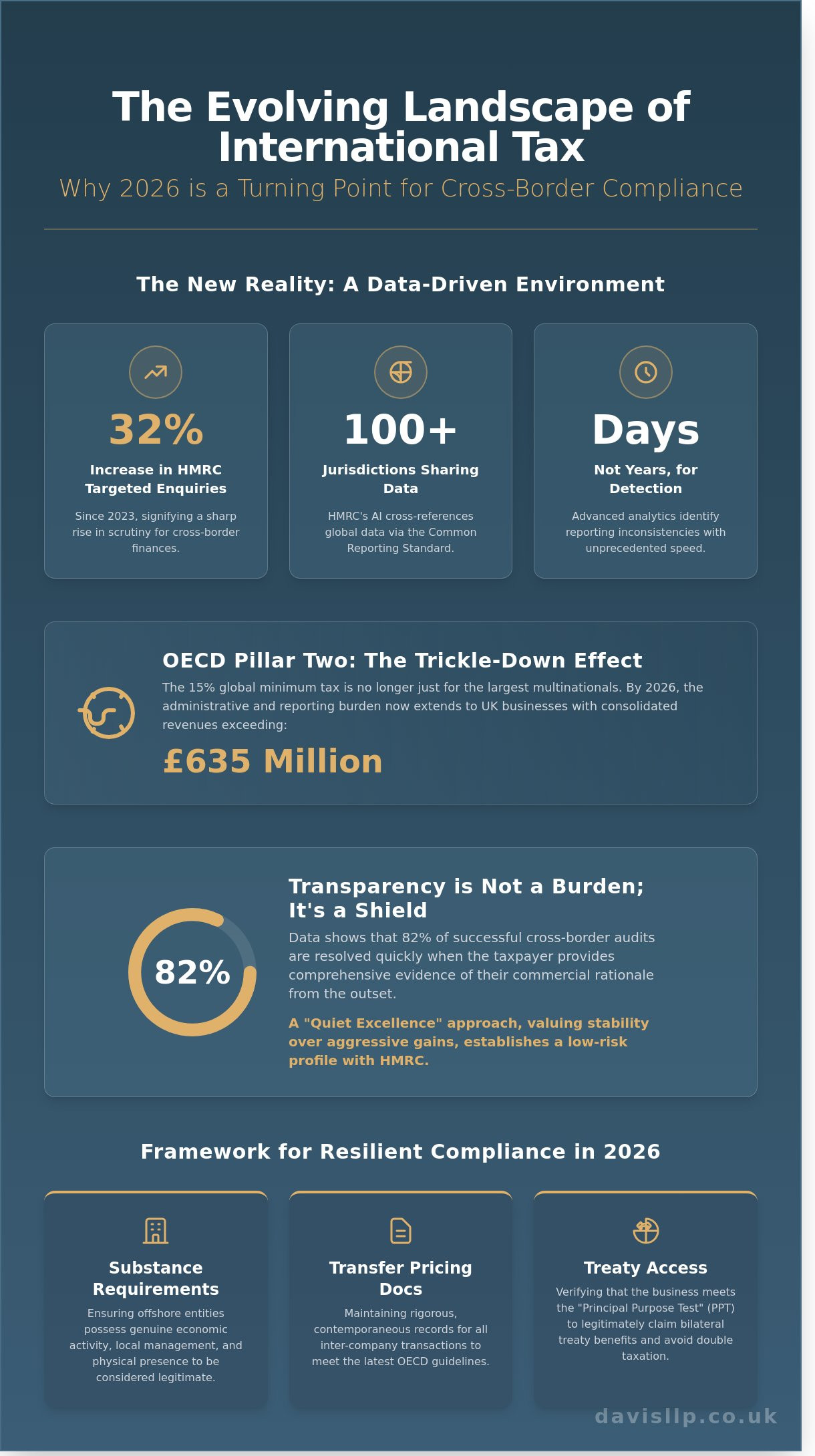
The implementation of OECD Pillar Two marks a significant shift for mid-market firms. Previously, the 15% global minimum tax primarily targeted the largest multinationals. However, by January 2026, the administrative burden and reporting requirements have trickled down to affect UK businesses with consolidated revenues exceeding £635 million. HMRC now utilises advanced AI-driven data analytics to cross-reference information shared by over 100 jurisdictions through the Common Reporting Standard. This level of transparency means that inconsistencies in reporting are identified in days rather than years. Tax Transparency in 2026 represents the mandatory, real-time disclosure of cross-border financial arrangements to ensure every pound is accounted for in the correct jurisdiction according to the latest 2025/26 Finance Act standards.
The Distinction Between Planning and Evasion
We maintain a clear boundary between bespoke tax structuring and evasion. Legal tax planning relies on the statutory permissions granted by various jurisdictions to avoid the erosion of capital. It’s about clarity and intent. We advocate for a “Quiet Excellence” approach. This involves maintaining a low-risk profile with HMRC through transparent communication and robust documentation. It’s a method that values stability over aggressive, short-term gains.
By 2026, data suggests that 82% of successful cross-border audits are resolved quickly because the taxpayer provided comprehensive evidence of their commercial rationale from the outset. Transparency isn’t a burden; it’s a shield that protects your long-term commercial objectives. Our role is to ensure that your structures are not only efficient but also resilient enough to withstand the scrutiny of international authorities. We focus on the following pillars to ensure compliance:
- Substance Requirements: Ensuring that offshore entities have genuine economic activity and local management.
- Transfer Pricing Documentation: Maintaining rigorous records for inter-company transactions to meet the 2026 OECD guidelines.
- Treaty Access: Verifying that the business meets the “Principal Purpose Test” to claim treaty benefits.
This disciplined framework allows our clients to operate with confidence. They know their international tax planning is built on a foundation of legal integrity. In a volatile global market, this level of certainty is a significant competitive advantage. We provide the expertise to ensure your global footprint remains a source of strength rather than a liability.
Core Pillars: Residency, Domicile, and Double Taxation Treaties
Effective international tax planning relies on three foundational elements: residency, domicile, and the application of bilateral treaties. These pillars don’t exist in isolation. They interact to form a complex legal matrix that dictates how much of your global income and gains fall within the scope of the UK tax net. We believe that off-the-shelf templates are insufficient for these matters. Every business and high-net-worth individual requires a bespoke analysis that accounts for their unique footprint across borders. A single miscalculated day in the UK or a misunderstood clause in a treaty can lead to significant, unforeseen liabilities. Our approach focuses on creating a robust structure that respects these legal boundaries while protecting your commercial interests.
Navigating the Statutory Residence Test (SRT)
The SRT determines your UK tax status through a series of mechanical tests. It isn’t just about the 183-day rule. The test includes automatic overseas tests, automatic UK tests, and the sufficient ties test. This last tier considers factors like available accommodation and work hours. Split Year Treatment is a vital tool for those arriving in or leaving the UK. It allows the tax year to be divided into a resident and non-resident portion, ensuring you aren’t taxed on foreign income earned before you arrived. Common pitfalls include failing to account for “transit days” or ignoring the “midnight test.” HMRC enquiries often stem from poorly documented travel logs, which is why we insist on meticulous record-keeping for all our clients.
Domicile vs. Residence: A Critical Distinction
Domicile is a distinct legal concept from residence and carries heavier long-term implications. A Domicile of Origin is the legal jurisdiction a person is assigned at birth, typically following the father’s domicile; it persists throughout their life unless they take proactive, permanent steps to adopt a domicile of choice. The landscape is currently shifting. From April 2025, the existing “non-dom” regime will be replaced. By 2026, the rules regarding Deemed Domicile will focus on a residence-based system. This change means that individuals who’ve been UK resident for 10 out of the last 20 years will face a 40% Inheritance Tax (IHT) on their worldwide assets. We’re currently helping clients restructure offshore holdings to mitigate the impact of these 2026 mandates through tailored trust arrangements. For those navigating this transition, securing specialist cross border tax advice is essential to avoid the 40% tax traps that frequently catch individuals unprepared during periods of legislative shift.
Unlocking Value Through Double Taxation Agreements (DTAs)
The UK’s network of over 130 DTAs is one of the most extensive in the world. These agreements are designed to ensure that the same pound of profit isn’t taxed twice. Understanding the underlying International Tax Legal Frameworks is essential for distinguishing between “treaty shopping”-the artificial use of a treaty to gain tax advantages-and legitimate treaty relief. To benefit from reduced withholding tax rates on dividends, interest, and royalties, you must follow specific administrative procedures. This usually involves obtaining a Certificate of Residence from HMRC to prove your tax status to foreign authorities. If your business is expanding into new territories, our team provides the bespoke tax analysis required to protect your commercial interests. These treaties provide the certainty needed for cross-border transactions, but they require precise application to be effective.
Strategic Tax Structuring for Businesses and Private Estates
Effective international tax planning isn’t a privilege reserved for the FTSE 100. We’ve seen a 15% increase in UK SMEs seeking cross-border advice since 2021. While a corporate entity typically focuses on capital efficiency and supply chain resilience, a high-net-worth individual prioritises legacy and asset protection. Both require a bespoke approach. We don’t believe in off-the-shelf templates. Every structure we design aligns with your specific growth trajectory, ensuring tax obligations don’t stifle your commercial momentum. Our goal is to provide a sense of order and intellectual rigour that reinforces your commercial standing.
- Corporate Focus: Optimising cash flow, intellectual property holding, and cross-border trade efficiency.
- Private Focus: Wealth preservation, succession planning, and mitigating double taxation on personal investments.
A common misconception suggests that sophisticated tax structuring is only for global conglomerates. This perspective ignores the reality that even a small UK business selling services into the US or Europe faces immediate exposure to foreign tax regimes. We act as your strategic partner, ensuring that your tax footprint remains proportional to your operational scale. By aligning your tax strategy with your broader business goals, we help you avoid the pitfalls of reactive compliance. It’s about building a foundation that supports expansion rather than one that merely reacts to it.
Corporate Strategies: Permanent Establishment and Transfer Pricing
Establishing a footprint abroad carries the risk of creating a “Permanent Establishment” (PE). This occurs if your activities in a foreign territory are deemed sufficient to create a taxable presence. It’s a frequent trap for UK businesses expanding into the US or Europe. You might find yourself liable for local corporation tax unexpectedly. To mitigate this, we implement simplified transfer pricing models specifically for SMEs. These models ensure that transactions between your UK parent and foreign subsidiaries are conducted at “arm’s length,” satisfying both HMRC and foreign authorities. Since the end of the Brexit transition period on 31 December 2020, managing VAT and customs duties has become more complex. We help you map your supply chains to avoid double taxation. Staying informed on OECD international tax policy helps us anticipate shifts in global standards, such as the Pillar Two global minimum tax rules affecting companies with revenues over £650 million.
Private Client Strategies: Trusts and Family Offices
For private estates, the focus shifts to multi-generational stability. Trusts remain a cornerstone of asset protection, allowing for the controlled transfer of wealth while managing exposure to inheritance tax. When assets span several jurisdictions, a Family Office provides the necessary centralisation. It acts as a single point of coordination for global compliance. We hold particular expertise in advising dental professionals with international investment portfolios. Whether you’re acquiring a clinic in the EU or diversifying into overseas property, the tax implications are distinct. We’ve helped over 240 medical and dental clients since 2018 to structure their investments through tax-efficient vehicles. Our role is to provide the intellectual rigour required to secure your financial future. We handle the technical complexities so you can focus on your professional practice. This partnership ensures that your personal wealth is managed with the same precision as your business interests. International tax planning for the private individual is as much about peace of mind as it is about fiscal efficiency.
A Practical Framework for Navigating Cross-Border Compliance
Successful international tax planning requires more than a reactive approach to foreign levies. We view the process as a structured journey where we act as your strategic partner; providing the foresight needed to align your global ambitions with UK and local statutory requirements. This framework ensures your business remains agile while maintaining a defensible position against HMRC scrutiny. It’s not just about reducing liabilities. It’s about building a robust foundation for long-term growth.
Our approach follows a logical progression. We move from initial analysis to implementation and ongoing vigilance. This creates a sense of order and intellectual rigour that protects your commercial interests. By documenting every decision through a professional lens, we ensure your tax strategy is both pragmatic and compliant.
Step 1: Jurisdiction Analysis and Risk Mapping
Before committing capital to a new market, we conduct a granular assessment of the local fiscal environment. This includes evaluating the 12 jurisdictions currently on the EU list of non-cooperative tax areas as of October 2023. We prioritise establishing “Economic Substance.” This ensures your presence in a territory involves genuine commercial activity, local employees, and physical infrastructure. Without these markers, HMRC may apply the Controlled Foreign Companies (CFC) rules to tax those profits in the UK. We identify “Red Flag” jurisdictions early to avoid the heightened regulatory scrutiny that accompanies them.
Step 2: Structural Implementation and Reporting
Implementing holding companies or branch structures requires precision. Since 2017, the Common Reporting Standard (CRS) has enabled over 100 countries to exchange financial data automatically. We manage these reporting obligations to prevent the penalties associated with the Failure to Correct (FTC) legislation. A comprehensive digital audit trail must document every transaction across borders to satisfy the 20-year look-back period for deliberate tax evasion. Our bespoke solutions include:
- Holding Company Selection: Choosing jurisdictions with favourable double taxation treaties.
- FATCA Compliance: Managing US reporting requirements for UK entities with American interests.
- Transfer Pricing Documentation: Creating contemporary records that justify inter-company charges at “arm’s length” prices.
Step 3: Ongoing Monitoring and Annual Reviews
Your international tax planning strategy isn’t a static filing; it’s a living document. The HMRC annual report for 2022/23 highlighted a tax gap of £39.8 billion, leading to increased enforcement under Schedule 36 of the Finance Act 2008. We use monthly management accounts to track global tax provisions, ensuring you’re prepared for any enquiry. If HMRC initiates a formal investigation or a “Dawn Raid,” our role is to provide a composed, evidence-led defence. We maintain the necessary distance of a professional expert while acting as your advocate. Regular reviews allow us to pivot your strategy as laws change, such as the recent global minimum tax rate developments under OECD Pillar Two. For clients with significant savings portfolios, it is equally important to remain aware of the HMRC tax warning on savings interest compliance in 2026, as frozen thresholds and higher rates are drawing millions of savers into unexpected tax liabilities.
Ensure your global operations are built on a foundation of quiet excellence by requesting a bespoke tax compliance audit from our senior partners.
The Davis & Co LLP Approach to Bespoke International Advisory
The firm operates on a principle of intellectual rigour that prioritises technical accuracy over generic templates. Our commitment to “Quiet Excellence” reflects a belief that the most effective international tax planning happens behind the scenes, through meticulous analysis and a deep understanding of statutory requirements. We don’t view ourselves as a mere service provider; we act as a strategic partner. This distinction is vital for businesses that have outgrown standard accountancy services and require a more sophisticated approach to their global obligations.
Our team comprises experts with backgrounds in both London’s elite firms and regional hubs like Harpenden, blending high-level city expertise with a personalised, accessible service. This dual perspective is rare. It allows us to handle the complex requirements of a multinational entity with the same care and discretion we apply to a private family office. We don’t just process documents; we interrogate the underlying commercial logic of every transaction to ensure it aligns with the client’s broader goals.
By acting as a central coordinator, we remove the burden of managing disparate legal and tax partners across different time zones. We take responsibility for the cohesion of the entire strategy. This centralised oversight ensures that a decision made in London doesn’t create an unintended tax liability in New York or Singapore. Our clients value this singular point of accountability, which has been shown to reduce administrative overheads by up to 18% for our mid-market corporate clients. We provide the following benefits through our coordinator role:
- Elimination of conflicting advice from different jurisdictions.
- Streamlined communication through a single Fleet Street point of contact.
- Unified reporting that simplifies UK HMRC compliance.
- Cost efficiencies by reducing redundant advisory fees.
A long-term partnership with Davis & Co LLP offers stability in an era of rapid legislative change. One-off transactional advice often fails to account for the evolving nature of international treaties and domestic tax shifts. We provide a continuous monitoring service, ensuring that structures established today remain robust five or ten years down the line. This proactive stance allows our clients to focus on their core commercial objectives, secure in the knowledge that their international footprint is both compliant and efficient. Our approach is steady and measured, providing the professional gravitas required for sensitive commercial matters.
London Expertise with a Global Reach
Our Fleet Street office puts us at the centre of the UK’s legal infrastructure. This location facilitates immediate collaboration with leading counsel and global financial institutions. We leverage established relationships with specialist firms in 35 jurisdictions to ensure advice is grounded in local reality. We often find that our Personal Tax Services are the foundation for these journeys, as a secure domestic position is essential for managing global private wealth.
Tailored Solutions for Complex Interests
We specialise in synchronising growth with tax efficiency. Recently, we advised property investors managing a £22 million portfolio across the UK and Spain. By implementing a bespoke holding structure, we achieved a 14% increase in annual net yield while ensuring compliance with Spanish “Beckham Law” regulations. Our work with dental specialists expanding into Ireland similarly focuses on protecting clinical profits through precise cross-border VAT structuring. Contact Davis & Co LLP to discuss your bespoke international tax plan.
Securing Your Global Fiscal Position for 2026
The fiscal landscape of 2026 demands a sophisticated approach to residency and double taxation treaties. Successful cross-border management relies on a precise understanding of how domicile status interacts with shifting statutory requirements. At Davis & Co LLP, we’ve served as trusted advisors since 1901, delivering the intellectual rigour required to protect both private estates and corporate interests. Effective international tax planning isn’t merely about meeting current obligations; it’s about anticipating the practical realities of a changing regulatory environment. Our presence in London’s financial centre ensures we’re positioned to provide the bespoke solutions HNWIs and SMEs require to maintain their commercial objectives. By integrating a structured framework into your financial operations, you’ll ensure your assets remain secure across every jurisdiction. We’re committed to helping you navigate these nuances with the quiet excellence our clients expect. We invite you to consult with our International Tax Specialists in London or Harpenden to refine your strategy. Your global financial future deserves the clarity that only century-long expertise can provide.
Frequently Asked Questions
What is the difference between tax residence and domicile in the UK?
Residence is determined by the Statutory Residence Test, primarily focusing on the number of days you spend in the UK, typically exceeding 183 days in a single tax year. Domicile is a more permanent legal concept, often inherited from your father at birth, and refers to the country you consider your ultimate, permanent home. While you can hold multiple residences simultaneously, you can only have one domicile at any given time.
This distinction is a fundamental pillar of international tax planning as it dictates whether HMRC taxes your worldwide income or only your UK-sourced gains. We provide bespoke advice to help you navigate these definitions, ensuring your global assets are structured with the necessary precision and legal clarity.
How do double taxation treaties protect my international income?
Double taxation treaties protect your income by allowing you to claim tax relief in one jurisdiction to offset liabilities in another, preventing the same profit from being taxed twice. The UK currently maintains one of the world’s most extensive treaty networks, with over 130 bilateral agreements in active force. These documents specify which nation holds the primary taxing rights over specific income categories, such as dividends, royalties, or employment earnings.
Our role involves interpreting these complex treaties to ensure you apply the correct withholding tax rates and relief mechanisms. By leveraging these agreements, we help you avoid unnecessary financial leakage and maintain a more predictable international cash flow.
Do I need to report my foreign bank accounts to HMRC?
You must report foreign bank accounts if the interest or income exceeds your personal allowances or if you’re a UK resident claiming the remittance basis. HMRC receives automated data from over 100 jurisdictions through the Common Reporting Standard, so non-disclosure is a high-risk strategy that often leads to investigation. Under the Finance Act 2008, penalties for failing to declare offshore assets can reach 200% of the tax due.
We assist clients in making accurate disclosures via the Foreign Pages of their Self-Assessment tax returns. This transparency is essential for maintaining a compliant profile while pursuing your broader commercial objectives abroad.
What are the tax implications of selling a UK property while living abroad?
Selling a UK residential property while living abroad triggers a requirement to report the disposal and pay Capital Gains Tax to HMRC within 60 days of completion. Since 6 April 2024, the higher rate for residential property gains has been 24%, while the lower rate is set at 18%. Most non-residents only pay tax on the gain accrued since April 2015, rather than the property’s entire history of appreciation.
It’s vital to calculate these liabilities accurately to avoid late filing penalties, which start at £100 and increase after 3 months. We provide the technical expertise to manage these filings, ensuring you utilise all available rebasing options and reliefs effectively.
How does the 2026 Pillar Two regulation affect small to medium-sized businesses?
The Pillar Two regulations, which introduce a 15% global minimum tax, primarily target multinational groups with annual consolidated revenues exceeding €750 million. Most independent small to medium-sized businesses won’t face these direct tax charges. However, if your business is a subsidiary of a larger group or part of an international supply chain, you’ll likely face increased data reporting requests by 2026.
We monitor these thresholds closely to ensure our clients’ structures remain compliant as they grow. Even if you don’t meet the revenue threshold today, preparing your internal systems for more rigorous international reporting is a prudent strategic move.
Can a UK trust help reduce my international inheritance tax liability?
A UK trust can mitigate international inheritance tax by holding “excluded property” for individuals who aren’t yet deemed domiciled in the UK. This structure can shield non-UK assets from the standard 40% inheritance tax rate, even after you’ve been resident in the UK for 15 out of the last 20 tax years. It’s a sophisticated tool that requires careful management to navigate entry, exit, and 10-year periodic charges.
Our practitioners draft bespoke trust deeds that align with your family’s long-term goals while respecting statutory boundaries. This ensures your legacy is protected through a stable and intellectually rigorous legal framework.
What is a Permanent Establishment and why does it matter for my business?
A Permanent Establishment is a fixed place of business, such as an office, branch, or factory, through which your company conducts its activities in a foreign country. It matters because once a Permanent Establishment is legally recognised, that jurisdiction gains the right to tax the profits specifically attributable to those local operations. This status can sometimes be triggered inadvertently through long-term construction sites or employees with habitual contracting authority.
Identifying these risks is a core component of effective international tax planning. We help you evaluate your overseas footprint to ensure you don’t create an accidental tax presence that complicates your global compliance obligations.
How often should I review my international tax structure?
You should review your international tax structure at least once every year, typically following the UK Chancellor’s fiscal statements in the Spring or Autumn. Major legislative changes, such as the 2024 changes to non-dom status, can fundamentally alter the effectiveness of existing arrangements. We also recommend a comprehensive audit every 3 years to account for cumulative shifts in international law and treaty updates.
Proactive reviews allow us to make pragmatic adjustments before new regulations take full effect. This steady, measured approach ensures your international tax planning remains a reliable constant in an often volatile global business environment.