Could a single ten-digit code be the difference between a seamless tax season and a protracted dispute with HMRC? It’s understandable that many professionals find the distinction between a National Insurance number and a utr number needlessly opaque, especially when a simple clerical error can lead to an immediate £100 penalty. You likely feel that your time is better spent on commercial growth and strategic objectives than on deciphering the nuances of administrative registration.
We’ve developed this comprehensive guide to help you master the essentials of your Unique Taxpayer Reference, from your initial application through to sophisticated tax management in 2026. You’ll gain a clear understanding of the registration process for various business structures and the precise 10 to 15 working day timelines for HMRC responses. We’ll also examine the pragmatic steps required to safeguard your tax identity; this ensures you remain secure and well-advised in an increasingly complex regulatory environment. By following this bespoke path, you can replace administrative anxiety with the quiet excellence that defines successful commercial ventures.
Key Takeaways
- Gain a precise understanding of the Unique Taxpayer Reference as a permanent 10-digit identifier and its distinct role compared to your National Insurance number.
- Navigate the formal registration process for your utr number via the Government Gateway, with tailored guidance for individuals, partnerships, and limited companies.
- Identify secure methods for locating a misplaced reference through HMRC’s digital platforms and physical documentation to maintain uninterrupted compliance.
- Prepare for the evolving regulatory landscape by integrating your reference with Making Tax Digital (MTD) and the Construction Industry Scheme (CIS).
- Discover how professional oversight and bespoke tax planning ensure your filings are managed with the precision required for complex financial profiles.
Understanding the Unique Taxpayer Reference (UTR) in 2026
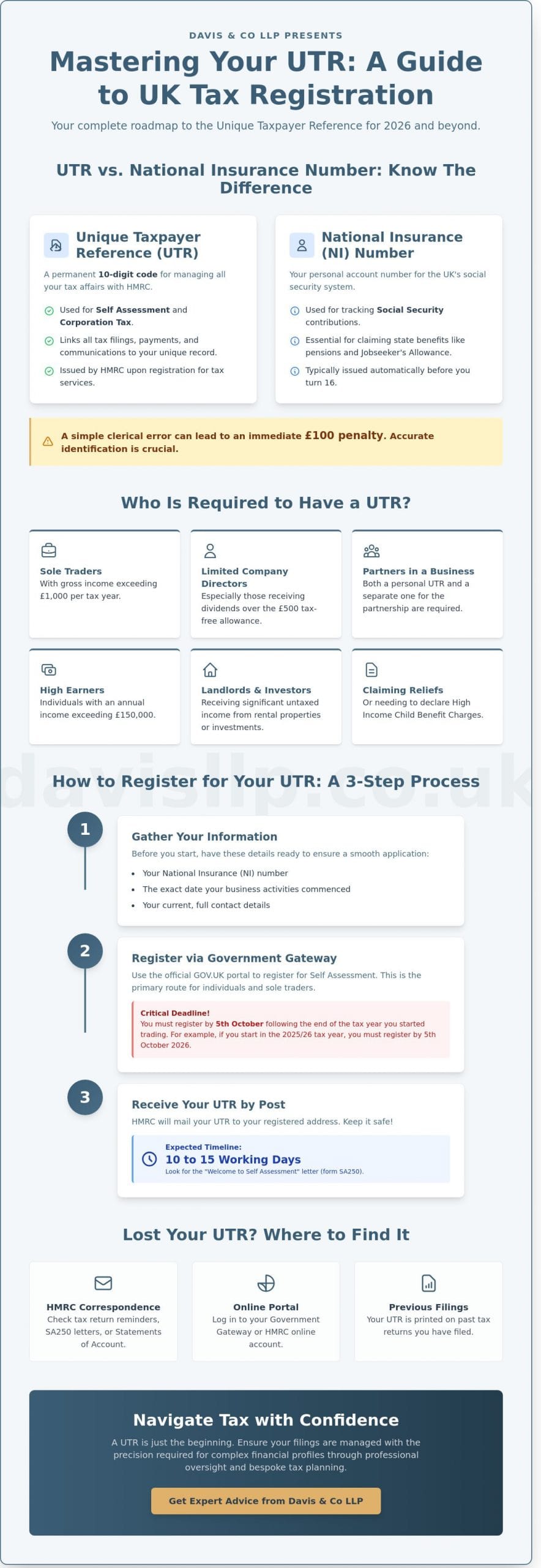
In the context of British tax compliance, the Unique Taxpayer Reference (UTR) remains a fundamental component of an individual’s or entity’s relationship with HM Revenue and Customs (HMRC). It’s a permanent, 10-digit identifier that persists throughout the lifetime of a business or a professional career. While many individuals confuse this with their National Insurance (NI) number, the two serve distinct purposes. Your NI number tracks social security contributions and benefit entitlements, whereas the utr number exists specifically to manage tax liabilities under the Self Assessment and Corporation Tax frameworks.
HMRC utilizes this identifier to manage the fiscal records of individuals, partnerships, and limited companies alike. It ensures that every communication, filing, and payment is correctly attributed to the right entity. For our clients, maintaining a clear understanding of this reference is the first step toward robust financial governance and the avoidance of administrative friction with the Revenue.
The Anatomy of a UTR Number
The structure of a UTR is consistently a 10-digit sequence, often presented in two blocks of five digits on official documentation. You’ll find it prominently displayed on HMRC correspondence, such as the “Welcome to Self Assessment” letter (form SA250), tax return reminders, or your Statement of Account. This numerical code allows the Revenue to match payments and filings to a specific tax record with absolute precision, reducing the risk of misallocated funds. The utr number serves as the definitive link between a taxpayer and their statutory obligations. We find that clear identification is vital for the seamless resolution of any tax-related inquiries.
Who is Required to Have a UTR?
Registration is mandatory for any individual or entity entering the Self Assessment system. For the 2024/25 tax year, this includes sole traders with a gross income exceeding £1,000. It also encompasses limited company directors, particularly those receiving dividends above the current £500 tax-free allowance. We observe that trustees and members of business partnerships must also secure their own references to ensure collective compliance. Specific requirements also apply to:
- Individuals with an annual income exceeding £150,000.
- Those receiving significant untaxed income from rental properties or overseas investments.
- People who need to claim certain tax reliefs or high-income child benefit charges.
- Partners in a business, who require both a personal UTR and a separate reference for the partnership itself.
Securing a reference is not merely a procedural hurdle; it’s a prerequisite for fulfilling your commercial and private client duties. We advise early registration to ensure that your bespoke tax strategy is supported by a verified and active HMRC record.
How to Register for a UTR Number: A Step-by-Step Guide
Obtaining a utr number is a fundamental statutory requirement for anyone engaging with the UK tax system outside of standard PAYE employment. The process is structured but requires meticulous attention to detail to avoid administrative delays. HMRC uses this ten-digit identifier to track your tax obligations and ensure your filings are correctly attributed to your record. To begin, you’ll need three core pieces of information: your National Insurance number, the exact date your business activities commenced, and your current contact details. HMRC anticipates that in 2026, most references will arrive by post within 10 to 15 working days of a successful application.
Registering as a Sole Trader or Individual
The primary route for individuals is through the Government Gateway. You must Register for Self Assessment via the official GOV.UK portal to initiate the request. This process involves creating a secure user ID and password, which serves as your digital credentials for all future tax interactions. Timing is critical; you’re legally required to register by the 5 October deadline following the end of the tax year in which you started trading. If you began trading in the 2025/26 tax year, for instance, your registration must be complete by 5 October 2026. Failure to meet this deadline can result in financial penalties, even if no tax is ultimately owed.
UTR Registration for Limited Companies and Partnerships
For limited companies, the registration trigger is usually automated. When you incorporate a business at Companies House, they notify HMRC within 14 days. HMRC then sends a letter containing the Corporation Tax utr number to the company’s registered office address. If this letter doesn’t arrive within 21 days of incorporation, you should proactively request it to ensure you meet your first filing deadlines. Partnerships require a more hands-on approach. The nominated partner must register the partnership entity itself; this generates a unique reference for the partnership that is entirely separate from the individual references held by each partner.
Managing the requirements of non-UK resident directors or international interests adds a layer of complexity. These individuals may need to provide additional proof of identity or residency to satisfy HMRC’s compliance protocols. If your commercial objectives involve complex cross-border structures, we can provide bespoke advisory services to ensure your registration is handled with the necessary discretion and precision. Our approach focuses on pragmatic solutions that align with your broader business strategy. We ensure that every statutory obligation is met with the quiet excellence our clients expect, allowing you to focus on your commercial growth while we manage the technicalities of tax identity.
Locating an Existing UTR: Where to Look When You Lose Your Reference
Misplacing a tax reference is a common occurrence that often arises at the very moment the information is most critical. For individuals and business owners alike, the utr number serves as a unique identifier for all Self Assessment matters. Before initiating a formal request for a replacement, we recommend a methodical review of your existing records. Most clients find that the reference is already present within their digital or physical archives.
Your professional advisor is frequently the most efficient resource in these circumstances. If we act as your authorised agent, we can access your reference immediately through the HMRC portal or our internal records. This avoids the administrative delays associated with government helplines and postal correspondence, allowing your commercial activities to proceed without interruption.
Searching Digital Records and Correspondence
The transition toward a digital tax system has made retrieving information more straightforward. If you’ve registered for HMRC’s online services, your reference is readily available through several channels:
- The HMRC App: Once logged in, your ten-digit reference is typically displayed within the “Tax Summary” or “Personal Details” section of the mobile interface.
- Personal Tax Account: Accessing your account via the GOV.UK portal provides a comprehensive overview of your tax status, where the reference is clearly visible on the main dashboard.
- Statutory Correspondence: Review your files for a “Notice to Complete a Tax Return.” HMRC issues these letters annually, and the reference is always printed in the top right-hand corner.
- Financial Applications: Banks and mortgage providers often require a utr number during the underwriting process for self-employed applicants. Your previous loan applications or secure messages from your lender may contain this data.
What to Do if You Cannot Find Your UTR
If digital searches prove unsuccessful, you’ll need to contact HMRC directly. The Self Assessment helpline is the primary point of contact for such enquiries. When you call, be prepared to answer rigorous security questions to verify your identity. These typically involve your National Insurance number, date of birth, and details from your recent employment or address history. This level of scrutiny ensures the integrity of your private financial data.
HMRC will never provide a UTR over the telephone for security reasons. Instead, they’ll dispatch a written reminder to the address they have on file. You should expect this correspondence to arrive within 15 working days. If you’ve recently moved, ensure your address is updated before requesting the reminder to avoid further complications. We suggest maintaining a digital scan of this document once it arrives to provide a bespoke solution for future administrative needs.
The Strategic Importance of Your UTR in the Modern Tax Landscape
Your utr number is the foundational element of your digital tax identity. It’s no longer just a reference for an annual paper return; it’s the primary key for the upcoming Making Tax Digital (MTD) for Income Tax Self Assessment (ITSA) regulations. From April 2026, individuals with qualifying income over £50,000 will need to use MTD-compatible software to provide quarterly updates to HMRC. This software relies on your UTR to map data accurately to your account. Mismatched data in this real-time environment can trigger automated compliance flags, making digital precision a statutory priority.
Within the Construction Industry Scheme (CIS), the UTR functions as a prerequisite for fair payment. Contractors verify your status using this number. Without it, they’re obliged to deduct 30% from your payments. This is a significant penalty compared to the standard 20% rate. For many, this 10% margin represents their entire profit on a project. We’ve seen how a missing or incorrect reference can lead to immediate cash flow constraints for subcontractors.
The UTR also facilitates sophisticated international tax planning. When you’re managing cross-border interests, you’ll need this number to claim relief under double taxation treaties. Foreign tax authorities require it to verify your UK tax residency. This ensures you aren’t taxed twice on the same income, preserving the commercial value of your international ventures. For those with shared financial arrangements, understanding how HMRC attributes income across joint accounts is equally important; our guide to HMRC joint bank accounts savings tax explains how interest is allocated between partners and the steps required to declare unequal beneficial interests.
Security and Fraud Prevention
HMRC received more than 130,000 reports of tax-related scams in the year ending September 2023. Many of these phishing attempts specifically target your UTR or Government Gateway credentials. These criminals often pose as HMRC officials promising a rebate to lure you into disclosing sensitive data. Once they have your reference, they can attempt to divert legitimate refunds to their own accounts. With an estimated 2.7 million savers now facing unexpected tax charges on their interest income, it’s equally important to understand the broader HMRC tax warning for 2026 regarding savings interest and compliance, as fraudsters frequently exploit confusion around new tax obligations to target individuals. In the same vein, the expanding scope of government financial surveillance — including the proposed DWP bank account checks under the new 2026 powers — underscores why maintaining accurate, up-to-date financial records linked to your UTR is increasingly essential.
You should only share your utr number with trusted entities. This list is narrow: HMRC, your bank, and your professional legal or tax advisors. If a third party gains unauthorised access to this reference, they can submit fraudulent tax returns in your name. This doesn’t just create tax liabilities; it can damage your personal credit standing and trigger lengthy investigations. We recommend regular audits of your digital footprint to ensure your sensitive data remains protected.
If you’re concerned about your compliance status or need assistance with complex filings, contact our tax advisory team for a bespoke consultation.
Professional Tax Management: Beyond the 10-Digit Code
Obtaining your utr number is merely the administrative threshold of your relationship with HMRC. While the code itself is a permanent fixture of your financial identity, its utility depends on the calibre of oversight applied to your filings. For individuals with complex income streams or commercial interests, simple compliance is rarely sufficient to protect wealth. We ensure that every submission reflects a clear, defensible position that aligns with your broader financial objectives.
Bespoke Solutions for Complex Tax Affairs
High-net-worth individuals often face tax liabilities that span multiple borders. If you hold assets in both the UK and overseas, your utr number acts as the primary anchor for reporting global income under the Statutory Residence Test. We manage these multi-jurisdictional requirements with a focus on avoiding double taxation. Trust and estate matters require a similar level of professional gravitas. HMRC issued over 1.1 million late filing penalties during the 2022/23 tax year. Starting at £100 for a single day’s delay and escalating to daily charges after three months, these automated sanctions are avoidable with disciplined management. Our team ensures all statutory deadlines are met with absolute punctuality.
Partnering with Davis & Co LLP
Davis & Co LLP acts as your formal authorised agent, standing between you and the complexity of HMRC correspondence. This arrangement allows us to receive and review all tax-related notifications on your behalf. We filter out administrative noise and identify issues that require immediate attention. Our approach shifts the focus from basic annual reporting to proactive advice. By identifying tax-efficient investment opportunities and relief claims before the tax year ends on 5 April, we help you transition from reactive compliance to structured wealth preservation. We provide a calm, reassuring presence in an ever-changing regulatory environment.
Professional tax management is about more than avoiding errors. It’s about strategic clarity. We work to ensure your commercial and personal interests are handled with the intellectual rigour they deserve. Ensure your tax affairs are managed with precision and discretion.
Securing Your Financial Standing for 2026 and Beyond
Managing your utr number effectively is a fundamental step in maintaining regulatory compliance within the UK’s evolving fiscal environment. As we approach the 2026 tax year, the precision of your 10-digit reference becomes increasingly vital for both commercial and private interests. You’ve now seen how to locate a lost reference and the specific steps required for new registrations. However, a reference code is merely the starting point for sophisticated financial management.
Since 1901, Davis & Co LLP has operated as Chartered Certified Accountants, providing a composed partnership approach to the most intricate client affairs. We specialise in international and complex tax planning, ensuring that your strategic objectives align with statutory requirements. Our team focuses on delivering pragmatic solutions that respect the nuances of your professional life. Whether you’re navigating cross-border challenges or seeking to optimise your domestic position, we provide the intellectual rigour your finances deserve.
Contact our expert team for bespoke tax planning and compliance to ensure your affairs remain secure and well-advised. We look forward to supporting your long-term success with the quiet excellence our clients have relied upon for over a century.
Frequently Asked Questions
Is a UTR number the same as a National Insurance number?
No, a UTR is distinct from your National Insurance number. While your National Insurance number tracks your contributions and benefit entitlements, your 10-digit tax reference serves as a unique identifier for tax purposes under HMRC’s statutory framework. We find that maintaining clarity between these two references is vital for accurate Self Assessment filings. This distinction ensures that your social security records and tax liabilities remain separate within the government’s digital infrastructure.
Can I file a tax return without my UTR number?
You can’t submit a Self Assessment tax return without your utr number. HMRC’s digital and paper systems require this specific identifier to link your financial data to your personal tax record. If you attempt to file without it, the submission will be rejected immediately. This rejection can lead to late filing penalties starting at £100 for even a one-day delay beyond the 31 January deadline. It’s a fundamental requirement for all taxpayers.
How long does it take for HMRC to issue a new UTR?
HMRC typically issues a utr number within 10 to 15 working days of a successful registration. If you’re applying from outside the UK, this period often extends to 21 days due to international postal schedules. We advise clients to register well before the 5 October deadline to ensure their statutory obligations are met without unnecessary haste. This proactive approach helps maintain your standing with the tax authorities and ensures your bespoke tax strategy remains on schedule.
Do I need a separate UTR for my limited company and myself?
Yes, your limited company requires its own UTR, separate from your personal identifier. Under UK company law, a corporation is a distinct legal entity subject to Corporation Tax. Consequently, you’ll manage a personal tax reference for your dividends and salary while the company uses its specific reference for annual accounts. This structure ensures your commercial and private tax liabilities remain clearly partitioned, providing a professional framework for your business’s fiscal management.
What happens if I have lost my UTR and the tax deadline is approaching?
You should immediately check previous tax returns or correspondence from HMRC to locate the missing digits. If these documents aren’t accessible, you must contact the Self Assessment helpline or access your Personal Tax Account online. Since the 31 January deadline is a strict statutory cut-off, retrieving this information early prevents the automatic £100 fine for late submissions. We suggest keeping a secure digital record of all such identifiers to ensure continuous compliance.
Does a UTR number expire if I stop being self-employed?
Your UTR doesn’t expire; it remains linked to your identity indefinitely. If you cease self-employment, you must notify HMRC to close your active tax record, which moves the number into a dormant state. Should you return to self-employment in the future, you’ll resume using the same identifier rather than receiving a new one. This consistency helps HMRC track your long-term tax history across different phases of your professional life, ensuring a reliable record of your statutory obligations.
Can I apply for a UTR number if I am not a UK resident?
You can apply for a UTR as a non-resident if you have UK-sourced income, such as profits from a rental property. Non-residents must often complete form SA1 or register through the specific pathway for non-resident landlords. Our experience shows that international clients require these bespoke registrations to manage their UK tax exposure correctly and avoid statutory penalties. It’s a standard requirement for anyone engaging with the UK’s commercial property market or other domestic revenue streams.
How do I change the address associated with my UTR?
You can update your registered address through your HMRC Personal Tax Account or by notifying them in writing. Accurate data is essential for receiving physical tax notices and avoiding missed deadlines that could lead to financial penalties. We recommend confirming any changes at least 30 days before a filing period. This ensures all strategic correspondence reaches your current location without disruption, maintaining the integrity of your professional communications with the Revenue and preventing administrative delays.