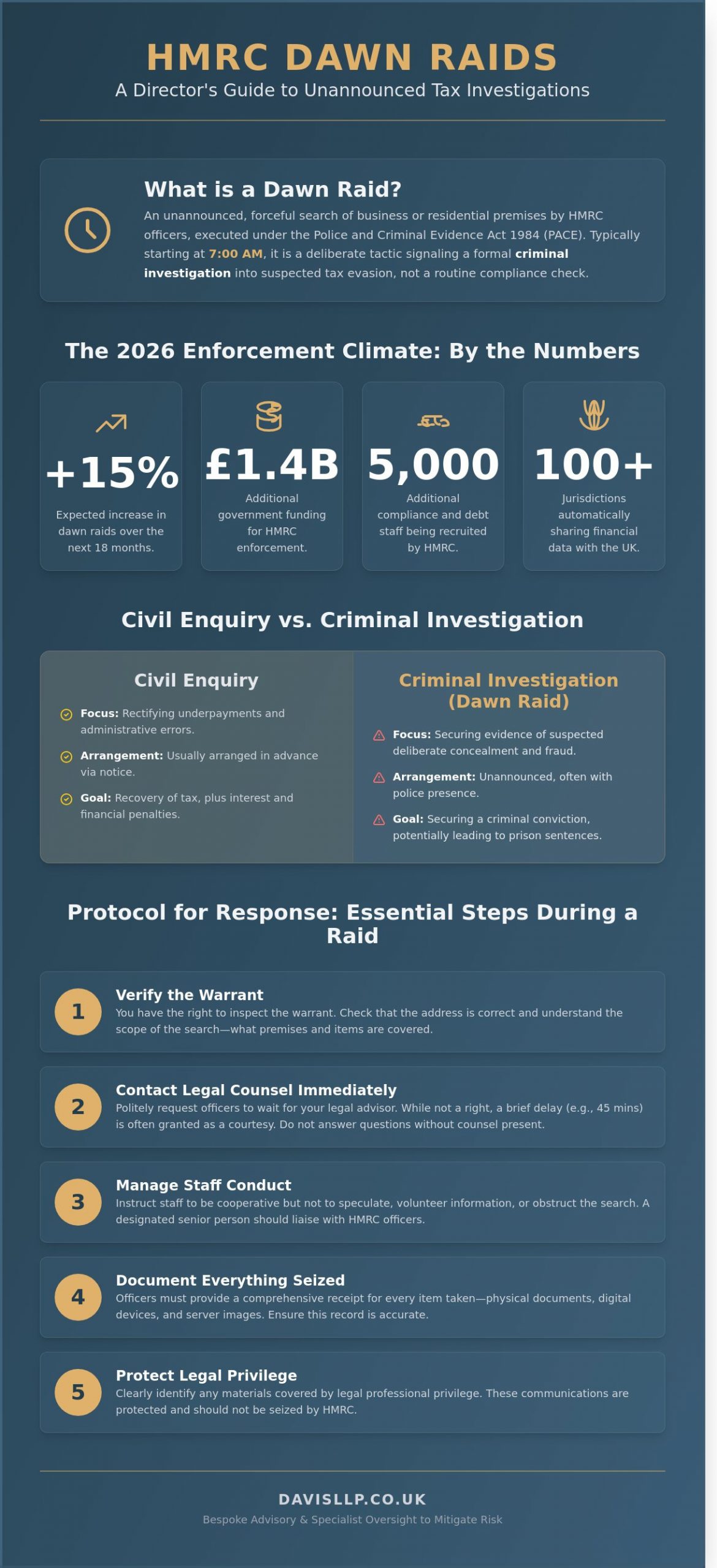
The unannounced arrival of HMRC officers at 7:00 AM isn’t a matter of chance; it’s the calculated culmination of a multi-year intelligence operation. With the government’s 2024 Autumn Budget allocating an additional £1.4 billion to enforcement, the frequency of HMRC dawn raids targeting tax evasion in the UK is expected to increase by 15% over the next eighteen months. You likely recognize that even the most diligent corporate structures can face scrutiny when statutory powers are exercised with such sudden intensity. The prospect of reputational damage or unintentional non-compliance is a legitimate concern for any director.
At Davis & Co LLP, we’ve developed this guide to provide the clarity you require during these high-pressure moments. You’ll understand the specific mechanics of a raid, the precise boundaries of HMRC’s authority, and how to protect your interests through legal professional privilege. This article outlines a bespoke strategy for maintaining robust tax compliance while ensuring your team is prepared for any unannounced visit.
Key Takeaways
- Understand the evolving enforcement landscape of 2026 and the specific legal criteria that define an unannounced HMRC search.
- Gain clarity on the statutory powers granted under PACE to navigate hmrc dawn raids tax evasion uk investigations with professional composure.
- Dispel common misconceptions surrounding search warrants and intervention criteria to ensure your organisation remains prepared for any eventuality.
- Establish a robust immediate response protocol to manage staff conduct and safeguard your legal position the moment officers arrive at your premises.
- Learn how bespoke advisory and specialist oversight can mitigate risk and ensure long-term compliance within complex international tax frameworks.
Understanding HMRC Dawn Raids: What They Are and Why They Occur
An HMRC dawn raid is an unannounced, forceful search of a business or residential property. Officers from HM Revenue and Customs (HMRC) execute these warrants under the Police and Criminal Evidence Act 1984 to secure evidence of suspected criminal conduct. While a routine compliance check is usually arranged in advance and focuses on administrative errors, a dawn raid signals a formal criminal investigation. We find that the sudden arrival of investigators at 7:00 am is a deliberate tactic intended to catch individuals off guard and prevent the disposal of sensitive records.
The distinction between civil enquiries and criminal investigations is absolute. In a civil check, HMRC seeks to rectify underpayments through penalties and interest. In cases involving hmrc dawn raids tax evasion uk, the objective is a criminal conviction. This shift to criminal enforcement is driven by the “tax gap,” which represents the difference between the tax that should be paid and the amount actually collected. To narrow this gap, the government has empowered HMRC to use its most intrusive powers against those suspected of deliberate concealment.
The Objectives of an Unannounced Search
The primary goal of any raid is the immediate preservation of evidence. Investigators prioritise securing digital devices, servers, and physical ledgers before they can be altered or destroyed. By arriving without warning, they ensure that the “audit trail” remains intact. Officers also seek to conduct interviews under caution on-site. These spontaneous statements often provide testimony that hasn’t been filtered by legal counsel, making them highly valuable to the prosecution. Identifying the full scale of the suspected fraud is easier when investigators can see the business operating in its natural state.
The Impact of the 2026 Tax Enforcement Climate
By 2026, the enforcement environment in the UK will be significantly more rigorous. HMRC’s commitment to tackling the £5.5bn tax fraud gap includes the recruitment of 5,000 additional compliance and debt staff. This surge in personnel means that property searches are becoming a more frequent tool for enforcement. We’re also seeing an increase in raids triggered by international data-sharing agreements. HMRC now receives automated financial information from over 100 jurisdictions, making it nearly impossible to hide offshore interests. The department’s current focus remains on high-value sectors, particularly international commerce and complex property structures, where the potential for significant revenue recovery is highest.
The Statutory Powers of HMRC During a Tax Evasion Investigation
HMRC’s authority is rooted in the Police and Criminal Evidence Act 1984 (PACE) and the Taxes Management Act 1970. These laws govern the conduct of hmrc dawn raids tax evasion uk cases, ensuring that investigations into suspected financial misconduct remain within a defined legal perimeter. An officer’s presence at your door signifies a formal escalation; their actions are guided by HMRC’s criminal investigation policy. This document outlines the necessity of proportionality and the high threshold required before a search is authorised.
Search Warrants and Legal Entry
A valid warrant, issued by a magistrate or judge, is the prerequisite for entry. You’ve the right to inspect this document to verify its scope. It must detail the specific premises and the nature of the items the officers are authorised to seize. It’s standard practice for HMRC to be accompanied by police officers to prevent any breach of the peace. While the law doesn’t mandate a delay for legal counsel, officers often allow a brief window, typically 45 minutes, for a professional advisor to reach the site. This period is a courtesy, not a right, and depends on the officers’ discretion at the scene.
Seizure of Digital and Physical Assets
HMRC’s reach extends to both physical documentation and digital infrastructure. Since 2022, there’s been a marked increase in the seizure of mobile devices and the imaging of cloud-based servers. Under Section 49 of the Regulation of Investigatory Powers Act 2000, officers can demand access to encrypted data. The process often involves a “sift” where investigators determine what’s relevant to the case. For every item removed, whether it’s a single ledger or a central server, HMRC must provide a comprehensive receipt. This record is essential for the eventual recovery of your assets.
Despite these broad powers, limitations exist to protect your fundamental rights. Officers cannot legally seize material covered by Legal Professional Privilege. If a document’s status is disputed, it’s typically “sealed and held” until a neutral third party can adjudicate. Managing the fallout of hmrc dawn raids tax evasion uk requires a calm, methodical approach to the situation. We find that a bespoke legal strategy is the most effective way to manage the risks inherent in these high-stakes investigations.
Debunking Common Myths About HMRC Search Warrants and Raids
Public perception of tax investigations is often shaped by high-profile media reports involving multinational conglomerates or organised crime syndicates. This creates a dangerous sense of security for many directors and private taxpayers. The reality of hmrc dawn raids tax evasion uk is far more expansive. HMRC’s enforcement strategies have evolved to target a much broader demographic, moving beyond the “big fish” to include any entity where financial inconsistencies suggest foul play.
One prevalent misconception is that seized evidence is automatically admissible in a court of law. This isn’t the case. If HMRC officers exceed the specific powers granted by their warrant, or if they inadvertently seize documents protected by Legal Professional Privilege (LPP), that evidence can be challenged and potentially excluded. We ensure our clients understand their rights to prevent such overreach during the high-pressure environment of a search.
Targeting Small Businesses and Individuals
SMEs are increasingly under the microscope for VAT and payroll discrepancies. In the 2022/23 tax year, the UK tax gap was estimated at £39.8 billion, and a significant portion of this is attributed to small businesses and individuals. HMRC utilizes “Connect” software, an analytical powerhouse that cross-references over 30 billion data points from banks, the Land Registry, and even social media profiles to identify anomalies in personal tax filings. HMRC raids can target any taxpayer where there is reasonable suspicion of fraud. We’ve seen an uptick in unannounced visits triggered by “red flags” such as lifestyle spending that appears vastly disproportionate to declared income levels.
The Truth About Notice Periods
You won’t receive a warning or a letter of intent before a raid. While a “notice of inspection” is a civil procedure that involves prior communication, a “search warrant” is a criminal tool designed for surprise. Officers typically arrive at 7:00 AM to ensure they can secure physical and digital evidence before it can be altered or destroyed. Waiting for a warning is a dangerous strategy for non-compliant taxpayers because the element of surprise is HMRC’s primary tactic to ensure compliance.
Understanding the protocol for managing a dawn raid is essential for protecting your commercial interests. Quick thinking is required, but so is a measured legal response. The distinction between a civil audit and a criminal search warrant is the difference between a managed conversation and a forced entry. We provide the calm, authoritative guidance needed to manage these intrusive events, ensuring that the search stays within the strict boundaries of the law while protecting your long-term reputation.
Protocol for Response: Essential Steps During an HMRC Dawn Raid
When HMRC officers arrive at a private residence or commercial premises, the initial sixty minutes often dictate the trajectory of the entire investigation. It’s vital to remain composed while asserting your legal rights. HMRC’s Fraud Investigation Service (FIS) conducted 539 property searches in the 2022/23 tax year, highlighting the increased use of these powers in high-stakes cases. We recommend a calm, methodical approach to ensure the search remains within its legal boundaries.
Immediate Verification and Communication
Request the identification of every officer present and carefully examine the search warrant. You should verify the warrant’s scope, ensuring it’s signed by a Justice of the Peace and specifies the correct address. Instruct staff to remain polite but to refrain from discussing the merits of the case; they’re only required to provide basic identifying information. Contact your legal advisor immediately to coordinate a response, as their presence can ensure officers don’t exceed their statutory powers.
Protecting Privileged Information
Protecting Legal Professional Privilege (LPP) is a cornerstone of any defence against hmrc dawn raids tax evasion uk investigations. Officers aren’t entitled to seize communications between you and your legal counsel. If a dispute arises over a document’s status, use the “blue bag” procedure. This involves sealing the items in a tamper-proof container for later review by an independent counsel. This prevents HMRC from accessing “excluded material” as defined by the Police and Criminal Evidence Act 1984 (PACE).
Maintain a meticulous record of the search as it unfolds. Assign a dedicated staff member to shadow each officer, noting which files are inspected and which electronic devices are imaged. This log provides the evidentiary basis for challenging the search’s legality if needed. Professional advisory is not a luxury during these moments; it’s a strategic necessity to manage the immediate fallout of hmrc dawn raids tax evasion uk and preserve your commercial reputation.
If you require discreet, expert assistance during an ongoing investigation, consult our specialist tax litigation partners today.
Mitigating Risk: How Bespoke Advisory Ensures Long-term Compliance
Robust management accounting acts as the primary shield against official suspicion. When financial records are reconciled monthly and maintained with precision, the risk of data mismatches triggering an inquiry decreases. HMRC’s Connect system now monitors over 55 billion pieces of data to identify anomalies. Discrepancies between reported earnings and asset growth often serve as the catalyst for hmrc dawn raids tax evasion uk. We provide the oversight necessary to ensure your accounts are beyond reproach and reflect the reality of your commercial operations.
Specialist oversight is vital for international tax planning. Cross-border interests often sit in “grey areas” that invite scrutiny if not handled with technical rigour. Voluntary disclosure is a strategic path we often recommend when historical errors are identified. Making an unprompted disclosure can reduce penalties from 100% of the tax owed to as little as 0% in some cases. Davis & Co LLP provides a composed, expert partnership to manage these sensitive disclosures and secure your long-term standing. Our approach isn’t just about filing returns; it’s about building a fortress of compliance. This is particularly relevant given the current HMRC tax warning for 2026 regarding savings interest and frozen thresholds, which has placed millions of additional taxpayers under greater scrutiny. The broader 2026 legislative environment also encompasses significant changes to financial surveillance beyond HMRC’s remit; understanding the full scope of DWP bank account checks and the new 2026 powers is equally important for clients seeking to maintain comprehensive regulatory compliance.
Proactive Audits and Compliance Reviews
Our firm identifies potential vulnerabilities within your existing tax structure through rigorous internal reviews. We focus on specific areas:
- VAT Compliance: Verifying that all inputs and outputs are recorded according to the latest HMRC mandates.
- Payroll Accuracy: Ensuring PAYE and National Insurance contributions are reported correctly across all jurisdictions.
- Raid-Readiness: Organising records so they’re transparent and easily accessible, demonstrating a clear culture of compliance.
The Value of Specialist Tax Planning
Handling trust tax and property accounting requires a bespoke approach that standard accounting cannot offer. We design solutions for international clients that respect the complexities of cross-border statutory requirements. This precision prevents the misunderstandings that lead to invasive investigations. Protect your interests with expert tax advisory from Davis & Co LLP.
Strengthening Your Regulatory Resilience for 2026
The regulatory landscape for hmrc dawn raids tax evasion uk is shifting as we approach 2026, with enforcement agencies utilising increasingly sophisticated digital forensic tools. Success in managing these high-stakes interventions depends on your team’s immediate adherence to established response protocols and a clear understanding of HMRC’s statutory search powers. Experience shows that reactive measures are rarely as effective as the implementation of robust, pre-emptive compliance frameworks.
Davis & Co LLP has operated at the intersection of complex tax law and commercial strategy since 1901. Our team of Chartered Certified Accountants brings 125 years of professional gravitas to every case, ensuring that both UK-based and international clients receive the intellectual rigour their affairs demand. We don’t believe in one-size-fits-all solutions; instead, we provide the steady, measured guidance needed to navigate volatile legal landscapes.
Secure your business with Davis & Co LLP’s expert tax services to establish a foundation of quiet excellence and regulatory resilience. We’re ready to act as your trusted strategic partner.
Frequently Asked Questions
What time of day do HMRC dawn raids usually happen?
HMRC dawn raids typically commence between 6:00 am and 7:00 am to ensure that occupants are present and to secure evidence before it can be destroyed. While 92% of searches begin in the early morning, officers may remain on the premises for several hours to complete their inventory. This timing is a tactical choice designed to catch individuals off-guard. You should contact a legal advisor immediately if officers arrive at your door during these hours.
Can HMRC raid my home if I run a business from there?
HMRC can legally search your home if you operate your business from that address and they possess a valid warrant issued under Section 20C of the Taxes Management Act 1970. In 2023, HMRC conducted over 400 property searches, many of which targeted residential locations used for commercial purposes. You should request to see the warrant and verify its specific scope before the search begins to ensure they don’t exceed their legal authority.
Do I have to answer questions during an HMRC dawn raid?
You aren’t legally required to answer substantive questions during an hmrc dawn raids tax evasion uk operation and should generally maintain your right to silence until legal counsel is present. Providing immediate, unconsidered responses can lead to self-incrimination or factual errors that complicate your defence. You must provide your name and address, but you should politely decline to discuss business affairs or financial records until we have reviewed the situation with you.
Can I call my accountant or solicitor while HMRC is searching my property?
You’ve a clear right to contact your solicitor or accountant immediately upon the arrival of HMRC officers. While the investigators aren’t strictly required to delay their search until your legal representative arrives, they’ll often wait for a reasonable period, such as 30 to 60 minutes, as a matter of professional courtesy. We advise you to request this pause and avoid signing any documentation until your solicitor has examined the warrant and the search procedure.
What is the difference between tax avoidance and tax evasion in the eyes of HMRC?
Tax evasion involves the deliberate and illegal non-payment of taxes, whereas tax avoidance is the legal utilisation of the tax regime to your advantage. HMRC identifies evasion through the intentional concealment of income or the provision of false information. Since the introduction of the General Anti-Abuse Rule in 2013, the boundary between the two has tightened. Evasion carries criminal penalties, including prison sentences of up to 7 years for serious fraud cases.
How long does an HMRC tax evasion investigation typically last?
An investigation into hmrc dawn raids tax evasion uk typically lasts between 18 and 36 months depending on the complexity of the financial structures involved. Cases involving international assets or offshore accounts often extend beyond 3 years. We work to resolve these matters efficiently, but the statutory nature of the evidence-gathering process means a swift conclusion is rarely possible. HMRC’s internal targets often aim for a case resolution within 24 months.
Will HMRC seize my computer and phone during a raid?
HMRC officers will likely seize computers, mobile phones, and external hard drives if they believe the devices contain evidence relevant to their investigation. Under Section 19 of the Police and Criminal Evidence Act 1984, they’ve the power to take any material that’s necessary to prevent its concealment or loss. In 75% of raids, digital forensics play a central role. We help manage the return of these items through formal legal applications once data is imaged.
What should I do if I think I have made an error in my past tax returns?
You should make a voluntary disclosure through HMRC’s Digital Disclosure Service as soon as you identify a discrepancy in your past returns. Proactive disclosure can reduce financial penalties by up to 100% in cases where the error wasn’t deliberate. If you wait for HMRC to open an enquiry, the costs and legal risks increase significantly. We provide bespoke advice to ensure your disclosure is accurate and protects your long-term commercial interests. Ensuring your UTR number is correctly registered and up to date is a fundamental step in maintaining accurate tax records and avoiding the administrative discrepancies that can trigger an HMRC enquiry.