What does a healthy profit figure tell you if the bank balance is moving in the opposite direction? Understanding your management accounts report means looking beyond the headline number and seeing how the figures connect. Financial terminology, unfamiliar statements and comparisons with budgets or earlier periods can make it difficult to know where to focus.
A profit figure is only one part of the picture. It may not explain when cash is coming in and going out, or why results have changed from one period to the next. The value lies in working out what the numbers mean for your business, not simply noting whether they have risen or fallen.
This practical guide explains what the main sections of a management accounts report show, how to assess changes against budgets and earlier periods, and which movements may need further investigation. You’ll also find a review process to help connect regular financial information with cash-flow awareness, planning and business decisions.
Key Takeaways
- Understanding your management accounts report starts with knowing what each section shows and whether it describes performance over a period or your financial position on a particular date.
- Compare results with budgets or relevant earlier periods before deciding whether a change needs attention.
- Use a consistent review routine: check the reporting period, scan key figures, investigate movements and record follow-up questions.
- Connect the figures to practical decisions, including how business performance and cash flow may affect your next steps.
- Regular management accounts and bookkeeping can support a clearer view of the business. Managing Cash Flow & Profits includes cash-flow forecasting and strategic budgeting.
Understanding your management accounts report: what it is and why it matters
You may have a set of figures that looks complete, yet still be unsure where to begin. Should you focus on profit, cash in the bank, costs or the comparison with your budget? Understanding your management accounts report starts with knowing its purpose: to help you assess the business and make informed decisions, rather than present numbers without context.
Management accounts are internal financial reports that help a business understand its performance and decide what to do next. They bring together financial information for owners and managers to review. Their contents depend on the questions the business needs answered. A report may include results for a period and information about the business’s financial position, but its format and level of detail can vary.
Statutory year-end accounts are prepared for external reporting, while management accounts are intended to support the running of the business. They serve different purposes: internal reporting does not replace statutory accounts, and statutory accounts may not provide the timely, decision-focused view an owner needs during the year. The principles of Management accounting help explain this distinction: financial information supports planning, control and decisions within an organisation.
There is no single reporting schedule or template that suits every business. The frequency and detail should reflect how the business operates and what its decision-makers need to monitor. A report is most useful when its figures relate to real questions, such as whether costs are changing, whether planned activity is on track or whether cash movement needs attention.
What questions should a management accounts report help answer?
Start with the reporting period. What revenue came in, what costs were recorded and what profit or loss resulted? Then consider what those results say about the business’s position and cash movements. A profitable period does not, on its own, explain when money is expected to arrive or payments are due. Ask what has changed, what may have contributed to it and whether it affects a priority, plan or upcoming decision.
Who uses management accounts in a UK business?
Owners and managers use management accounts to review performance, consider priorities and guide decisions. A business owner may need a concise view of profit, cash and emerging issues, while a manager responsible for a particular area may need more detail about its income or costs. The report should give its readers useful detail without obscuring the overall picture. Internal management information should be understood alongside statutory reporting, not treated as a substitute for it.
What the main sections of your management accounts report tell you
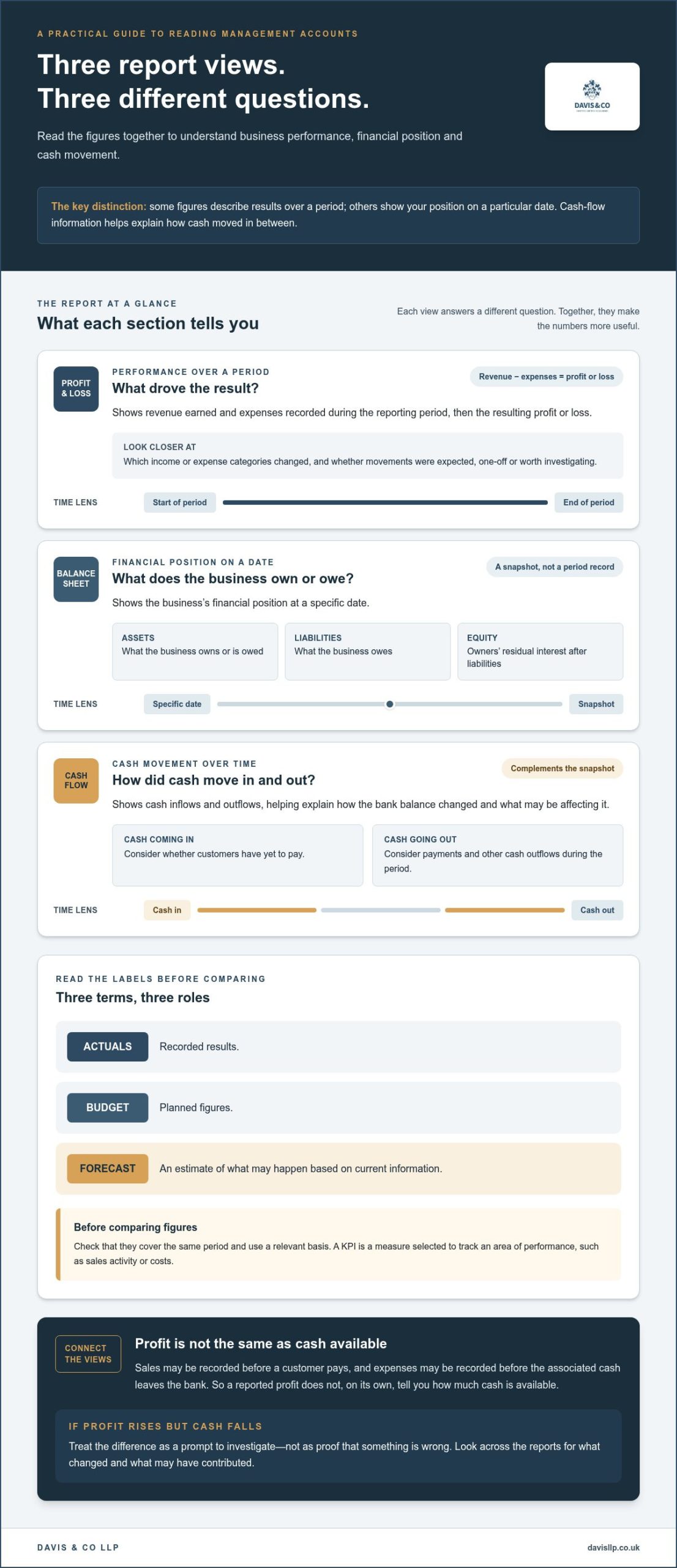
Each section answers a different question, so read the figures as connected evidence rather than isolated totals. The profit and loss account shows results across a period. The balance sheet presents the business’s financial position on a particular date. Cash-flow information, where included, shows how cash has moved in and out. Together, these views help explain what the business earned, what it owns or owes, and how its cash has changed.
Check the labels as you read. Actuals are recorded results; a budget sets out planned figures, while a forecast estimates what may happen based on current information. A key performance indicator, or KPI, is a measure selected to track an area of performance, such as sales activity or costs. Before comparing figures, check that they cover the same period and use a relevant basis.
Reading the profit and loss account
The profit and loss account brings together revenue earned and expenses recorded during the reporting period, then shows the resulting profit or loss. Look beyond the bottom line. A change in total costs may be driven by one category, while revenue growth may not lead to stronger profit if expenses have risen too. Check which income and expense categories matter to your business, and whether movements are expected, one-off or worth investigating.
Profit measures the result recorded for a period; cash available shows what the business can draw on at a given time. These are related, but they answer different questions. Sales may be recorded before a customer pays, and expenses may be recorded before the associated cash leaves the bank. A reported profit therefore doesn’t, on its own, tell you how much cash is available.
Reading the balance sheet and cash flow information
The balance sheet shows financial position on a specific date. Assets are what the business owns or is owed; liabilities are what it owes; equity represents the owners’ residual interest after liabilities are accounted for. The balances are a snapshot, not a record of everything that happened during the period. Cash-flow information complements that snapshot by showing cash inflows and outflows over time, helping you understand how the bank balance changed and what may be affecting it.
Read the reports together. If profit has increased but cash has fallen, treat the difference as a prompt to investigate, not as proof that something is wrong. Consider whether customers have yet to pay, or whether payments and other cash outflows occurred during the period. Understanding your management accounts report means using each section to frame the next useful question.
- Profit and loss: What drove the period’s result?
- Balance sheet: What does the position look like on the reporting date?
- Cash flow: What cash came in or went out, and when?
- Budget, forecast and KPIs: How do actual results compare with plans and selected measures?
When the figures need a wider explanation, regular management accounts support can help connect reporting with business performance and cash-flow management.
Interpreting management accounts without overreacting
A figure that differs from plan can look alarming, but a single result rarely explains the whole story. Put it in context: consider the length and timing of the reporting period, the budget or forecast used for comparison, and relevant results from earlier periods. A revenue shortfall, for example, may coincide with lower costs, while an increase in profit may not mean cash has improved. Each measure offers one part of the picture.
An unusual movement is a prompt to investigate, not a conclusion. Before changing a plan or setting a new priority, work out what the movement represents and whether other measures support the same interpretation. This is how understanding your management accounts report can turn routine figures into useful analysis, rather than treating the report as historical paperwork to file away.
Compare actual results with budgets and forecasts
A variance is the difference between an actual result and a comparison figure, such as a budget or forecast. Note its size and direction, then consider the business context: does the comparison cover the same period, and are the assumptions behind the plan still relevant? If revenue is below budget, trace the total to the underlying income categories. If costs are above plan, identify which expenses account for the difference before deciding whether it is temporary or needs a response.
Use the comparison to frame a follow-up question, not to assign blame. A revenue variance could reflect a change in sales activity, timing or another factor specific to the business. The report may show where to look, but supporting detail and operational context help explain why the figure moved.
Look for patterns across periods and measures
Where the information allows, compare like-for-like periods. A seasonal business may not get a useful comparison by setting one month against the month immediately before it; the equivalent period in an earlier year may provide more context. Check that reporting periods and categories align before interpreting differences as a trend. One isolated movement may warrant attention, but it does not by itself establish a persistent pattern.
Read related measures together. Revenue, costs and profit describe performance from different angles, while cash flow shows cash movements. If revenue rises but profit falls, review costs. If profit strengthens while cash weakens, investigate the timing of receipts and payments. These combinations help narrow the questions to explore, though they do not establish a cause on their own.
Observation: Revenue is below budget.
Possible explanation: Income may have shifted between periods, or particular income categories may be lower than planned.
Follow-up question: Which categories changed, and does the same movement appear in earlier comparable periods?
Observation: Profit has increased, but cash has fallen.
Possible explanation: Cash receipts and payments may have happened at different times from the income and expenses recorded.
Follow-up question: Which cash movements help explain the difference, and do they affect current plans?
When the figures are read in context, they can inform practical decisions about priorities and planning. Record what the report shows, what remains uncertain and what information would clarify the movement. Distinguishing a confirmed pattern from an open question keeps analysis measured and useful.
A practical review process for your management accounts report
A consistent review helps turn a set of figures into a clear record of what needs attention. You don’t need to explain every movement immediately. First check that you’re reading the right information, then distinguish what the report shows from what still needs investigation. This approach makes understanding your management accounts report more structured and helps prevent assumptions from becoming decisions.
A step-by-step checklist for reviewing the report
Work through the same sequence each time. The detail you examine may vary with the report and your priorities, but a dependable routine makes comparisons and follow-up easier.
- Confirm the reporting period. Check the start and end dates and whether the figures cover the business activity you intend to review. Note any omissions or timing differences that could affect interpretation.
- Scan the summary. Identify the main results and movements before going into detail. Use the summary to decide where to focus, not as a substitute for examining the figures behind it.
- Compare the results. Review actual figures against available budgets, forecasts or relevant prior-period information. Check that the periods and categories are comparable before drawing conclusions.
- Trace notable movements. Follow a change in revenue, costs, profit or cash through the relevant report categories. This can help distinguish a broad shift from a movement concentrated in one area.
- Record explanations and follow-up. Note what you understand, what remains uncertain and any decision or action required. Keep questions beside the relevant figures so the reason for each follow-up is clear.
Turn report findings into useful management questions
A number is a starting point for a question. Consider whether an operational change, a timing issue or an assumption behind the budget could explain a movement. Then ask which priority it affects: cash flow, profitability, planned activity or another business objective. Treat a possible explanation as a hypothesis until you have reviewed the supporting information.
Separate immediate operational actions from matters that need further analysis or advice. A discrepancy may call for checking the underlying detail; a broader change in performance may require a considered discussion before plans are adjusted. For each open question, record who will follow it up, what information is needed and when it should be reviewed. Consistency matters more than adopting a reporting schedule that doesn’t suit the business.
This process makes the report useful beyond the moment it arrives. Comparing findings with the next review helps show whether an issue was resolved, continues to develop or needs a different response. For a wider view of how accounting can support growth and compliance, explore our strategic small business accountant guide.
If you’d like support connecting regular reporting with business decisions, explore management accounts support from Davis & Co.
How Davis & Co supports management accounts and business decisions
A management accounts report is most valuable when its figures help answer practical questions about the business. Davis & Co provides regular management accounts and bookkeeping to help owners review performance and consider their next steps. The aim is not simply to present figures, but to make them more useful in the context of business priorities.
From regular reporting to clearer financial oversight
Bookkeeping records financial activity, providing information that can support management reporting. Regular management accounts can help owners review results and consider how they relate to plans, priorities and cash-flow needs. The relevant detail depends on the business and the questions its decision-makers need to answer, so read the report in light of its purpose and the figures it contains.
If you’re working on understanding your management accounts report, bring specific questions to a review: which movement needs explanation, what comparison would be useful, and what decision might depend on the answer? This gives the discussion a clear focus without treating an unexplained figure as proof of a particular cause. Davis & Co is an independent partnership of Chartered Certified Accountants established in 1901, with management accounts and bookkeeping among its services for businesses.
When broader cash-flow or growth advice may help
Some reporting questions extend beyond the period’s result. If you’re considering how expected receipts and payments may affect plans, Davis & Co’s Managing Cash Flow & Profits service includes cash-flow forecasting and strategic budgeting. These can help you consider future cash requirements and how budgets relate to business priorities. Forecasts still need to be interpreted in light of changing circumstances.
For businesses considering growth, the Business Growth Package includes Virtual Financial Accounting. This connects financial information with a wider focus on business growth. A useful starting point is your own situation: do you need to understand a movement in the report, consider its cash-flow implications or review how financial information supports a business plan?
Bring the figures and questions you’ve noted to a discussion, including what you understand and what remains unresolved. This helps focus on the decisions that matter and consider what further analysis may be useful, without assuming a particular financial outcome. Davis & Co can discuss management accounts and related business support in the context of your needs.
Discuss management accounts and business support with Davis & Co.
Make your next report a starting point for action
The next time you review your figures, choose one business question you want them to help answer. It might concern a planned investment, changing priorities or an assumption behind your budget. Record what the information supports, what remains uncertain and when you’ll revisit the decision. Over time, this creates a useful link between financial reporting and your choices, rather than treating each report as a standalone exercise.
Understanding your management accounts report is an ongoing practice. As your business changes, the questions that matter may change too. A considered review can help you decide when the information is sufficient for an operational step and when a deeper discussion would be valuable. If you’re ready to connect your reporting with the decisions ahead, explore management accounts support for your business.
Frequently Asked Questions
How often should management accounts be prepared?
There’s no single schedule that suits every business; the right interval depends on how often you need financial information to guide decisions. A business reviewing cash commitments or changing trading conditions may benefit from more frequent oversight than one whose activity is steadier. Consider how quickly you need to spot changes, the time required to produce useful figures and whether periods can be compared consistently. Set a cadence that supports decisions without creating reports that go unused.
Are management accounts legally required in the UK?
Management accounts, as internal reports, aren’t generally a specific legal requirement in the UK. They’re prepared to help business owners and managers understand activity and make decisions. This is separate from statutory accounting and filing duties, which depend on the business’s legal structure and circumstances. For example, a limited company’s statutory reporting responsibilities are not replaced by internal reports. Keep the two purposes distinct and take appropriate advice if you’re unsure which obligations apply to your organisation.
Can management accounts replace statutory accounts?
No. Management accounts are designed for internal oversight, while statutory accounts are prepared for external reporting under the requirements that apply to the business. An internal report may use categories or detail suited to management decisions, so it shouldn’t be treated as a substitute for statutory accounts or their associated filing obligations. Use management information during the year to support decisions, while handling statutory reporting separately and appropriately.
Can a sole trader use management accounts?
Yes. A sole trader can use management accounts to organise financial information and assess how the business is performing, even if the reports are prepared for personal use rather than a management team. For instance, separating income and costs by type can help show which activities contribute most to the overall result. The format can be proportionate to the business, with a focus on trading performance, cash movements and upcoming commitments.
What should I do if figures in my management accounts do not look right?
Pause before acting and identify the specific figure, period and comparison that concern you. When understanding your management accounts report, check whether relevant transactions are missing, duplicated, recorded in the wrong period or grouped under an unexpected category. Compare the report with supporting records, then note what you cannot explain and arrange an accounting review. Avoid changing figures without understanding the accounting reason, as this may obscure the source of the discrepancy.
Do management accounts include a cash flow statement?
Not necessarily. The contents depend on the reporting needs and the information being prepared, so some management accounts may include a cash-flow statement or other cash-movement analysis, while others may present cash information differently. If you need to plan for upcoming payments, check what period the cash information covers and whether it shows actual movements or projected ones. A cash forecast is distinct from a record of cash already received and paid.