The lowest accountancy quote can be the least useful place to start. If you’re searching “how much do chartered accountants charge uk”, the answer depends on what the engagement covers, the complexity of your affairs and the expertise your circumstances require.
It’s reasonable to expect a clear fee and to want confidence that essential work won’t appear later as an extra. A sole trader’s routine compliance needs differ from a company’s ongoing reporting, while property income, trusts or cross-border tax affairs may call for more specialist support. A headline figure, on its own, rarely shows those differences.
This 2026 guide explains the main factors that shape accountancy fees and how to compare proposals by scope, service and level of advice, rather than price alone. It also covers what to consider when your needs extend beyond standard compliance, so you can identify an adviser whose expertise fits your personal or business circumstances. Davis & Co LLP has supported individuals and businesses as Chartered Certified Accountants since 1901, with advice tailored to each client’s needs.
Key Takeaways
- There’s no single answer to “how much do chartered accountants charge uk”; fees reflect the scope, complexity and advice your engagement requires.
- Identify which services relate to your circumstances, from personal or trust tax to property accounting and business support.
- Compare fixed-scope, recurring and time-based fees by looking at the work each structure is designed to cover.
- Use a checklist to assess deliverables, responsibilities and potential extras, so a low headline fee doesn’t obscure gaps in the service.
- Consider whether specialist expertise fits your needs. Davis & Co LLP has served individuals and businesses as Chartered Certified Accountants since 1901.
UK Chartered Accountant Fees and Variations
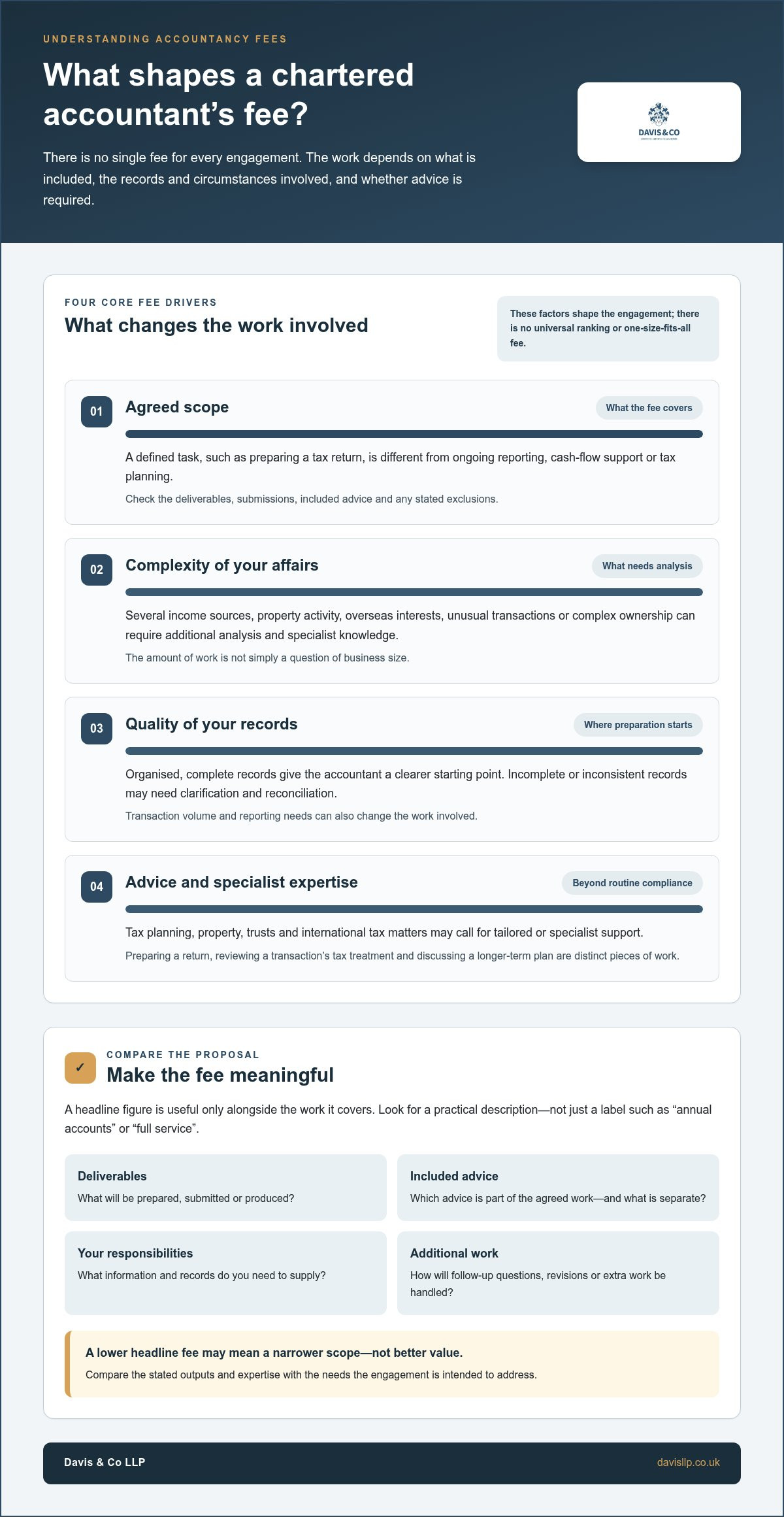
There is no single fee that applies to every engagement. The work involved depends on the agreed scope, the complexity of your financial affairs, the quality of your records and whether you need advice as well as routine compliance. That is why the question “how much do chartered accountants charge uk” cannot be answered meaningfully without first defining the work.
A defined compliance task, such as preparing a tax return from complete records, differs from ongoing support involving regular reporting, cash-flow management or tax planning. Trust, property and international tax matters may call for specialist knowledge. A fee becomes useful for comparison only when you consider it alongside the deliverables, exclusions and responsibilities in the proposal.
What does a chartered accountant’s fee generally cover?
A fee should describe the agreed work, which might include preparing accounts, completing a return, submitting documents or providing specified advice. It should also make clear what information you need to supply, what the accountant will produce and whether follow-up questions or revisions are included. These details help both sides understand where the engagement begins and ends.
Keep compliance separate from continuing business or tax-planning support. A proposal for a particular filing does not automatically include ongoing advice, bookkeeping or regular management information. Likewise, a broad advisory engagement should identify its intended outputs rather than rely on a general promise of support. Professional designations can also differ: the Institute of Chartered Accountants in England and Wales (ICAEW) is one UK professional body associated with chartered accountancy. The precise qualification and membership depend on the individual accountant.
Why can two clients receive different proposals?
Consider two individuals with similar employment income. One has clear, organised records and a straightforward tax position; the other has several income sources, property activity or overseas interests. The second engagement may require additional analysis and specialist tax knowledge, even if both clients appear to need “a tax return”. The same applies to businesses: transaction volume, record quality and reporting needs can change the work involved.
Incomplete or inconsistent records may need clarification and reconciliation before accounts or returns can be prepared. Well-maintained records, by contrast, give the accountant a clearer starting point. The amount of work is not simply a question of business size. A smaller organisation with unusual transactions or complex ownership may need more detailed work than a larger business with orderly records and a clearly defined reporting requirement.
When reviewing a proposal, look for a practical description of the work rather than relying on labels such as “annual accounts” or “full service”. Check what will be prepared and filed, which advice is included, what information you must provide, and how additional work will be handled. A lower headline fee may reflect a narrower scope, not better value. Compare the stated outputs and expertise with the needs the engagement is intended to address.
Which accounting services can change the scope of your engagement?
An accounting engagement is shaped by what you need done, not simply by whether you’re an individual or a business. Personal tax compliance, business reporting and forward-looking advice are distinct areas of work. A proposal is clearer when each is identified separately, with its own deliverables and responsibilities, rather than grouped under a broad label such as “accountancy support”.
This distinction helps explain why “how much do chartered accountants charge uk” has no useful one-size-fits-all answer. Preparing a return from organised information is different from work involving several tax matters, ongoing business records or specialist planning. The Prospects.ac.uk Chartered Accountant Job Profile provides background on the profession’s range of duties, which can extend beyond preparing accounts or returns.
Personal and specialist tax work
For an individual, the scope might centre on Self Assessment, with additional work relating to capital gains, foreign income or personal tax planning. Property income or overseas interests can raise different questions and call for advice tailored to the person’s circumstances. Trust and estate-related tax matters may also involve distinct compliance and advisory work, rather than being routine additions to an individual return.
Distinguish the task itself from related advice. Preparing a return, reviewing the tax treatment of a particular transaction and discussing a longer-term plan are not necessarily the same deliverable. A clear engagement describes which work is included and identifies additional matters separately, helping you understand how specialist requirements affect the overall scope.
Business compliance and ongoing support
Business requirements can also be divided into separate areas. Bookkeeping maintains financial records; VAT compliance and Making Tax Digital support address reporting needs; and payroll involves its own processes. These services may inform one another, but should not be assumed to form part of a single standard package. The engagement should explain which records, submissions or support are covered.
Return preparation is distinct from management accounts, cash-flow management or wider business advice. Return preparation focuses on reporting required information, while management accounts and cash-flow support can help owners understand performance and plan decisions. Davis & Co LLP provides virtual finance advice, including remote consultations and secure digital document exchange.
For a wider view of how compliance and growth support can fit together, explore this small business accounting and growth guide. Davis & Co LLP tailors support to individual and organisational circumstances, including personal, trust, property and business needs. If you’re weighing up how compliance and business development fit together, Davis & Co accounting support outlines the firm’s services.
Comparing UK Accountant Fee Structures
Accountancy fees are commonly arranged around a defined piece of work, continuing support or time spent on professional advice. Each structure can suit a different need, but the label alone doesn’t establish what’s included. A fixed fee may cover only specified deliverables, while a recurring arrangement may combine several services or focus on a narrower ongoing task.
So, consider “how much do chartered accountants charge uk” alongside how the work is organised. A recurring fee can make regular support more predictable, whereas a one-off or time-based arrangement may suit a distinct piece of advice. Use the proposal to understand the work, responsibilities and how a change in circumstances will be handled.
| Structure | Suitable work | Points to clarify |
|---|---|---|
| Fixed-scope | A defined task, such as preparing specified accounts or a tax return. | Which records and deliverables are included, and what falls outside the agreed scope? |
| Recurring | Ongoing compliance or business support, such as regular bookkeeping or management information. | Which services are provided, how often, and how are changes in workload handled? |
| Time-based | Advice or work whose extent depends on the matter being reviewed. | How is time recorded, how will progress be communicated, and what task is being undertaken? |
Fixed-scope and recurring arrangements
A defined engagement makes the expected outputs easier to understand because the work is tied to an agreed task. Recurring support may suit compliance or business needs that continue through the year, rather than arise once. Establish the service boundaries: regular bookkeeping and periodic management accounts, for example, are distinct deliverables even if both support financial oversight.
Business activity can change. New income streams, changes in transaction volume or a need for additional reporting may affect the work required. A sound arrangement provides for reviewing the scope if circumstances shift, rather than relying on an outdated description of the service.
Hourly and one-off professional work
With time-based charging, the fee reflects the time spent on the agreed work. This can suit an advisory matter where the steps or extent aren’t fully known at the outset. Define the question to be addressed, the expected output and how progress will be communicated, particularly if further work appears necessary.
One-off advice should also be distinguished from continuing compliance responsibilities. A discussion about a specific tax or business decision doesn’t, by itself, include recurring returns, bookkeeping or ongoing reviews. Before work begins, make sure the arrangement records the purpose of the advice and any separate ongoing services you require.
How can you compare accountant proposals and judge value?
A headline fee can look attractive while covering only part of the work you need. To judge value, compare proposals on the same basis: the tasks included, the advice available, your responsibilities and how additional work is handled. This gives a more reliable answer to “how much do chartered accountants charge uk” than comparing figures without context.
What should you check before comparing proposals?
Use this checklist to make differences between proposals visible. If a point is unclear, treat it as an open item in your comparison rather than assuming it is included.
- List the required outputs. Note which accounts, returns, records, filings or advice you need, then identify where each proposal addresses them. For example, a proposal might include preparation of accounts but describe tax filing or bookkeeping separately.
- Read the scope and exclusions. Check what the stated fee covers, what is excluded and whether follow-up advice is part of the engagement. A low headline fee may suit a narrow task, but it may not cover all the work needed for your circumstances.
- Understand how extra work is handled. Look for an explanation of what happens if new information, additional transactions or a change in circumstances expands the task. The proposal should make clear how that change will be discussed and agreed.
- Clarify each party’s responsibilities. Establish what information and records you must supply, the format required and the agreed deadlines. This helps you compare services on the basis that each proposal involves the same level of input from you.
- Compare like with like. Align the deliverables, support period and responsibilities before weighing the fees. If one proposal covers ongoing bookkeeping and another covers only annual accounts, they aren’t equivalent offers.
How do you assess expertise and working fit?
Value also depends on whether the proposed expertise matches the matter. A personal tax engagement, a business’s recurring reporting needs and a case involving property, trusts or international interests can call for different experience. Consider whether the adviser’s approach reflects your priorities, rather than treating every engagement as routine compliance.
Communication is part of the service. Is there a clear route for raising questions? Does the proposal describe how advice is delivered and how often you can expect updates? If remote working matters to you, consider whether the arrangement suits you. Davis & Co LLP provides virtual finance advice, including remote consultations and secure digital document exchange.
For broader considerations involved in appointing an adviser, the chartered accountant selection guide can help you think beyond the fee comparison. Davis & Co’s accounting support covers services for individuals and businesses with differing requirements.
Davis & Co Tailored Accounting Support
Davis & Co LLP is an independent firm of Chartered Certified Accountants established in 1901, supporting individuals and businesses across the UK and overseas. The right engagement depends on the questions you need answered and the work required. Defining your circumstances helps establish whether you need focused compliance, specialist tax advice or continuing business support.
For individuals, personal tax support can include Self Assessment and matters involving foreign income. Property income, trust affairs or international interests may bring separate requirements, so the scope should reflect the details of your position rather than assume a standard return tells the whole story. Davis & Co provides UK and international tax support tailored to each client’s circumstances.
Support for individuals and complex tax affairs
Trust Tax Return Services address trust tax return requirements and related tax matters. Estate-related tax questions may require different work from routine personal tax compliance, so the engagement should describe that work specifically. This helps you understand which tasks are covered and where a separate advisory requirement may sit.
Tailored advice is particularly relevant when income or assets involve more than one area of tax. For example, a person with property income and overseas interests may need property accounting and international tax expertise considered in the scope. The purpose is to address the circumstances presented, not to promise a particular tax result.
Business advice and a practical next step
For businesses, Davis & Co’s support includes business growth acceleration and cash-flow management. These advisory needs differ from preparing a return or maintaining records: they focus on financial information and considerations that inform business decisions. Depending on the organisation’s priorities, the engagement may centre on a defined issue or combine ongoing support with compliance work.
Virtual finance advice offers a remote way to access support. Remote consultations and secure digital document exchange make it practical to discuss financial matters and share relevant information without meeting in person. This option may suit individuals and businesses who prefer to work remotely.
If you’re still considering how much do chartered accountants charge uk, set out the work you need in clear terms. Identify the tax matters, records, filings or business questions involved, then discuss how they can be addressed and what the engagement will cover. That gives both sides a stronger basis for agreeing a suitable scope, whether your needs are personal, specialist or organisational.
To discuss your accounting and tax requirements with Davis & Co, share the support you’re looking for. We can consider your circumstances and the professional support that fits them.
Make your next accountancy decision with clarity
The question “how much do chartered accountants charge uk” is most useful when it leads to a clearer understanding of the work you need, rather than a search for a headline figure in isolation. Before appointing an adviser, consider what you want help managing, whether that means meeting a compliance responsibility, addressing a specialist tax matter or gaining perspective on a business decision.
Bring those priorities into the conversation. A discussion can help define the practical scope of support, distinguish immediate requirements from longer-term advice and establish a working arrangement suited to your circumstances. Davis & Co LLP provides tailored support for individuals and businesses across the UK and overseas, including UK and international tax services.
Outline the questions or responsibilities you’d like professional support with. Discuss your accounting and tax requirements with Davis & Co to establish what support fits.
Frequently Asked Questions
How much do chartered accountants charge in the UK?
There’s no universal fee: it depends on the work agreed and the expertise or ongoing support involved. If you’re asking “how much do chartered accountants charge uk”, compare proposals by their actual outputs, not just their labels. Preparing a return may differ from a proposal that also covers reviewing unusual income or discussing tax planning. Davis & Co tailors support to each client’s circumstances.
What information should I prepare before asking an accountant about fees?
Prepare a short outline of your circumstances, the work you’re seeking and any relevant deadlines. A business can describe its activities, accounting records, reporting responsibilities and recent changes, such as taking on staff or adding a revenue stream. For personal tax, list the income sources and questions involved, including property or overseas income if relevant. Recent records can help the accountant understand the likely scope.
Is the cheapest accountant always the best choice?
Not necessarily. A lower fee may cover a more limited task, while another proposal may include specialist advice or support that matters to your situation. Compare the proposed outputs, your own responsibilities, communication arrangements and the adviser’s relevant experience. A business needing regular insight into cash flow, for example, has different priorities from someone seeking help with a single tax question. Choose based on fit and clarity, not the headline figure alone.
Can I claim accountant fees as a business expense?
Tax treatment depends on the nature of the work and your circumstances, so don’t assume every accounting or advisory fee is treated alike. Keep the invoice and engagement details, including a description of the work, as these can help explain what the charge relates to. Consult current HMRC guidance or seek advice on your specific position. If an invoice covers several services, a breakdown may help identify what each part relates to.
Do I have to use an accountant to complete a Self Assessment tax return?
No, you can complete your own return, but using an accountant doesn’t remove your responsibility to provide accurate information and review what is submitted. Whether you need to file depends on your circumstances and current HMRC rules. For self-employment, the relevant threshold is over £1 000 before expenses. Check current HMRC guidance for your situation, particularly if you have other income or tax matters to report.
Can I change accountants during the tax year?
A change may be possible, but plan it around the work already completed and any approaching filing responsibilities. Review your engagement terms, note which records have been prepared and identify outstanding tasks, such as a return or bookkeeping period. A well-organised handover can include prior accounts, relevant correspondence and records for the current period. Agreeing who is handling each remaining task helps reduce uncertainty during the transition.
What should an accountant’s engagement letter explain?
An engagement letter should set out the services agreed, each party’s responsibilities and the practical arrangements for working together. Check how records and questions will be exchanged, what information you need to provide and how changes to the work will be addressed. It should also give you a written reference for the agreed scope. Keep a copy with your accounting records so you can refer back to it if your needs change.