A larger portfolio does not automatically make a person’s finances more tax-efficient. Tax planning for high net worth individuals means considering how investments are taxed alongside ownership, access to capital and the transfer of wealth, including potential inheritance tax exposure.
It’s understandable to look for investments that combine growth potential with tax relief, but the relief alone doesn’t determine whether an investment is suitable. For VCT subscriptions made from 6 April 2026, income tax relief is 20%; the stated maximum investment is £200,000, and the minimum holding period is five years. These conditions sit alongside investment risk and the time your capital may be committed.
This guide explains where venture capital schemes and family investment companies may fit, and how Capital Gains Tax allowances and losses can affect investment decisions. The UK annual Capital Gains Tax exemption is £3,000, according to HM Revenue & Customs. Understanding how these choices interact can help you assess tax consequences as part of a broader plan, rather than treating any single investment structure as a solution in itself.
Key Takeaways
- Assess venture capital schemes by weighing potential tax relief against investment risk, access to capital and the required holding period.
- Consider whether a family investment company’s ownership and income structure supports your family’s wider wealth-transfer objectives.
- Plan investment disposals with the Capital Gains Tax exemption, spouse or civil-partner transfers and the treatment of losses in view.
- Distinguish between high-net-worth labels and the tax rules that actually apply to your assets, residence and family circumstances.
1. Are venture capital schemes a tax efficient investment for additional rate taxpayers?
Tax relief can improve the effective cost of an investment, but it doesn’t remove commercial risk. For investments from 6 April 2026, UK Venture Capital Trust subscriptions may qualify for 20% income tax relief, with a maximum investment of £200,000 and a five-year minimum holding period. Qualifying Enterprise Investment Scheme investments may offer up to 30% income tax relief. Compare eligibility and relief with the possibility of losing capital and limited access to your investment.
HM Revenue & Customs sets the UK annual pension contribution allowance at £60,000, subject to earnings and other restrictions. Pension funding, VCTs and EIS should be assessed together with your portfolio and income needs, rather than as interchangeable tax shelters.
A family investment company (FIC) can hold investments and retain income for reinvestment. Its articles and share structure may separate voting control from economic rights, while gifting shares can form part of succession planning. Before transferring assets, model the company’s tax position, dividend flows and future access to capital. An FIC is a structure, not an automatic tax saving.
Residence affects UK tax exposure on overseas income and gains, while domicile is no longer the basis for the UK inheritance tax framework from 6 April 2025. International families should consider residence, timing and asset ownership together. A US expat may also have US foreign account reporting, including FBAR (FinCEN Form 114) and Form 8938 under FATCA.
Offshore reporting duties depend on residence, income and asset type. Error consequences depend on the mistake and its circumstances; accurate records and prompt correction matter. Compare UK tax advisers by scope, deliverables, relevant cross-border experience and charging basis. Fees depend on the work’s scope and complexity and are provided after a quote request.
Finally, weigh tax avoidance and investment risk alongside relief: HM Revenue & Customs says leaving at least 10% of a UK estate to charity can reduce the overall inheritance tax rate from 40% to 36%. That planning should sit within a documented strategy, not dictate investment choice.
2. Family investment companies: Where do they fit?
A family investment company (FIC) can hold investments and separate voting control from economic rights through different share classes. Parents may retain decision-making powers while gifting shares to children, potentially moving future investment growth outside their personal estates. The structure does not, by itself, remove inheritance tax exposure: ownership, share rights and the timing of gifts all matter.
HM Revenue & Customs states that the UK annual inheritance tax gifting exemption is up to £3,000. Larger gifts may fall outside the donor’s estate if the donor survives seven years, according to HM Revenue & Customs. HM Revenue & Customs gives the UK inheritance tax nil-rate band as £325,000, with liability described as 40%. These thresholds make the size, timing and recipient of each transfer relevant.
For wealthy families, lifetime gifting can combine exemptions with selective larger transfers. A FIC may help manage how investments and dividends are allocated across generations, but families should consider who controls the company and how recipients can access value. Trusts provide a different ownership arrangement, with distinct inheritance tax considerations. Neither structure should be chosen on tax relief alone.
Residence now matters directly to UK inheritance tax planning. The UK moved from a domicile-based to a residence-based framework from 6 April 2025, and the relevant test includes residence in at least four of the previous seven tax years. International families should review residence history alongside asset ownership and planned gifts. The treatment of pensions also belongs in succession planning: UK pensions are proposed to be included in an estate for inheritance tax from April 2027.
To assess how gifts, company ownership and cross-border residence interact, international tax planning can form part of a coordinated review.
3. Capital Gains Tax exemptions, rates and losses
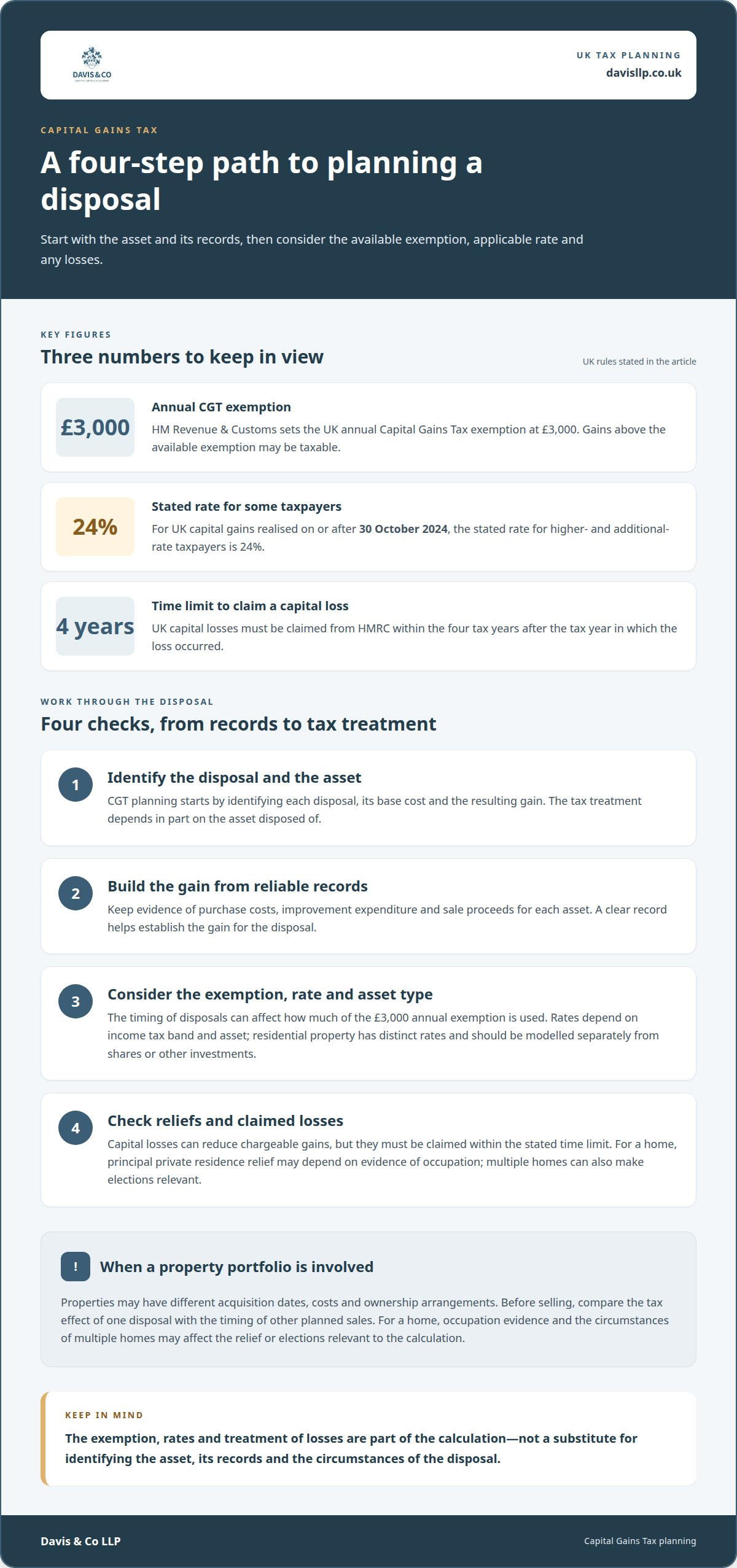
Capital Gains Tax planning starts with identifying each disposal, its base cost and the resulting gain. HM Revenue & Customs sets the UK capital gains tax annual exemption at £3,000. Gains above the available exemption may be taxable, so the timing of disposals can affect how much allowance is used. Keep records of purchase costs, improvement expenditure and sale proceeds for each asset.
Rates depend on the taxpayer’s income tax band and the asset disposed of. For UK capital gains realised on or after 30 October 2024, the stated rate for higher- and additional-rate taxpayers is 24%. Residential property has distinct rates, so a property disposal should be modelled separately from shares or other investments. The property’s use and any applicable relief can affect the calculation.
A property portfolio may include assets with different acquisition dates, costs and ownership arrangements. Before selling, compare the tax effect of disposing of one property with the timing of other planned sales. For a home, principal private residence relief may depend on evidence of occupation; multiple homes can also make elections relevant. These details can affect the taxable gain.
Capital losses can reduce chargeable gains, but they must be claimed. UK capital losses must be claimed from HMRC within the four tax years after the tax year in which the loss occurred. Keep evidence of the transaction and calculate the loss consistently with other disposals. Transfers between spouses or civil partners may also help organise ownership, subject to the applicable rules.
SEIS, EIS and venture capital trusts may offer tax relief linked to qualifying investments, but relief does not remove investment risk. Before investing, assess eligibility, holding expectations and the effect on portfolio concentration. Compare possible relief with the capital at risk and the income needs the investment must serve. Gifts of shares, securities or land to charity may provide income tax relief on market value and may exempt the gain.
4. Definitions of high-net-worth and ultra-high-net-worth individuals
“High-net-worth” has no single meaning across financial services, tax administration and investment planning. HMRC changed its definition in 2016, classifying individuals with assets worth more than £10 million as high-net-worth individuals. This is a classification, not a separate tax status: crossing the threshold does not, by itself, determine an individual’s tax liability.
“Ultra-high-net-worth” is also used differently between markets. A generally accepted definition is investable assets of at least £22.5 million. Investable assets are not the same as total wealth: a main residence, personal possessions, private company shares and liquid investments may be treated differently in a particular assessment. Establish which assets the definition includes before using it to guide a strategy.
For the 2026/27 tax year, employment income can be subject to a top UK income tax rate of 45%. The UK Dividend Allowance is £500, while the Personal Savings Allowance for basic-rate taxpayers is £1,000. These allowances and rates apply according to income type and circumstances; a high asset value alone does not establish the rate that applies.
Start with an inventory of assets, ownership, income and intended lifetime transfers. Then map the tax treatment of each asset against priorities such as liquidity, succession and risk. Owners of private company shares should include control rights and possible disposal plans. Internationally mobile individuals should also account for residence and cross-border income. Review the plan when a material change in assets, family circumstances, residence or tax rules affects its assumptions.
Use the HNW label as context, not as the plan itself. A clear assessment of your income, assets and objectives can show which strategies warrant attention. Review your tax position as part of a considered plan.
Davis & Co LLP: International Tax Planning
Davis & Co LLP provides International Tax Planning for individuals whose residence, income or investments cross borders. The firm can consider UK tax alongside overseas assets and family arrangements, so decisions are assessed in context rather than isolation.
This support may be relevant if you are relocating, hold investments in more than one country, or need to coordinate personal tax with a wider wealth plan. Davis & Co LLP also provides Personal Tax Services, as well as Cash Flow Management and Business Growth Acceleration when these needs intersect with personal or business finances. The right focus depends on your circumstances and objectives.
If a change in residence or international income has affected your tax position, contact Davis & Co LLP to discuss your planning needs.
Turn your investment priorities into a clear plan
The next step in tax planning for high net worth individuals is to connect investment decisions with wider priorities. Consider what you need your wealth to support, how much liquidity you want to retain and how changes in family circumstances or residence could affect your plans. These priorities help identify which strategies deserve attention and which add complexity without advancing your objectives.
A considered plan should be revisited when circumstances change, rather than treated as a one-off exercise. Davis & Co LLP can assess how international tax considerations fit alongside your personal and business financial position, with advice shaped around your circumstances.
Contact Davis & Co LLP to discuss your planning priorities and identify a suitable next step. A clear view of your objectives can help you move forward with greater confidence.
Davis & Co LLP for High Net Worth Tax Planning
Davis & Co LLP provides International Tax Planning, Personal Tax Services and Trust Tax Services to support the tax considerations discussed in this article. Its services also include Property Accounting, Audit and Assurance, and Company Secretarial Services.
Turn to Davis & Co LLP when you need help considering personal, trust or international tax matters alongside business or property finances. The firm also offers Cash Flow Management, Business Growth Acceleration, Management Accounts, Bookkeeping Services, VAT Compliance, Payroll Services and specialist tax services for dental practices.
Frequently Asked Questions
Why does inheritance tax planning matter for high net worth individuals?
Families need to plan how wealth can pass between generations without overlooking ownership, liquidity or intended use. For tax planning for high net worth individuals, a practical concern is whether beneficiaries can meet liabilities without selling assets at an unsuitable time. Reviewing the estate alongside business interests, property and family intentions can identify potential pressure points and inform decisions about lifetime transfers.
Are trusts an effective tax planning tool for high net worth families?
Trusts can support succession planning by separating legal ownership from who benefits, and by setting terms for managing or distributing assets. Their suitability depends on the trust’s purpose, its assets, the people involved and the applicable tax treatment. For example, a family may consider whether controlled distributions suit younger beneficiaries better than an outright transfer.
Are venture capital schemes a tax efficient investment for additional rate taxpayers?
SEIS, EIS and venture capital trusts may be tax-efficient for an investor who qualifies for relief and accepts the risks associated with smaller, less liquid businesses. Assess the investment’s role in the wider portfolio, the investor’s ability to hold it and whether potential relief is relevant to their tax position. Relief should not outweigh the possibility of capital loss or concentration risk.
Family investment companies: Where do they fit?
A family investment company may suit families who want structured oversight of investments while planning how ownership develops across generations. Before establishing one, consider who will make decisions, how profits may be retained or distributed, and how future share transfers align with family intentions. Clear governance can help prevent disagreements from undermining the company’s long-term purpose.
What does a “Tax Optimisation Strategy” involve?
A tax optimisation strategy coordinates tax decisions with wider financial objectives instead of focusing on one transaction in isolation. It may map income sources, asset ownership, investment plans and succession intentions, then identify lawful reliefs or structures relevant to those circumstances. The strategy should also set out practical actions, such as record-keeping and decision points, to keep implementation aligned with the plan.
What is a “Tax Minimisation Strategy”?
A tax minimisation strategy focuses more narrowly on reducing tax liabilities through available allowances, reliefs and appropriate structuring. It should use legitimate arrangements and reflect the commercial purpose and personal circumstances behind each decision. A lower tax bill is not the only measure of success: liquidity, investment risk, administrative demands and family objectives also matter when deciding whether an approach is worthwhile.