The tax relief on pension contributions in the UK depends on how contributions are made and the Income Tax you pay. Under relief at source, pension providers claim 20% basic-rate tax relief from HMRC and add it to your pension; higher-rate and additional-rate taxpayers may be entitled to claim further relief.
It’s understandable to focus on how much goes into your pension, but tax relief is another important part of the picture. This guide explains how tax relief on pension contributions in the UK works, including relief at source, net pay arrangements and employer contributions. Your tax position and the type of pension scheme affect how relief is applied and whether you need to claim it.
Key Takeaways
- Your tax relief depends on your income tax position and how pension contributions are made.
- Relief at source and net pay apply tax relief differently, which can affect what appears in your pension and payslip.
- Employer contributions work differently from personal contributions and are an important part of understanding the overall pension input.
- Knowing the earnings limit and how your tax position affects relief can help you assess your contributions more clearly.
How much pension tax relief do I get?
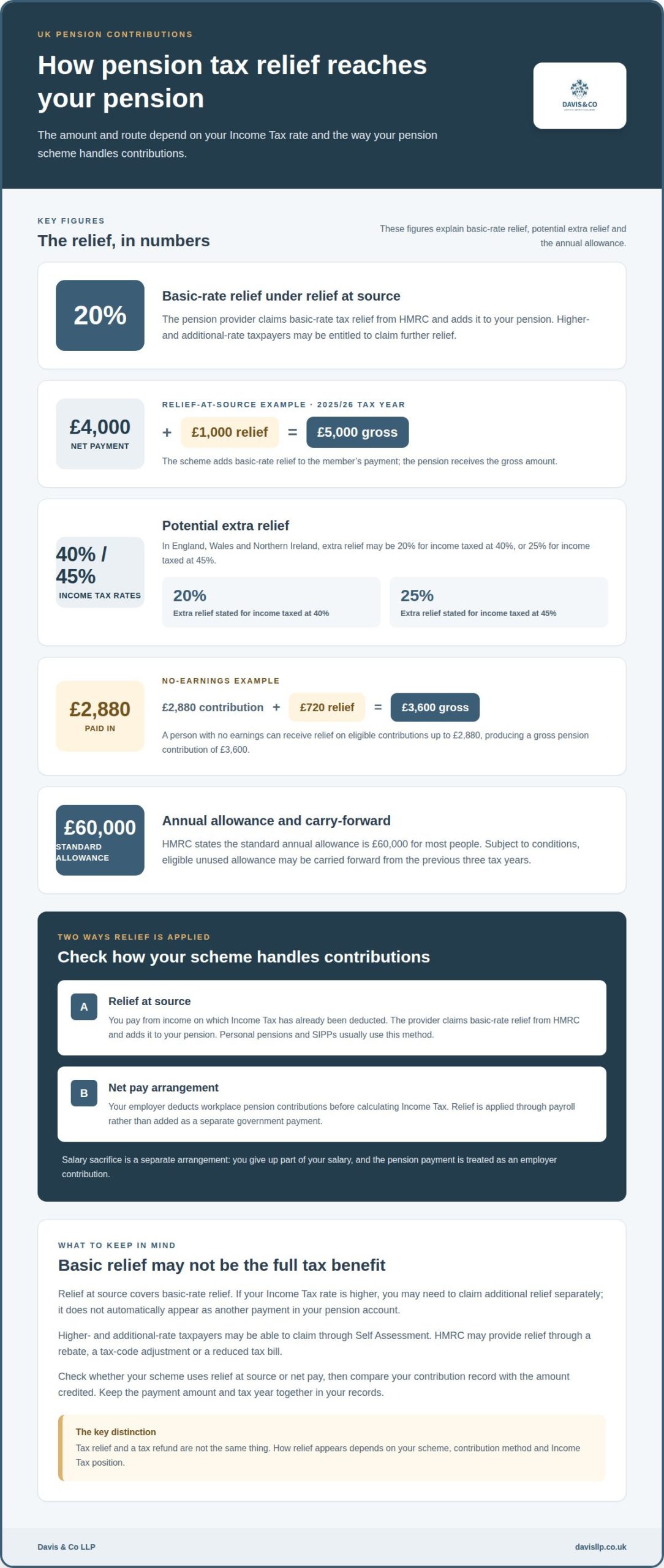
The amount depends on your Income Tax rate, pension scheme and contribution method. HM Revenue & Customs says pension providers claim 20% tax relief under relief at source.
Relief by Tax Rate
Pension tax relief reflects the highest Income Tax rate you pay on eligible contributions. Basic-rate taxpayers usually receive basic-rate relief automatically through relief at source, while higher- and additional-rate taxpayers may claim more. In England, Wales and Northern Ireland, the additional relief can be 20% for income taxed at 40%, or 25% for income taxed at 45%. The distinction matters because basic relief alone may not equal the relief you’re entitled to.
Eligibility for Extra Relief
Extra relief is generally relevant when your Income Tax rate exceeds the basic rate applied by a relief-at-source scheme. People with low earnings or no tax to pay can still receive relief on eligible contributions: a person with no earnings can contribute £2,880 and receive £720, making a gross pension contribution of £3,600. This helps distinguish tax relief from a tax refund. If your scheme already gives all the relief you’re entitled to, there may be no additional claim to make.
Claiming Extra Relief
Higher- and additional-rate taxpayers may need to claim further relief through Self Assessment. HMRC may provide it through a rebate, a tax-code adjustment or a reduced tax bill. If your scheme does not apply relief automatically, you may also need to make a claim. For example, a one-off contribution made separately from salary may not receive relief through a net pay arrangement. When claiming, include your National Insurance number, pension type, net contributions and the relevant tax years.
Carry-Forward Rules for Unused Allowance
Carry-forward allows eligible unused annual allowance from earlier years to be used against pension savings, subject to conditions. HM Revenue & Customs states the standard annual allowance is £60,000 for most people, and unused allowance may be carried forward from the previous three tax years. This can matter when contributions vary between years, but it does not replace checking the allowance available for the current year or establish entitlement to extra tax relief.
What is relief at source?
Relief at source is a method used by personal pension schemes to add basic-rate tax relief to a member’s contribution. You pay from income on which Income Tax has already been deducted; the scheme then claims the relief from HMRC and adds it to your pension. As a result, the amount credited to the pension is higher than your payment.
With relief at source, the scheme claims basic-rate relief from HMRC and adds it to your pension. In a net pay arrangement, your employer deducts contributions before calculating Income Tax, so the tax relief is applied through payroll instead.
For example, in the 2025/26 tax year, a £4,000 net payment into a relief-at-source scheme receives £1,000 in basic-rate relief, creating a £5,000 gross contribution. The pension receives the gross amount, although the member paid the net amount. This distinction matters when reviewing pension statements or comparing contributions across schemes.
The scheme’s claim covers basic-rate relief, but it may not include all the relief available to a higher-rate taxpayer. If your Income Tax rate is above the basic rate, you may need to claim the additional amount separately. This extra relief does not automatically appear as another payment in your pension account, so your pension statement may not show the full tax benefit.
Relief at source can also apply when someone has no earnings. A person with no earnings can receive relief on contributions up to £2,880, producing a gross contribution of £3,600. This limit concerns the amount eligible for relief, not the amount the member pays directly into the scheme.
To understand the treatment, identify whether the pension scheme uses relief at source or net pay, then compare the contribution record with the amount credited. Keep the payment amount and tax year together in your records; this helps distinguish tax relief added by the scheme from relief claimed separately. For an organised view of pension entries in your financial records, see pension contribution records.
Net pay arrangements
In a net pay arrangement, workplace pension contributions are deducted from salary before Income Tax is calculated, applying tax relief through payroll. Personal pensions and SIPPs usually use relief at source: the scheme claims basic-rate relief and adds it to your pension.
Personal and Occupational Pension Arrangements
An occupational pension is arranged through an employer, while an individual opens a personal pension, including a SIPP. The distinction matters because the scheme’s contribution method determines how tax relief reaches your pension and whether you may need to make an additional claim.
With a net pay arrangement, your employer deducts regular pension contributions from earnings before calculating Income Tax. You receive the tax relief through the payroll calculation, rather than as a separate government payment. The contribution goes into your pension, while your taxable pay is reduced.
Payroll treatment also explains why the pension contribution and the change in take-home pay are different figures. The amount paid into the scheme reflects the gross contribution, while the effect on salary reflects its tax treatment. Salary sacrifice is a separate arrangement: you give up part of your salary, and the pension payment is treated as an employer contribution.
Tax Relief on Personal Pensions and SIPPs
Personal pensions and SIPPs generally use relief at source: the provider claims basic-rate tax relief and adds it to eligible contributions. Higher- and additional-rate taxpayers may be able to claim further relief on contributions within the relevant income bands.
A personal pension contribution may be handled separately from payroll, depending on the pension arrangement. Instead, the provider claims basic-rate relief, and you claim any additional relief separately. The annual allowance also matters because it limits pension savings that can receive tax advantages; your earnings affect how much you can contribute personally with tax relief.
For low earners, a net pay scheme may initially provide less benefit than relief at source if they pay no Income Tax. For eligible contributions in tax years starting from 2024/25, HMRC provides a top-up after April for the previous tax year. This helps align the tax relief received under net pay with relief at source. Check which arrangement applies before interpreting a payslip or pension statement, since the same contribution can appear differently across payroll and scheme records.
How does UK tax relief on pension contributions work?
Pension tax relief reduces the Income Tax effectively paid on eligible personal contributions. HM Revenue & Customs states that relief on private pension contributions is available up to 100% of a person’s annual earnings. The relief method determines whether the pension scheme claims it or payroll applies it.
With relief at source, you pay a net contribution and the provider adds basic-rate relief. With net pay, contributions are deducted from salary before Income Tax is calculated. The methods affect how relief is applied, but you still need to consider your earnings and pension contributions together.
A higher-rate taxpayer may be entitled to further relief and need to claim it separately, depending on their tax position.
Employer contributions work differently: the employer pays them into your pension rather than deducting them from your take-home pay, and Income Tax or National Insurance is not deducted from the contributions. Under salary sacrifice, the pension payment is also treated as an employer contribution: you give up part of your salary in exchange for that payment.
The annual allowance sets a separate limit on pension savings that can receive tax advantages. HM Revenue & Customs sets the standard annual allowance at £60,000 for most people. Contributions from personal payments and an employer both matter when assessing pension savings against the allowance, so a member with several schemes should consider the combined amounts.
For a limited-company director, employer contributions may also affect the company’s tax position when they meet the relevant business-purpose condition. The interaction between salary, dividends, personal contributions and employer payments can therefore influence the appropriate contribution route. A review of your personal tax position can help clarify how pension contributions fit with your wider tax affairs.
Davis & Co LLP
Davis & Co LLP’s Personal Tax Services can help you understand pension contributions in the context of your wider tax position. This may be useful when you need to work out how your contribution method, taxable income and any claim for additional relief fit together. It can be particularly relevant if you have several income sources, contribute through both a workplace scheme and a personal pension, or need to include pension payments in your tax affairs.
If your pension decisions also involve overseas tax matters, Davis & Co LLP’s International Tax Planning can help you consider them in context. The right assessment depends on your circumstances, including how contributions are made and the tax year they relate to. Contact Davis & Co LLP for guidance on how your pension contributions fit within your wider financial position.
Make pension decisions part of your wider plan
Pension choices form part of your wider financial picture. Changes to your employment, income sources or business circumstances can affect how contributions fit your plans, so consider them alongside other tax and financial decisions. The right approach depends on your circumstances, not on the pension contribution alone.
Davis & Co LLP provides Personal Tax Services, International Tax Planning, Business Growth Acceleration and Cash Flow Management. These services may be relevant when pension decisions intersect with overseas affairs, business planning or personal tax considerations. Considering the different parts of your finances together can help you understand how they relate.
If you would like to discuss how tax relief on UK pension contributions fits your wider circumstances, contact Davis & Co LLP. A clear conversation can help you identify the next steps with confidence.
Davis & Co LLP can help with pension tax questions
Davis & Co LLP’s Personal Tax Services are a practical next step if you need help understanding how tax relief on pension contributions relates to your wider tax affairs.
Contact Davis & Co LLP for support reviewing your personal tax position or understanding pension contributions as part of your tax planning.
Frequently Asked Questions
How do I work out if I have a tapered allowance?
Compare your threshold income and adjusted income for the relevant tax year. Tapering applies when threshold income is more than £200,000 and adjusted income is more than £260,000. The allowance then falls by £1 for every £2 of adjusted income above £260,000. For adjusted income of £360,000 or more, the tapered allowance is £10,000.
How much can I contribute to my pension if I’m a high earner?
Your personal contribution eligible for tax relief is generally limited by your relevant UK earnings, while total pension savings are also tested against the annual allowance. The standard allowance is £60,000 for most people in 2026/27, but tapering or the money purchase annual allowance can reduce it. These limits measure different things, so a high salary alone does not establish your available allowance.
What are relevant UK earnings?
Relevant UK earnings are earnings that can support personal pension contributions eligible for tax relief. Employment earnings and self-employment profits can count, while property income does not normally qualify. For an employee of a limited company, dividends do not count as earnings for this purpose. This distinction matters if your income includes rent, dividends or other sources alongside salary.
What happens if I pay into someone else’s pension?
For tax-relief purposes, a contribution made by someone else is treated as a contribution by the pension member. The member’s relevant UK earnings therefore affect the relief available, not the payer’s income. For example, a family member’s payment into your pension does not give them pension tax relief based on their own earnings; eligibility is assessed against yours.
What is the annual allowance?
The annual allowance is the limit on pension savings that can receive tax advantages in a tax year. HM Revenue & Customs states that the annual allowance is £60,000 for most people in 2026/27. For a defined benefit pension, the allowance is measured by the increase in the pension’s value, rather than simply by contributions paid. Tapering and other rules may alter an individual’s allowance.
When are claims for extra relief not needed?
You generally do not need to claim extra relief if your scheme has already applied all the relief you are entitled to. For example, a basic-rate taxpayer whose personal pension provider adds basic-rate relief has no higher-rate difference to reclaim. In a net pay arrangement, regular contributions are deducted before Income Tax, so relief is applied through payroll. A higher-rate taxpayer may still need to claim any additional relief due.