A trust’s tax responsibilities can depend on more than its income. Its structure, assets and transactions also matter, so trustees need to know what has happened and which records support each decision. The right trust tax services uk support starts with understanding the trust’s circumstances and the responsibilities that sit with its trustees.
This practical guide covers the main UK tax and reporting issues trustees may need to consider in 2026, including Income Tax, Capital Gains Tax, Inheritance Tax and Trust Registration Service requirements. It also explains why a trust’s obligations and a beneficiary’s personal tax position should be considered separately.
We’ll outline how a trust’s type and activity can affect its responsibilities, highlight relevant deadlines and rule changes, and explain when specialist accounting support may help organise its administration. Davis & Co LLP provides trust tax services tailored to each trust’s circumstances.
Key Takeaways
- A trust’s deed, type, assets and transactions shape the tax questions trustees may need to address.
- Income Tax, Capital Gains Tax and Inheritance Tax apply in different circumstances. Review the trust’s activity before assuming a liability exists.
- Identify the trust, gather relevant records and establish which reporting requirements may apply.
- Specialist trust tax services uk can help trustees manage complex activity and reporting questions with support tailored to the trust.
- Davis & Co LLP’s trust tax support can sit alongside personal tax and international tax planning where relevant.
UK trust tax services: why a trust’s structure matters
Trust tax services cover accounting and tax support connected with a trust’s obligations and circumstances. The work starts by understanding how the trust is constituted and operates, rather than assuming that every trust has the same tax treatment. Its deed, type, assets, income, disposals and payments to beneficiaries can all affect the questions trustees need to consider.
A trust may hold investments, property or other assets, and the tax questions raised by one asset or transaction may differ from those raised by another. A distribution, for example, needs to be recorded as part of the trust’s activity. The recipient may also need to consider how it affects their personal tax affairs. The UK trust taxation overview on Wikipedia provides broader context on the main taxes that may be relevant.
Who may need UK trust tax support?
Trustees are central to the process. They oversee records and decisions and need to understand the trust’s relevant tax matters. Settlors, beneficiaries and family representatives may also need clarity about their respective positions. Support can be useful when a trust is first established and when its assets, activity or circumstances change, prompting a review of earlier assumptions.
Why trust type and circumstances matter
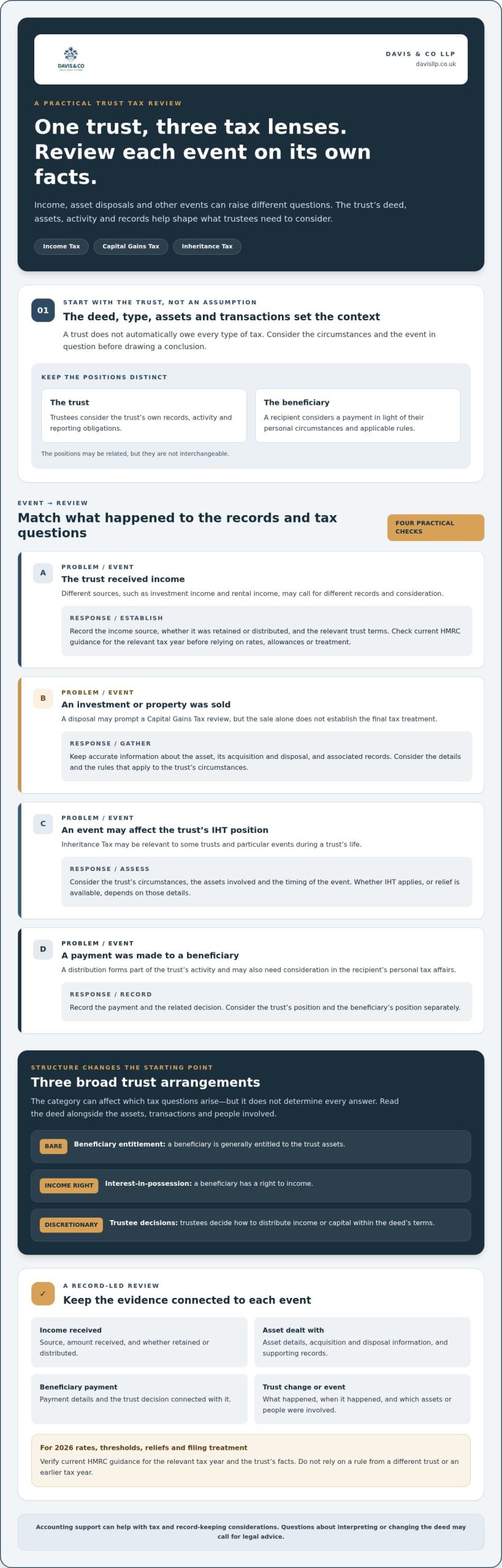
Bare, interest-in-possession and discretionary trusts are broad categories with different arrangements for who benefits and how decisions are made. In a bare trust, a beneficiary is generally entitled to the trust assets. An interest-in-possession trust gives a beneficiary a right to income. Trustees of a discretionary trust decide how to distribute income or capital within the deed’s terms. These distinctions can affect which tax questions arise.
The category alone doesn’t determine every answer. The deed’s provisions, the trust’s assets, its transactions and the people involved need to be considered together. A trust holding investments and one holding property, for instance, may need to review different records and events. Effective trust tax services uk support connects those details to the trust’s accounting and reporting considerations, without treating a general rule as a conclusion for every case.
Trustees’ tax responsibilities should also be kept distinct from beneficiaries’ personal tax affairs. A trust may have its own reporting obligations, while a beneficiary may need to assess a distribution in light of their individual circumstances. The two positions can be related, but they aren’t interchangeable. Keep clear records of income, decisions and payments to help maintain that distinction.
Accounting support complements, rather than replaces, legal advice. An accountant can consider the tax and record-keeping implications of the trust’s circumstances. Legal advice is relevant to interpreting the deed or considering changes to its terms. The right professional input helps trustees address each question within its proper scope.
How UK trust taxation can involve Income Tax, Capital Gains Tax and Inheritance Tax
A trust may need to consider more than one area of tax, but that doesn’t mean every trust automatically owes Income Tax, Capital Gains Tax (CGT) or Inheritance Tax (IHT). The relevant questions depend on the trust’s terms, assets, activity and the event being reviewed. The Official UK government guidance on trusts and taxes provides a starting point. Trustees should also check current HMRC guidance for the rules relevant to their circumstances.
Consider each tax separately. Income received, an asset sale, a payment to a beneficiary or a change affecting the trust can raise different questions. Records should show what happened, when it happened and which assets or people were involved. This helps keep the trust’s tax position distinct from a beneficiary’s personal tax affairs.
Trust income and Income Tax considerations
Income Tax analysis can depend on the source of income and the trust’s type and terms. Investment income and rental income, for example, may require different records and consideration. Trustees may need to establish how income was received, whether it was retained or distributed, and what reporting questions follow. A beneficiary’s position is separate and depends on their own circumstances and the applicable rules.
Rates, allowances and the treatment of income can change. Check current HMRC guidance for the relevant tax year and the trust’s facts before relying on a figure or deciding who is responsible for tax. This is especially important if the trust has several income sources, makes distributions or has changed its arrangements.
Trust asset disposals and Inheritance Tax events
A disposal, such as selling an investment or property held by a trust, may prompt a CGT review. Trustees generally need accurate information about the asset, its acquisition and disposal, and associated records to establish whether a gain has arisen and what rules may apply. The sale itself doesn’t establish the final tax treatment. The details and current rules matter.
IHT may also be relevant to some trusts and particular events during a trust’s life. Whether it applies, and whether any relief is available, depends on the trust’s circumstances, the assets involved and the timing of the event. Don’t rely on a rule that applied to a different trust or an earlier tax year.
A practical review can ask:
- Has the trust received income, and what was its source?
- Were any assets sold, transferred or otherwise dealt with?
- Were payments made to beneficiaries, and how were they recorded?
- Has an event occurred that could affect the trust’s IHT position?
For 2026 rates, thresholds, reliefs and filing treatment, verify current HMRC requirements before acting. Tailored trust tax services uk support can help connect the trust’s records and events to the relevant tax questions. Trustees seeking accounting support can explore trust tax support from Davis & Co LLP.
When do trustees benefit from specialist trust tax accounting support?
A trust with one asset, little activity and orderly records may appear straightforward. Trustees may be able to keep routine administration organised themselves if they understand what needs to be recorded and can identify relevant reporting duties. The question is whether the trust’s activity and the trustees’ knowledge and time are sufficient to manage its tax position confidently.
Professional accounting support can be useful when records are incomplete, an unusual transaction has occurred or trustees are unsure whether an event needs to be reported. A specialist review can bring relevant information together, identify tax questions and clarify where current HMRC guidance needs to be applied. For broader context on tax advice, see our UK tax advice guide.
Trust circumstances that may call for closer review
Consider a closer accounting review if the trust holds several types of assets, receives income from different sources, or has made disposals or distributions during the tax year. A change in trustees or beneficiaries can also affect the information that needs to be kept current. These factors don’t automatically mean a tax liability exists, but they can make it harder to assess the trust’s position using routine records alone.
Cross-border connections may add another layer. A trustee or beneficiary living outside the UK, or assets and income connected with another country, may raise international tax questions alongside UK considerations. The relevant treatment depends on the facts and rules involved. Identify these connections early rather than leaving them until a reporting decision is due.
Accounting support and legal advice serve different purposes
Accounting support focuses on the trust’s financial records, tax analysis and relevant compliance questions. Legal advisers address matters such as interpreting the deed, drafting trust documents and advising on their legal administration. The roles can complement one another: clear financial information supports a tax review, while legal interpretation can clarify the trust’s terms.
To judge whether specialist input may help, ask:
- Can the trustees explain and evidence the trust’s income, payments and asset transactions?
- Are they confident about which records and tax questions relate to the trust, rather than to beneficiaries personally?
- Have any changes or cross-border factors made the position less familiar?
- Is there enough time and current knowledge to review requirements before relevant deadlines?
If the answers reveal uncertainty, an accountant can help establish what needs attention. Support can be proportionate to the trust’s circumstances: a well-documented trust with little activity presents different questions from one with multiple income streams or significant changes. Davis & Co LLP provides trust tax services tailored to individual circumstances, helping trustees approach tax compliance and planning with informed accounting support.
A practical process for organising trust tax records and reviews
A consistent review makes it easier to spot gaps before tax reporting decisions are due. Work through four stages: identify the trust and relevant period, gather its records, review what happened, then establish which reporting or registration requirements apply. This is a preparation process, not a substitute for checking current HMRC rules against the trust’s facts.
- Identify the trust. Note its type, the period under review, the current trustees and the terms relevant to its assets and activity.
- Gather records. Bring together the deed, trustee details and documents relating to trust assets, income and transactions.
- Review activity. Record income received, expenses, disposals, distributions and material decisions, with dates and supporting evidence.
- Confirm requirements. Assess whether a trust return, Trust Registration Service action or another reporting step may apply, then verify relevant deadlines and payment dates.
Information trustees can organise for a tax review
Start with the trust deed and current trustee information. Then assemble records showing what the trust owns and what happened during the period. These might include statements showing income, invoices or other expense records, documents relating to asset disposals, and evidence of distributions or trustee decisions. Keep trust records separate from trustees’ and beneficiaries’ personal finances, even when the same family members are involved.
A clear timeline can be as useful as a file of documents. Note when each transaction or decision took place and keep its supporting record alongside it. If information is missing or an entry is unclear, flag it for follow-up rather than relying on memory. This helps a tax review distinguish confirmed facts from questions that still need resolving.
Review filing and registration questions
Once the activity is summarised, consider whether it gives rise to a trust tax return or another reporting obligation for the period. Registration with the Trust Registration Service is a separate question. Requirements and exceptions depend on the trust’s circumstances and current rules. Neither a general checklist nor a previous year’s filing decision establishes what applies now.
Check current HMRC guidance for the trust type and relevant events, including any applicable filing, registration and payment dates. This is especially important if the trust’s circumstances have changed or rules have been updated. For wider compliance context, our HMRC tax compliance guide discusses the importance of keeping tax obligations under review.
Good preparation gives trustees a clearer basis for decisions, but interpreting reporting requirements can still be difficult. Davis & Co LLP provides trust tax services uk support tailored to a trust’s circumstances. If you would value accounting support with organising and reviewing trust tax matters, explore trust tax support.
How Davis & Co LLP supports UK trust tax matters
Trust tax questions are connected to the trust’s wider circumstances. Davis & Co LLP is an independent firm of Chartered Certified Accountants providing trust tax services alongside personal tax and international tax planning. Our approach is to understand the trust’s structure, assets, activity and relevant people before considering the accounting and tax questions that may arise.
A trust’s tax position and a beneficiary’s personal affairs can be connected without being identical. Clear communication helps trustees understand which matters relate to the trust, what information is relevant and where an individual’s separate tax position may need consideration. Support is tailored to the circumstances, with a focus on tax compliance and informed planning rather than a one-size-fits-all assumption.
A considered approach to trust tax support
Each discussion begins with the facts that shape the trust’s position. These may include its terms, the trustees’ records, the assets it holds and the activity under review. A careful assessment brings the relevant questions into focus and identifies where current tax requirements need to be considered. Trustees can then approach decisions with a clearer understanding of the accounting issues involved.
Trust administration can involve sensitive family and financial information. Davis & Co LLP’s work is focused on the facts and questions relevant to each trust. The firm’s history dates to 1901, while the accounting and tax support is tailored to the trust’s circumstances. No particular tax saving or filing outcome can be assumed in advance.
Coordinate trust matters with wider personal or international tax
A trust matter may overlap with an individual’s tax position, for example when a beneficiary receives a distribution or has other personal tax considerations. Davis & Co LLP also provides personal tax services, which can help trustees and beneficiaries keep their respective positions distinct while considering related information.
Cross-border circumstances may require a broader view. If trustees, beneficiaries, assets or income have connections outside the UK, international tax questions may sit alongside the trust’s UK tax matters. Our international tax planning guidance provides context for those circumstances; the specific analysis depends on the facts and applicable rules.
For trustees considering trust tax services uk, a tailored discussion can help establish which accounting and tax questions are most relevant to the trust. Discuss trust tax support with Davis & Co LLP.
Make your next trust tax review a considered one
Turn uncertainty into a short list of questions: which trust activity needs attention, what records are available, and whether a recent change affects the trust’s tax position. This gives trustees a clear starting point for a focused discussion and helps keep the trust’s affairs distinct from beneficiaries’ personal tax matters.
The right level of trust tax services uk support depends on the trust’s circumstances. A tailored conversation can help identify the issues to review and how accounting support may fit alongside other professional advice already involved. You don’t need to have every answer prepared before taking that step.
Discuss your UK trust tax requirements with Davis & Co LLP and take a measured step towards managing the trust’s tax matters with greater clarity.
Frequently Asked Questions
Do trustees have to file a UK tax return for a trust?
No, a trust tax return isn’t required in every case. The filing position depends on the trust’s income, activity and circumstances for the relevant tax year, as well as current HMRC rules. Trustees should distinguish a year with no reportable activity from one involving income or an asset disposal, rather than assume the same filing decision applies to both. Keep the reasoning and supporting records together, and seek accounting advice if the requirement is unclear.
Does a trustee become personally responsible for a trust’s tax?
Not automatically. Responsibility depends on the trust’s circumstances and the applicable rules. Trustees should establish which obligations relate to the trust and avoid treating them as identical to a beneficiary’s personal tax position. If a trust tax issue arises, record the relevant decision and transaction, then obtain advice before deciding how any amount should be dealt with. Specialist trust tax services uk can help clarify the accounting questions without assuming that every trustee has the same personal exposure.
Can a trust have more than one trustee for tax purposes?
Yes, a trust can have multiple trustees. They should agree how key documents will be stored, who will coordinate information and how decisions affecting the trust will be recorded. For instance, if one trustee receives investment statements and another organises distributions, both should have access to a complete record of relevant activity. The deed and applicable rules inform their responsibilities, so informal arrangements shouldn’t replace a shared understanding.
What happens to trust tax matters when a trustee changes?
A trustee change is a prompt to review the handover, not a reason to assume the trust’s tax position has changed in a particular way. Incoming trustees should receive relevant correspondence, prior returns, working papers and records of unresolved matters, with sensitive information transferred securely. The trustees should also consider whether registration details need updating under current rules. Keep a dated record of the change and any follow-up decisions, and seek advice if the reporting steps are uncertain.
How are trust tax matters handled when a trust ends?
When a trust ends, trustees need to consider what happens to its assets and records before administration is completed. Transferring an asset to a beneficiary may raise different questions from distributing cash, and unresolved income or reporting matters may still need attention. Review the deed, transaction history and proposed steps together, then check current HMRC requirements. Tax consequences depend on the trust’s facts, so don’t treat closure as simply a final bank transfer.
How much do UK trust tax services cost?
The cost of trust tax support depends on the trust’s structure, the records available and the work involved. A review of a well-organised trust with limited activity may differ from work involving multiple assets, transactions or unresolved reporting questions. Davis & Co LLP can discuss the trust’s circumstances and scope of work with you. Sharing a clear outline of the trust and its recent activity helps establish what support is relevant.
Can an accountant advise on both trust and personal tax matters?
Yes. An accountant can consider trust and personal tax matters together where they intersect, while keeping each taxpayer’s position distinct. A beneficiary’s receipt from a trust, for example, may prompt separate questions about the trust’s records and the beneficiary’s own affairs. Davis & Co LLP provides both trust tax and personal tax services, with support tailored to the circumstances. The relevant documents and facts help determine which issues belong to the trust and which require individual consideration.