Does your current firm offer strategic foresight, or are they merely recording history after the fact? For many businesses, the search for the right chartered accountants begins with a desire for compliance but ends with the frustration of generic advice that ignores the nuances of their specific sector. It’s a common sentiment. In the 2023/24 tax year, HMRC estimated the UK tax gap at £39.8 billion, a figure often driven by businesses missing out on legitimate reliefs or failing to navigate international obligations correctly. This leaves many directors feeling like a small fish in a large, indifferent pond, disconnected from the very expertise they require.
At Davis & Co LLP, we understand the need for a proactive partner who provides clarity on your global tax position and ensures your transition between firms is handled with surgical precision. This article provides a comprehensive framework to help you evaluate and select a firm that prioritises your commercial growth over simple administrative box-ticking. We’ll examine the essential criteria for choosing an advisor who delivers bespoke tax strategies and a seamless integration of your financial data, ensuring no loss of continuity or momentum during the 2024 fiscal period.
Key Takeaways
- Distinguish between standard compliance and the strategic advantages of a proactive advisory firm that aligns with your long-term commercial objectives.
- Verify the essential credentials of chartered accountants london, ensuring your chosen partner possesses the professional standing and historical stability required for complex matters.
- Determine the necessity for specialist expertise in niche areas such as international tax and trust accounting to navigate the complexities of the 2026 regulatory landscape.
- Evaluate how the integration of modern financial technology can offer real-time insights and more precise oversight of your private or corporate interests.
- Learn to conduct a thorough culture check during the consultation phase to ensure a bespoke fit and a seamless transition to your new professional advisor.
Why Selecting a Chartered Accountant is a Strategic Business Decision
Selecting a financial partner is a decision that dictates the trajectory of a business’s fiscal health and statutory standing. The distinction between a generic bookkeeper and a firm regulated by the Institute of Chartered Accountants in England and Wales (ICAEW) or the ACCA is found in the depth of their training and the rigour of their professional oversight. We view accountancy not merely as a recording of past events, but as a proactive discipline that prepares a business for future challenges.
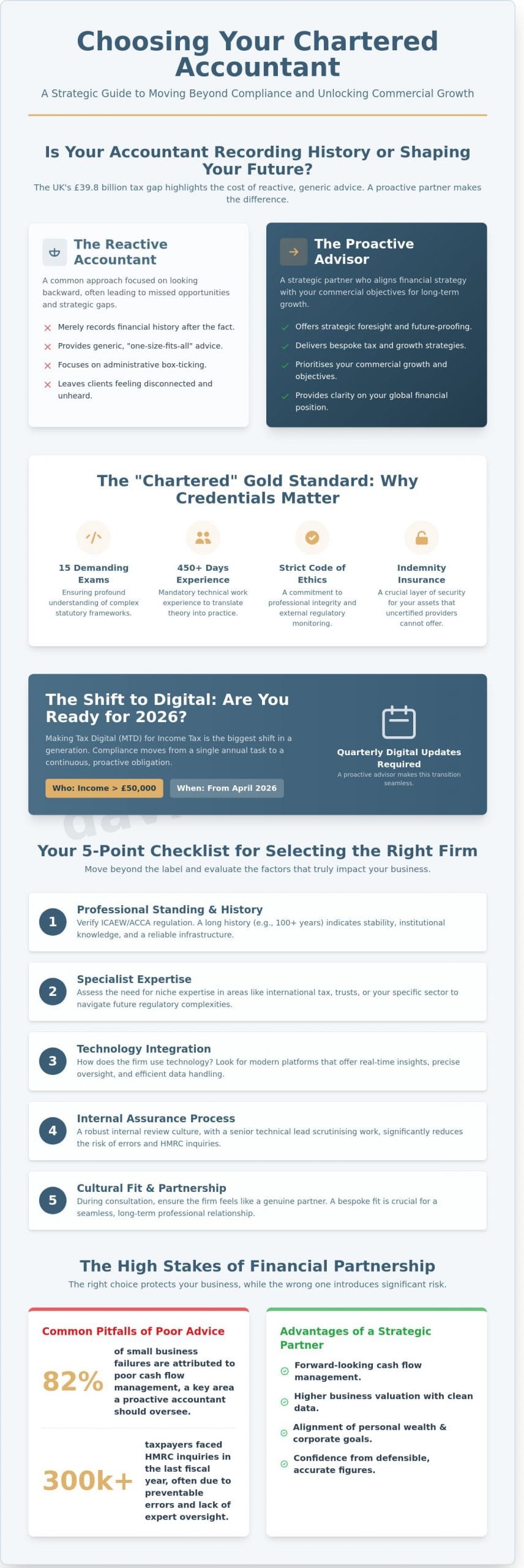
The UK’s tax environment is undergoing its most significant shift in a generation. By April 2026, the mandate for Making Tax Digital (MTD) for Income Tax Self Assessment will require individuals with qualifying income over £50,000 to maintain digital records and provide quarterly updates. This transition moves the requirement from a retrospective annual task to a continuous, proactive obligation. Our role as chartered accountants london businesses trust involves mitigating the risks associated with these HMRC transitions while ensuring compliance is handled with absolute precision. We focus on the granular details of statutory requirements so our clients can focus on their commercial objectives.
The “Chartered” Standard: Why Credentials Matter
The “Chartered” designation is a hallmark of professional integrity and technical excellence. Members of the ICAEW and ACCA must complete at least 450 days of technical work experience and pass 15 demanding examinations. This ensures they possess more than just basic numeracy; they have a profound understanding of complex statutory frameworks. Every firm with this status must hold Professional Indemnity Insurance and adhere to a strict code of ethics. This provides a layer of security for your assets that uncertified providers cannot replicate. It’s about the security that comes from knowing your advisor is subject to external regulatory monitoring. This quiet excellence in credentials translates directly into the safety and stability of your financial legacy.
From Compliance to Commercial Strategy
A strategic partnership goes beyond the submission of year-end accounts. We focus on monthly management reporting to identify cash flow patterns before they impact operations. For a business seeking a higher valuation, consistent and accurate financial data is essential. Statistics from the banking sector suggest that approximately 82% of small businesses fail due to cash flow mismanagement. A proactive small business accountant prevents this by looking forward rather than backward. By integrating commercial insight with private client requirements, we provide bespoke solutions that align personal wealth with corporate objectives. This dual focus is a defining marker of how chartered accountants london firms support long-term growth and stability through every stage of the business lifecycle.
The Essential Credentials Checklist: Beyond the Label
Selecting chartered accountants london businesses can trust requires a move beyond simple certification. While membership with the ICAEW or ACCA is a mandatory baseline, it doesn’t guarantee the strategic depth your business might require. A firm’s history serves as a primary indicator of stability. A practice that has operated for over 100 years, for example, possesses an institutional memory that spans multiple economic cycles and legislative shifts. This longevity suggests a reliable infrastructure that isn’t prone to the high staff turnover seen in newer, more aggressive firms. When researching chartered accountants london, look for firms that offer more than just year-end filing.
You should also look for a firm that maintains a robust internal assurance process. This means your accounts aren’t just prepared; they’re subjected to a secondary layer of scrutiny by a senior technical lead before they reach you. This internal audit culture reduces the risk of HMRC inquiries, which affected over 300,000 taxpayers in the last fiscal year. It’s about precision and the quiet confidence that comes from knowing every figure is defensible.
Regulatory and Professional Compliance
Compliance is no longer a seasonal event. With the UK government’s focus on digital transformation, your accountant must be fluent in the latest HMRC digital reporting requirements. This includes the complexities of Making Tax Digital for the 1.4 million VAT-registered entities in Britain. Ensure the firm is registered for statutory audit if your business meets the turnover or asset criteria under the Companies Act 2006. They should also provide comprehensive company secretarial services to manage your filings at Companies House, protecting your directors from avoidable personal liability risks.
The Human Element: Who Will Manage Your File?
The “bait and switch” is a frequent frustration in professional services. A senior partner sells the vision, but a junior trainee executes the work. You should insist on a dedicated point of contact who possesses at least 10 years of post-qualification experience. This ensures your business history is understood and retained, rather than being lost in a cycle of departing staff. The communication style should be measured and deliberate. You don’t need a partner who reacts; you need one who anticipates. It’s about having a calm authority at your side.
A high-calibre advisor acts as a strategic partner, balancing technical statutory requirements with your broader commercial objectives. If you value this level of composed expertise, exploring a partnership with Davis LLP can provide the security your financial interests require. We focus on bespoke solutions that respect the precision of the law while acknowledging the practicalities of modern business.
Evaluating Specialist Expertise: International and Niche Tax
Selecting chartered accountants london involves more than verifying basic compliance capabilities. It requires an assessment of whether a firm possesses the intellectual depth to manage complex, multi-jurisdictional financial structures. Generalist practitioners often overlook the granular details of trust tax or the specific reporting requirements for non-domiciled individuals, which can lead to significant HMRC penalties. A specialist firm doesn’t just record history; it anticipates the fiscal impact of cross-border movements and niche industry regulations.
International Tax and Cross-Border Considerations
The UK’s tax system is intricately linked with global markets through over 130 double taxation treaties. For clients with interests in multiple territories, the firm must demonstrate a mastery of the Statutory Residence Test, introduced in 2013, and the nuances of the remittance basis for non-doms. We believe that a high-calibre advisor should provide a clear strategy for family offices managing worldwide assets, ensuring that tax efficiency is optimised without breaching statutory boundaries. You should ask for specific examples of how they’ve managed the 2008 UK-France Double Taxation Convention or similar treaties to prevent double exposure.
- Statutory Residence: Analysis of day-counting and ties to the UK under the SRT.
- Treaty Relief: Practical application of double taxation agreements to mitigate global liabilities.
- Family Office Support: Discretionary management of global asset reporting and succession planning.
Specialist Sectors: The Dental and Property Example
Generic accounting often fails to address the unique operational realities of specific professions. Dental practitioners, for instance, require bespoke advice regarding NHS pension reconciliations and the complex VAT status of associate contracts. A firm with a dedicated dental desk understands these specificities, whereas a generalist might miss opportunities for capital allowances on surgery fit-outs. This level of “niche” expertise is a hallmark of the leading chartered accountants london offers.
Property accounting has become increasingly technical following the Finance Act 2019 and the introduction of the 60-day Capital Gains Tax reporting rule for residential disposals. Accuracy is essential. While a generalist may handle a simple rental income statement, they might struggle with the Annual Tax on Enveloped Dwellings (ATED) or the complexities of Interest Restriction rules for corporate landlords. You should seek a firm that maintains distinct desks for property and private clients, ensuring that your advice is tailored to the specific legislative framework governing your sector. Precision in these areas isn’t optional; it’s a fundamental requirement for protecting your commercial interests.
Assessing the Partnership: Service Delivery and Technology
Selecting chartered accountants london businesses can rely on involves looking beyond the annual audit. A modern partnership relies on the seamless integration of technology and human expertise. In 2023, data from the Office for National Statistics indicated that UK business investment increased by 3.7 per cent, a trend that requires precise financial oversight to maintain. The right firm does not merely record history; it helps you write it by providing real-time financial insights.
Modern Accounting Technology and Integration
The transition to cloud-based systems such as Xero or Sage has changed how we view financial health. A firm should provide real-time visibility into your ledger, allowing for immediate course correction rather than retrospective analysis. Effective chartered accountants london use this data to drive management accounting. This includes monitoring Key Performance Indicators (KPIs) and maintaining 12-month rolling forecasts. Sophisticated software provides the raw data, but the intellectual rigour of a qualified professional ensures these figures translate into actionable commercial decisions. We believe that technology should empower the advisor, not replace the nuanced judgement required for complex tax planning or statutory compliance. Many directors who initially search for bookkeeping services near me discover that a fully integrated approach to record-keeping and management accounts delivers far greater commercial value than standalone ledger maintenance.
Growth Acceleration and Strategic Advisory
A proactive firm acts as a sounding board for your commercial objectives. They should offer business growth acceleration services that look five or ten years ahead. According to a 2023 report by the British Chambers of Commerce, 53 per cent of firms reported difficulties in accessing finance; a chartered accountant’s role in preparing robust financial cases is critical in this environment. Your advisor should assist with:
- Detailed cash flow management to prevent liquidity constraints during rapid expansion.
- Assistance with long-term exit strategies, ensuring the business is structured for maximum valuation.
- Strategic planning sessions that align with your specific corporate culture and risk appetite.
The relationship must be built on a foundation of shared values. If your organisation prioritises discretion and steady growth, a firm that mirrors this “quiet excellence” will prove more effective than one focused on aggressive, high-risk manoeuvres. The right advisor understands the human impact of financial decisions. They bridge the gap between statutory requirements and your personal or corporate ambitions through bespoke solutions. This cultural alignment ensures that the advice you receive is not only technically sound but also practically applicable to your unique circumstances. For a deeper understanding of how a dedicated small business accountant can transform your financial obligations into a platform for genuine growth, our strategic guide for 2026 provides a comprehensive framework.
Finalising Your Selection: Transitioning to Your New Firm
The final stage of appointing chartered accountants london involves moving from theoretical discussion to practical implementation. This transition requires a structured approach to ensure your commercial and private interests remain protected. It’s a process of formalising a partnership that will likely last for many years; therefore, the final steps must be handled with precision and discretion. When you decide to engage chartered accountants london, the quality of the onboarding process is a direct reflection of the firm’s overall professionalism.
The Consultation and Proposal Phase
A bespoke proposal should be more than a list of services. It must reflect a deep understanding of your specific statutory obligations and strategic goals. We believe the initial consultation serves as a vital culture check. It’s the moment to determine if the firm’s approach aligns with your own values. A composed partnership is built on this mutual understanding. You should expect a detailed fee structure that eliminates ambiguity. This document should address both your immediate tax compliance and your long-term wealth preservation or business growth objectives. If a proposal feels generic, it probably won’t meet the nuanced needs of a sophisticated London business or a private estate.
A Seamless Handover Process
The transition between firms is often perceived as a point of friction; however, a capable firm manages this with quiet efficiency. We take the lead in requesting your historical records and tax papers from the previous incumbent. This process is designed to safeguard your continuity of service. It’s particularly vital that VAT returns and monthly payroll cycles are synchronised to prevent any HMRC penalties. Professional clearance is a standard, stress-free procedure where your new firm writes to the previous accountant to ensure a transparent and ethical transfer of your financial records.
The first 90 days of the partnership are critical for establishing a rhythm. During this period, we focus on integrating your data into our systems and verifying the accuracy of previous filings. You’ll receive a formal engagement letter. This is a statutory requirement that outlines the scope of our work and the agreed fee structure. Reviewing this document ensures that every aspect of the partnership is documented with the precision your affairs deserve. We aim to identify any immediate tax efficiencies within the first 60 days of our appointment, providing a pragmatic start to our professional relationship. This methodical approach ensures that your financial management remains a dependable constant.
Securing Your Financial Future Through Strategic Partnership
Selecting the right firm is a fundamental pillar of long-term commercial success. It’s about moving beyond basic compliance to find a partner who understands the nuance of your specific sector. Since our founding in 1901, Davis & Co LLP has provided this level of professional gravitas to clients across the UK. We recognise that the search for chartered accountants london often begins with a checklist of credentials, yet the true value lies in tailored strategic advice that addresses complex challenges like international tax structures or the specific financial requirements of dental practices.
A century of experience has taught us that a successful partnership relies on a blend of tradition and modern technology. Our team of Chartered Certified Accountants delivers bespoke solutions that reflect your unique business objectives. By prioritising specialist expertise over generic services, you ensure your enterprise remains resilient in an evolving regulatory landscape.
Discover how our bespoke accounting solutions can accelerate your business growth.
We look forward to helping you navigate your next stage of expansion with confidence.
Frequently Asked Questions
What is the difference between a Chartered Accountant and a regular accountant?
Chartered Accountants must complete at least three years of documented training and pass rigorous professional examinations through bodies like the ICAEW. While anyone can legally call themselves an accountant in the United Kingdom, chartered accountants london are bound by a strict code of ethics and mandatory professional indemnity insurance. It’s a distinction that provides a layer of security and technical expertise vital for managing complex statutory requirements.
How do I switch my business to a new accounting firm without disruption?
You can switch firms by authorising a professional clearance process where your new advisor communicates directly with your outgoing firm. We manage this transition by requesting a full trial balance and historical tax records covering the previous 24 months. This structured handover typically takes 21 days to complete. It’s a process that ensures your statutory filings remain on schedule and prevents any administrative gaps during the transition.
Can a London-based firm effectively manage my international tax obligations?
A London firm with international expertise manages global tax obligations by leveraging the 130 double taxation treaties the United Kingdom maintains. We apply specific HMRC statutory residence tests to determine your liability and ensure compliance across all relevant jurisdictions. This methodical approach protects your cross-border income from being taxed twice. It provides a clear strategy for international expansion or personal relocation.
Do I need a specialist accountant for my dental practice?
Dental practices benefit from specialist accountants who understand unique financial structures like NHS pension contributions and UDA tracking. These businesses often use complex associate agreements that require precise VAT and self-assessment handling to remain compliant. Specialist advisors ensure your practice adheres to specific General Dental Council financial regulations. This level of focus helps prevent costly errors in your annual returns and associate pay calculations.
What should I expect to pay for Chartered Accounting services in 2026?
Industry projections suggest that basic compliance fees for small businesses may rise by 5% annually, reaching an average of £1,800 per year by 2026. For complex advisory services, hourly rates for chartered accountants london are projected to range between £250 and £500 based on partner seniority. These figures reflect the rising costs of regulatory compliance. They don’t include the costs of bespoke consultancy for specific one-off projects.
How often should I meet with my Chartered Accountant for strategic advice?
You should meet with your advisor at least four times a year to review quarterly performance and adjust your tax strategy. While annual compliance is a legal necessity, these quarterly sessions allow us to identify cash flow trends and tax-saving opportunities before your financial year ends. Regular contact ensures your business remains agile. It allows for proactive adjustments rather than reactive corrections after your year-end has passed.
What information does a firm need to provide a bespoke tax planning quote?
We require your most recent set of accounts and a summary of your current corporate structure to provide a bespoke tax planning quote. You should also provide your projected turnover for the next 12 months and details of any planned asset disposals. This information allows us to assess the complexity of your requirements accurately. We can then present a proposal that aligns with your specific commercial objectives.
Is it better to have a large firm or a boutique partner for a family office?
A boutique partner provides the discretion and continuity of service that a family office requires across 25-year horizons. Large firms often face higher staff turnover, whereas a boutique firm ensures you work with a dedicated partner who understands your long-term legacy. We focus on building these enduring relationships. This approach ensures your family’s wealth is managed with a consistent level of high-calibre expertise and personal accountability.