Is the dream of property ownership becoming a mathematical impossibility, or are we simply overlooking the most potent tax-efficient tool in a first-time buyer’s arsenal? We recognise that with average UK house prices reaching £285,000 as of late 2023, the prospect of securing a deposit feels increasingly distant. It’s a sentiment shared by many who find themselves caught between the desire for a home and the perceived rigidity of the £450,000 property price cap. Utilizing a lifetime isa for first time buyers isn’t merely a savings choice; it’s a strategic move to leverage a 25% government bonus that can significantly accelerate your path to completion.
We’ll demonstrate how to maximise this £1,000 annual uplift while ensuring your contributions sit comfortably within your wider £20,000 yearly ISA allowance. You’ll gain a clear understanding of the 25% withdrawal penalty and the precise timelines needed to ensure your funds are ready when you find the right property. This guide provides a bespoke roadmap to help you manage these regulations with the composure and foresight that a significant investment demands.
Key Takeaways
- Understand how to maximise the 25% government bonus to effectively enhance your capital when transitioning into property ownership.
- Identify the essential statutory requirements and property value limits that govern the successful application of these tax-efficient accounts.
- Assess the strategic implications of the 25% withdrawal charge to ensure a lifetime isa for first time buyers remains a prudent element of your long-term plan.
- Discover how to balance your annual £20,000 ISA allowance across multiple vehicles to maintain a bespoke and compliant personal tax profile.
- Learn how our professional advisory services provide the clarity needed to navigate complex HMRC regulations and structure your wealth with precision.
What is a Lifetime ISA for First-Time Buyers?
The Lifetime ISA (LISA) represents a sophisticated component of the UK’s broader Individual Savings Account (ISA) regime, specifically engineered to assist individuals in securing their first residential property. Since its inception in April 2017, we’ve observed it become a pivotal tool for those seeking a structured, tax-efficient path toward homeownership. At its core, the lifetime isa for first time buyers functions as a dual-purpose vehicle; it provides a mechanism for property acquisition while simultaneously offering a robust framework for retirement planning after the age of 60.
The strategic advantage of this account lies in its fiscal efficiency. Any growth within the fund, whether through interest in a cash LISA or capital appreciation in a stocks and shares LISA, remains entirely insulated from UK Income Tax and Capital Gains Tax. This allows for a compounding effect that isn’t eroded by statutory levies, providing a clear advantage for long-term capital accumulation. Maximising the utility of a lifetime isa for first time buyers requires a clear understanding of these tax wrappers to ensure they align with your broader financial objectives.
The 25% Government Bonus Explained
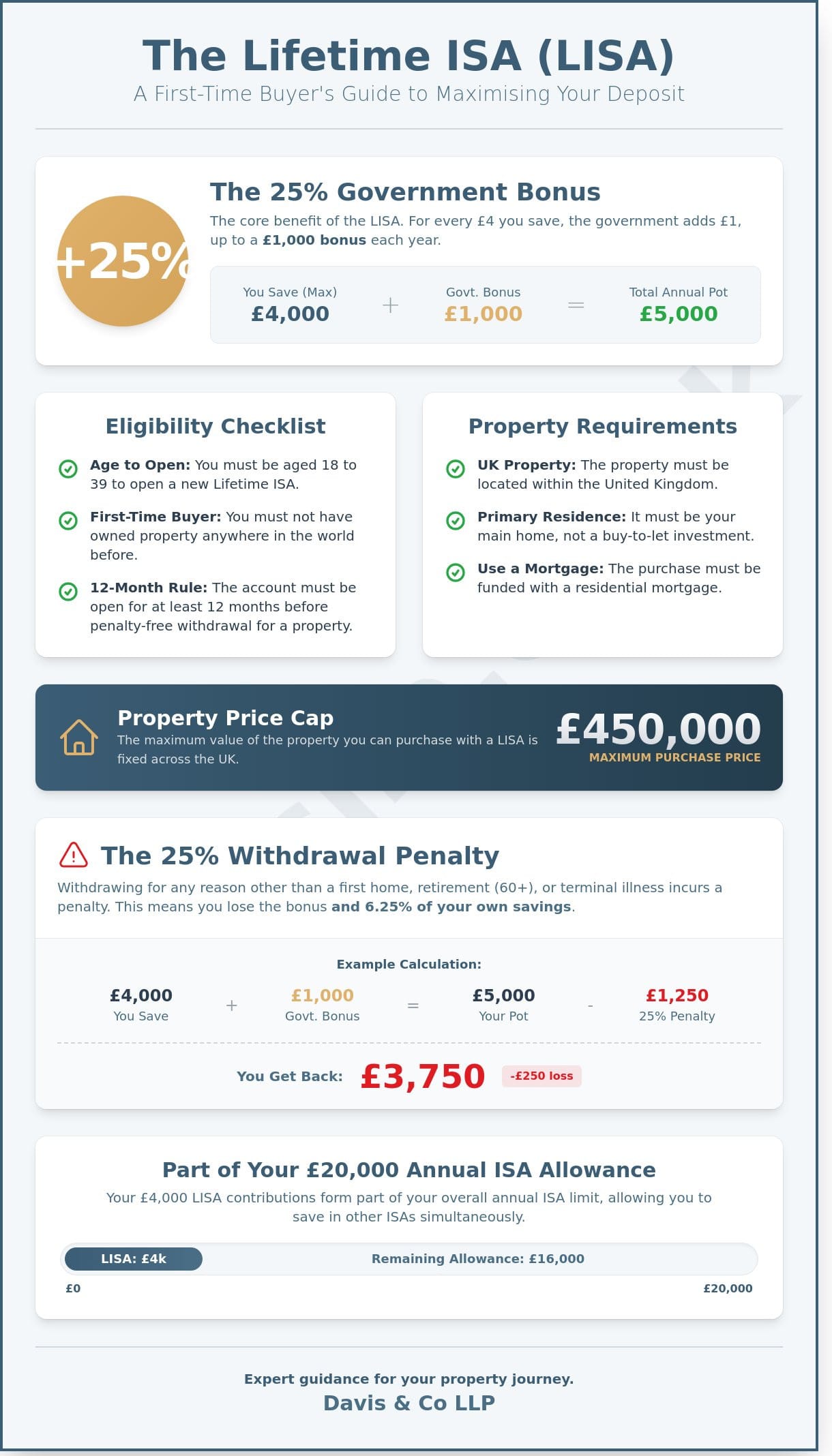
The defining feature of the LISA is the non-repayable government bonus. For every £4 committed to the account, the state provides an additional £1. With a maximum annual contribution threshold of £4,000, savers can accrue a £1,000 annual uplift. These bonuses are processed on a monthly basis, meaning the additional capital begins generating its own returns almost immediately. This 25% instantaneous return is a powerful catalyst for building a deposit, far outstripping the rates typically found in standard commercial savings products. We view this as an essential uplift for those navigating the current UK property market.
Eligibility Criteria for Opening an Account
To access these benefits, specific statutory requirements must be met. Applicants must be aged between 18 and 39 when the account is established. Once opened, you can continue to contribute and receive the 25% bonus until your 50th birthday. It’s vital to note the 12-month rule: the account must be active for at least 365 days before the funds can be withdrawn for a property purchase without penalty. We recommend opening an account with a nominal sum early to ensure this clock begins ticking, providing flexibility for future bespoke property searches. This ensures your capital is ready when the right opportunity arises.
Rules and Restrictions for First-Time Buyers
The lifetime isa for first time buyers operates within a precise regulatory framework designed to support residential ownership rather than speculative investment. To qualify for the 25% government bonus, the property must be your first legal interest in a residential dwelling anywhere in the world. This definition is strictly applied by HM Revenue & Customs; it includes properties inherited or held in a trust. Additionally, the asset must be located within the United Kingdom and serve as your primary residence. The scheme prohibits buy-to-let investments; you cannot purchase a property with the intent to rent it out immediately. If your circumstances change and you must move, strict rules govern whether the property can be let in the future without breaching the original terms of the account.
A fundamental requirement for utilizing these funds is the use of a mortgage. The scheme is not available to cash purchasers. You must take out a traditional residential mortgage or a regulated home purchase plan to buy your home. This ensures the account supports those who require financial leverage to enter the market. For those planning a complex purchase, our bespoke conveyancing services provide the necessary oversight to ensure all statutory requirements are met during the transaction.
The £450,000 Property Price Cap
The maximum purchase price for any property bought with a LISA is set at £450,000. This figure has remained static since the scheme’s inception in April 2017 and applies universally across England, Scotland, Wales, and Northern Ireland. While this cap provides significant headroom in many regional markets, it requires careful consideration in high-value areas such as London or the South East, where average prices often exceed this threshold. If the transaction price exceeds this limit by even a single pound, you cannot use the bonus. In such instances, withdrawing the funds triggers a 25% government charge, which effectively removes the bonus and a portion of your original capital. We suggest reviewing official government guidance on LISAs to understand the full implications of these price thresholds before committing your long-term savings strategy.
The 12-Month Rule and Conveyancing
Time is a structural requirement of the account. A lifetime isa for first time buyers must be open for at least 12 months before the funds can be withdrawn for a home purchase. This clock starts from the date of the first payment into the account, not the date the account was registered. When you reach the completion stage of your purchase, your solicitor or conveyancer manages the withdrawal process. Funds are transferred directly to the legal professional’s client account rather than your personal bank account. This ensures the withdrawal remains tax-free and compliant with regulatory standards. You must provide your solicitor with a signed declaration and a formal request at least 30 days before the expected completion date to allow for administrative processing by the ISA provider.
Evaluating the Risks: The 25% Withdrawal Penalty
While the 25% government bonus represents a compelling incentive, the mechanism includes a stringent recovery provision for non-compliant withdrawals. This charge applies if you access your capital for any reason other than purchasing a first home or reaching the age of 60. It’s vital to view these funds as a long-term commitment rather than a flexible savings pot. The penalty is designed to ensure the scheme remains focused on its dual objectives of home ownership and retirement planning. We often see clients underestimate the “locked-in” nature of these accounts, which can lead to friction when unexpected capital requirements arise.
The Hidden Cost of Unauthorised Withdrawals
The financial implications of an early withdrawal extend beyond simply losing the government’s contribution. Because the 25% charge applies to the total account value, it erodes your original principal. Consider a scenario where you deposit £4,000 and receive a £1,000 bonus, bringing your balance to £5,000. If you withdraw this for an unapproved reason, the 25% penalty totals £1,250. You’re left with only £3,750. This represents a 6.25% net loss of your initial £4,000 investment. We advise our clients to maintain a separate emergency fund to avoid this statutory clawback.
When the Penalty Does Not Apply
There are specific circumstances where you can access your funds without incurring a charge. These are clearly defined by the UK Government Lifetime ISA regulations. The penalty is waived in the following instances:
- Purchasing a first home valued at £450,000 or less, provided the account has been open for at least 12 months.
- Reaching your 60th birthday, at which point the funds can be accessed tax-free for any purpose.
- Being diagnosed with a terminal illness with less than 12 months to live, supported by medical evidence.
- Transferring the balance to another LISA provider, provided you use the official transfer process rather than withdrawing the cash yourself.
Using a lifetime isa for first time buyers requires a disciplined approach to liquidity. If your property search involves houses exceeding the £450,000 threshold, or if your timeline is shorter than the 12-month minimum holding period, the penalty becomes a significant risk. At Davis & Co LLP, we provide bespoke analysis to ensure your use of a lifetime isa for first time buyers aligns with your broader commercial and personal objectives. We help you determine if this restrictive structure suits your current financial trajectory or if alternative tax-efficient vehicles would better serve your needs. Our role is to ensure your strategy is pragmatic and resilient against shifting circumstances.
Strategic Integration into Your Personal Tax Plan
Every individual in the United Kingdom operates within a strict £20,000 annual ISA allowance. This limit remains static for the 2024/25 tax year, regardless of how many individual accounts you hold. When you commit the maximum £4,000 to a lifetime isa for first time buyers, you’ve utilised 20% of your total tax-free capacity. This necessitates a pragmatic approach to your remaining £16,000. We often advise clients to distribute this balance between a standard Cash ISA for immediate liquidity and a Stocks and Shares ISA to pursue long-term capital growth.
A cohesive strategy ensures these vehicles work in harmony rather than in isolation. Managing these accounts requires a clear understanding of your commercial objectives and your timeline for property acquisition. We believe that “quiet excellence” in financial planning comes from this level of meticulous detail. You shouldn’t view the LISA as a standalone product but as a core component of a broader, bespoke tax-efficient portfolio. Engaging with expert tax advice in the UK ensures that every element of your savings structure is aligned with the latest regulatory changes and optimised for your personal circumstances.
LISA vs. Pension for Retirement
The mathematical parity between a LISA and a pension depends heavily on your specific income bracket. For a basic-rate taxpayer earning between £12,570 and £50,270, the 25% LISA bonus mirrors the 20% tax relief found in a traditional pension. However, higher-rate taxpayers earning above £50,270 receive 40% relief on pension contributions. For these individuals, the pension is almost always the more efficient vehicle for retirement. Understanding exactly where you fall within the tax brackets uk residents face in 2026 is essential to making this comparison accurately. We provide the intellectual rigour needed to weigh these options against your long-term goals. Those building pension wealth alongside their LISA should also be aware of the forthcoming inheritance tax on pensions rule changes arriving in April 2027, which will fundamentally alter how unused pension funds are treated within an estate.
Cash LISA vs. Stocks and Shares LISA
Your choice between cash and equities depends on your anticipated date of purchase. If you plan to buy a home within the next three years, a Cash LISA offers the security of capital preservation. Market volatility can be unforgiving over short horizons. Conversely, if your lifetime isa for first time buyers has a horizon of five years or more, a Stocks and Shares LISA may offer superior growth. Historical data indicates that equities tend to outperform cash over longer periods, provided you have the risk appetite to withstand interim fluctuations.
High-earners must be particularly vigilant. The 25% government bonus is a compelling incentive, yet it shouldn’t overshadow the benefits of salary sacrifice or the complexities of the personal allowance taper for those earning over £100,000. Our role is to ensure your savings strategy remains both compliant and commercially astute.
To ensure your savings strategy is fully optimised for your unique circumstances, contact our private client team for a consultation.
How Davis & Co LLP Supports Your Financial Journey
Our firm operates as a dedicated partner for individuals seeking to build a robust financial foundation through property ownership. We provide comprehensive personal tax services designed to ensure your capital is structured with maximum efficiency. While the lifetime isa for first time buyers offers a clear 25% government bonus, its integration into a broader wealth strategy requires professional oversight to avoid common pitfalls. We focus on the interplay between your savings, income, and long-term fiscal objectives.
Managing the complexities of HMRC compliance is a core component of our advisory. We monitor your ISA subscriptions to ensure you don’t exceed the £20,000 total annual limit for the 2024/25 tax year. This oversight is vital for those who balance multiple accounts, such as a Cash ISA and a LISA, where an accidental over-subscription can lead to the loss of tax-exempt status or administrative penalties. Our team provides the clarity needed to maintain full compliance while maximising your available allowances.
Bespoke solutions are essential for clients with cross-border interests or complex family wealth structures. If you’re receiving funds from overseas or managing assets in multiple jurisdictions, we provide the technical expertise to ensure your UK property purchase remains tax-efficient. We view your first home not as an isolated transaction, but as a strategic asset within a wider, long-term plan for financial security.
Tailored Tax and Advisory Services
Effective tax planning involves more than just selecting the right account. We review your annual contributions to prevent the 25% government charge that applies to unauthorised withdrawals. Our advisors also assist in integrating property accounting with personal tax returns, a crucial step if you intend to transition your first home into a buy-to-let investment in the future.
We provide expert guidance on gifting for parents who wish to assist their children with a deposit. This includes advising on the £3,000 annual gift exemption and the seven-year rule for Potentially Exempt Transfers. By structuring these gifts correctly, we help your family mitigate future Inheritance Tax liabilities while securing your foothold on the property ladder. Families engaged in this type of intergenerational wealth planning should also review our analysis of inheritance tax on pensions and the 2027 legislative changes, which introduce significant new considerations for estates that include pension assets.
Next Steps for First-Time Buyers
Taking the first step toward homeownership requires a pragmatic assessment of your current position. We recommend you:
- Evaluate your eligibility and confirm your target property sits below the £450,000 statutory cap.
- Open a LISA with a small deposit immediately to start the 12-month “clock” required before a penalty-free withdrawal for a home purchase can be made.
- Assess how a lifetime isa for first time buyers fits alongside your pension and other investment vehicles.
Reliable advice is the cornerstone of a successful purchase. Contact Davis & Co LLP for a professional consultation on your personal tax strategy to ensure your path to property ownership is both secure and strategically sound.
Securing Your Property Ambitions with Strategic Tax Planning
Navigating the complexities of the UK property market requires more than just diligent saving; it demands a structured approach to tax efficiency. A lifetime isa for first time buyers offers a potent 25% government bonus, but its true value is unlocked only when integrated into a wider fiscal strategy. Whether you’re managing the £450,000 property price limit or mitigating the risk of the 25% withdrawal penalty, precision is paramount. It’s not simply about the account itself; it’s about how that capital sits alongside your other investments and long-term liabilities.
Davis & Co LLP has served as Chartered Certified Accountants since 1901, providing the bespoke personal tax and property accounting expertise necessary for such high-stakes decisions. Our role as strategic advisors ensures your property ambitions don’t compromise your overall financial health. We’ve spent over a century refining our approach to complex financial interests, ensuring every client receives a plan tailored to their unique circumstances. You’re invited to discuss your personal tax strategy with our expert team to ensure your transition into homeownership is as seamless as it is rewarding. Your financial future deserves the clarity that decades of experience provide.
Frequently Asked Questions
Can I use a Lifetime ISA if I am buying a house with someone else?
Yes, you can purchase a property with another person when using a lifetime isa for first time buyers. If your partner is also a first-time buyer, they’re entitled to use their own LISA and bonus towards the same purchase. However, the property’s purchase price must not exceed £450,000. If your partner has owned property before, you can still use your individual bonus, provided the joint purchase meets all other statutory criteria.
What happens to my Lifetime ISA if I decide not to buy a house?
If you choose not to purchase a residential property, you’ll usually incur a 25% government withdrawal charge on the total balance. This penalty effectively reclaims the government bonus and a portion of your original capital. You can avoid this charge by waiting until you reach age 60 to access the funds or if you’re diagnosed with a terminal illness. These regulations ensure the account remains focused on its dual purpose of home ownership or retirement.
Can I have both a Help to Buy ISA and a Lifetime ISA?
You’re permitted to hold both a Help to Buy ISA and a Lifetime ISA simultaneously. However, you can only apply the government bonus from one of these accounts towards your first home purchase. If you transfer funds from a Help to Buy ISA into a Lifetime ISA, the amount counts towards your £4,000 annual LISA limit. We often advise clients to evaluate which vehicle offers the most strategic advantage for their specific property timeline.
Is the Lifetime ISA bonus taxable as income?
The 25% government bonus isn’t classified as taxable income and remains entirely tax-free. Any interest or investment growth earned within the account also remains exempt from Income Tax and Capital Gains Tax. This tax-efficient structure makes the lifetime isa for first time buyers a robust tool for capital accumulation. It allows your savings to grow without the erosion typically caused by annual tax liabilities on personal savings.
Can I use my Lifetime ISA for a deposit on a buy-to-let property?
You can’t use a Lifetime ISA to fund a deposit for a buy-to-let property or a second home. The account’s statutory purpose is to assist individuals in purchasing their first legal residence which they intend to inhabit. If you use the funds for a commercial investment property, the 25% withdrawal penalty will apply. This restriction reflects the government’s objective to support genuine owner-occupiers within the UK housing market.
What is the maximum I can save in a Lifetime ISA over my lifetime?
The maximum personal contribution to a Lifetime ISA is £128,000 if you open the account at 18 and save until age 50. This figure assumes the current £4,000 annual limit remains constant over those 32 years. With the maximum government bonus of £32,000 added, your total balance could reach £160,000 before accounting for interest or investment returns. It’s a structured path for long-term wealth preservation and property acquisition.
How does the 2026 ISA allowance affect my Lifetime ISA?
The 2026 ISA allowance is expected to remain at £20,000 per tax year, though the Treasury reviews this in each Budget. Your Lifetime ISA contribution of up to £4,000 sits within this overall limit. If you maximise your LISA, you’ll have £16,000 remaining for other ISA types, such as Cash or Stocks and Shares. We monitor these statutory thresholds closely to ensure our clients’ portfolios remain compliant and tax-efficient throughout the financial year.
Can I transfer my existing ISA into a Lifetime ISA?
You’re able to transfer funds from an existing ISA into a Lifetime ISA quite easily. It’s important to recognise that any transferred amount counts towards your £4,000 annual LISA limit. For instance, moving £4,000 from a Cash ISA in April 2024 would utilise your entire LISA allowance for that tax year. This process requires a formal transfer request through your provider to maintain the tax-wrapped status of your capital. For a comprehensive overview of how shifting HMRC regulations may affect your savings decisions, our guide to tax advice uk residents should consider for 2026 provides the detailed framework needed to plan with confidence.