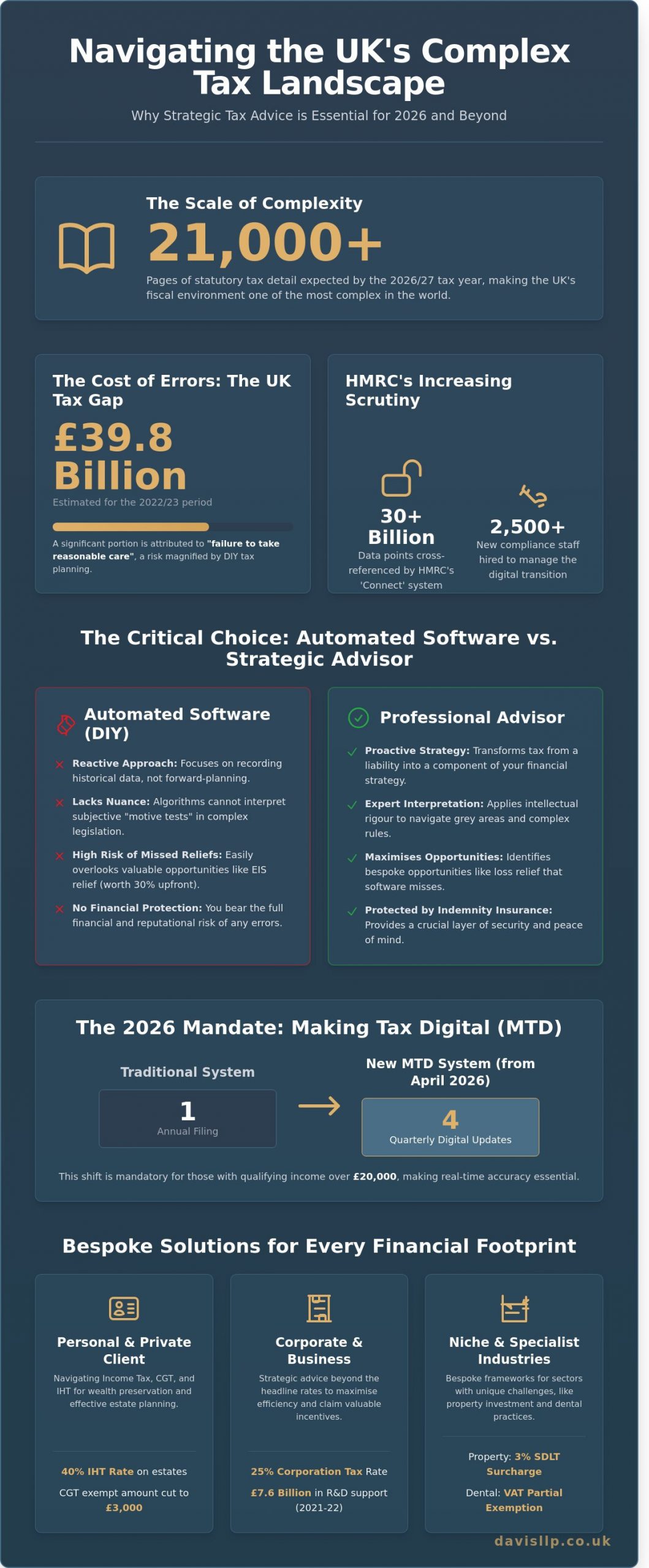
By the time the 2026/27 tax year begins, the UK’s tax legislation is expected to encompass over 21,000 pages of statutory detail, making it one of the most complex fiscal environments globally. It’s natural to feel concerned that shifting regulations might lead to inadvertent HMRC penalties or missed opportunities for wealth preservation. Securing high-calibre tax advice uk has become a fundamental requirement for those who value precision and wish to avoid the unnecessary costs of poor planning. We understand that your priority is to maintain compliance while ensuring your assets are managed with the utmost efficiency.
This guide offers a structured framework for identifying the professional support that best suits your unique circumstances. You’ll discover how a bespoke advisory partnership can transform tax from a source of anxiety into a manageable component of your broader financial strategy. We’ll outline the critical regulatory changes arriving in 2026 and provide a clear roadmap for optimising your tax position. Our aim is to provide you with the intellectual rigour and practical solutions needed for long-term stability.
Key Takeaways
- Understand the distinction between basic compliance and strategic consultancy to ensure your financial affairs are managed with professional foresight rather than mere reactivity.
- Identify the appropriate tier of support required for your specific financial footprint, from personal Income Tax planning to complex Inheritance Tax strategies.
- Recognise why automated software cannot replace professional tax advice uk, as expert interpretation remains essential for identifying bespoke opportunities within the Making Tax Digital framework.
- Evaluate potential partners by prioritising Chartered status and sector-specific expertise to ensure your advisor possesses the intellectual rigour necessary for your industry.
- Discover how a partnership grounded in heritage and understated confidence provides the stability and discretion required to navigate the UK’s evolving fiscal landscape.
Understanding the Role of Tax Advice in the UK
Professional tax advice in the UK represents a transition from retrospective compliance to forward-facing strategy. While a tax return preparer focuses on recording historical data to satisfy statutory obligations, a strategic consultant evaluates how current decisions influence future fiscal liabilities. We view this distinction as fundamental to wealth preservation. Effective tax advice uk doesn’t merely ensure you’re “legal”; it ensures your capital is structured with maximum efficiency.
The 2026 fiscal environment requires a more sophisticated approach than previous decades. HMRC’s “Connect” analytical system now cross-references over 30 billion data points, including bank interest, land registry records, and even social media. Relying on a partnership with an expert allows you to move away from the persistent anxiety of an unexpected enquiry. Instead, you gain the confidence that your affairs are robust and defensible. It’s about replacing uncertainty with a controlled, intellectual rigour.
Why “DIY” Tax Planning Often Falls Short
HMRC estimated the UK tax gap at £39.8 billion for the 2022/23 period, with a significant portion attributed to “failure to take reasonable care.” Basic accounting software often misses the nuance of complex personal or commercial structures. For instance, failing to correctly claim Enterprise Investment Scheme (EIS) relief can cost an investor 30% in upfront income tax relief. Professional indemnity insurance provides a layer of security that software cannot match. If a manual error occurs, you’re protected. Without it, the financial and reputational risks rest solely on your shoulders.
- Software algorithms lack the capacity to interpret subjective “motive tests” in anti-avoidance legislation.
- Missing a single Capital Gains Tax (CGT) allowance or relief can easily outweigh the cost of professional fees.
- Strategic advisors identify opportunities for “loss relief” that automated systems frequently overlook.
The 2026 Tax Landscape: A Brief Overview
The current climate is defined by unprecedented transparency. By April 2026, the final phase of Making Tax Digital (MTD) for Income Tax Self Assessment (ITSA) will be mandatory for those with qualifying income over £20,000. This shift requires quarterly digital updates rather than a single annual filing, making real-time accuracy essential. We’ve seen HMRC increase their compliance staff by 2,500 personnel to manage this transition. Tax advice is a proactive strategy for wealth preservation. It’s the difference between reacting to a legislative change and being prepared for it years in advance.
The Different Tiers of UK Tax Advisory Services
Personal tax advice focuses on the interaction between Income Tax, Capital Gains Tax (CGT), and Inheritance Tax (IHT). With the CGT annual exempt amount reduced to £3,000 as of April 2024, the margin for error has narrowed significantly. Strategic disposal of assets is no longer a luxury; it’s a necessity for capital preservation. Understanding the current tax brackets uk residents face is equally essential, particularly for high earners navigating the hidden 60% effective tax rate that triggers when income exceeds £100,000.
Corporate advisory moves beyond the 25% Corporation Tax headline rate. We look at R&D tax incentives, which provided £7.6 billion in support to UK companies in the 2021-22 period according to HMRC data. Navigating these incentives requires technical precision to ensure claims withstand HMRC’s increasingly rigorous enquiry process.
Niche industries require bespoke frameworks. Property investors, for instance, must account for the 3% Stamp Duty Land Tax (SDLT) surcharge on additional dwellings and the complexities of Annual Tax on Enveloped Dwellings (ATED). Similarly, dental practices face unique VAT partial exemption challenges that standard accounting firms often overlook.
Personal Wealth and Private Client Services
Effective estate planning ensures family assets transition across generations without being eroded by the 40% IHT rate. Trust tax services provide a robust mechanism for this protection. By utilising discretionary trusts, we manage the timing of income distributions to beneficiaries, often mitigating higher rate tax liabilities. Precise timing of asset disposals can save a client up to 6% in CGT on residential property by staying within the lower 18% bracket rather than the 24% upper rate. Understanding the inheritance tax gift rules uk is equally essential, as a structured gifting programme can significantly reduce the taxable value of your estate over time. With the forthcoming 2027 rule changes set to bring unused pension funds within the scope of IHT, understanding the full implications of inheritance tax on pensions is now a critical component of any comprehensive estate plan.
Business Advisory and Growth Acceleration
Strategic growth relies on the evolution from retrospective bookkeeping to proactive management accounting. This shift provides the clarity needed for cash flow management. It’s a vital component since 20% of UK small businesses fail in their first year due to liquidity issues according to Office for National Statistics data. VAT compliance is equally critical. As Making Tax Digital (MTD) becomes the standard for all VAT registered businesses, maintaining digital records is a statutory requirement that prevents costly penalties and protects your commercial reputation. For businesses managing payroll obligations alongside these changes, understanding the minimum wage 2025 thresholds and their 2026 implications is essential to avoiding HMRC underpayment penalties that can reach 200% of arrears.
Professional Advice vs. Automated Software
The rollout of Making Tax Digital (MTD) for Income Tax Self Assessment, scheduled for April 2026, has led some to believe that software has rendered professional consultation obsolete. This is a fundamental misunderstanding of the legislative landscape. While digital tools excel at capturing transactions, they lack the intellectual capacity to apply the nuances of the Taxes Act 1988 or subsequent Finance Acts to a client’s specific commercial context. Software organises data. An advisor interprets it.
For instance, a platform might record a property disposal, but it won’t necessarily identify the most efficient application of Private Residence Relief or the timing of a capital loss to offset a gain. At Davis & Co LLP, we view technology as a foundation, not the final architecture. We combine the efficiency of modern cloud accounting with the traditional professional gravitas required to manage complex HMRC enquiries. Our approach ensures that data is not merely processed but used as a strategic asset to protect your wealth.
Bespoke strategies are particularly vital for those with cross-border interests. Automated systems struggle with the intricacies of the Statutory Residence Test or the application of Double Taxation Agreements. These areas require a human element to navigate the conflict between different jurisdictions. We act as a strategic partner, ensuring your global tax footprint remains compliant yet efficient.
When Software Is Sufficient
Digital tools often suffice for individuals with a single source of PAYE income or those with very simple micro-businesses earning below the £30,000 MTD threshold. However, a clear tipping point occurs when a portfolio expands to include international assets or complex dividend structures. Automated systems cannot provide bespoke solutions for unique life events, such as a business exit or a high-value inheritance, where the tax implications are multifaceted. Relying solely on an algorithm during these transitions often results in missed relief opportunities.
The Strategic Value of a Chartered Certified Accountant
A Chartered Certified Accountant adheres to the rigorous ethical and technical standards set by professional bodies. This ensures a level of intellectual rigour that an algorithm cannot replicate. Beyond mere compliance, an advisor acts as a vital buffer between the client and HMRC during statutory investigations. Statistics from the 2023/24 tax year indicate that HMRC’s compliance yield reached £39.8 billion, highlighting the increased scrutiny on individual and corporate returns. Having a professional advocate is essential when seeking high-level tax advice uk residents can rely on. Software calculates what you owe, while an advisor plans what you keep.
How to Choose the Right UK Tax Advisor
Selecting a professional to provide tax advice uk is a decision that carries significant weight for your financial future. It’s not a simple procurement of a service; it’s the establishment of a strategic alliance. You should prioritise credentials that signify a commitment to the highest professional standards. Chartered status, granted by bodies such as the Institute of Chartered Accountants in England and Wales (ICAEW) or the Chartered Institute of Taxation (CIOT), ensures your advisor is bound by a strict code of ethics and continuous professional development. Statistics from 2024 indicate that 70% of tax-related penalties issued by HMRC could have been avoided through the oversight of a properly qualified professional.
Sector expertise is equally vital. A firm that understands the intricacies of the 2026 fintech landscape or the specific VAT nuances of international trade will provide far more value than a generalist. We believe in a partnership model that transcends transactional filings. This approach focuses on long-term reliability and foresight. Transparency in fees is the final pillar. The professional services market has moved away from the opaque hourly billing of the past. By 2026, fixed-fee structures for bespoke advisory packages have become the benchmark for trust and clarity.
Questions to Ask During an Initial Consultation
Inquire specifically about how the firm is preparing for the HMRC Making Tax Digital (MTD) expansion scheduled for April 2026. You need to know they’re ahead of the curve. Ask for bespoke examples of how they’ve handled challenges similar to yours, such as navigating the 2025 reforms to Capital Gains Tax. A proactive advisor won’t wait for you to call. They’ll have a defined approach to communication, perhaps through quarterly strategic reviews, to ensure your tax position remains optimised as legislation evolves.
Red Flags to Avoid in Tax Consultancy
Be cautious of any firm promoting “too good to be true” tax avoidance schemes. HMRC’s 2024 crackdown on promoters of such arrangements has led to a 15% increase in targeted audits for participants. If a firm lacks a physical UK presence or a clear, verifiable professional history, it’s a significant risk. Aggressive marketing often masks a lack of depth. We find that quiet excellence is a far more reliable indicator of success. A high-calibre advisor relies on their reputation and the precision of their work rather than loud, hyperbolic claims. Reliability is found in the details, not the sales pitch.
To ensure your financial affairs are managed with the precision they deserve, speak with our specialist tax partners today.
Bespoke Tax Solutions with Davis & Co LLP
Reliability and discretion form the bedrock of our practice. At Davis & Co LLP, we project a sense of quiet excellence that reflects our 125-year history. Since 1901, our firm has evolved from a traditional legal institution into a modern advisory powerhouse, providing the high-calibre tax advice uk residents and international stakeholders require. We don’t rely on aggressive marketing; instead, our reputation for professional gravitas speaks for itself. We view every client engagement as a composed partnership, where your financial security is our primary objective. Our longevity is a testament to our ability to adapt while maintaining the core values of integrity and meticulousness that our founders established over a century ago.
Our expertise is both broad and highly specialised. We support a diverse range of clients, from dental specialists managing complex practice structures to international family offices overseeing multi-generational wealth. This depth of experience allows us to transition you from a state of regulatory uncertainty to one of strategic clarity. We understand that tax isn’t merely a statutory obligation; it’s a critical component of your broader commercial and personal objectives. By identifying potential risks before they manifest as liabilities, we ensure that your financial decisions are backed by rigorous intellectual analysis and a deep understanding of current UK legislation.
Our Approach to International and Complex Tax
Managing cross-border financial interests requires a level of precision that only comes with decades of experience. We coordinate advice across multiple jurisdictions, ensuring that your global assets are structured efficiently and remain compliant with 2026 regulations. Our team acts as a central hub, synthesising complex information into actionable, pragmatic solutions for individuals and corporations alike. We handle the intricacies of double taxation treaties and offshore disclosures with the utmost discretion, particularly for clients managing assets exceeding £100,000 in foreign jurisdictions. For those managing assets across borders, our International Tax Planning Guide offers deeper insights into protecting your wealth from unnecessary exposure.
Securing Your Financial Future
True financial security isn’t found in reactive measures but in long-term, tailored strategies. We invite you to experience a partnership where your goals are met with intellectual rigour and a steady, deliberate rhythm. We provide the stability you need in a volatile fiscal environment, ensuring your legacy remains protected. Whether you’re coordinating corporate restructuring or personal inheritance planning, we offer the bespoke guidance necessary for success. It’s time to move beyond standard compliance and embrace a more strategic outlook. Contact Davis & Co LLP for bespoke tax advice and secure the professional tax advice uk partnership your finances deserve.
Securing Your Financial Position for 2026 and Beyond
Navigating the UK’s evolving fiscal landscape requires more than just standard software. While digital tools offer basic compliance, they often lack the strategic depth needed for complex private and commercial interests. Since 1901, Davis & Co LLP has provided the intellectual rigour required to manage sensitive financial matters with discretion. Our status as Chartered Certified Accountants ensures that every piece of tax advice uk clients receive is grounded in over 120 years of professional heritage. We specialise in high-stakes areas, including international tax structures and the specific nuances of dental practice accounting. Whether you’re managing a corporate portfolio or personal wealth, a bespoke approach ensures you remain compliant while optimising your position under current regulations. We invite you to consult Davis & Co LLP for tailored tax advice to discuss your specific requirements. Taking proactive steps today provides the stability your business and family deserve for the years ahead.
Frequently Asked Questions
How much does professional tax advice cost in the UK in 2026?
Professional fees for tax advice in the UK typically range from £200 to £600 per hour in 2026, depending on the complexity of your requirements. For standard compliance or a self-assessment filing, you might expect a fixed fee between £350 and £1,200. Complex structural planning or international wealth management naturally commands a higher investment. We find that early engagement often prevents costly errors that far exceed the initial advisory fee.
Do I need a tax advisor if I am a PAYE employee?
You generally won’t need a tax advisor if your only income is via PAYE and falls below the £150,000 threshold. However, if you’ve received benefits in kind, have rental income, or earned more than £10,000 in dividends, professional oversight becomes beneficial. HMRC’s data-matching capabilities in 2026 mean even minor discrepancies in your tax code can lead to unexpected liabilities that we can help you navigate.
What is the difference between a tax advisor and a chartered accountant?
A tax advisor focuses specifically on tax legislation and strategic planning, while a chartered accountant manages broader financial records and statutory audits. While many accountants provide tax services, a specialist tax advisor often holds the Chartered Tax Adviser (CTA) qualification, representing the highest level of tax expertise. This distinction is vital when you require bespoke advice on capital gains or complex inheritance tax matters rather than just year-end accounts.
Can a UK tax advisor help with international or offshore assets?
Yes, a UK tax advisor provides essential guidance on international assets, particularly concerning the Statutory Residence Test and double taxation treaties. With the 2026 updates to global transparency standards, it’s vital to ensure your offshore holdings are compliant with HMRC regulations. We help clients manage the tax implications of foreign property and overseas investments to ensure they’re protected from double taxation across multiple jurisdictions.
How can I check if a tax consultant is properly qualified?
You can verify a consultant’s credentials by searching the online registers of the Chartered Institute of Taxation (CIOT) or the Institute of Chartered Accountants in England and Wales (ICAEW). Qualified professionals will hold designations such as CTA or ACA. It’s wise to confirm their firm is registered for anti-money laundering supervision; this is a legal requirement for all tax practitioners operating in the UK market.
Will a tax advisor help me if HMRC starts an investigation?
A tax advisor provides robust representation and technical support if HMRC initiates an enquiry or a full investigation into your affairs. We act as your primary point of contact, managing all correspondence and negotiating settlements to ensure the process remains fair. Having expert tax advice uk during an investigation can reduce the risk of excessive penalties, which can reach 100% of the tax due in certain cases.
Is it worth paying for tax advice for a small business?
Small businesses often find that professional tax advice pays for itself through the identification of eligible reliefs like R&D tax credits or capital allowances. In 2026, small enterprises can save an average of £3,500 annually by correctly structuring their VAT and corporation tax obligations. Beyond simple savings, a strategic partnership ensures your business remains compliant with the latest statutory changes, allowing you to focus on commercial growth.
What information should I prepare before meeting a tax advisor?
You should gather your P60 or P45, records of all dividend payments, and statements for any interest earned during the tax year. If you’ve sold assets, bring details of the original purchase price and the disposal value to calculate potential capital gains. Providing these documents in a clear, organised format allows us to deliver more precise advice and reduces the time spent on administrative data entry during our consultation. With an estimated 2.7 million savers now facing unexpected tax charges on their interest income, understanding the HMRC tax warning for 2026 regarding savings interest is particularly relevant when preparing your financial records for review.