Did you know that HMRC collected a record £7.5 billion in Inheritance Tax during the 2023/24 financial year, a figure driven largely by families who failed to account for the inheritance tax gift rules uk? It’s natural to feel a sense of trepidation when considering the transfer of significant assets, particularly with the looming threat of double taxation or the complexities of taper relief calculations. You likely want to ensure your children benefit from your success without triggering a stressful HMRC investigation into your estate’s affairs.
We’ve developed this guide to provide the intellectual rigour and practical strategy needed to protect your family’s legacy. Clarity is your best defence. You’ll gain a clear understanding of current tax-free thresholds and learn how to implement a bespoke gifting programme that doesn’t compromise your own long-term financial security. We’ll explore the statutory exemptions available in 2026, the specific mechanics of potentially exempt transfers, and the precise steps required to ensure your estate remains fully compliant while minimising unnecessary liabilities.
Key Takeaways
- Understand how the Nil Rate Band and Residence Nil Rate Band interact to establish the foundational thresholds for your taxable estate.
- Navigate the complexities of the inheritance tax gift rules uk to ensure lifetime transfers are structured correctly within the statutory seven-year framework.
- Learn to effectively utilise annual and small gift exemptions to incrementally reduce your future liability without incurring immediate tax implications.
- Discover the strategic benefits of the “normal expenditure out of income” rule as a sophisticated tool for regular, tax-efficient wealth transfer.
- Recognise the importance of a bespoke estate planning strategy to ensure your legacy is protected through precise and legally robust professional advice.
The Framework of UK Inheritance Tax and Gifting in 2026
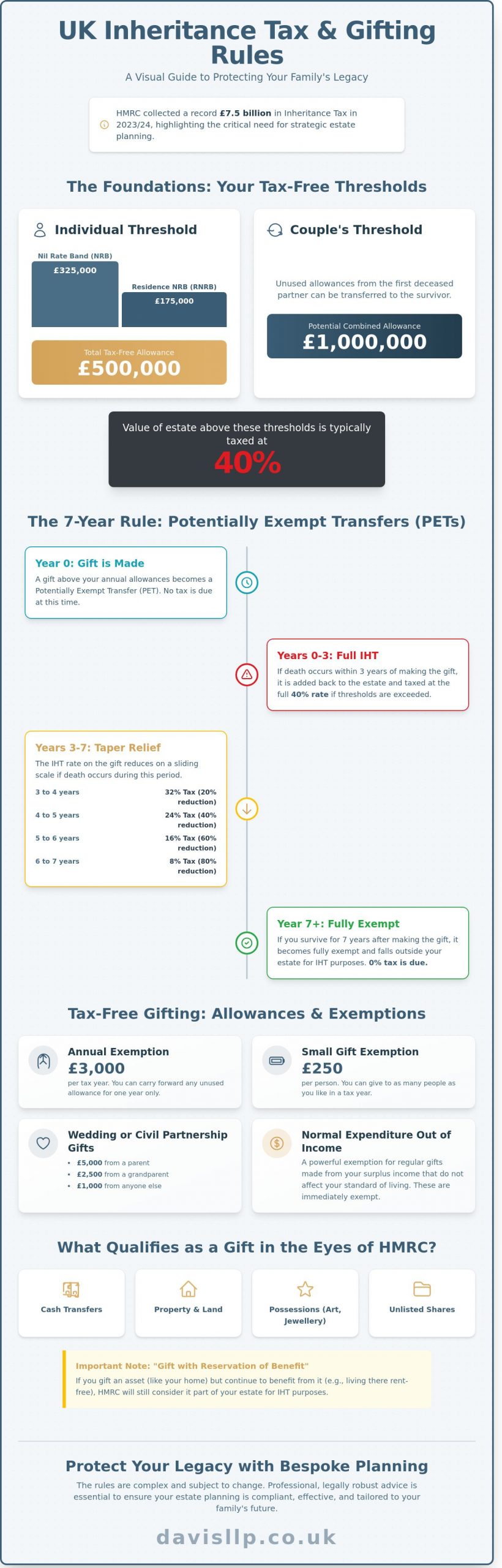
Inheritance Tax (IHT) is the charge levied on the value of a person’s estate upon their death. This includes all property, cash, and personal possessions held at the time of passing. For the 2025/26 tax year, the standard Nil Rate Band (NRB) remains at £325,000. Additionally, the Residence Nil Rate Band (RNRB) offers an extra £175,000 when a primary home is bequeathed to direct descendants. Combined, these allowances can reach £500,000 for an individual or £1 million for a surviving spouse or civil partner. The UK Inheritance Tax Framework dictates how these thresholds apply to the total value of an estate. Effective wealth management often involves using the inheritance tax gift rules uk to mitigate the 40% tax rate applied to assets exceeding these limits.
We distinguish between two primary categories of transfers: exempt gifts and Potentially Exempt Transfers (PETs). Exempt gifts, such as the £3,000 annual allowance, are immediately removed from the estate. PETs are gifts that exceed these small allowances. They only become fully exempt from tax if the donor survives for seven years following the date of the gift. If death occurs within this period, the gift is added back to the estate’s value, though taper relief may apply after year three.
Why is Gifting Central to Estate Planning?
Proactive gifting reduces the 40% tax liability on assets exceeding the combined £500,000 threshold. It’s a pragmatic way to facilitate wealth transfer. Beyond the financial logic, there’s a profound psychological benefit. Clients often find satisfaction in seeing their children or grandchildren utilise an inheritance for a first home or education while they’re still present to witness it. The seven-year rule makes early action vital. If a donor passes away within three years of a gift, the full 40% rate applies. Between three and seven years, taper relief reduces the tax on a sliding scale. Starting this process early ensures that more of your wealth reaches your beneficiaries rather than the Treasury.
What Qualifies as a Gift in the Eyes of HMRC?
HMRC defines a gift as anything that has a value, including cash, physical assets, or a loss in value to your estate. For instance, if a parent sells a property worth £400,000 to a child for £250,000, the £150,000 difference is treated as a gift. We must also consider the “gift with reservation of benefit” rule. This prevents individuals from gifting a home while continuing to live in it rent-free; in such cases, HMRC still counts the property as part of the estate. The valuation of non-cash assets requires a bespoke assessment to ensure compliance with current market rates and statutory requirements.
- Cash transfers: Direct payments to individuals or trusts.
- Property: Transferring ownership of land or buildings.
- Possessions: Gifting jewellery, art, or vehicles.
- Unlisted shares: Transferring business interests that aren’t on a public exchange.
Understanding the inheritance tax gift rules uk allows for a structured approach to legacy planning. We focus on ensuring that every transfer is documented and compliant with current regulations to protect your family’s financial future.
The Seven-Year Rule: Understanding Potentially Exempt Transfers
The mechanism of a Potentially Exempt Transfer (PET) is a cornerstone of strategic estate planning. It allows you to transfer assets during your lifetime without an immediate tax charge. These transfers only achieve full tax-exempt status if you survive for a period of seven years from the date the gift was made. If you pass away within this timeframe, the gift is retrospectively added to your estate’s value, potentially triggering a 40% tax liability. Understanding the nuances of the Official Inheritance Tax Gift Rules is vital for anyone looking to pass on wealth effectively.
When a donor dies within the seven-year window, the gift is tested against the Nil Rate Band first. If the gift’s value remains within the current £325,000 threshold, it may not incur a direct tax charge, but it will reduce the allowance available for the rest of the estate. It’s a common misconception that all gifts are instantly subject to tax upon death; the reality depends heavily on the chronological order of your lifetime giving. We often find that a bespoke review of your gifting history can provide the clarity needed to avoid unexpected liabilities for your beneficiaries.
How Does Taper Relief Work?
Taper relief provides a sliding scale of tax reduction for gifts made between three and seven years before death. It’s essential to recognise that this relief only applies to gifts that exceed the £325,000 Nil Rate Band. It doesn’t reduce the value of the gift itself, but rather lowers the tax rate applied to it. If death occurs within three years, the full 40% rate applies. Between years three and four, the rate drops to 32%. This continues to decrease to 24% in year five, 16% in year six, and 8% in year seven. By the time seven years have passed, the tax rate effectively becomes 0%.
The Importance of Record-Keeping for PETs
Meticulous record-keeping is a pragmatic necessity for every donor. Your executors are legally responsible for reporting lifetime gifts to HMRC during the probate process, and a lack of documentation can lead to protracted disputes or overpayment of tax. We recommend maintaining a formal “gift log” that captures specific data points for every transfer. This log should include the exact date of the transfer, the precise financial value, the recipient’s full details, and the source of the funds used. Clear records ensure that the inheritance tax gift rules uk are applied accurately, protecting your family from the stress of an HMRC investigation years after the gift was made. Accurate figures and dated bank statements serve as the ultimate evidence of your intentions.
Tax-Free Allowances: Navigating Annual and Small Gift Exemptions
Effective estate planning requires a precise understanding of the various exemptions that allow for the immediate transfer of wealth without incurring a future tax liability. The most significant of these is the Annual Exemption, which permits individuals to give away a total of £3,000 each tax year. If this allowance is not fully utilised, the remaining balance can be carried forward for exactly one year, providing a brief window to maximise its impact. This mechanism ensures that a portion of your estate is removed from the IHT calculation immediately, regardless of when the gift was made. It’s a foundational tool for those looking to reduce their taxable estate incrementally.
The Small Gift Allowance offers a separate route for smaller tokens of appreciation. You can give up to £250 per person to as many individuals as you wish during a tax year. However, statutory restrictions prevent you from combining this with other exemptions for the same beneficiary. You cannot, for instance, give a child £3,250 by combining both allowances. For those looking for the definitive UK Government Inheritance Tax Gift Rules, these distinctions are vital for ensuring compliance. Gifts to qualifying UK charities and political parties also remain entirely tax-free, reflecting a policy that encourages philanthropic and civic support without penalising the donor’s estate.
Maximising the Annual Exemption
Couples often find strategic value in pooling their allowances. By coordinating their giving, a married couple or civil partners can distribute £6,000 annually. This figure rises to £12,000 if neither partner utilised their exemption in the preceding tax year. We recommend prioritising these gifts to beneficiaries who aren’t intended to receive larger, potentially exempt transfers (PETs) to keep the tax record clear. This structured approach helps in maintaining a transparent audit trail for HMRC, ensuring that every pound gifted is accounted for under the correct exemption category.
Gifts for Weddings and Civil Partnerships
Special provisions apply to gifts made on the occasion of a wedding or civil partnership. These transfers must occur on or shortly before the ceremony to qualify. The permitted amounts are strictly tiered: £5,000 for a gift to a child, £2,500 for a grandchild or great-grandchild, and £1,000 for any other individual. Unlike the seven-year rule that governs larger transfers, these are classified as “exempt” gifts. This means they are excluded from the estate from day one. Understanding these inheritance tax gift rules uk ensures that significant family milestones don’t create unintended tax burdens for the next generation. We suggest keeping a dated record of the ceremony and the relationship to the recipient to satisfy future HMRC enquiries.
Advanced Gifting: Normal Expenditure out of Income and Trusts
While standard annual exemptions provide a foundational strategy, sophisticated estate planning often requires more robust mechanisms. The “Normal Expenditure out of Income” rule remains one of the most effective yet underutilised provisions within the inheritance tax gift rules uk. Unlike Potentially Exempt Transfers (PETs), which require the donor to survive seven years for the gift to leave their estate, these specific transfers are exempt from the moment they’re made.
The “Normal Expenditure out of Income” Exemption
This exemption serves as a vital tool for individuals with surplus annual earnings. To satisfy HMRC, a gift must meet three strict criteria. It must be regular, it must come from post-tax income rather than capital assets, and the donor must retain enough income to maintain their usual standard of living. We often see this applied through the payment of £15,000 annual school fees for a grandchild or a recurring £1,000 monthly contribution into a child’s pension. Success depends entirely on the quality of your evidence. HMRC utilises Form IHT403 to scrutinise these claims. Without a clearly documented “settled pattern” of giving, the exemption may be challenged during probate, potentially leading to an unexpected 40% tax bill on those sums. For high earners navigating both income and estate tax obligations simultaneously, understanding the tax brackets uk residents face in 2026 is equally essential to ensuring your surplus income calculations remain accurate.
Using Trusts for Controlled Gifting
Trusts offer a strategic alternative for those who wish to reduce their taxable estate while maintaining a degree of oversight. When you transfer assets into a Discretionary Trust, the transaction is classified as a Chargeable Lifetime Transfer (CLT). If the value of the gift exceeds the current £325,000 Nil Rate Band, a 20% entry tax charge is triggered immediately. This contrasts with a Bare Trust, where the beneficiary has an absolute right to the capital and income at age 18 in England and Wales, making the gift a PET for tax purposes.
Choosing between these structures requires a pragmatic assessment of your family’s needs. A Discretionary Trust provides flexibility, allowing trustees to decide how and when funds are distributed. This is essential for protecting assets from a beneficiary’s potential divorce or bankruptcy. For simpler requirements, a Bare Trust might suffice, though it lacks the long-term protection of more complex arrangements. We provide bespoke trust structuring services to ensure your gifts align with your broader commercial and personal objectives.
Bespoke Estate Planning: Why Professional Advice is Essential
Effective estate planning is never a generic exercise. While the statutory thresholds provide a framework, your personal financial landscape requires a tailored strategy that accounts for family dynamics, liquidity needs, and long term security. Relying on a “one size fits all” approach often overlooks the nuances of the inheritance tax gift rules uk, potentially exposing your beneficiaries to a 40% tax charge on assets you intended to protect.
Davis & Co LLP serves as a strategic partner in this process. We move beyond simple calculations to provide a comprehensive analysis of your estate. DIY planning carries significant risks; a single misstep in documenting a gift or failing to account for the “gift with reservation of benefit” rules can lead to protracted legal challenges or unexpected HMRC assessments. We ensure every transfer is compliant and aligns with your broader commercial objectives.
A holistic view is vital. It’s not just about reducing a tax bill; it’s about balancing the desire to help the next generation with the practical necessity of funding your own future care. With UK care home costs often exceeding £50,000 per annum in many regions, we help you determine exactly how much you can afford to give away without compromising your own standard of living. This comprehensive view must also account for the inheritance tax on pensions rule changes arriving in April 2027, which will bring most unused pension funds within the scope of IHT and fundamentally alter how retirement savings factor into your overall estate value.
The Role of a Chartered Certified Accountant
Our approach begins with a forensic analysis of your entire financial position. We identify the most efficient gifting strategies by examining your income, capital gains exposure, and available exemptions. For clients with global interests, we provide specialised expertise in international tax planning. This is crucial for those holding assets in multiple jurisdictions where conflicting tax treaties may apply. Engaging expert tax advice uk professionals recommend ensures that your estate planning strategy remains aligned with the latest 2026 legislative changes across all relevant jurisdictions.
We pride ourselves on the “quiet excellence” we bring to sensitive family discussions. Wealth transition is often an emotional subject; our role is to provide a calm, objective presence. We facilitate these conversations with discretion, ensuring that all parties understand the technical implications of the chosen strategy while maintaining family harmony.
Next Steps: Organising Your Legacy
The path to a secure legacy starts with a structured consultation. We begin with a detailed asset review, followed by a bespoke implementation plan that addresses your specific goals. This process is not a singular event. Legislation evolves, as seen in recent fiscal statements, and your personal circumstances will inevitably change over time. We recommend a formal review of your estate plan at least every two years to ensure it remains robust.
If you’re ready to secure your family’s future, we invite you to contact us for a bespoke tax review. Our team will help you navigate the complexities of the inheritance tax gift rules uk with precision and professional gravitas, ensuring your legacy is preserved exactly as you intend.
Protecting Your Family’s Wealth in a Shifting Regulatory Landscape
Navigating the inheritance tax gift rules uk requires more than just a basic awareness of the seven-year timeline; it demands a proactive approach to the £3,000 annual exemption and the strategic use of trusts. Since 1901, Davis & Co LLP has assisted families in managing complex international and domestic tax obligations with discretion and precision. Effective planning isn’t a one-time event. It’s a continuous process of refinement that adapts to your changing circumstances and the evolving 2026 legislative framework.
Whether you’re utilising the normal expenditure out of income rule or establishing a bespoke trust structure, the nuances of these regulations mean that early action is your most effective safeguard. You can secure your family’s future with a bespoke tax planning consultation from Davis & Co LLP to ensure your estate remains resilient and your legacy is protected. Our Chartered Certified Accountants provide the professional gravitas and technical expertise needed to handle these sensitive matters with the care they deserve. We’re here to help you move forward with confidence.
Frequently Asked Questions
What is the 7-year rule for inheritance tax in the UK?
The 7-year rule dictates that most gifts made to individuals are classed as Potentially Exempt Transfers, meaning they only become fully exempt from tax if the donor survives for seven years from the date of the gift. If death occurs within this period, the gift’s value is integrated back into the estate for the calculation of inheritance tax gift rules uk liabilities. This timeframe ensures that substantial lifetime transfers aren’t used solely to circumvent the 40% tax rate applicable to estates exceeding the £325,000 nil-rate band.
Can I give £3,000 to each of my children tax-free every year?
You can’t give £3,000 to each child tax-free; rather, you possess a single £3,000 annual exemption that applies to the total of all gifts made in a tax year. While you can divide this £3,000 between multiple children, any amount exceeding this threshold becomes a Potentially Exempt Transfer. You may also carry forward any unused portion of the previous year’s £3,000 allowance, but this is limited to one tax year only.
How does taper relief work on gifts made before death?
Taper relief reduces the tax rate payable on gifts that exceed the £325,000 nil-rate band if the donor dies between three and seven years after making the transfer. The relief doesn’t reduce the value of the gift itself; instead, it lowers the 40% tax rate in stages, dropping to 32% at three years and reaching 8% by year six. This sliding scale offers a pragmatic reduction for those who’ve begun their estate planning but pass away before the full seven-year period concludes.
Do I have to pay tax on money given to me as a wedding gift?
You won’t pay tax on wedding gifts provided they fall within specific statutory limits based on the donor’s relationship to the couple. Parents can give up to £5,000, grandparents can provide £2,500, and any other individual can gift £1,000 per person without incurring a tax liability. These gifts must be made on or shortly before the ceremony to qualify under the current 2026 HMRC guidelines.
What qualifies as “normal expenditure out of income” for IHT purposes?
Normal expenditure out of income allows you to make regular gifts of any size tax-free, provided they’re paid from your surplus post-tax income and don’t reduce your standard of living. To qualify for this exemption, you must demonstrate a consistent pattern of giving, such as monthly contributions to a grandchild’s school fees or annual insurance premiums. HMRC requires detailed evidence that these payments didn’t necessitate a withdrawal from your capital or savings.
Are gifts to charities exempt from UK Inheritance Tax?
Gifts made to UK-registered charities or qualifying political parties are entirely exempt from Inheritance Tax regardless of the amount. If you choose to leave at least 10% of your net estate to charity in your will, the standard Inheritance Tax rate on the remainder of your assets falls from 40% to 36%. This strategic provision encourages philanthropic giving while offering a tangible reduction in the overall tax burden for your beneficiaries.
What happens if I give away my house but continue to live in it?
If you gift your home but continue to reside there, HMRC views this as a gift with reservation of benefit, meaning the property remains part of your estate for tax purposes. To avoid this, you must pay a full market rent to the new owner, which is reviewed regularly to ensure it remains at a commercial level. Without this rent, the 7-year rule doesn’t begin to apply, and the house’s full market value at the time of your death will be subject to the 40% tax rate.
How should I keep records of the gifts I make for HMRC?
We recommend maintaining a precise log of all lifetime transfers, including the date of the gift, the recipient’s identity, and the specific value transferred. You should keep these records alongside your bank statements and tax returns for at least seven years, though holding them indefinitely provides greater security for your executors. Clear documentation is vital for proving that certain payments were made from surplus income rather than capital, ensuring your estate benefits from every available exemption.