Could the annual audit be the most significant tool in your charity’s strategic arsenal, rather than just a regulatory burden? You likely recognize that maintaining the delicate balance between operational impact and the Charity Commission’s rigorous reporting standards is a constant pressure for trustees. Securing high-quality assurance services for non-profits is often the difference between a reactive struggle and a proactive demonstration of integrity. It’s about transforming a statutory necessity into a clear signal of reliability to your stakeholders.
We understand that the complexities of UK law can feel opaque, especially since over 169,000 registered charities must navigate these requirements to maintain public trust. This guide provides the clarity you need to master financial reporting, from independent examinations to complex audits, ensuring your organisation remains beyond reproach. We will explore the nuances of current compliance, the strengthening of internal controls, and how robust governance directly influences your standing with major grant-makers and the public.
Key Takeaways
- Discern the specific statutory thresholds that dictate whether your organisation requires a full audit or a less intensive independent examination under UK regulations.
- Recognise how internal control assessments serve as a vital safeguard, identifying systemic vulnerabilities before they impact your charitable objectives.
- Explore how professional assurance services for non-profits uphold the integrity of your financial reporting, thereby protecting your essential “public benefit” status.
- Implement a structured preparation timeline to facilitate a seamless engagement, ensuring your year-end documentation is robust and the administrative burden is minimised.
- Understand the value of a bespoke approach to governance that integrates technical rigour with a pragmatic appreciation for the unique challenges of the third sector.
Understanding Assurance Services for Non-Profits in the UK
In the UK third sector, assurance is defined as an independent professional evaluation designed to improve the quality of information for decision-makers. It’s a process that goes beyond a standard audit, offering a formal conclusion about a specific subject matter, such as financial statements, internal controls, or regulatory compliance. Understanding Assurance Services is essential for trustees who must demonstrate that their organisation operates with integrity and transparency. This external validation is vital for maintaining “public benefit” status under the Charities Act 2011, as it proves that assets are applied solely for charitable purposes rather than private gain.
Primary stakeholders in this process include the Charity Commission for England and Wales, the Office of the Scottish Charity Regulator (OSCR), and HMRC. Major donors, particularly those providing grants exceeding £25,000, increasingly require assurance services for non-profits to mitigate their own financial risks. As we approach 2026, the regulatory landscape is shifting toward more granular reporting. Organisations must prepare for heightened scrutiny as the public demands greater accountability for how every pound is spent. We believe that proactive engagement with these standards is the most effective way to protect a charity’s reputation and operational longevity.
The Purpose of Independent Financial Oversight
Establishing credibility with corporate partners and institutional funders is a primary driver for seeking independent oversight. When a charity enters a high-value partnership, a robust assurance report acts as a badge of reliability. It gives trustees the necessary confidence to make long-term strategic decisions, knowing the underlying financial data is accurate and verified. This is particularly critical for the management of restricted funds. If a donor provides £50,000 for a specific community project, assurance ensures these funds aren’t diverted to general administrative costs. This level of precision prevents legal disputes and maintains the trust of the philanthropic community.
Regulatory Bodies and Compliance Frameworks
The Charity Commission and OSCR serve as the principal regulators, ensuring that the 168,000 registered charities in England and Wales adhere to statutory requirements. Central to this compliance is the Charities Statement of Recommended Practice (SORP), which dictates how non-profits must prepare their annual accounts. The SORP 2026 framework modernises charitable reporting standards to improve transparency and ensure financial statements accurately reflect the complex operational realities of modern non-profits. By aligning with these evolving standards, organisations can provide a clear, bespoke narrative of their impact and financial health to all interested parties. Professional assurance services for non-profits ensure that these complex frameworks are applied with the intellectual rigour required for full compliance.
Audit vs. Independent Examination: Choosing the Right Level of Assurance
Determining the appropriate level of scrutiny for your charity’s accounts is a pivotal decision for trustees. While the primary goal is to ensure transparency, the path chosen depends heavily on statutory requirements and the organisation’s strategic goals. Professional assurance services for non-profits provide the clarity needed to navigate these choices, ensuring that your financial reporting aligns with both legal obligations and stakeholder expectations.
When is a Statutory Audit Mandatory?
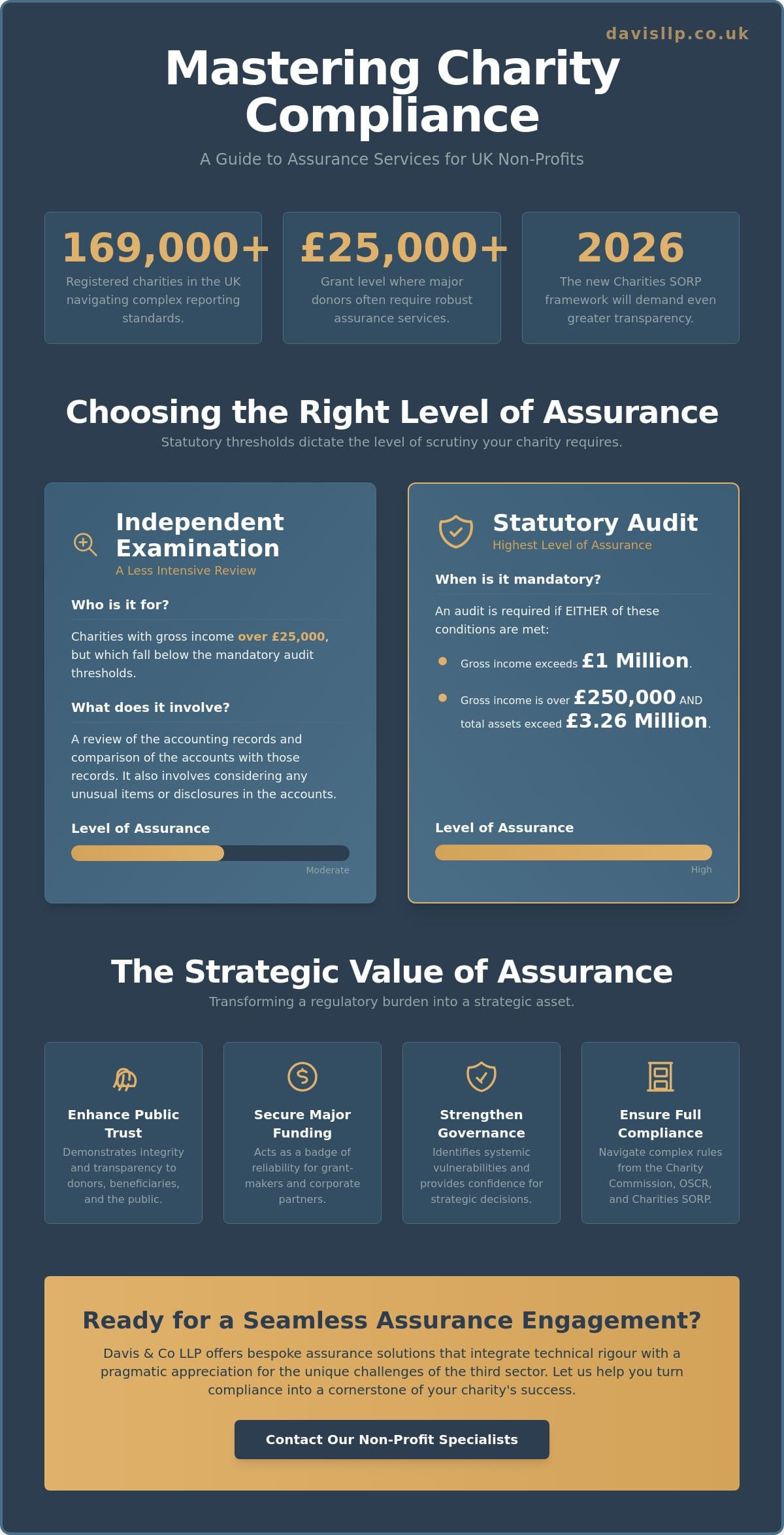
The Charities Act 2011 dictates strict thresholds for mandatory audits. A charity must undergo a full statutory audit if its gross income exceeds £1 million for the financial year. Alternatively, an audit becomes compulsory if gross income is above £250,000 and the aggregate value of its assets, before liabilities, exceeds £3.26 million. These rules apply to both charitable companies and unincorporated associations, though companies must also remain mindful of Companies Act 2006 requirements. We find that many organisations approaching these limits benefit from early preparation to avoid the administrative pressure of a sudden transition to higher scrutiny. This preparation is a core component of maintaining UK Compliance and Trust within the sector.
The Benefits of an Independent Examination
For charities that fall below the £1 million income threshold, an independent examination offers a pragmatic alternative. It’s less onerous than a full audit but still provides a robust level of external scrutiny. The examiner’s role is to review the accounting records and identify any “matters of material significance” that must be reported to the Charity Commission. This process is particularly cost-effective for mid-sized charities, allowing them to redirect resources toward their core mission. It’s often beneficial to combine this review with expert tax advice in the UK to ensure that Gift Aid claims and VAT positions are fully optimised.
Some trustees choose a voluntary audit even when they don’t meet the statutory triggers. This is often a strategic move to satisfy the requirements of major grant funders or to provide additional comfort to high-net-worth donors. A full audit offers a higher level of assurance than an examination because it involves testing the underlying data and systems rather than just reviewing the accounts. While the costs are higher, the resulting “clean” audit report can be a powerful tool for securing future investment. We work closely with boards to weigh these costs against the potential for increased funding. If you’re uncertain which path suits your current growth trajectory, our team can provide a bespoke assessment of your assurance services for non-profits requirements.
Beyond Compliance: The Strategic Value of Internal Control Assessments
Internal controls function as the first line of defence against financial mismanagement and operational drift. While many organisations view these assessments as a mandatory hurdle, proactive leaders recognise them as a tool for identifying systemic weaknesses before they escalate into reputational crises. High-quality assurance services for non-profits provide a forensic look at how funds move through the organisation, ensuring that every pound remains aligned with the core mission.
A frequent concern among smaller teams is that the assurance process will prove too disruptive or resource-intensive. We’ve found that the opposite is true. A bespoke assessment identifies inefficiencies that actually save time in the long term. For global NGOs, these robust controls are the foundation for successful international tax planning. Without clear internal oversight, managing cross-border tax liabilities becomes unnecessarily complex and carries significant financial risk.
Mitigating Financial and Reputational Risk
Risk often hides in routine processes. Errors in Gift Aid claims can lead to substantial repayments to HMRC, while poorly monitored grant disbursements may result in funding being clawed back. Effective assurance examines these areas, alongside payroll accuracy, to ensure compliance with the Charity Commission guidance on risk management. We place specific emphasis on the segregation of duties; it’s a simple yet vital mechanism where no single individual has total control over a financial transaction. Beyond safety, an unqualified assurance report serves as a powerful marketing tool. It demonstrates to major donors and institutional grant-makers that your organisation is a low-risk, high-impact investment.
Supporting Trustee Governance and Fiduciary Duties
Trustees hold ultimate legal responsibility for a charity’s financial health. Under UK law, failure to exercise due diligence can lead to personal liability for board members in extreme cases. Professional assurance acts as a protective buffer, providing trustees with the objective data they need to fulfil their fiduciary duties with confidence. The process culminates in a management letter that provides a strategic roadmap for improvement, allowing the board to address specific vulnerabilities with precision.
Preparing Your Organisation for a Seamless Assurance Engagement
Preparation isn’t just a matter of administrative compliance; it’s a strategic choice to protect your team’s time and resources. By establishing a clear timeline, you reduce the “audit burden” that often disrupts daily operations. We recommend beginning your year-end closing procedures at least 60 days before your reporting date. This lead time allows for the reconciliation of complex restricted funds and ensures that all supporting evidence is readily available for review. A culture of transparency throughout the financial year ensures that when assurance services for non-profits commence, there are no hidden surprises that could delay the process.
The 9-month deadline for filing with the Charity Commission for England and Wales provides a hard limit, but aiming for an earlier completion date builds institutional resilience. It’s better to address queries in May than to scramble in October. This proactive approach transforms the engagement from a stressful hurdle into a routine validation of your organisation’s integrity.
The Essential Documentation Checklist
Having a structured repository of information is vital for a smooth process. Digital accounting software now plays a central role in this preparation. Roughly 75% of UK charities have moved to cloud-based systems like Xero or QuickBooks to maintain real-time oversight. Your documentation should include:
- Bank reconciliations: Fully balanced statements for all accounts held at the year-end.
- Restricted fund ledgers: Clear evidence of how specific grants were spent, ensuring compliance with donor intentions.
- Trustee minutes: Records of board meetings that authorise significant financial decisions or strategic shifts.
Staff should be prepared for walkthroughs of your financial systems. These interviews allow the advisor to understand the practical application of your internal controls. It’s not an interrogation; it’s a collaborative effort to ensure your systems are robust enough to prevent fraud or error.
Selecting a Specialist Non-Profit Advisor
Choosing the right partner is perhaps the most critical decision in the assurance cycle. Generalist firms often lack the nuanced understanding required to interpret the Charities SORP (Statement of Recommended Practice) under FRS 102. A specialist advisor understands that a non-profit’s “profit” is actually a reinvestment into its mission. When beginning the selection of a chartered accountant, ask about their experience with organisations of your specific size and sub-sector.
Evaluate the firm’s commitment to the sector’s values. You need a partner who views assurance services for non-profits as a tool for growth, not just a statutory box-ticking exercise. They should offer bespoke solutions that reflect your unique operational challenges. This alignment ensures the advice you receive is pragmatic, intellectual, and grounded in the realities of the third sector.
Bespoke Assurance Solutions: The Davis & Co LLP Approach
Davis & Co LLP operates on a foundation of quiet excellence. We understand that for third-sector organisations, reputation is the most valuable asset. Our approach to assurance services for non-profits isn’t merely about ticking statutory boxes; it’s about providing a steady, professional hand that allows trustees to focus on their core mission. We bring a sense of gravitas to every engagement, ensuring that your financial oversight reflects the seriousness of your charitable objectives.
We integrate these services with broader small business accounting principles. This ensures that even the most complex non-profit remains agile and compliant. We treat each organisation as a unique entity, providing pragmatic advice that balances regulatory requirements with operational efficiency. Our goal is to create a sense of order and intellectual rigour that reinforces your organisation’s credibility with donors, regulators, and the public alike.
Our Methodology: Precision and Discretion
We begin by immersing ourselves in the operational reality of your organisation. Whether you manage a local community trust or a complex, cross-border structure with international branches, our team applies the same level of intellectual rigour. We don’t delegate your security to junior staff. Every client benefits from consistent senior partner involvement. This ensures continuity of service and a deep understanding of your specific history. This level of discretion is vital when handling sensitive donor data or multi-jurisdictional compliance issues. We focus on the nuance of your operations, ensuring our assurance services for non-profits are as precise as they are unobtrusive.
Securing Your Organisation’s Future
Transitioning from compliance-led oversight to strategy-led assurance provides a distinct advantage. It moves the conversation from retrospective reporting to proactive risk management. A long-term relationship with a trusted advisor means your organisation is prepared for future regulatory shifts. With the Charity Commission overseeing more than 168,000 registered charities in England and Wales as of 2023, maintaining high standards isn’t optional; it’s a prerequisite for survival. We invite trustees to enter a composed partnership with us, focused on the long-term health of your mission. If you require a high-calibre review of your current standing, we offer a confidential consultation to discuss your requirements and how we might support your strategic objectives.
Securing Your Mission Through Proactive Financial Oversight
Navigating the distinction between a full statutory audit and an independent examination is essential for maintaining trust with the Charity Commission and your stakeholders. Effective assurance services for non-profits do more than satisfy regulatory mandates; they provide a rigorous assessment of internal controls that protects your charitable assets from unforeseen risks. By preparing early and maintaining meticulous records, your board can transform a standard compliance requirement into a valuable strategic advantage.
At Davis & Co LLP, we draw upon over 120 years of heritage as Chartered Certified Accountants to provide bespoke advisory services tailored to complex and international non-profit structures. Our approach is one of composed partnership, ensuring your financial reporting remains beyond reproach while you focus on delivering your core mission. We invite you to discuss your non-profit assurance requirements with our specialist partners to ensure your organisation remains resilient and compliant. Securing your organisation’s financial integrity today ensures a more impactful tomorrow for the communities you serve.
Frequently Asked Questions
What is the difference between an audit and an independent examination for a charity?
An audit provides a high level of assurance by confirming whether financial statements offer a true and fair view of the organisation’s affairs. In contrast, an independent examination is a less extensive process that checks for specific issues such as accounting inconsistencies. Under the Charities Act 2011, charities with an annual income exceeding £1 million must undergo a full audit; those with income between £25,000 and £1 million may opt for an independent examination.
Does our non-profit need an audit if we’re not a registered charity?
Your organisation may still require an audit if it’s registered as a company limited by guarantee under the Companies Act 2006. Non-profits must seek an audit if they meet two of three criteria: an annual turnover above £10.2 million, total assets exceeding £5.1 million, or more than 50 employees. We find that many organisations choose voluntary audits to satisfy lenders or provide stakeholders with additional confidence in their financial stewardship.
How much do assurance services for non-profits typically cost in the UK?
Costs for these services vary based on the size of the organisation and the complexity of its transactions. Independent examinations for small charities often range from £750 to £2,500. Full statutory audits for medium-sized non-profits typically start at £5,000 and can exceed £15,000 for complex entities. These figures reflect market rates for qualified professionals who ensure compliance with the Statement of Recommended Practice (SORP) and provide bespoke advice.
Can our treasurer perform the independent examination for our organisation?
No, the examiner must be entirely independent of the charity’s management and trustees to avoid conflicts of interest. Charity Commission guidance CC32 stipulates that the examiner cannot be a trustee, an employee, or a close relative of anyone in a leadership role. This ensures the scrutiny remains objective. It’s essential that the individual possesses the required skills; if the charity’s income exceeds £250,000, they must hold a professional qualification from a recognised body.
What happens if our assurance report identifies a material financial error?
If an auditor or examiner discovers a material error, they’ll include a qualified opinion or a specific comment in their report. They’re also legally obligated to report “matters of material significance” to the Charity Commission or relevant regulator. This process occurred in 13% of cases reviewed by the Commission in its 2023 monitoring report. We work with clients to rectify these issues through improved internal controls before they escalate into formal regulatory investigations.
How often should a non-profit review its internal financial controls?
Trustees should conduct a formal review of their internal financial controls at least once every 12 months. This annual assessment ensures that safeguards against fraud and error remain effective as the organisation grows. The Charity Commission’s CC8 guidance highlights that robust controls protect charitable assets and maintain public trust. Regular reviews allow boards to adapt to new digital threats or changes in banking regulations that might affect their 2025 financial planning.
What are the 2026 UK charity audit thresholds?
The current statutory thresholds are expected to remain in place through 2026 unless updated by the Cabinet Office. Currently, a charity requires an audit if its gross income exceeds £1 million. An audit is also mandatory if income is over £250,000 and the charity’s gross assets exceed £3.26 million. Staying informed about these figures helps trustees prepare for the transition from an independent examination to a full audit as their annual income grows.
How can assurance services help our non-profit secure more grant funding?
Professional assurance services for non-profits act as a mark of financial integrity that reassures potential donors and grant-making bodies. Many major funders, such as the National Lottery Community Fund, require audited accounts for grants that exceed £10,000. By presenting verified financial data, your organisation demonstrates a commitment to transparency and risk management. This professional standing often becomes a deciding factor during the competitive due diligence phase of a funding application.