The most intuitive path to find a chartered accountant often involves selecting the practice with the largest local presence, yet this choice can frequently lead to a lack of personalised attention. When the National Audit Office reported that HMRC’s tax gap reached £39.8 billion in the 2022-23 period, the necessity for precise, strategic advice became clearer than ever. You likely recognise that basic compliance is no longer sufficient to protect your interests. You deserve a partnership where your commercial objectives are understood and where tax efficiency is managed with the same rigour as your core operations. It’s frustrating to feel that your business is merely another file on a desk, especially when proactive planning could be the difference between stagnation and growth.
This guide details the professional criteria and strategic questions required to select a firm that delivers genuine value beyond annual filings. We’ll show you how to identify an advisor who provides the bespoke support necessary for long-term financial stability. You’ll learn how to evaluate a firm’s industry expertise and their ability to act as a sophisticated partner in your success through 2026.
Key Takeaways
- Distinguish between the generic term ‘accountant’ and the legally protected ‘Chartered’ title to ensure your interests are guarded by the highest professional and ethical standards.
- Discover how to find a chartered accountant who transcends basic compliance to provide the strategic advisory required for genuine business growth and commercial acceleration.
- Gain a practical checklist for evaluating potential firms, focusing on the verification of credentials via official registers and the importance of direct access to seasoned partners.
- Shift your perspective on professional fees from a necessary expense to a strategic investment that identifies efficiencies and delivers measurable value to your bottom line.
- Learn the advantages of a bespoke approach that seamlessly integrates commercial expertise with private client advisory for a truly holistic financial partnership.
Why You Must Find a Chartered Accountant (Not Just an ‘Accountant’)
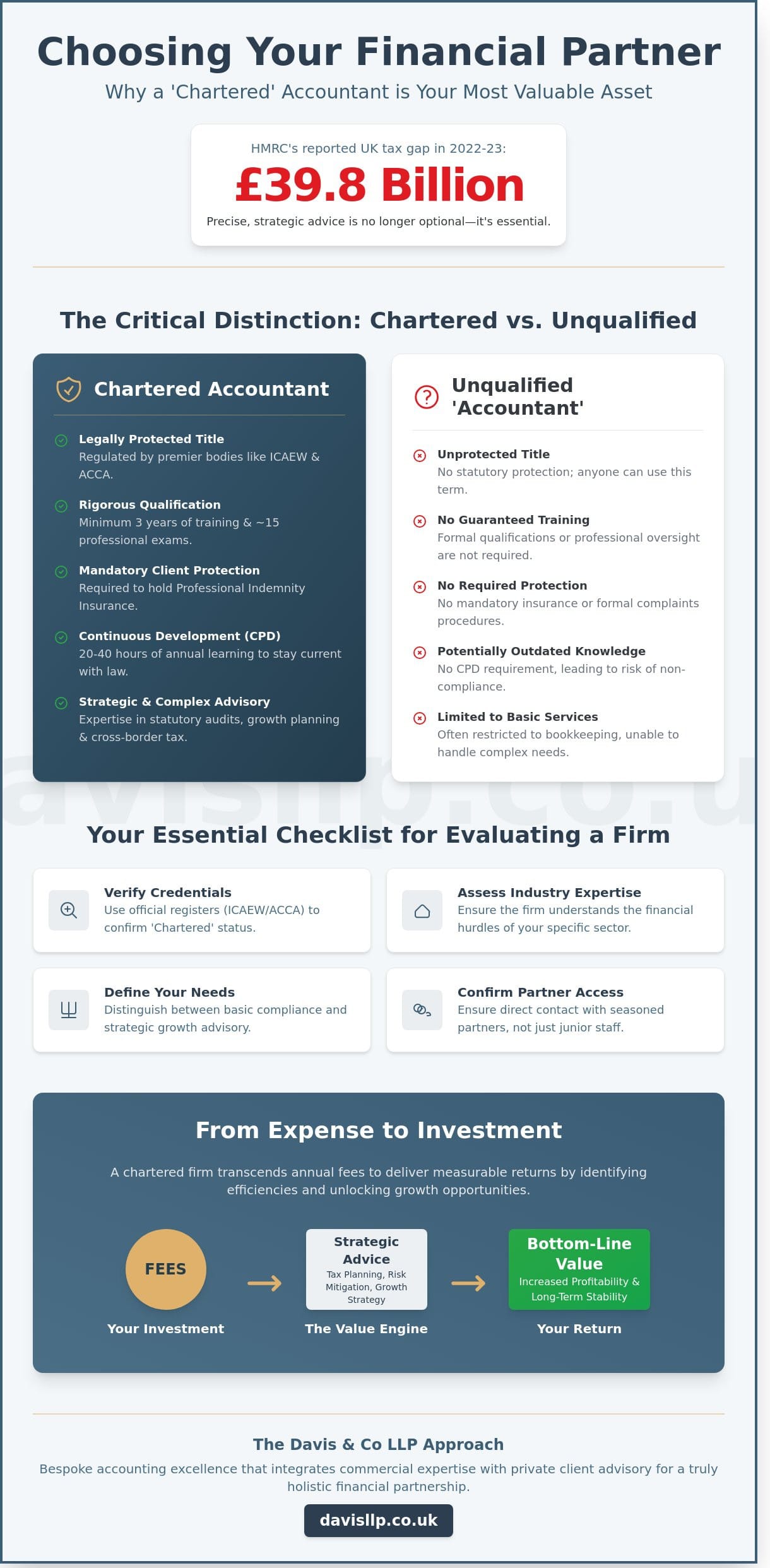
In the United Kingdom, the term ‘accountant’ lacks statutory protection. This legal loophole allows individuals without formal training, qualifications, or professional oversight to offer financial services to the public. To find a chartered accountant is to engage a professional who has met the rigorous standards set by premier bodies such as the Institute of Chartered Accountants in England and Wales (ICAEW) or the Association of Chartered Certified Accountants (ACCA). These practitioners have completed a minimum of three years of documented technical training and passed approximately 15 demanding professional examinations covering law, audit, and tax.
The Legal and Professional Protections
Professional bodies serve as essential regulators. They ensure every member maintains high standards of practice through mandatory oversight. These organisations require members to hold professional indemnity insurance, which provides a vital safety net for your commercial interests. If a service fails to meet professional standards, these bodies offer formal, transparent complaints procedures to protect the client. Continuous Professional Development (CPD) is also a strict requirement. Since the implementation of the Finance Act 2024, UK tax regulations have evolved rapidly; chartered professionals must complete between 20 and 40 hours of structured learning annually to remain current with these statutory shifts.
Chartered vs. Unqualified: Understanding the Risk
Engaging an unregulated advisor often leads to increased HMRC scrutiny. Recent industry data suggests that businesses using unqualified practitioners face a higher risk of penalties due to technical inaccuracies in filings. While an unqualified individual might provide basic bookkeeping, they frequently lack the depth of expertise required for complex matters like statutory audits or cross-border tax structures. We recognize that a reactive, compliance-only approach is insufficient for sophisticated commercial objectives. When you find a chartered accountant, you secure a partner capable of providing the nuanced advice required for long-term stability. Chartered status represents a definitive mark of technical excellence and ethical integrity.
The distinction becomes most apparent during periods of growth or transition. An unqualified advisor may manage daily entries, but they cannot offer the same level of strategic foresight. Professional bodies enforce a strict code of ethics, meaning a chartered professional is bound by law and contract to act with the utmost objectivity. This level of reliability is indispensable for private clients and businesses alike.
Defining Your Requirements: From Compliance to Strategy
Before you begin the search to find a chartered accountant, you must delineate the scope of your requirements. A business with a £100,000 annual turnover has vastly different needs than a £10 million enterprise seeking acquisition advice. While simple bookkeeping keeps you compliant with HMRC, strategic financial management is what accelerates business growth. You should assess whether your current priority is basic statutory filing or a more sophisticated level of advisory that influences your commercial direction.
The scale of the firm you choose should mirror your long-term goals. A sole practitioner might offer a personal touch for a small consultancy, but they may lack the resources to support a rapid scale-up or a complex corporate restructuring. The decision to find a chartered accountant who understands your specific turnover bracket ensures that your advisor isn’t learning on your time. They should already be familiar with the financial hurdles common to your stage of the business lifecycle.
Complex Needs: International Tax and Trusts
Cross-border financial interests introduce significant risk. Double taxation treaties are intricate; they require a partner who understands the interplay between UK law and foreign jurisdictions. If you hold assets in multiple countries, your advisor must manage these complexities to prevent unnecessary leakage. Managing family offices and trust tax compliance requires a high degree of discretion and technical precision. For high-net-worth individuals, international tax planning is essential to protect a legacy and ensure wealth is transferred efficiently across generations. We often find that a bespoke approach is the only way to address these multi-layered private interests.
Sector-Specific Expertise: Why Niche Matters
Standard accounting often fails to capture the nuances of specific industries. Dental professionals and medical practices operate under unique NHS pension rules and VAT exemptions that a generalist might easily overlook. Similarly, property investors face complex challenges with capital gains tax and rental income structures that require specialist handling. Hospitality businesses face equally distinct pressures; the impulse to search for restaurant accountants near me based on proximity alone can leave operators without the bespoke insight needed to manage volatile food costs, Tronc regulations, and fluctuating energy prices. You must ask: “Does this firm truly understand the KPIs of my specific industry?”
A firm with niche expertise will provide benchmarks against your competitors, offering insights that go beyond the balance sheet. This level of detail aligns with global professional standards for accountants, ensuring your advisor adds tangible value to your operations. If your business involves cross-border trade or complex corporate structures, you might consider how a tailored advisory service could better support your strategic objectives.
Assessing these needs early prevents the friction of outgrowing a firm too quickly. It’s about finding a partner who matches your ambition and possesses the technical depth to support it.
The Essential Checklist for Evaluating a Chartered Firm
Selecting a partner to oversee your financial interests requires a methodical approach that goes beyond a simple search. To find a chartered accountant who aligns with your long-term vision, you must first verify their professional standing. We recommend checking the official registers of the leading professional body for chartered accountants or the ACCA directly. This verification confirms the firm is subject to rigorous regulatory oversight and holds the necessary professional indemnity insurance, which is a fundamental safeguard for any commercial entity.
- Technological Integration: By 2026, the transition to Making Tax Digital is comprehensive. Ensure the firm utilises sophisticated cloud accounting suites and AI-powered management reporting tools rather than relying on legacy systems.
- Commercial Gravitas: Evaluate whether the advisor offers pragmatic solutions. You require an expert who interprets the law to facilitate your business goals, not one who hides behind technical jargon.
- Resource Allocation: Clarify whether your account will be managed by a junior trainee or a seasoned partner. The value of an advisor is often found in the years of experience they bring to complex disputes or restructuring.
Technical Proficiency vs. Commercial Awareness
A proficient firm manages your balance sheet, yet a strategic partner understands your underlying business objectives. We’ve seen that technical accuracy is merely the baseline. The real distinction lies in proactivity. During your initial consultation, observe if the advisor asks about your 2026 exit strategy or current cash flow pressures. A firm that provides monthly management accounts rather than just annual filings allows for agile, data-driven decision-making. A 2023 industry survey indicated that 62% of SME clients felt distanced from their advisors; choosing a firm that prioritises your commercial reality prevents this disconnect. This foresight is what separates a service provider from a true consultant.
Communication Styles and Partner Accessibility
The “factory” model of high-volume accounting often leaves clients feeling like a reference number. We believe in a bespoke approach where the communication rhythm is steady and measured. A professional partnership should never feel hurried. When you find a chartered accountant, ask them specifically: “How often will we meet to discuss my strategic growth?” A deliberate, quarterly meeting schedule suggests a firm that values your success as much as their own. This consistency builds the trust necessary for handling sensitive commercial matters with total discretion. It’s the difference between a reactive service and a steady, dependable partnership that evolves alongside your business.
Calculating Value Beyond the Annual Fee
Many directors view accountancy fees as a static overhead, similar to a utility bill. This perspective is limited and often counterproductive. When you find a chartered accountant who operates as a strategic partner, the fee becomes an investment in capital preservation and fiscal efficiency. Choosing a service based solely on the lowest quote often leads to “cheap” accounting. This shortcut frequently results in overlooked tax reliefs or HMRC penalties. For example, late filing penalties start at £100 but can quickly escalate to 100% of the tax due if errors are deemed deliberate.
When you decide to find a chartered accountant, it’s vital to prioritise the potential return on investment over the initial quote. A firm that understands your sector’s nuances will identify savings that far exceed their professional costs. This shift from a cost-centre to a value-add model is the hallmark of a high-calibre advisory relationship.
How Specialist Advice Pays for Itself
Specialised planning identifies efficiencies that generalist practices might miss. Consider a UK tech firm investing £100,000 in software development. Under the current merged R&D scheme, that company could be eligible for a net tax benefit of approximately £15,000 to £16,200. Without a specialist to flag these qualifying costs, that capital is effectively lost. Our approach to Business Growth Acceleration focuses on identifying these high-impact opportunities to improve long-term profitability. “Specialist tax advice should be viewed as a profit-centre, not a cost-centre.”
Assessing Scalability and Long-Term Partnership
Changing providers is a disruptive process that consumes management time and risks the loss of institutional knowledge. It’s better to select a firm that can scale alongside your ambitions. A partner capable of handling everything from routine payroll to complex statutory audits ensures continuity as your business complexity grows. This stability allows the advisor to understand your commercial trajectory over years, not just tax quarters.
- Breadth of Service: Ensure the firm manages VAT, corporate tax, and personal wealth planning under one roof.
- Heritage and Future-Proofing: Look for a firm with a proven track record that also embraces modern cloud-based reporting.
- Strategic Alignment: Your advisor should anticipate challenges before they appear on a balance sheet.
If you’re ready to secure a partner for your next phase of expansion, contact Davis LLP to discuss a bespoke advisory plan.
The Davis & Co LLP Approach: Bespoke Accounting Excellence
When you seek to find a chartered accountant in 2026, the choice usually hinges on a preference for substance over style. At Davis & Co LLP, we operate with a philosophy of quiet excellence. We don’t engage in aggressive marketing or loud proclamations of success. Instead, our reputation is built on a century of understated confidence and a commitment to providing a calm, reassuring authority for our clients. We act as a strategic partner, ensuring your financial structures are robust enough to withstand the complexities of modern regulation.
Our dual expertise in both commercial and private client sectors distinguishes our practice. We understand that for many business owners, personal and corporate wealth are inextricably linked. By providing tailored solutions that address both domestic and international tax matters, we ensure that no aspect of your financial life is left to chance. This holistic view allows us to provide a level of strategic oversight that goes beyond simple compliance.
Our Heritage of Professional Gravitas
Founded in 1901, Davis & Co LLP has maintained a consistent presence in the UK professional landscape for over 120 years. This heritage is a mark of reliability and discretion. Because we operate as an independent partnership, we’re able to offer a personal, considered service that larger, more anonymous firms often struggle to replicate. Our structure allows us to focus on the long-term health of our clients’ portfolios rather than short-term internal targets.
We’ve developed a particular role as a strategic advisor for dental and property professionals. These sectors face unique challenges, from complex capital allowances to specific HMRC reporting requirements. Our history of success in these fields provides our clients with the security of knowing their affairs are managed by experts who understand their specific industry nuances.
Strategic Advisory for Private and Commercial Clients
We believe that effective accounting requires more than just technical skill; it requires intellectual rigour. Our approach to Personal Tax Services and international wealth management is designed to protect and grow your assets through careful, strategic planning. We integrate audit, assurance, and tax planning into a cohesive strategy that reflects your practical realities.
Our firm provides a composed partnership that makes clients feel secure and well-advised. When you find a chartered accountant through our firm, you gain access to a team that values precision and clarity. We focus on the human and business impact of every financial decision. This ensures our advice is always pragmatic and aligned with your commercial objectives. We invite you to experience a partnership where traditional values meet a contemporary, sophisticated application.
Securing Your Financial Legacy Through Strategic Partnership
Transitioning from basic bookkeeping to high-level financial strategy is essential as we approach 2026. A standard accountant might manage your annual filings, but they often lack the rigorous training and ethical oversight mandatory for Chartered professionals. When you decide to find a chartered accountant, you’re choosing a partner capable of navigating complex HMRC regulations and international tax frameworks with precision.
Since 1901, Davis & Co LLP has delivered this level of intellectual rigour to our clients. We provide specialist expertise in dental accounting and international tax, ensuring every strategy is partner-led and tailored to your specific commercial objectives. Our firm’s history of success suggests that reliability isn’t just a goal; it’s our standard. We focus on providing the calm, reassuring authority you need to manage sensitive financial matters effectively.
Taking control of your fiscal health is a significant step toward long-term stability. We’re ready to help you navigate the complexities ahead with confidence.
Frequently Asked Questions
What is the difference between a Chartered Accountant and a regular accountant?
A Chartered Accountant is defined by their membership in a recognised professional body, such as the ICAEW or ICAS, which requires a minimum of three years of postgraduate training and 450 days of technical work experience. While anyone can legally call themselves an “accountant” in the UK, only those who meet these statutory standards provide the level of professional indemnity and ethical oversight required for complex commercial matters.
How much does it cost to hire a Chartered Accountant in 2026?
Fees for a Chartered Accountant in 2026 typically range from £150 to £400 per hour, depending on the complexity of the advisory required and the firm’s location. For standard annual compliance and corporate tax filing, small to medium enterprises often budget between £2,500 and £5,000 per annum according to 2025 industry benchmarks from the Accountancy Age. It’s a strategic investment that often pays for itself through identified tax efficiencies.
Can a Chartered Accountant help me with an HMRC investigation?
A Chartered Accountant provides essential representation during an HMRC investigation by managing all correspondence and ensuring your statutory rights are protected. Their expertise in the Taxes Management Act 1970 allows them to negotiate settlements and mitigate potential penalties, which can otherwise reach 100% of the tax due in cases of deliberate inaccuracy. We act as a professional shield between you and the revenue, ensuring the process remains fair and transparent.
How do I switch from my current accountant to a Chartered firm?
Switching to a Chartered firm is a structured process governed by professional ethics that requires your new advisor to request “professional clearance” from your previous accountant. Once you’ve signed a new letter of engagement, we handle the transition of your records and historical data. This move is typically completed within 21 days to ensure no disruption occurs to your upcoming filing deadlines.
Is it worth hiring a specialist accountant for my dental practice?
Specialist accountants are vital for dental practices because they understand the specific nuances of NHS pensions, UDA contracts, and complex VAT exemptions on clinical services. When you find a chartered accountant with healthcare expertise, you’re better positioned to manage the 40.8% average overhead costs reported by the NASDAL in their 2024 benchmarking report. For dental professionals seeking to avoid costly miscalculations on NHS and private income splits, our guide to choosing a specialist dental accountant provides a comprehensive framework for evaluating the right partner for your practice. This bespoke approach ensures your practice remains profitable while staying compliant with sector-specific regulations.
What qualifications should I look for when I find a chartered accountant?
You should prioritise individuals holding the ACA, CA, or ACCA qualifications, as these represent the gold standard of British accounting excellence. It’s also prudent to verify their firm’s registration on the ICAEW’s directory when you find a chartered accountant to confirm they hold a valid practising certificate. This verification ensures the professional is bound by a strict code of conduct and possesses mandatory professional indemnity insurance.
Does a small business really need a Chartered firm for bookkeeping?
While a small business can use a bookkeeper for daily transactions, a Chartered firm ensures your financial foundation supports long-term commercial objectives. Having a qualified professional oversee your records reduces the risk of errors that lead to HMRC penalties. These fines currently start at £100 for a late tax return and escalate based on the delay duration, so professional oversight is often a cost-saving measure.
How can a Chartered Accountant help with international tax planning?
Chartered Accountants assist with international tax planning by navigating double taxation treaties and ensuring compliance with the OECD’s Base Erosion and Profit Shifting framework. They provide bespoke strategies for transfer pricing and cross-border VAT, protecting your global interests. This expertise ensures you don’t pay more tax than is legally required across different jurisdictions while maintaining full transparency with international tax authorities.