If you are still managing property finances based on the precedents of a few years ago, your current approach to service charge accounting and audit is likely already falling short of the Leasehold and Freehold Reform Act 2024. The full implementation of this legislation in 2026 has transformed the regulatory landscape, making transparency a statutory mandate rather than a professional courtesy. We understand that the transition from the Landlord and Tenant Act 1985 to this new framework can feel overwhelming, particularly when balancing the needs of leaseholders with rigorous reporting deadlines.
It’s a common frustration to feel caught between the nuances of an independent accountant’s report and the depth of a full audit. This guide provides the clarity you need to align with the latest RICS standards and the ICAEW’s March 2026 technical updates. We’ll outline how to implement standardised demands and meet the strict four-month sign-off window for commercial accounts. By the end of this article, you’ll have a pragmatic strategy to ensure compliance, eliminate insurance commission disputes, and foster a more stable, transparent relationship with your tenants through clear financial reporting.
Key Takeaways
- Understand the statutory trust relationship governing service charge funds to ensure your reporting reflects the highest standards of transparency and fiduciary duty.
- Identify the critical distinctions between the ICAEW TECH 03/11 guidance for residential properties and the RICS Professional Statement for commercial assets to remain compliant in 2026.
- Determine whether your property requires a comprehensive service charge accounting and audit or a more focused independent accountant’s report to satisfy specific legal and leasehold obligations.
- Establish year-round bookkeeping protocols and clear communication channels to proactively manage budget variances and minimise potential disputes with leaseholders.
- Learn how a bespoke approach to property accounting can transform compliance from a regulatory burden into a strategic framework that protects your commercial interests.
What is Service Charge Accounting and Why is it Essential?
Service charge accounting is the meticulous process of tracking, recording, and reporting the shared costs associated with the management and maintenance of multi-let properties. It’s far more than a simple bookkeeping exercise; it’s a specialized discipline that sits at the intersection of property law and financial transparency. When a tenant pays a service charge, the law dictates that these funds are held in a statutory trust. This means the money is legally separated from the landlord’s personal or business assets, ensuring contributions are spent solely on the upkeep and services of the specific building or estate. We believe that a robust service charge accounting and audit framework is the most effective way to demonstrate this integrity and protect the interests of all parties involved.
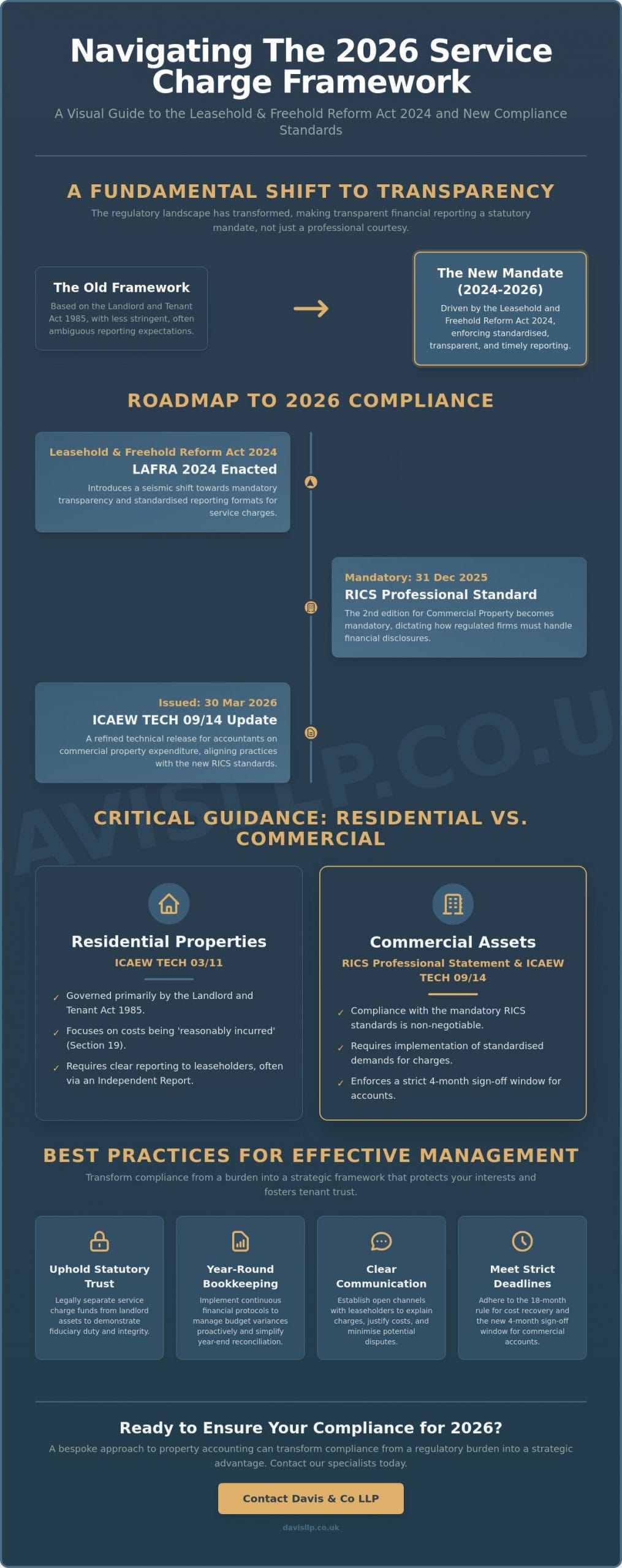
The Landlord and Tenant Act 1985 provides the primary statutory framework, particularly for residential portfolios. It mandates that costs must be transparent and that leaseholders have a right to inspect the underlying accounts. For commercial property, the RICS Professional Standard sets a similarly high bar for accountability. Professional oversight is essential because the complexity of these accounts often exceeds standard corporate reporting requirements. Without expert guidance, landlords risk falling foul of the strict 18-month rule for cost recovery or failing to meet the rigorous 2026 reporting deadlines. A dedicated service charge accounting and audit approach ensures that your financial reporting is not just compliant, but also strategically sound.
The Purpose of Service Charge Accounts
The fundamental goal of these accounts is to confirm that all expenditure has been ‘reasonably incurred’ according to Section 19 of the 1985 Act. This isn’t merely a suggestion; it’s a legal threshold that landlords must meet to recover costs from their tenants. By providing a transparent financial trail, managers allow leaseholders to verify their contributions against actual invoices and service contracts. This clarity is vital for successful year-end reconciliations. It ensures that any balancing charges are justified and that credits are applied fairly, which significantly reduces friction during the billing cycle and prevents long-standing disputes.
Key Stakeholders in the Process
Different parties carry distinct responsibilities within this financial ecosystem. The landlord or freeholder holds the ultimate fiduciary duty to manage the trust funds correctly. Property managers act as the administrative arm, handling the daily flow of invoices and contractor payments. Finally, the directors of a Residents’ Management Company (RMC) often find themselves in a challenging position. They are responsible for the building’s financial health but may lack technical training. For these individuals, professional support is a critical shield against personal liability and ensures the company remains compliant with both property law and Companies House requirements.
The Regulatory Framework for 2026 Compliance
The Leasehold and Freehold Reform Act 2024 (LAFRA 2024) has fundamentally altered the landscape of service charge accounting and audit by mandating stricter transparency and accountability. This legislation, which continues to see secondary provisions implemented throughout 2026, has shifted the focus from simple cost recovery to a more rigorous, standardised reporting model. For commercial properties, the RICS Service Charges in Commercial Property Professional Standard (2nd Edition), which became mandatory on 31 December 2025, now dictates how regulated firms must handle financial disclosures. These changes aren’t merely administrative; they’re designed to reduce the friction that has historically plagued the landlord and tenant relationship.
Central to this new era of compliance is the updated guidance from the ICAEW. On 30 March 2026, the Audit and Assurance Faculty issued TECH 09/14, providing a refined technical release for accountants reporting on commercial property expenditure. This works alongside the established TECH 03/11 for residential properties to ensure that every financial statement meets a high threshold of intellectual rigour. For social housing providers, the 2026 updates to FRS 102 (SORP) have introduced more granular disclosure requirements, particularly concerning the allocation of overheads across mixed-tenure developments. Our team provides bespoke property accounting to ensure these nuances don’t lead to costly compliance gaps.
Understanding your rights to service charge information is the first step in mitigating risk; Section 21 of the Landlord and Tenant Act 1985 remains a vital mechanism for leaseholders to demand a summary of costs. Under the 2026 reforms, the failure to provide this information in the prescribed format can lead to the immediate withholding of payments by tenants. It’s no longer sufficient to provide a basic spreadsheet; you must provide a statutory summary that aligns with the new standardised demand formats introduced this year.
Statutory vs. Best Practice Requirements
While the law sets the minimum floor for compliance, RICS and ICAEW best practices provide the ceiling for professional conduct. Adhering to these higher standards ensures that your service charge accounting and audit procedures stand up to scrutiny if challenged. In 2026, the ‘reasonableness’ test requires that every item of expenditure is not only necessary for the property’s upkeep but also procured through a demonstrably competitive and transparent process. Following best practice is the most effective way to avoid the time and expense of First-tier Tribunal (Property Chamber) challenges.
Trust Tax and Corporation Tax Considerations
Interest earned on service charge bank accounts is held in trust for the leaseholders; this often necessitates a trust tax return to HMRC to report and settle any tax due on that income. It’s a common oversight to assume these accounts are tax-neutral. Furthermore, Residents’ Management Companies (RMCs) must remain vigilant regarding corporation tax liabilities, especially if they generate non-service charge income or trade for profit. We recommend a pragmatic review of your corporate structure to ensure that all tax obligations are met without compromising the integrity of the service charge trust.
Audit vs. Independent Accountant’s Report: Which Do You Need?
Choosing between a full audit and an independent accountant’s report is not a matter of preference; it’s a decision rooted in the specific wording of your lease and the scale of the property. While many use these terms interchangeably, they represent distinct levels of professional scrutiny. An audit provides “reasonable assurance” that the financial statements are free from material misstatement, involving a deep dive into internal controls and risk assessments. Conversely, an independent accountant’s report is a more targeted engagement. It focuses on verifying that the expenditure shown in the accounts is supported by invoices and that the figures align with the property’s bank statements and trial balance. For most landlords, finding the right balance between these two is essential for effective service charge accounting and audit management.
The lease document acts as the primary authority in this decision. If a lease specifically mandates an “audit” by a Registered Auditor, you’re legally bound to provide one, regardless of the property’s size. However, the RICS Code of Practice and the latest 2026 technical updates suggest that for many residential developments, an independent accountant’s report is the more pragmatic choice. It provides the transparency leaseholders require without the significant overhead costs associated with a full statutory audit. We often find that a cost-benefit analysis favours the independent report for standard residential blocks, while larger commercial or mixed-use assets benefit from the higher level of assurance an audit provides.
When a Full Audit is Mandatory
A full audit becomes a statutory or contractual necessity in several scenarios. Many modern leases for large-scale developments, particularly those with complex plant and machinery or significant reserve funds, explicitly require an audit to protect the interests of all stakeholders. Furthermore, mixed-use developments where commercial and residential costs are apportioned across different schedules often present a higher risk profile. In these cases, the rigorous testing of an audit ensures that the allocation of costs is both fair and mathematically accurate, reducing the likelihood of challenges at a First-tier Tribunal.
The Value of the Independent Accountant’s Report
For the majority of residential portfolios, the independent accountant’s report is the industry standard. It offers a robust layer of protection by confirming that the money leaseholders have paid into the trust account has been spent as claimed. The scope of work is specific: the accountant checks a sample of invoices, reviews bank reconciliations, and ensures the accounts are prepared in accordance with the 2026 ICAEW technical releases. This approach satisfies the transparency requirements of the Leasehold and Freehold Reform Act 2024 while keeping management costs at a level that leaseholders are more likely to accept as reasonable.
Best Practices for Effective Service Charge Management
Excellence in property management is built on a foundation of administrative precision. While the 2026 regulatory environment is more demanding, it also provides a clearer framework for those who prioritise intellectual rigour in their operations. Implementing a robust bookkeeping system is the first step toward a seamless service charge accounting and audit cycle. By recording transactions as they occur, you avoid the year-end rush that often leads to errors and delays. A well-structured service charge accounting and audit process ensures that you meet the statutory requirements of the Leasehold and Freehold Reform Act 2024 without compromising on commercial efficiency.
We recommend establishing a separate, interest-bearing bank account for every individual property or scheme. This isn’t just a matter of good practice; it’s a legal necessity to ensure that service charge funds are never co-mingled with the landlord’s general cash flow, upholding the statutory trust relationship. Proactive management of reserve funds, or sinking funds, is equally vital for long-term stability. These funds are intended for major capital expenditure, such as roof replacements or lift refurbishments. Clear communication with leaseholders regarding these reserves prevents the friction that frequently triggers disputes. When budget variances occur, addressing them early through transparent reporting is far more effective than waiting for the year-end reconciliation.
Maintaining Financial Transparency
Transparency is the most effective deterrent against litigation. Providing regular interim reports to directors and stakeholders ensures that everyone remains informed about the building’s financial health throughout the year. In 2026, digital accessibility is no longer optional. Using secure portals to share accounts and supporting invoices allows leaseholders to exercise their rights without administrative friction. For those managing complex portfolios, seeking expert tax advice in the UK ensures that your service charge structures are aligned with broader corporate tax and VAT requirements.
Avoiding Common Pitfalls
The most frequent errors we observe often stem from a lack of monthly reconciliation. Failing to match bank statements with the service charge ledger can hide discrepancies that become difficult to resolve months later. The treatment of VAT on commercial service charges also requires careful attention. Mistakes in this area can lead to significant HMRC penalties and disrupt cash flow. Finally, remember that the 2026 standards require commercial service charge accounts to be signed off within four months of the year-end. Missing this deadline, or falling foul of the strengthened 18-month rule for cost recovery, can render legitimate expenditure unrecoverable from tenants. If you require assistance in refining these processes, our property accounting experts are available to provide bespoke support.
Davis & Co LLP: Bespoke Service Charge Solutions
Managing the intricacies of a modern property portfolio requires more than a standard accountancy service; it demands a partner who understands the delicate balance between statutory obligation and commercial reality. As Chartered Certified Accountants with a profound specialism in the property sector, we provide the technical rigour necessary to navigate the 2026 regulatory environment. Our approach is defined by a sense of quiet excellence. We don’t merely process figures; we interpret them within the context of your specific business objectives, ensuring that your service charge accounting and audit procedures are both robust and transparent.
We recognise that for Residents’ Management Companies (RMCs), landlords, and property managers, financial disclosures are often sensitive. Friction with leaseholders frequently arises from a lack of clarity, which is why our partnership model focuses on creating clear, indisputable reporting lines. By acting as a composed and reassuring authority, we help our clients maintain the trust of their tenants while fulfilling their fiduciary duties. Whether you are overseeing a single residential block or a complex mixed-use commercial estate, our tailored solutions are designed to provide security and professional distance.
Our Comprehensive Suite of Services
Our expertise extends across the full spectrum of property-related financial requirements. We specialise in the preparation of statutory accounts and independent accountant’s reports that align with the latest ICAEW and RICS standards. For larger or more complex structures where the risk profile is higher, our audit and assurance team provides the deep-level scrutiny required to satisfy both legal mandates and investor expectations. Beyond the service charge itself, we manage the broader compliance landscape, including trust tax and corporation tax for property-holding entities. This holistic oversight ensures that no aspect of your tax or accounting profile is left to chance.
Why Strategic Partnership Matters
A relationship with us moves beyond the transactional nature of basic bookkeeping. We view ourselves as a strategic partner, helping you anticipate regulatory shifts before they impact your operations. Our firm has been a dependable constant in the British professional landscape since 1901, and we leverage this heritage to provide stable, considered advice. This long-standing history of success allows us to offer a perspective that is both traditional in its values and contemporary in its application. If you are seeking to refine your financial reporting and reduce the administrative burden of compliance, please contact our specialists for a bespoke service charge consultation. We are ready to assist you in establishing a framework that protects your assets and fosters long-term stability.
Securing Your Property Portfolio for 2026 and Beyond
Transitioning to the 2026 standards requires a shift from reactive bookkeeping to proactive, strategic financial management. As we’ve explored, navigating the nuances of the Leasehold and Freehold Reform Act 2024 and the latest RICS standards is essential for maintaining transparency. Whether you’re managing a residential block or a complex commercial estate, the goal remains the same: ensuring every expenditure is reasonably incurred and correctly reported. Achieving excellence in service charge accounting and audit is not merely about ticking boxes; it’s about protecting the statutory trust and maintaining the integrity of your landlord-tenant relationships.
Davis & Co LLP has served as a dependable constant in the professional landscape since 1901. As Chartered Certified Accountants specialising in property accounting and audit, we bring dedicated expertise in international and trust tax compliance to every engagement. We provide the intellectual rigour and bespoke support you need to remain compliant in an increasingly regulated market. Discover how Davis & Co LLP provides bespoke service charge accounting and audit services to help you secure your commercial interests. It’s time to transform your compliance obligations into a framework for long-term stability and success.
Frequently Asked Questions
Is it a legal requirement to have service charge accounts audited?
Legal requirements depend primarily on the wording of your lease and the statutory threshold of the property. Under the Leasehold and Freehold Reform Act 2024, residential buildings with four or more dwellings now require formal annual accounts prepared by a qualified accountant. If your lease specifically demands an “audit” by a Registered Auditor, you’re contractually bound to provide one regardless of the property’s size.
What is the difference between a service charge audit and a certification?
A service charge audit provides a high level of assurance by evaluating internal controls and testing for material misstatements within the financial records. In contrast, a certification, often referred to as an independent accountant’s report, focuses on verifying that expenditure is supported by invoices and aligns with bank records. While an audit is more intensive, a certification is often the pragmatic choice for standard residential developments where the lease doesn’t mandate a full audit.
How soon after the year-end must service charge accounts be issued?
For commercial properties, the RICS Professional Standard requires service charge accounts to be signed off within four months of the year-end. Residential timelines are typically dictated by the lease, but best practice suggests a six-month window for distribution. It’s critical to observe the strengthened 18-month rule; if costs aren’t demanded within 18 months of being incurred, they may become unrecoverable from leaseholders.
Who is responsible for appointing the accountant for service charge reports?
The responsibility for appointing a qualified professional lies with the landlord, freeholder, or the directors of the Residents’ Management Company (RMC). This appointment is a key part of their fiduciary duty to ensure that service charge funds are managed transparently and accurately. We recommend choosing a firm with specific expertise in property accounting to ensure all statutory and contractual obligations are met without delay.
Can leaseholders legally withhold service charges if accounts are not provided?
Leaseholders have a statutory right to withhold payment if the landlord fails to provide a summary of costs or uses an invalid demand format. Following the 2026 reforms, all demands must follow a prescribed standardised format to be legally enforceable. If these requirements aren’t met, or if the accounts aren’t provided within the legal timeframe, tenants can legally pause their contributions until the default is rectified.
What happens if the service charge funds are not held in a separate trust account?
Failing to hold funds in a separate trust account is a breach of Section 42 of the Landlord and Tenant Act 1987. This statutory trust ensures that service charge money is legally ring-fenced from the landlord’s personal or business assets. Non-compliance can lead to criminal penalties and provides leaseholders with strong grounds to challenge the management of the building at a First-tier Tribunal.
How do I ensure my service charge accounting is compliant with TECH 03/11?
Compliance is achieved by ensuring your service charge accounting and audit procedures follow the joint guidance issued by the ICAEW and RICS. This involves preparing accounts on an accruals basis, maintaining a clear audit trail for all expenditure, and ensuring that all interest earned is credited back to the trust account. Professional oversight is generally required to ensure these technical standards are consistently maintained across your portfolio.
Are the costs of the audit or accountant’s report recoverable through the service charge?
The costs associated with a professional service charge accounting and audit are generally recoverable from leaseholders, provided the lease includes a clause for management or professional fees. These costs must satisfy the statutory “reasonableness” test. Most modern leases recognise that professional reporting is a necessary expense for the proper administration of the property and the protection of its shared funds.