The abolition of the Furnished Holiday Let regime represents the most significant shift in property taxation in a generation, effectively reclassifying your short-term rental from a trading business to a passive investment. As the 2026/27 tax year begins, the tax implications of furnished holiday lets have fundamentally changed, leaving many owners to face higher liabilities and restricted reliefs. You’ve likely spent years building a portfolio under a specific set of rules, and it’s natural to feel concerned about the impact of losing full mortgage interest relief or the 10% rate on disposals.
We understand that this transition requires more than just compliance; it demands a strategic re-evaluation of your property assets. Our guide provides a definitive framework for navigating these changes, ensuring you understand exactly how the new baseline affects your bottom line. We’ll examine the remaining opportunities for tax efficiency, including the replacement of domestic items relief and the complexities of profit splitting between spouses. By the end of this analysis, you’ll have the clarity needed to restructure your portfolio for long-term stability in this new regulatory environment.
Key Takeaways
- Understand the fundamental shift from trading to investment status and what this reclassification means for your property’s tax baseline in 2026.
- Navigate the new finance cost restrictions to mitigate the financial impact of losing full mortgage interest deductibility on your rental income.
- Evaluate the updated tax implications of furnished holiday lets regarding the loss of Business Asset Disposal Relief and the realignment of Capital Gains Tax rates.
- Identify proactive strategies for joint ownership to maintain tax efficiency despite the loss of flexible profit-splitting for married couples and civil partners.
- Adopt a more professionalised approach to property accounting to ensure your portfolio remains resilient against evolving HMRC compliance standards.
The Abolition of the Furnished Holiday Let (FHL) Regime: A 2026 Perspective
The 2026/27 tax year marks a definitive conclusion to the preferential treatment previously afforded to owners of short-term accommodation. Following the abolition of the Furnished Holiday Let (FHL) regime on 6 April 2025, your property is now categorized as a standard residential property business. This isn’t merely a change in nomenclature; it’s a fundamental reclassification from “trading” status to “investment” status. The shift carries profound tax implications of furnished holiday lets that require immediate attention to protect your yields.
Historically, the UK tax system viewed the operation of a vacation rental as a commercial activity akin to running a hotel. This allowed for significant advantages, such as full relief for mortgage interest and access to capital allowances for internal fittings. By 2026, these benefits have vanished. Owners now face a four-pronged fiscal challenge: restricted finance cost relief, the loss of Business Asset Disposal Relief, the end of capital allowances on new expenditure, and the removal of flexible profit-splitting. We’ve seen that these changes don’t just increase the tax bill; they complicate the basic accounting structure of your portfolio.
Why the FHL Status Ended in 2025
The government’s decision to sunset the FHL regime was driven by a desire to “level the playing field” between holiday rentals and long-term residential lets. With active short-term listings in the UK reaching 375,400 by January 2026, policymakers sought to address the perceived impact on local housing availability in tourist hotspots. For many owners, this “fairness” objective has created a significant fiscal hurdle. It essentially forces a professionalization of the sector, where only those with robust Property Accounting and strategic planning will maintain viable margins in a more restrictive environment.
The Immediate Impact on Your 2026 Tax Return
Your 2026 tax return will look remarkably different. You’ll no longer report holiday let income in separate sections; instead, it must be consolidated with your other UK or overseas property income. This consolidation can push some landlords into higher tax brackets, particularly as the personal allowance remains frozen at £12,570 for the 2026/27 year. For those with complex or cross-border portfolios, our International Tax Planning services are vital to ensure that income is reported correctly and that any available double taxation treaties are utilized effectively. We recommend an early audit of your 2026 records to ensure compliance and to mitigate the negative tax implications of furnished holiday lets under the unified property reporting standards.
Income Tax and the New Finance Cost Restrictions
The transition to Section 24 rules represents a significant fiscal adjustment for owners of leveraged holiday accommodation. Under the previous regime, mortgage interest was treated as a fully deductible business expense, allowing you to pay tax only on your net profit. Since the 2025 abolition, this mechanism has been replaced by a 20% tax credit system. This means you’re now taxed on your gross rental income before interest is deducted, which fundamentally alters the tax implications of furnished holiday lets for anyone with a mortgage.
This change introduces a substantial risk of “bracket creep.” Because your reportable taxable income now includes the portion of revenue used to service debt, you may find your total income pushed into a higher tax band. For those whose income approaches the £100,000 threshold, this can trigger the tapered loss of the personal allowance, where £1 is removed for every £2 earned above the limit. We’ve observed that this effectively creates a marginal tax rate that can exceed 60% for some individuals, making proactive Personal Tax Services a necessity rather than an option.
Calculating the Real Cost of Borrowing
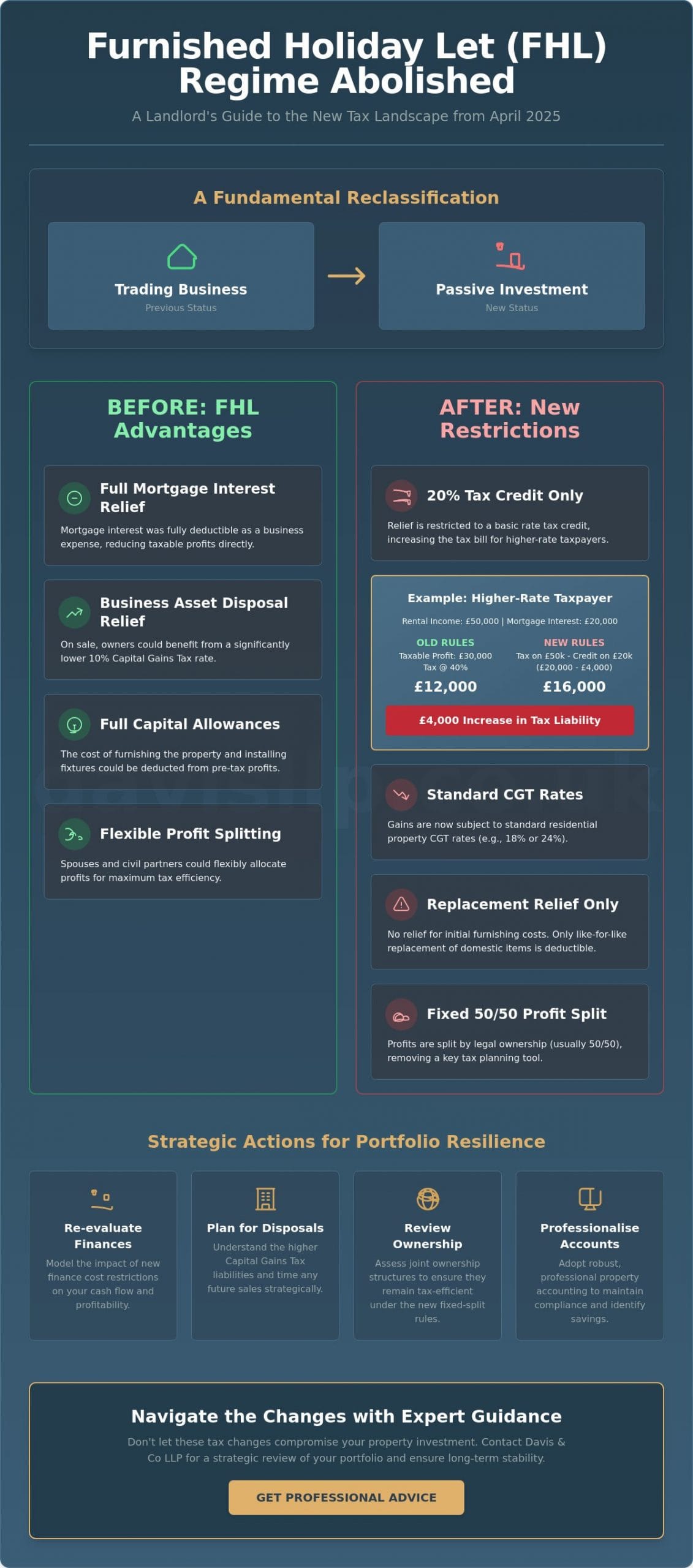
Consider a higher-rate taxpayer generating £50,000 in rental income with £20,000 in mortgage interest. Previously, they paid 40% tax on the £30,000 profit, resulting in a £12,000 bill. In the 2026/27 tax year, they pay 40% on the full £50,000 (£20,000) but receive a 20% credit on the interest (£4,000). The final tax bill rises to £16,000, reducing their net cash flow by £4,000 despite no change in rental performance. Section 24 reclassifies mortgage interest from a business expense into a personal tax credit, fundamentally decoupling tax liability from actual cash profitability.
Strategic Debt Management
Mitigating these losses requires a sophisticated approach to debt allocation across your entire portfolio. We often work with clients to review whether debt can be restructured or shifted toward other business areas where full relief might still be accessible. Seeking Expert Tax Advice in the UK is essential when considering complex transitions, such as incorporating your portfolio into a limited company. While companies can still deduct interest as an expense, the costs of transferring properties, including Stamp Duty Land Tax and Capital Gains Tax, must be carefully weighed against the long-term income tax savings. Our team can assist with the Cash Flow Management analysis required to determine if your current financing structure remains viable under these new constraints.
Navigating Capital Gains and Capital Allowances Post-Abolition
The reclassification of holiday lets from a trade to an investment has profound consequences for capital taxes and reinvestment strategies. Business Asset Disposal Relief (BADR), which previously capped Capital Gains Tax (CGT) at 10%, is no longer available for the sale of former FHL properties. Instead, owners are subject to standard residential property CGT rates of 18% for basic rate taxpayers and 24% for those in higher or additional bands. With the annual exempt amount reduced to just £3,000 for the 2026/27 tax year, the tax implications of furnished holiday lets upon disposal have become significantly more expensive.
We must also address the shift in how you claim for property contents. You can no longer claim capital allowances for new expenditure on furniture, fixtures, or white goods. While you can continue to “run off” existing capital allowance pools from previous years, new investments must rely on “replacement of domestic items relief.” This relief only applies to the like-for-like replacement of existing items; it doesn’t cover the initial cost of furnishing a property. This change requires a more meticulous approach to Property Accounting to ensure every eligible replacement is captured and documented correctly.
The End of Trading Reliefs for CGT
The loss of trading status removes access to Gift Holdover Relief and Business Asset Rollover Relief. This creates a significant hurdle for estate planning, as you can no longer pass a property to the next generation without triggering an immediate CGT liability based on the market value. For non-resident owners, these changes are even more complex. Managing a global portfolio requires sophisticated International Tax Planning to navigate the interplay between UK residential property rules and overseas tax obligations. We help our clients evaluate whether holding properties within a trust or a corporate structure might offer a more sustainable path for succession.
Pension Contributions and Earned Income
It’s vital to recognize that profits from former FHLs are no longer classified as “relevant UK earnings.” Previously, these profits could be used to justify higher tax-relieved pension contributions. In 2026, this income is treated as passive investment return, which doesn’t support pension funding. If your retirement strategy relied on these profits to maximize your annual allowance, you’ll need to identify alternative earned income streams. We recommend a full review of your Personal Tax Services to ensure your pension funding remains optimized under these restricted definitions.
Strategic Restructuring for Joint Owners and Married Couples
For many years, married couples and civil partners enjoyed a unique flexibility when managing the profits from their holiday accommodation. This privilege was a byproduct of the trading status, allowing for an allocation of income that didn’t necessarily mirror the underlying capital ownership. With the abolition of the regime, we’ve entered a period where the tax implications of furnished holiday lets are governed by the rigid 50:50 default rule for joint owners. Unless proactive steps are taken, HMRC will assume that income is split equally between spouses, regardless of who performs the majority of the management or who is in a lower tax bracket.
This shift from “trading” to “investment” income means that the previous ability to split profits purely for tax efficiency has vanished. To deviate from the 50:50 split, couples must now prove that their beneficial interest in the property is actually unequal. This requires a formal alignment of your tax reporting with the underlying legal reality of the property’s title. For those managing high-value portfolios, this transition often necessitates a thorough review of Property Accounting records to ensure that the declared income distribution is defensible under scrutiny.
The Form 17 Declaration Process
If you wish to be taxed on your actual share of ownership rather than an arbitrary 50:50 split, you must submit a Form 17 declaration to HMRC. Timing is critical; the declaration must be made within 60 days of the date the beneficial interest changed. You’ll need to provide documentary evidence, such as a deed of trust, to support the unequal allocation. We caution against “sham” beneficial interest transfers that lack legal substance, as HMRC increasingly utilizes data matching to identify inconsistencies between land registry records and tax filings.
Estate Planning and Inheritance Tax (IHT)
The reclassification also complicates your long-term succession strategy. In 2026, it’s exceptionally rare for a holiday let to qualify for Business Property Relief (BPR) because it’s now viewed as a passive investment business. This means the full value of the property is likely subject to a 40% Inheritance Tax charge upon death. Integrating these assets into a comprehensive estate plan is essential to avoid a forced sale of the property by the next generation. It’s vital to conduct a professional legal deed review before your next tax filing to ensure your ownership structure is both tax-efficient and legally robust. If you’re concerned about the impact of these changes on your family’s future, our Personal Tax Services can help you navigate these complex restructuring requirements.
Professional Management of Property Portfolios as Strategic Assets
The transition into the 2026 tax year marks the end of an era for casual holiday let ownership. As we’ve established, the tax implications of furnished holiday lets now require the same level of rigorous oversight as any high-value commercial enterprise. Moving from a passive ownership model to one of proactive tax management is no longer optional for those who wish to maintain their yields. The 2026 landscape demands a strategic pivot, where your portfolio is treated as a sophisticated asset class that requires active, professional stewardship.
A critical component of this new era is the HMRC Tax Warning 2026, which signals a period of heightened scrutiny regarding property business compliance. We assist our clients in navigating these warnings by conducting thorough structural reviews, ensuring that every available relief is captured and every disclosure is technically sound. For owners with cross-border interests, our International Tax Planning services are essential. We ensure that your UK property assets are managed in a way that respects the interplay between domestic rules and international tax obligations, preventing unforeseen fiscal friction.
The Role of Specialized Property Accounting
Resilience in this restrictive environment is built on the foundation of accurate reporting. Our Property Accounting services go beyond simple record-keeping; we focus on the steady, deliberate management of your transition. This includes the careful “run-off” of legacy FHL capital allowance pools, ensuring you extract the maximum remaining value from previous investments. By maintaining this level of precision, we facilitate more effective Cash Flow Management, providing you with the data needed to make informed decisions about debt restructuring or portfolio expansion.
Conclusion: Securing Your Financial Legacy
We believe that navigating the complexities of property taxation requires a composed partnership between an owner and their advisor. At Davis & Co LLP, we provide the discretion and intellectual rigour necessary to manage sensitive commercial matters with the gravitas they deserve. The abolition of the FHL regime is a significant hurdle, but it’s one that can be managed through disciplined planning and strategic foresight. As you assess your position for the 2026/27 tax year, we invite you to contact us for a comprehensive portfolio audit. Together, we can ensure that your property assets continue to serve as a robust pillar of your financial legacy, managed with the quiet excellence that defines our practice.
Securing Your Portfolio’s Future in a New Regulatory Era
The transition toward a unified property tax regime necessitates a fundamental shift in how you perceive and manage your holiday accommodation. We’ve explored how the loss of trading status impacts everything from interest relief to capital gains; however, the most vital takeaway is the need for proactive, structural oversight. Adopting a professionalised management model is no longer just a recommendation. It’s a prerequisite for maintaining profitability in 2026 and beyond.
Navigating the complex tax implications of furnished holiday lets requires a partner who understands the nuance of high-value portfolios. As Chartered Certified Accountants since 1901, we specialise in Property Accounting and International Tax, providing bespoke advisory services for high-net-worth individuals. We focus on delivering the discretion and precision your financial matters deserve. Consult our specialists for a strategic review of your property tax position to ensure your investments are optimised for the landscape ahead. We’re here to help you build a resilient and lasting financial legacy.
Frequently Asked Questions
Are furnished holiday lets still tax-efficient in 2026?
Furnished holiday lets have lost the specific tax advantages that once distinguished them from long-term residential rentals. In 2026, they’re taxed under standard property income rules, meaning efficiency is now achieved through meticulous portfolio management rather than inherent regime benefits. We recommend a strategic review of your total income to identify remaining opportunities for tax mitigation within the current framework.
Can I still claim capital allowances on my holiday home in 2026?
You can’t claim capital allowances for new expenditure on furniture or fixtures in 2026. However, you’re permitted to “run off” any existing capital allowance pools established before the 2025 abolition. For new purchases, you must now utilize “replacement of domestic items relief,” which applies to like-for-like replacements of furnishings and appliances rather than initial fit-outs.
How does the abolition of the FHL regime affect my mortgage interest tax relief?
The 2026 rules align holiday lets with Section 24 restrictions, meaning mortgage interest is no longer a deductible business expense for individual owners. Instead, you receive a 20% tax credit against your final liability. This change often results in higher taxable profits and can inadvertently push owners into higher tax brackets despite no increase in actual cash flow.
What happens to my FHL losses brought forward from previous years?
Losses generated under the former FHL regime can be carried forward and offset against future profits of your now-standard property business. These losses are generally restricted to the same property business type, so UK FHL losses offset UK property income. We ensure these legacy balances are correctly integrated into your ongoing property accounting to preserve their tax-shielding value.
Do I need to change how I split profits with my spouse for our holiday let?
The abolition of the FHL regime removed the flexibility to split profits unequally between spouses without a corresponding share in ownership. In 2026, the default split is 50:50 for joint owners. To maintain an unequal distribution for tax efficiency, you must hold the property in unequal shares and submit a Form 17 declaration to HMRC alongside a valid deed of trust.
Is my holiday let still exempt from Inheritance Tax through Business Property Relief?
It’s exceptionally difficult to secure Business Property Relief (BPR) for a holiday let in 2026. Since the property is now classified as a passive investment rather than a trading business, it’s typically subject to the full 40% Inheritance Tax rate. We advise integrating these assets into a broader trust or estate plan to mitigate the potential impact on your heirs.
Should I move my holiday let into a limited company after the 2025 changes?
Incorporation remains a potential solution for highly leveraged portfolios because limited companies can still deduct mortgage interest as a business expense. However, the tax implications of furnished holiday lets within a company structure include potential Stamp Duty Land Tax and Capital Gains Tax on the initial transfer. A detailed cash flow analysis is necessary to determine if long-term savings outweigh these entry costs.
How do the 2026 rules affect overseas holiday properties owned by UK residents?
Overseas holiday lets owned by UK residents have also lost their FHL status and are now consolidated with other foreign property income. This means you can no longer offset losses from an overseas holiday let against UK property profits. Our international tax planning services focus on ensuring you utilize all available double taxation treaties while complying with these unified reporting requirements.