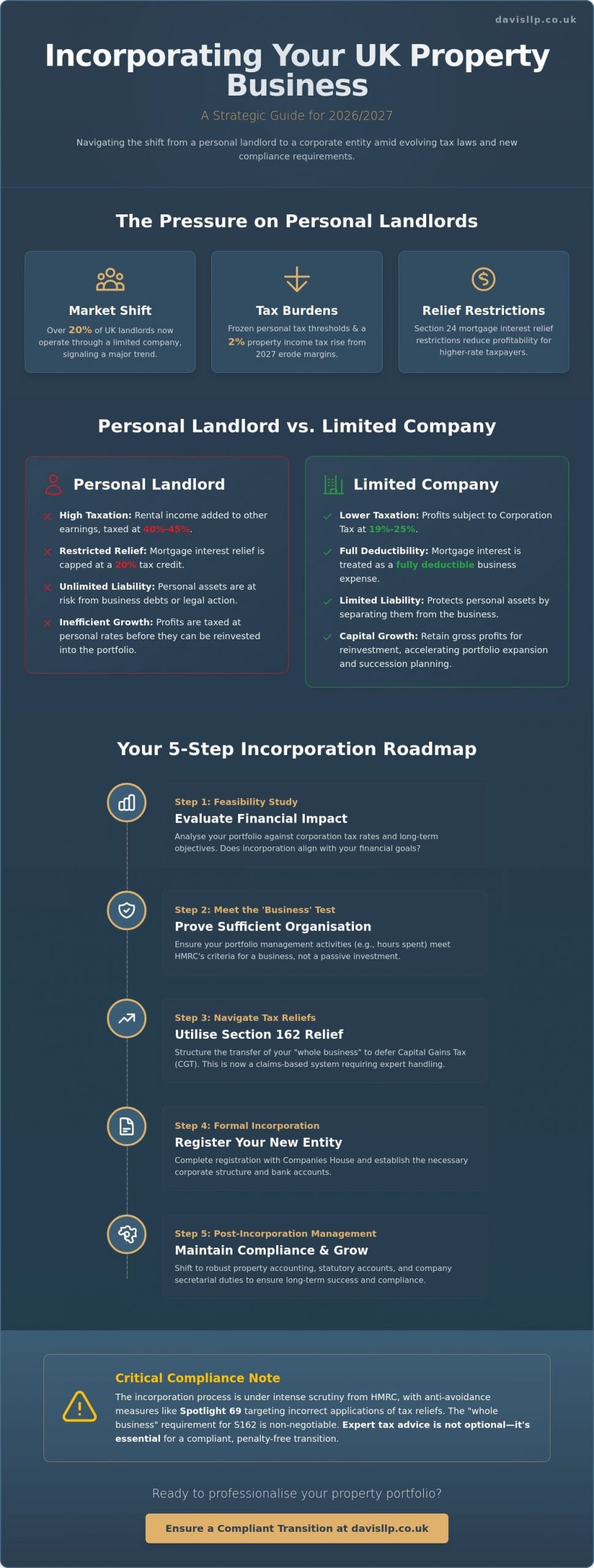
Over 20% of UK landlords now manage their portfolios through a limited company, signaling a fundamental shift from private investment to formal corporate governance. You’ve likely felt the impact of frozen personal tax thresholds and the 2% rise in property income tax rates scheduled for 2027. It’s a challenging environment where mortgage interest relief restrictions continue to erode margins, making the administrative burden of personal ownership feel increasingly unsustainable.
We’ve designed this guide to provide a clear, strategic framework for incorporating a property business uk, focusing on how you can lower your personal tax liability while ensuring full compliance with HMRC’s latest anti-avoidance measures, such as Spotlight 69. We’ll examine the critical move to a claims-based system for Section 162 Incorporation Relief that began in April 2026 and how a corporate structure facilitates professionalized succession planning. Our analysis explores how professional property accounting and tax services can help you transition to a model that offers both stability and long-term growth.
Key Takeaways
- Evaluate the financial impact of frozen personal tax thresholds against current corporation tax rates to determine if a corporate structure aligns with your long-term objectives.
- Gain clarity on the “whole business” requirement when incorporating a property business uk to ensure you utilize Section 162 relief without triggering immediate tax liabilities.
- Assess your current operations against HMRC’s criteria for “sufficient organisation” to ensure your portfolio meets the legal definition of a business rather than a passive investment.
- Implement a structured roadmap for transition, starting with a comprehensive feasibility study and moving toward robust property accounting and management accounts.
- Understand the administrative shift toward statutory accounts and company secretarial duties, ensuring your business remains compliant and professionalised for future succession.
The Evolving Landscape of UK Property Taxation in 2026
The fiscal environment for individual landlords has reached a point of critical friction. For years, the restriction of mortgage interest relief under Section 24 has quietly eroded the viability of personal ownership. By 2026, the combined pressure of frozen personal allowances and a scheduled 2% rise in property income tax rates from April 2027 has made the traditional model feel increasingly restrictive. We’re seeing a decisive movement toward incorporating a property business uk as investors seek a more professionalised vehicle for growth.
When you operate as an individual, your rental income is layered on top of other earnings, often pushing you into the 40% or 45% tax bands. In contrast, the corporate environment offers a more nuanced structure. While the main rate of corporation tax is 25% for profits exceeding £250,000, many businesses benefit from the 19% small profits rate for earnings under £50,000. This disparity allows for more efficient capital retention. By incorporating a property business uk, you can reinvest gross profits into portfolio expansion rather than losing nearly half of your margin to personal taxation.
Why Landlords are Moving Toward Incorporation
The motivation for transitioning to a corporate structure extends beyond immediate tax savings. It’s about building a scalable enterprise. Within a limited company, profits can be retained to fund future acquisitions without triggering personal income tax charges. We often see clients utilise this structure for succession planning; shares can be transferred over time, which is far more flexible than transferring physical property titles. Additionally, in an environment where tenant rights are expanding, the limited liability protection offered by a corporate entity provides a necessary layer of security for your personal assets.
The 2026 Regulatory Context
The 2026 Budget introduced several measures that demand a more sophisticated approach to property management. With the nil-rate bands for inheritance tax remaining frozen and new caps on Business Property Relief, the strategic placement of assets has never been more critical. When you register a new entity with Companies House, you’re not just creating a shell; you’re establishing a formal business that must adhere to rigorous reporting standards. Because the rules regarding Section 162 relief became claims-based in April 2026, securing expert tax advice in the UK is no longer optional. It’s a foundational requirement to ensure your transition doesn’t trigger unforeseen capital gains or stamp duty land tax liabilities.
Key Tax Reliefs: Navigating s162 and s158
The transition from personal ownership to a corporate structure hinges on the effective application of specific tax reliefs to mitigate immediate liabilities. Section 162 Incorporation Relief serves as the primary mechanism for most investors incorporating a property business uk, allowing for the deferral of Capital Gains Tax (CGT) when a business is transferred as a going concern. However, this isn’t a selective process. The “whole business” requirement dictates that all assets of the business must be transferred, preventing landlords from cherry-picking specific properties to move into the company while retaining others personally.
To qualify for these reliefs, the activity must transcend passive investment. According to HMRC’s definition of a property business, there must be a demonstrable level of “business” activity, often measured by the hours spent managing the portfolio. Assets are transferred at their current market value, which establishes the new base cost for the company. This valuation process must be rigorous, as HMRC frequently scrutinises the commercial rationale behind the transfer values to ensure they align with independent market data.
Section 162: The Mechanics of CGT Deferral
Under Section 162, the individual receives shares in the new company as consideration for the business transfer. It’s a relief that rolls over the gain into the base cost of the shares, effectively delaying the tax bill until those shares are eventually sold. It’s vital to calculate the “net value” correctly; this is the market value of the assets minus any business liabilities, such as existing mortgages, being taken over by the company. Since April 2026, this relief is no longer automatic. You must now make a formal claim on your Self-Assessment tax return, supported by detailed documentation of the transfer. Managing this transition requires precise property accounting to ensure the opening balance sheet of the company accurately reflects these values.
SDLT and Partnership Rules
Stamp Duty Land Tax (SDLT) often represents the most significant immediate cost of incorporation. While sole traders generally pay SDLT on the market value of the properties transferred, existing partnerships may benefit from more favourable treatment under Schedule 15 of the Finance Act 2003. This can, in specific circumstances, reduce the SDLT liability to zero. We’ve found that the “two-year rule” is a critical compliance threshold; HMRC often looks for evidence that a genuine partnership existed for at least 24 months before incorporation to prevent “anti-avoidance” challenges. Without this history, the risk of the transfer being reclassified as a series of individual sales is high, which would trigger full SDLT charges at the prevailing corporate rates.
Defining a ‘Business’: HMRC’s Threshold for Incorporation
Establishing a corporate structure is not merely a matter of filing paperwork; it is a fundamental reclassification of your activity in the eyes of HMRC. The distinction between a passive investment and a legitimate business is the pivot upon which tax reliefs like Section 162 turn. While many investors assume that owning several properties automatically constitutes a business, the legal threshold is significantly higher. It requires a level of “sufficient organisation” that mirrors a traditional commercial enterprise rather than a private hobby. When incorporating a property business uk, we must demonstrate that your activity is industrious, regular, and conducted with a clear profit motive.
HMRC’s scrutiny has intensified recently, particularly following the publication of Spotlight 69, which warns against aggressive schemes that lack economic substance. It’s vital to separate these artificial arrangements from legitimate commercial transitions. You can find detailed analysis on the tax implications of incorporation and how to avoid the pitfalls of non-compliant structures. For a transition to be robust, it must be driven by business objectives such as portfolio scaling, liability protection, or succession planning, rather than being an isolated attempt to bypass Section 24 restrictions.
The Ramsay Test: A Benchmark for Business Status
The landmark case of Ramsay v HMRC remains the primary benchmark for defining what constitutes a business in the property sector. In this instance, the Upper Tribunal ruled that a business exists if the activities performed are “serious, pursued with reasonable continuity, and on a sound and recognised business basis.” Generally, this translates to a minimum of 20 hours of active management per week. We help clients document this administrative rigour by maintaining detailed logs of tenant liaison, maintenance oversight, and financial planning. For those with complex or offshore holdings, integrating international tax planning into your business model ensures that the corporate structure remains efficient across multiple jurisdictions.
Evidence of a Trading Partnership
The transition is often most seamless when it originates from a pre-existing partnership. HMRC typically looks for a trail of partnership tax returns as primary evidence that a business was in operation before the company was formed. Beyond tax filings, the commercial reality must be reflected in your daily operations. This includes maintaining dedicated partnership bank accounts, formalising partnership agreements, and ensuring all utility contracts and tenancy agreements are held in the business name. These steps create a clear “audit trail” that distinguishes the business as a separate legal and economic entity, providing the necessary substance to support a claim for incorporation relief.
The Incorporation Roadmap: A Strategic Transition
Moving from the intent of incorporating a property business uk to its successful execution requires a structured sequence of operational and legal events. This is a fundamental transformation of your investment vehicle. We approach this transition through a five-step roadmap designed to ensure that the new corporate entity is both tax-efficient and commercially viable from its inception. The process begins with a rigorous feasibility study, where we model the impact of the 2026 corporation tax rates against your projected rental yields and financing costs.
Once the financial logic is confirmed, the second step involves formalising any existing partnership arrangements. As we discussed regarding the “two-year rule,” HMRC requires evidence of a genuine business partnership prior to the transfer. Step three focuses on securing lender consent. Most personal mortgages cannot simply be transferred; they must be redeemed and replaced with commercial products. Following this, the fourth step is the formal execution of the transfer, where assets are moved into the company in exchange for shares. Finally, step five involves the post-incorporation filings, ensuring that both Companies House and HMRC receive the necessary documentation to recognise the new structure and any associated tax relief claims.
Financing and Mortgage Considerations
The transition to a corporate structure almost always necessitates a shift from personal buy-to-let mortgages to commercial mortgage products. This refinancing process is often the most time-consuming element of the roadmap. You must account for potential early repayment charges (ERCs) on your existing personal loans, which can significantly impact the initial cost-benefit analysis. Lenders in 2026 are particularly focused on the “cleanliness” of the corporate structure. They typically prefer a Special Purpose Vehicle (SPV) that is dedicated solely to property activities, as this simplifies their risk assessment and often leads to more competitive interest rates.
Legal and Administrative Execution
The formal transfer of the portfolio is governed by a ‘Sale and Purchase Agreement’. This document outlines the market value of the properties and the specific consideration, usually shares, provided by the company. Beyond the transfer itself, the administrative burden of maintaining a limited company is higher than that of personal ownership. Utilising professional company secretarial services ensures that your statutory registers are maintained and that all annual filings are accurate. Furthermore, you must legally update all tenant notices and ensure that deposit protection schemes are transferred to the company’s name to avoid potential penalties under the Renters’ Rights Act. If you are ready to begin this transition, our team can provide the professional property accounting required to manage your new corporate portfolio.
Maintaining Excellence: Post-Incorporation Management
Once the formal process of incorporating a property business uk is complete, the focus shifts from the mechanics of transition to the discipline of corporate governance. This is where the true value of the structure is realised. Operating through a limited company replaces the relatively simple personal Self-Assessment with a more rigorous framework of Corporation Tax and statutory accounts. It’s no longer just about tracking rental income; it’s about managing a balance sheet that reflects the long-term health of your property enterprise.
Effective management in 2026 requires moving beyond retrospective bookkeeping. We advocate for robust property accounting systems that provide real-time visibility into your cash flow and tax liabilities. This data allows for more informed director decision-making. Regular management accounts help you understand the impact of the 2027 property tax rises before they take effect, allowing for proactive adjustments to your portfolio or financing. Strategic profit extraction also becomes a primary consideration. Balancing a small salary with dividends, which carry a basic rate of 10.75% in the 2026/27 tax year, alongside employer pension contributions, can significantly optimise your net position compared to personal ownership.
The Role of the Strategic Property Accountant
A strategic small business accountant does more than just ensure compliance; they act as a partner in your growth. As your portfolio scales, we monitor thresholds for the Annual Tax on Enveloped Dwellings (ATED), which applies to corporate-held residential properties valued over £500,000. While many property businesses qualify for relief, the reporting requirements are strict. We ensure these returns are filed accurately to avoid unnecessary penalties and ensure your cash flow management remains efficient.
Long-term Compliance and Governance
Maintaining your standing with Companies House is essential for preserving the benefits of incorporation. This involves meeting strict filing deadlines for annual accounts and confirmation statements, as well as maintaining transparency regarding persons with significant control. For larger property companies, an annual audit and assurance process may become a statutory requirement, providing an additional layer of reliability for lenders and stakeholders. Our approach focuses on building a collaborative partnership, where we provide the ongoing advisory needed to navigate the complexities of the UK’s evolving fiscal landscape. By professionalising your business structure, you aren’t just saving tax; you’re building a resilient, generational asset.
Securing Your Property Legacy for 2026 and Beyond
The landscape of UK property investment is shifting toward a more formalised, corporate approach. As we’ve explored, incorporating a property business uk allows you to mitigate the impact of mortgage interest relief restrictions and access more favourable corporation tax rates. Success depends on more than just a change in legal status; it requires a commitment to rigorous property accounting and a clear understanding of HMRC’s business threshold. By navigating the complexities of Section 162 relief and partnership structures with precision, you can protect your margins and build a resilient vehicle for growth.
At Davis & Co LLP, we’ve served as Chartered Certified Accountants since 1901, providing bespoke advisory for high-net-worth property investors. Our deep-seated expertise in international tax and property accounting ensures your transition is both compliant and strategically sound. Speak with our property tax specialists at Davis & Co LLP to discuss your incorporation strategy. Taking these proactive steps today positions your portfolio for long-term stability in an evolving fiscal market.
Frequently Asked Questions
What is the main benefit of incorporating a property business in 2026?
The primary advantage is the ability to deduct 100% of mortgage interest from rental income before calculating tax, a relief that remains restricted for individual landlords under Section 24. This allows for more efficient capital retention, especially since the corporation tax rate for profits under £50,000 is 19% for the 2026/27 financial year. It’s a structure that supports long-term reinvestment and portfolio scaling more effectively than personal ownership.
Do I have to pay Stamp Duty when I transfer properties to my own company?
Transferring properties to a company is legally treated as a sale at market value, which typically triggers Stamp Duty Land Tax (SDLT) at the prevailing corporate rates. However, if you’re incorporating a property business uk that is currently operated as a genuine partnership, you may qualify for specific relief. Under Schedule 15 of the Finance Act 2003, partnership transfers can sometimes reduce the SDLT liability to zero, provided the partnership has been established for a sufficient period.
What is HMRC Spotlight 69 and how does it affect my incorporation plan?
Spotlight 69 is an HMRC warning against artificial tax avoidance schemes designed to bypass mortgage interest relief restrictions without genuine commercial substance. It doesn’t prohibit legitimate incorporation, but it does target “hybrid” structures that lack economic reality. To ensure your plan is robust, the transition must be a “whole business” transfer with documented management activity. This avoids the risk of HMRC reclassifying the arrangement as a tax avoidance scheme.
How many properties do I need before incorporation becomes tax-efficient?
There is no statutory minimum number of properties, as efficiency depends on your total taxable income and growth objectives. Generally, the move becomes more attractive when rental income pushes you into the higher (40%) or additional (45%) income tax bands. Most investors find the administrative costs and refinancing fees are outweighed by tax savings once they hold three or more properties, though individual circumstances vary based on mortgage debt levels.
Can I incorporate my property business if I only own one rental property?
It’s legally possible to incorporate with a single property, but it is rarely cost-effective due to the high administrative burden and refinancing costs. To qualify for Section 162 relief, you must demonstrate that you’re running a business rather than holding a passive investment. A single property rarely meets the “sufficient organisation” threshold established in case law, which typically looks for a significant weekly commitment to management activities.
What happens to my existing mortgages when I incorporate?
Existing personal mortgages cannot be transferred to a limited company. They must be redeemed and replaced with commercial mortgage products specifically designed for corporate entities. This process usually involves paying early repayment charges if you’re within a fixed-rate period. Lenders will conduct fresh valuations and affordability checks on the new company, often preferring a Special Purpose Vehicle (SPV) that holds only property assets to simplify their risk assessment.
Is incorporation relief (s162) automatic or do I need to claim it?
As of April 6, 2026, Section 162 Incorporation Relief is no longer an automatic entitlement. You must make a formal claim on your Self-Assessment tax return for the year the transfer occurs. This claim must be supported by documentation proving that the business was transferred as a going concern in exchange for shares. All business assets must be included in the transfer to satisfy the “whole business” requirement and successfully defer Capital Gains Tax.
How do I extract profits from a property company tax-efficiently?
Directors typically use a combination of a small salary and dividends to extract funds while staying within the most efficient tax thresholds. For the 2026/27 tax year, the dividend allowance is £500, with the basic rate for dividend tax set at 10.75%. Directing profits into a company pension scheme is another effective method, as these contributions are treated as a deductible business expense, reducing the company’s overall corporation tax liability.