For the sophisticated founder, the Seed Enterprise Investment Scheme is far more than a simple tax incentive; it’s a three-year strategic commitment that demands technical precision to remain effective. We recognize that the complexity of HMRC compliance and the fear of losing relief due to a technical error can be daunting. Having this seed enterprise investment scheme explained through a strategic lens allows you to move past uncertainty and focus on growth. Our experience suggests that a well-structured approach is the difference between a successful raise and a costly compliance failure.
In this guide, we’ll show you how to master the SEIS framework to secure up to £250,000 in vital seed funding while ensuring your investors claim their 50% income tax relief and capital gains tax exemptions. We’ve outlined the 2026 eligibility criteria, including the £350,000 gross asset threshold and the three-year trading limit. You’ll gain a clear understanding of how to maintain compliance for the full three-year term, protecting both your business and your partners. By the end of this article, you’ll have the clarity needed to utilize this scheme as a cornerstone of your capital strategy.
Key Takeaways
- Secure up to £250,000 in early-stage capital by offering investors substantial 50% income tax relief and comprehensive capital gains tax exemptions.
- Understand the specific eligibility requirements for 2026, including the “new qualifying trade” rule and the three-year company age limit, with the seed enterprise investment scheme explained in a clear, actionable format.
- Mitigate the risk of tax relief clawbacks by identifying common compliance pitfalls and adhering to the mandatory three-year shareholding period.
- Explore how we align SEIS with broader growth strategies, such as R&D tax credits and international tax planning, to maximize your firm’s fiscal efficiency.
What is the Seed Enterprise Investment Scheme (SEIS) in 2026?
The Seed Enterprise Investment Scheme (SEIS) represents one of the UK’s most robust fiscal tools for encouraging early-stage entrepreneurship. It’s a government-backed initiative that provides significant tax reliefs to individual investors who purchase new shares in qualifying companies. Having this seed enterprise investment scheme explained through a strategic lens allows founders to see it as more than a tax break; it’s a mechanism for building investor confidence. By utilizing the Seed Enterprise Investment Scheme, you position your startup to attract sophisticated partners who understand the value of risk mitigation in the venture capital landscape of 2026.
While the Enterprise Investment Scheme (EIS) focuses on more established businesses seeking growth capital, SEIS is specifically tailored for the seed stage. It serves as a precursor to EIS. A company cannot transition back to SEIS once it’s utilized EIS funding. This structural hierarchy ensures that capital flows where it’s needed most during the very beginning of the corporate lifecycle. For the 2026 tax year, the scheme remains a cornerstone of the UK’s strategy to foster high-growth potential in sectors like technology, life sciences, and green energy.
The Evolution of SEIS Limits
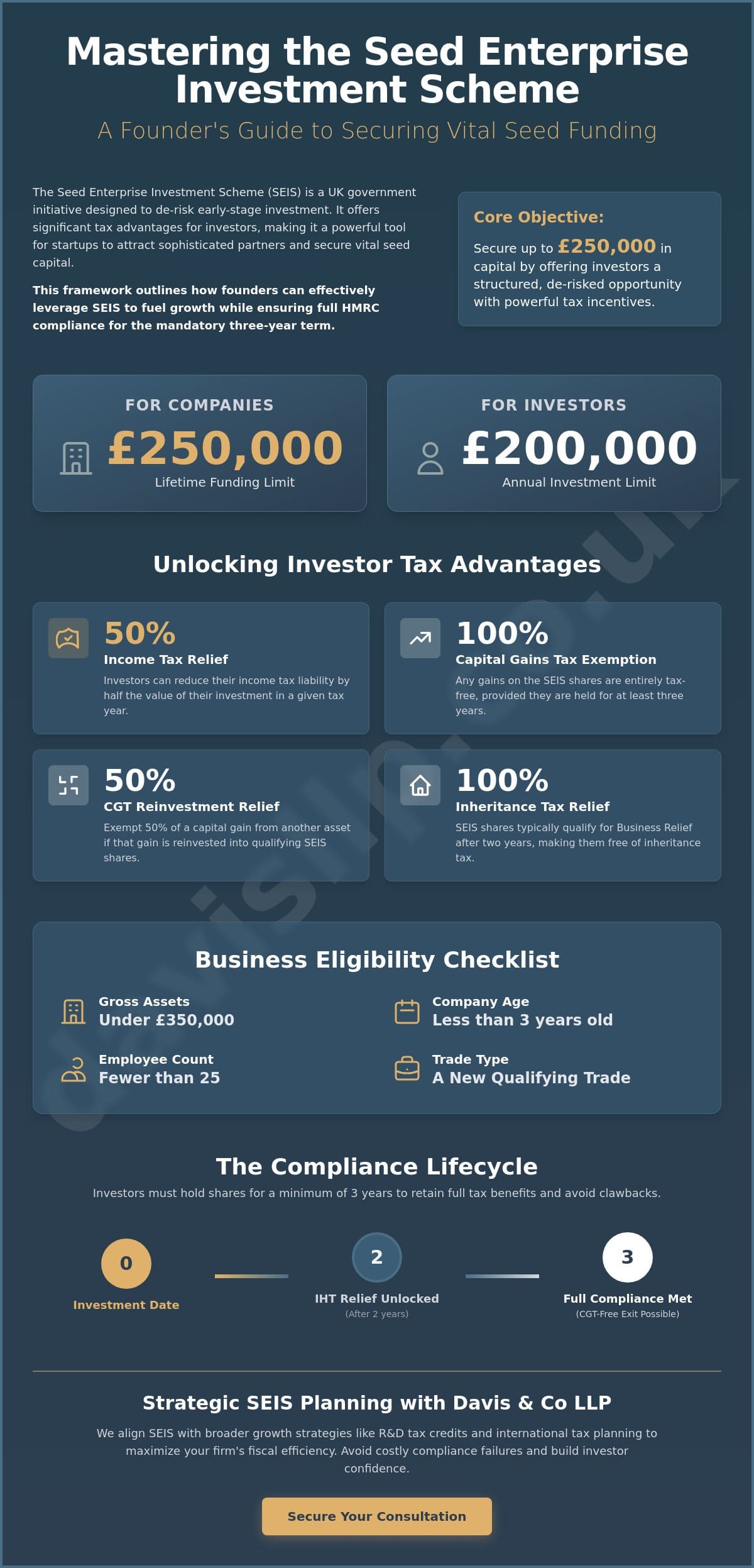
The current landscape is defined by the significant expansions made to the scheme’s capacity. Companies can now raise a lifetime maximum of £250,000 through SEIS, which is a substantial increase from previous thresholds. For the individual investor, the annual limit is set at £200,000 per tax year. We find that the 2023/24 expansion remains the benchmark for 2026 planning. It fundamentally changed the scale of seed rounds, allowing founders to extend their operational runway without seeking immediate Series A participation. This increased capacity reflects a recognition of the rising costs associated with launching a scalable business.
Core Objectives for Founders and Investors
The scheme’s primary function is to de-risk equity investments in high-risk environments. By offering a 50% income tax break, the government effectively halves the investor’s downside risk from the outset. This creates vital liquidity for startups entering the “valley of death,” that precarious period between initial product development and sustainable revenue. It’s a system that reinforces the UK’s standing as a global hub for innovation. We see it as a collaborative partnership where the state shares the risk to ensure that high-potential ideas don’t fail simply due to a lack of early-stage capital. For investors, it transforms a high-risk gamble into a structured, tax-efficient component of a diversified portfolio.
Analysing the Tax Advantages for Investors and Businesses
The fiscal advantages of the scheme are designed to offset the inherent volatility of early-stage ventures. Primary among these is the 50% income tax relief, which allows an investor to reduce their tax liability by half the value of their investment. This immediate recovery of capital is a powerful incentive, effectively subsidizing the entry cost into a new venture. When we look at the seed enterprise investment scheme explained in the context of a broader portfolio, the immediate tax saving provides a significant cushion against the risk of the underlying asset.
Beyond the initial relief, the Capital Gains Tax (CGT) reinvestment relief offers a compelling way to manage existing tax liabilities. Investors can receive a 50% exemption on a capital gain from another asset if that gain is reinvested into SEIS-qualifying shares. This is complemented by the fact that any future gains on the SEIS shares themselves are entirely tax-free, provided they are held for at least three years. As noted in the British Business Bank’s SEIS guide, these incentives are pivotal in bridging the funding gap for innovative startups and high-growth potential firms.
Inheritance Tax (IHT) planning also benefits from the scheme’s structure. Shares in SEIS companies typically qualify for Business Relief after a two-year holding period. This means they can be passed on free of IHT, provided the company still qualifies at the time of death. It’s a sophisticated layer of protection that appeals to long-term investors looking to preserve family wealth while supporting the next generation of UK business leaders. For those managing complex wealth structures, these benefits often form a core part of their international tax planning efforts.
Loss Relief: The Ultimate Safety Net
If a startup fails, loss relief provides a final layer of protection. This allows an investor to offset their net loss against their income tax bill at their marginal rate. For a top-rate taxpayer utilizing both the 50% income tax relief and CGT reinvestment relief, the total capital at risk can be as low as 13.5p for every £1 invested. This calculation assumes the investor is offsetting a gain taxed at the higher rates. We advise clients to carefully time these claims to ensure they maximize the relief against their highest-taxed income.
Benefits to the Issuing Company
For the founder, the scheme is a catalyst for attracting “smart money” from experienced angel investors. These individuals often prioritize SEIS-eligible deals because of the structured downside protection. This leads to a lower cost of capital than traditional debt, which often isn’t even available to pre-revenue firms. By utilizing SEIS, you’re not just raising funds; you’re building a cap table filled with sophisticated partners who are incentivized to help you reach a Series A round. This alignment of interests is fundamental to sustainable growth and long-term stability.
Eligibility Criteria: Can Your Business Qualify?
Determining eligibility is the most critical hurdle for any founder seeking investment. While the broad strokes of the seed enterprise investment scheme explained in earlier sections highlight its benefits, the technical criteria are where many applications falter. To qualify, your company must be involved in a “new qualifying trade.” This means the business cannot simply be a continuation of an older trade or a pivot from an existing entity. HMRC looks for genuine novelty and a fresh commercial start, ensuring that the relief supports truly nascent ventures.
The age limit is equally strict. Your company must have been trading for less than three years from the date of its first commercial sale. This date is often a point of contention with HMRC; we advise maintaining meticulous records of your first invoices to avoid disputes. Additionally, your business must have fewer than 25 full-time equivalent employees and gross assets not exceeding £350,000 immediately before the share issue. These limits ensure the capital is directed toward early-stage ventures rather than established firms seeking a tax-efficient refinance.
Beyond the hard numbers, the “Risk to Capital” condition remains a subjective but pivotal test. HMRC must be satisfied that the company has a long-term objective to grow and develop its trade, and that the investment poses a significant risk to the investor’s capital. This isn’t a box-ticking exercise. It requires a narrative that demonstrates a genuine entrepreneurial venture where there’s a real possibility that the investor could lose more than they gain.
Disqualified Trades and Activities
Certain sectors are excluded from the scheme to prevent its use in low-risk or asset-backed industries. Property development, legal services, banking, and insurance are typically disqualified. We also see issues with “incidental” non-qualifying activities. If more than 20% of your trade involves disqualified activities, your entire eligibility may be compromised. Our team at Davis & Co LLP conducts rigorous assessments of your specific trade activities to ensure they meet HMRC’s stringent definitions before you approach your first investor.
The Advance Assurance Process
Obtaining Advance Assurance is a non-negotiable step for any serious founder. It provides a provisional confirmation from HMRC that your company and its shares will qualify for the scheme. You’ll need to submit a comprehensive business plan, three-year financial forecasts, and your articles of association. In the 2025-2026 period, 4,085 applications were received with a 76% approval rate. While timelines vary, you should expect a response within four to six weeks, provided your documentation is complete and precise.
The Compliance Lifecycle: Avoiding SEIS Relief Clawbacks
Securing initial funding is a significant milestone, yet it marks the beginning of a complex three-year compliance lifecycle. Many founders mistakenly view the scheme as a “set and forget” arrangement, but HMRC requirements remain active long after the capital hits the bank. Having the seed enterprise investment scheme explained as a continuous process is vital because any breach during the first 36 months can lead to a full clawback of the tax reliefs. This three-year rule is the most critical period for maintaining the integrity of the investment.
Common pitfalls often involve share buybacks or accidental repayments of debt to investors. If a company repurchases shares from any shareholder within the three-year window, it can trigger a withdrawal of relief for all SEIS investors. Similarly, the “substantial interest” rule prohibits any investor from owning more than 30% of the company’s ordinary share capital, voting rights, or assets on a winding up. This restriction includes shares held by “associates,” such as spouses or business partners, making cap table management a delicate task. We also monitor “value received” rules, which prevent investors from receiving non-commercial benefits that could be interpreted as a return of capital.
Ongoing Reporting Requirements
Compliance is maintained through timely filings and accurate documentation. You must submit the SEIS1 compliance statement only after your company has carried out its qualifying trade for at least four months or has spent at least 70% of the total amount raised. Once HMRC approves the statement, you can issue SEIS3 certificates to your investors. These certificates are the formal documents they need to claim their 50% income tax relief. Missing these windows or providing inaccurate data can delay your investors’ claims and damage your relationship with your backers.
Managing Changes in Business Structure
Strategic shifts in your business model or capital structure require careful oversight. If your company is acquired or merges within the first three years, the SEIS relief is typically withdrawn unless the transaction is a qualifying share-for-share exchange. Issuing new classes of shares can also complicate matters if they carry preferential rights that violate SEIS conditions. We find that maintaining regular management accounts is essential for monitoring these thresholds in real time. This proactive approach ensures that operational decisions don’t inadvertently compromise your tax status. To ensure your business remains fully compliant throughout its growth phase, contact our specialist team for a tailored compliance audit.
Strategic SEIS Planning with Davis & Co LLP
Effective capital raising requires more than just a passing understanding of tax law; it demands a cohesive strategy that aligns with your long-term commercial objectives. We view the scheme as a foundational element of a much larger fiscal architecture. By having the seed enterprise investment scheme explained within the context of your total tax exposure, we help you identify synergies that less specialized practices might overlook. For instance, we frequently integrate SEIS with international tax planning for firms with global ambitions, ensuring that your UK-based incentives don’t conflict with future cross-border structures.
For technology-led startups, we emphasize the powerful combination of SEIS and R&D tax credits. While SEIS provides the initial equity injection, R&D credits offer a recurring cash benefit that extends your runway without further dilution. This dual-track approach creates a robust financial base. We also act as the strategic bridge between funding rounds. Because a company cannot utilize SEIS after it has received EIS investment, the timing of your share issues is paramount. We manage this transition meticulously, preparing your cap table for the increased scrutiny of Series A investors and larger venture capital firms.
Beyond the Filing: Growth and Advisory
Our partnership extends far beyond the submission of compliance statements. We utilize the capital raised through SEIS to drive business growth acceleration, focusing on high-impact operational milestones. Central to this is disciplined Cash Flow Management. We ensure that your newly acquired capital is deployed with precision, maintaining the liquidity necessary to weather the early stages of market entry. Our role is to protect the founders’ equity by ensuring every pound of SEIS funding is used to build tangible value, satisfying both your internal goals and your investors’ expectations for growth.
Why Professional Gravitas Matters
In high-stakes negotiations, the presence of a trusted advisor provides a layer of credibility that can be the deciding factor for sophisticated angels. Investors feel more secure when they know a business has access to expert tax advice, as it reduces the perceived risk of future HMRC challenges. Our professional standing and history of successful compliance act as a seal of quality for your pitch deck. Ultimately, a compliant and strategically managed SEIS structure is about more than just immediate tax relief; it’s about building a stable, reputable, and scalable enterprise that is ready for the challenges of 2026 and beyond.
Securing Your Startup’s Fiscal Future
We’ve analyzed the technical nuances of the scheme, from the £250,000 raising limit to the meticulous three-year compliance lifecycle. Having the seed enterprise investment scheme explained as a strategic asset rather than a mere filing requirement ensures that you build a foundation attractive to sophisticated investors. Success in 2026 requires a balance between aggressive growth and disciplined adherence to HMRC’s standards. Our experience suggests that those who prioritize early-stage compliance often find the smoothest path to future funding rounds.
As Chartered Certified Accountants since 1901, we bring over a century of reliability to your venture. Our specialists in strategic business growth and international tax possess deep expertise in navigating complex HMRC venture capital schemes. We offer the composed partnership necessary to manage sensitive commercial matters with precision and discretion. Consult with our specialist tax advisors to structure your SEIS raise and protect the long-term interests of both your founders and your investors. We look forward to helping you transform your vision into a resilient, high-growth enterprise.
Frequently Asked Questions
Can a director of a company claim SEIS tax relief?
Directors can often claim SEIS tax relief, provided they meet specific criteria regarding remuneration and shareholding. Generally, an unremunerated director is eligible, while a paid director may qualify if they satisfy the “substantial interest” rules and were not previously involved in the company’s trade. We ensure that a director’s involvement is structured to satisfy HMRC’s definition of a qualifying investor without breaching the 30% shareholding limit.
What is the maximum amount a company can raise under SEIS in 2026?
A company can raise a lifetime maximum of £250,000 under the Seed Enterprise Investment Scheme. This limit, which was increased from £150,000 in April 2023, remains the current threshold for the 2025-2026 tax year. It’s essential to plan your funding rounds carefully; any investment raised beyond this cap will not qualify for SEIS tax benefits, and you cannot utilize the scheme once you have raised capital through the Enterprise Investment Scheme (EIS).
How long must an investor hold SEIS shares to keep the tax relief?
Investors must hold their SEIS shares for a minimum of three years from the date of issue to retain their tax reliefs. If shares are sold or transferred before this 36-month period concludes, HMRC will likely withdraw the 50% income tax relief and any capital gains tax exemptions. This holding period ensures that the capital remains committed to the business during its most critical early growth phase, providing the stability needed for long-term development.
Can SEIS and EIS be used in the same funding round?
You can use SEIS and EIS in the same funding round, but the SEIS shares must be issued before any EIS shares. HMRC requires a clear distinction between the two, as a company cannot utilize SEIS once it has officially received investment through the EIS. We assist founders in sequencing these share issues to ensure that the maximum possible relief is secured for early backers while maintaining full compliance with venture capital scheme regulations.
What happens if my company fails after receiving SEIS investment?
If a company fails, investors can claim loss relief on their net investment at their marginal rate of income tax. This is a vital component of having the seed enterprise investment scheme explained as a risk-mitigation tool. Even if the business ceases trading, the combination of the initial 50% tax relief and subsequent loss relief can significantly reduce the total capital an investor actually loses, often limiting the downside to a fraction of the original investment.
Is there a deadline for HMRC to process an SEIS1 compliance statement?
HMRC does not have a strict statutory deadline for processing an SEIS1 compliance statement, though they typically aim to respond within 15 to 30 working days. You can only submit this statement after your company has traded for four months or spent at least 70% of the investment. Delays often occur if the initial application lacks the necessary financial forecasts or business plan details required for a thorough technical review.
Does SEIS relief apply to Capital Gains Tax on other assets?
SEIS relief does apply to Capital Gains Tax on other assets through a mechanism known as reinvestment relief. If you reinvest a gain from the sale of any asset into SEIS-qualifying shares, you can claim a 50% exemption on that original gain. This is a unique benefit that makes the seed enterprise investment scheme explained particularly attractive for investors who have recently disposed of property or other high-value assets and face a significant tax bill.
What is the “Risk to Capital” condition for SEIS?
The “Risk to Capital” condition is a subjective test where HMRC assesses whether the company has a genuine intent to grow and if the investor’s capital is truly at risk. The investment must not be a “low-risk” arrangement designed solely for tax avoidance. Your business plan must demonstrate that there is a significant chance the investor could lose more capital than they gain through the tax reliefs, reflecting the high-risk nature of seed-stage entrepreneurship.