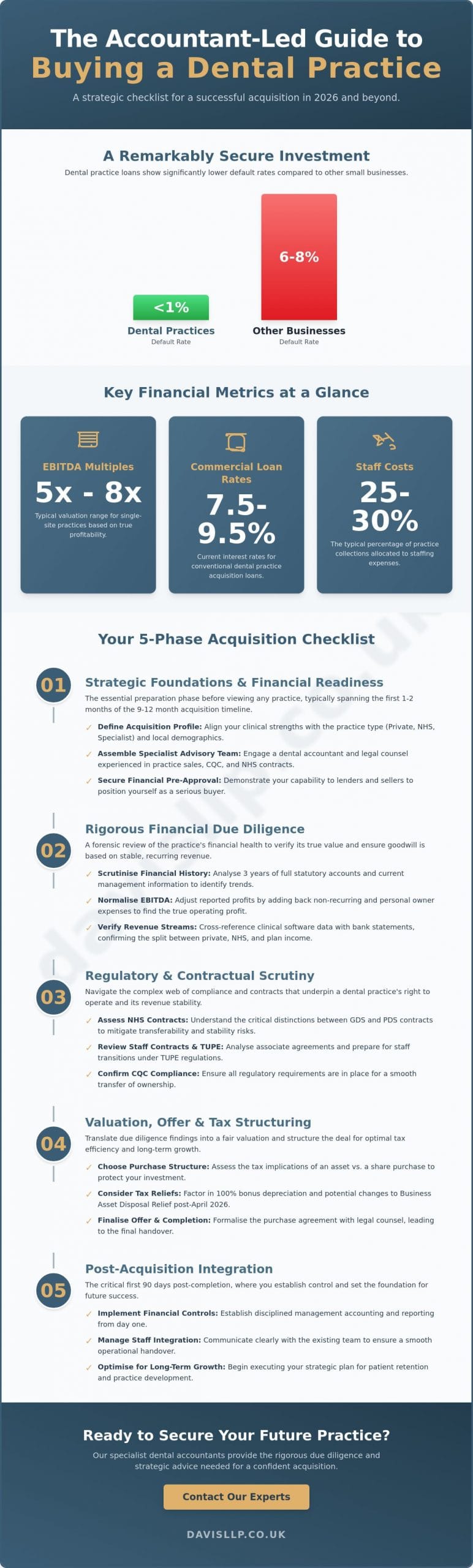
Did you know that dental practice loans maintain a default rate of less than 1%, which is significantly lower than the 6% to 8% seen in other small business sectors? This remarkable stability makes dentistry an exceptionally secure investment, yet the path to a successful acquisition in 2026 requires a rigorous buying a dental practice checklist to navigate the evolving financial and regulatory environment. We recognise that while you’re eager to build your legacy, you’re likely navigating concerns regarding hidden liabilities in practice accounts or the complexities of NHS contract transfers. It’s natural to feel a sense of caution when evaluating the true value of goodwill or managing staff transitions under TUPE.
This article provides a comprehensive, accountant-led framework for navigating the financial and operational complexities of your acquisition. We’ll explore how the 100% bonus depreciation and current EBITDA multiples, which typically range from 5x to 8x for single sites, should influence your valuation. We also address the strategic timing of your purchase in light of potential shifts in Business Asset Disposal Relief after April 2026, ensuring your new venture stands on a firm financial foundation from the outset.
Key Takeaways
- Define your acquisition profile with precision to ensure your personal financial capacity aligns with the requirements for commercial lending and long-term growth.
- Follow a structured buying a dental practice checklist to scrutinise statutory accounts and management information, ensuring the true value of goodwill is accurately reflected.
- Understand the critical distinctions between GDS and PDS contracts to mitigate risks associated with NHS contract stability and transferability.
- Assess the complex tax implications of asset versus share purchases to choose a structure that protects your investment and facilitates future growth.
- Establish disciplined management accounting and financial controls during the initial 90-day integration phase to secure the practice’s operational and fiscal health.
Establishing Strategic Foundations and Financial Readiness
Success in the 2026 dental market begins long before the first viewing. It requires an analytical approach to your professional objectives and a clear-eyed assessment of your fiscal position. This phase forms the first pillar of any robust buying a dental practice checklist. We believe that clarity at this stage prevents costly misalignments later, especially as interest rates for conventional loans currently hover between 7.5% and 9.5%. Your readiness isn’t merely about having the capital; it’s about having a documented strategy that demonstrates your capability to lenders and sellers alike.
Defining Your Practice Profile
You must decide whether your clinical strengths align better with a private boutique, an NHS-heavy community practice, or a specialist referral hub. A private practice requires a sophisticated marketing strategy and high patient retention. Conversely, an NHS-heavy model demands operational efficiency to manage lower margins. We suggest evaluating the local patient demographic and competitive density to determine if a turnkey operation justifies its premium or if a turnaround opportunity offers better long-term growth. This decision dictates your recruitment needs, equipment investment, and your daily clinical pace.
Assembling the Specialist Advisory Team
The complexity of dental acquisitions means that generalist advisors often overlook sector-specific nuances like UDA delivery risks or associate retention clauses. A specialist dental accountant is essential for vetting preliminary data and initiating the due diligence process. Their role is to ensure the practice’s reported EBITDA isn’t artificially inflated by under-investing in equipment or ignoring rising staff costs, which now account for 25% to 30% of collections. Having a specialist on your team is a non-negotiable part of your buying a dental practice checklist because they understand the specific tax structures that benefit dental practitioners. Legal counsel with specific experience in dental sales is equally vital to manage the intricacies of CQC registration and NHS contract transfers.
Setting a 2026 timeline requires a disciplined approach. From the initial search to clinical handover, the process typically spans nine to twelve months. Securing pre-approval for commercial lending early in this journey positions you as a serious buyer in a market where Dental Service Organisations (DSOs) are increasingly aggressive. By establishing these strategic foundations, you transition from a hopeful buyer to a prepared investor, ready to act with confidence when the right opportunity emerges. We’ve seen that those who invest time in this preparatory phase often secure better terms and experience fewer delays during the final stages of completion.
Rigorous Financial Due Diligence: Beyond the Balance Sheet
Financial due diligence is where the perceived value of a practice meets the reality of its cash flow. It’s the most critical phase in your buying a dental practice checklist. We look beyond surface-level statutory accounts to understand the underlying drivers of profitability. It’s essential to scrutinise three years of full statutory accounts alongside current management information to identify trends that a single year’s data might mask. This forensic approach ensures that the “goodwill” you’re purchasing is rooted in verifiable patient retention and recurring revenue rather than a temporary spike in high-value treatments.
The EBITDA Normalization Process
Normalization is the process of identifying and adding back non-commercial expenses that won’t persist after the sale. This includes the principal’s personal drawings, one-off clinical equipment repairs, or discretionary travel costs. We focus on assessing the true profitability under new management, ensuring that the 5x to 8x multiples often seen in 2026 are applied to an accurate figure. This prevents you from overpaying for a lifestyle business that lacks scalable systems. In dental valuations, EBITDA represents the practice’s earnings before interest, taxes, depreciation, and amortisation, adjusted to reflect the true operating profit available to a new owner.
Verifying Revenue and Patient Data
A robust audit requires cross-referencing clinical software reports with actual financial bank statements. We verify the split between private, NHS, and plan-based income to ensure the revenue stream is balanced. Understanding the current fee structure is vital; if fees haven’t been adjusted for inflation, you may face immediate pressure to raise them, risking patient attrition. We also examine dental practice regulations and compliance history to ensure the practice hasn’t achieved its revenue through unsustainable clinical volumes. Identifying hidden liabilities like equipment leases, deferred tax, and staff accruals is equally paramount during this review.
For practices with NHS contracts, we analyse UDA performance to assess the risk of clawbacks, which can devastate your first year of cash flow. We also perform a ‘Goodwill’ audit to verify patient retention rates and recurring revenue. If you’re concerned about navigating these complexities, our dental tax specialists can provide the forensic analysis required to secure your investment. We believe that a disciplined investigation today prevents unforeseen fiscal challenges tomorrow, allowing you to focus on clinical excellence from day one.
Navigating Regulatory Compliance and Contractual Obligations
The regulatory landscape in 2026 requires a more proactive approach than simply following a standard solicitor’s brief. While our previous discussion focused on the forensic audit of accounts, this stage of your buying a dental practice checklist ensures the legal right to operate remains intact. We’ve observed that delays in completion often stem from a lack of foresight regarding regulatory timelines, particularly where the Care Quality Commission (CQC) is concerned. It’s not enough to assume the status quo will suffice; you must actively manage the transition of registrations and contracts to protect your investment’s continuity.
CQC and NHS Contract Transfers
Managing the CQC registration transfer is a delicate process that requires early intervention. The 2026 requirements for Registered Manager status are more stringent, demanding clear evidence of clinical governance and leadership capability. Completion cannot occur until the CQC approves the new provider’s registration, a process that can take several months. We recommend initiating this alongside your financial due diligence to avoid costly delays. Similarly, NHS contract due diligence is vital. You must distinguish between General Dental Services (GDS) and Personal Dental Services (PDS) agreements. We ensure the contract isn’t at risk of termination upon sale and that the provider’s history of UDA delivery won’t trigger immediate performance reviews under new ownership.
Staffing and TUPE Considerations
Your team is the practice’s most valuable asset, yet they represent a significant legal liability if handled incorrectly. The Transfer of Undertakings (Protection of Employment) regulations, or TUPE, mean you inherit the existing staff’s terms and conditions. It’s an integral component of any buying a dental practice checklist to review associate agreements with precision. We look for indicators of employment risk in supposedly self-employed contracts, as HMRC’s scrutiny of IR35 compliance remains high. Beyond the legalities, we assess staff pension compliance and holiday pay accruals to ensure no hidden costs surface post-completion. Managing the cultural transition is equally essential; securing the retention of key staff prevents the loss of patient goodwill and maintains operational stability during the first 90 days.
Property and leasehold arrangements also demand rigorous scrutiny. We review service charges and ‘rent review’ clauses to identify potential spikes in overhead. A lease that’s nearing its end or lacks the protection of the Landlord and Tenant Act 1954 can undermine the practice’s long-term value. By addressing these contractual obligations early, we help you build a secure framework that supports both clinical excellence and commercial growth. It’s this level of detail that transforms a simple purchase into a strategic acquisition.
The Acquisition Lifecycle: From Valuation to Final Completion
Once you’ve identified a target that meets your clinical and strategic criteria, the process shifts from investigation to execution. This phase of the buying a dental practice checklist is where the fiscal architecture of the deal is defined. We begin with the Heads of Terms, a document that, while largely non-binding, sets the roadmap for the entire transaction. It’s vital to secure an exclusivity or ‘lock-out’ period at this stage. This prevents the seller from negotiating with other parties, such as aggressive Dental Service Organisations, while you incur the costs of detailed professional advice. A clear set of terms provides the stability required to move forward with confidence.
Asset vs. Share Purchase Strategies
The choice between an asset or share purchase is one of the most significant financial decisions you’ll make. In an asset purchase, you buy the goodwill, equipment, and patient list, allowing you to “step up” the value of inherited assets for capital allowances. Conversely, a share purchase involves acquiring the entire limited company. A share purchase requires deeper tax due diligence because you inherit the company’s entire history, including potential latent tax liabilities. Sellers often prefer share sales to utilise Business Asset Disposal Relief, which offers a 10% tax rate on qualifying gains, though this relief may face changes after April 2026. We help you weigh these implications to ensure the chosen structure aligns with your long-term profit extraction goals.
Securing Specialist Financing
Lenders in 2026 remain supportive of the dental sector due to its historically low default rates, yet they’ve become more discerning regarding a practice’s operational resilience. When you’re finalising funding, specialist healthcare lenders will scrutinise your business plan and cash flow forecast with rigour. They view dental ‘goodwill’ as strong security, but they’ll expect to see how you plan to manage rising staff costs, which now average 25% to 30% of collections. We often advise on structuring the loan with a mix of capital repayment and potential interest-only periods to protect your initial cash flow during the transition. If you’re unsure how to present your financial position to a lender, our dental tax specialist team can assist in preparing the robust documentation required for approval.
The final hurdle is the Disclosure Letter. This is the seller’s opportunity to limit their liability by disclosing specific issues that contradict the warranties in the sale agreement. We review this document alongside your legal counsel to ensure that any disclosed risks, such as pending staff grievances or equipment failures, are reflected in the final purchase price. By maintaining a disciplined approach through to completion, you ensure that the practice you’re buying is exactly the practice you’ve planned for. This meticulous attention to detail is what separates a successful acquisition from a problematic one.
Post-Acquisition Integration and Long-Term Tax Optimization
The final stage of any buying a dental practice checklist involves the transition from acquisition to active management. Completion marks the beginning of a critical 90-day integration period where the establishment of fiscal control and operational visibility becomes paramount. We believe that the momentum built during the due diligence phase should translate into immediate structural improvements. This isn’t merely about maintaining the status quo; it’s about implementing the financial discipline required to optimise a practice where overhead costs can consume between 59% and 67% of collections. Our role is to ensure your new venture operates with the precision of a high-calibre clinical institution from day one.
Financial Systems and Management Reporting
Integrating cloud-based bookkeeping allows for real-time profitability tracking across different clinical departments. We recommend setting clear KPIs for UDA delivery to monitor NHS performance against contract requirements while simultaneously tracking private treatment conversion rates. Regular review of management accounts is essential for informed decision-making. These reports provide the clarity needed to identify if staff costs, which typically account for 25% to 30% of revenue, are aligned with industry benchmarks. By automating these processes, you reduce the administrative burden on your team and gain a transparent view of your cash flow.
Long-Term Tax and Wealth Planning
Strategic tax planning should begin the moment you take ownership to ensure you’re utilising corporate structures effectively for profit extraction. We help you look ahead to future exit or succession events, ensuring the business is structured to be tax-efficient from the outset. Managing your personal tax liabilities requires expert tax advice in the UK, particularly as regulations around capital gains and dividend tax continue to evolve. In 2026, we also focus on leveraging R&D tax credits for clinical innovation, such as the adoption of advanced digital scanning or 3D printing technologies. This proactive approach ensures that your wealth grows in tandem with your clinical reputation.
Ongoing compliance remains a cornerstone of your operational stability. We manage the complexities of VAT, payroll, and statutory audit requirements so you can focus on clinical expansion. Identifying opportunities for efficiency gains, such as renegotiating supplier contracts or expanding specialist referral services, drives growth acceleration. By following this comprehensive buying a dental practice checklist through to the post-acquisition phase, you transform a clinical facility into a high-performing commercial asset. We position ourselves as your strategic partner, providing the intellectual rigour and dependable advice required to navigate the complexities of practice ownership over the long term.
Securing Your Future in Clinical Ownership
Acquiring a dental practice is a significant milestone that requires a blend of clinical ambition and fiscal precision. By following a structured buying a dental practice checklist, you’ve established the groundwork for a transaction that prioritises long-term stability over short-term gains. We’ve explored how forensic due diligence, regulatory foresight, and strategic tax planning work in concert to protect your investment in an evolving market. Success in 2026 demands more than just identifying a viable location; it requires a deep understanding of EBITDA normalisation and the nuances of NHS contract transfers to ensure your capital is deployed effectively.
Navigating these complexities alone can be daunting, but you don’t have to manage the burden of financial scrutiny without support. We invite you to partner with Davis & Co LLP for specialist dental tax and acquisition support. As Chartered Certified Accountants established since 1901, we provide niche dental expertise and sophisticated advice on international and UK tax planning. Our history of professional gravitas ensures your transition into practice ownership is handled with the discretion and intellectual rigour it deserves. We look forward to helping you build a thriving clinical legacy with confidence.
Frequently Asked Questions
What is the difference between an asset purchase and a share purchase when buying a dental practice?
An asset purchase involves buying specific components like goodwill, equipment, and the patient list, whereas a share purchase means acquiring the entire limited company. Asset sales allow you to “step up” the value of equipment for capital allowances, potentially reducing future tax bills. Share sales are often preferred by sellers for tax efficiency but require you to inherit the company’s full legal and tax history, necessitating more rigorous due diligence.
How long does the average dental practice acquisition take in 2026?
The average acquisition currently takes between nine and twelve months from the initial offer to final completion. This timeline is largely dictated by the Care Quality Commission (CQC) registration process and the complexities of NHS contract transfers. We suggest incorporating these milestones into your buying a dental practice checklist early in the process to ensure that regulatory delays don’t interfere with your planned clinical handover date.
What are Units of Dental Activity (UDAs) and why do they matter in due diligence?
Units of Dental Activity (UDAs) are the primary measure of output for NHS dental contracts and are essential for assessing a practice’s revenue stability. During due diligence, we scrutinise the practice’s history of delivery to identify any risks of financial clawbacks. If a practice has consistently under-delivered its contracted units, the new owner may inherit a significant financial liability or face a permanent reduction in contract value shortly after completion.
Do I need to re-apply to the CQC if I am buying an existing dental practice?
You must apply for a new provider registration or a manager registration depending on how the acquisition is structured. Even when a practice is already registered, the CQC requires a formal application to verify that the new owner meets current fitness and clinical governance standards. This process is a frequent source of completion delays, so it’s vital to submit your application as soon as the deal structure is finalised.
How is ‘goodwill’ valued in a dental practice sale?
Goodwill is typically valued as a multiple of EBITDA or as a percentage of annual collections, which often ranges from 60% to 80%. In 2026, single-location practices are generally commanding multiples of 5x to 8x EBITDA. Larger groups or multi-location practices often see higher multiples, sometimes reaching 12x or 14x, due to the continued aggressive interest from Dental Service Organisations and private equity groups.
What happens to the existing staff under TUPE regulations during a practice takeover?
Existing staff automatically transfer to the new owner on their current terms and conditions under TUPE regulations. This protects employee rights but means you inherit all historical liabilities related to their employment, including any past grievances or underpaid entitlements. It’s essential to audit holiday pay accruals and pension compliance during the due diligence phase to ensure no unforeseen costs emerge once you take control of the team.
Can I buy a dental practice as an associate without a large deposit?
Many specialist healthcare lenders offer high loan-to-value products for associates, sometimes requiring a deposit as low as 10%. While conventional loan rates for 2026 currently sit between 7.5% and 9.5%, lenders view the dental sector as exceptionally low risk due to default rates remaining under 1%. A robust business plan and a clear cash flow forecast are often more influential in securing funding than the size of your cash reserve.
What are the common ‘hidden costs’ found after completing a dental practice purchase?
Common post-completion costs include mandatory digital security upgrades and addressing under-accrued staff liabilities. For instance, practices must now comply with the February 16, 2026, HIPAA Notice of Privacy Practices update, which may require immediate administrative investment. Including these regulatory requirements in your buying a dental practice checklist ensures you’re prepared for the reality that staff costs now account for approximately 25% to 30% of total collections.