With the Inheritance Tax nil-rate band frozen at £325,000 until 2031, a threshold unchanged since 2009, the quiet impact of fiscal drag is now capturing more family estates than ever before. It’s a sobering reality that makes the role of a specialist trust tax accountant uk more critical than simply filing annual returns. It’s about defending the integrity of your legacy against an increasingly complex regulatory tide.
We recognize the weight of responsibility that comes with managing multi-generational wealth. You likely feel the pressure of tightening Business Property Relief caps and the rigorous demands of the Trust Registration Service. This guide provides a clear path through these challenges. You’ll discover how specialist trust tax accounting secures family wealth, ensures absolute HMRC compliance, and optimizes your long-term fiscal efficiency. We’ll examine the strategic adjustments required for 2026 to minimize tax leakage and establish a resilient asset protection strategy. By aligning technical precision with your family’s unique objectives, we can transform static compliance into a dynamic tool for preservation.
Key Takeaways
- Understand why a dedicated trust tax accountant uk is essential for navigating the intricate intersection of UK trust law and fiduciary responsibility.
- Navigate the 2026 fiscal landscape with a comprehensive breakdown of updated rates for Income Tax, Capital Gains, and Inheritance Tax.
- Explore strategic frameworks, such as settlor-interested trusts and international planning, to protect assets and prevent cross-border tax leakage.
- Ensure full regulatory adherence by mastering the latest Trust Registration Service (TRS) requirements and mandatory reporting deadlines for 2026.
- Discover how a composed professional partnership can secure your family’s financial legacy through discreet, individualized service delivery.
The Essential Role of a Specialist Trust Tax Accountant in the UK
Managing a trust in the current fiscal climate is no longer a simple administrative duty. It’s a high-stakes commitment to preserving a family legacy against a backdrop of shifting legislation and increased HMRC scrutiny. A specialist trust tax accountant uk serves as the guardian of this process, ensuring that the intersection of legal duty and financial optimization remains balanced. Trust tax accounting is the strategic management of a trust’s fiscal obligations to protect beneficiary interests.
Generalist accountants often lack the granular knowledge required to handle the specific nuances of the Taxation of UK trusts. While a standard practitioner might be proficient in corporate or personal filings, trusts operate under a distinct set of rules that govern everything from income distribution to ten-year anniversary charges. Relying on generalist advice can lead to missed opportunities for tax mitigation or, worse, unintended non-compliance that jeopardizes the trust’s capital. A dedicated partner identifies these risks early, transforming a passive filing process into a proactive strategy for wealth preservation.
The Fiduciary Responsibility of Trustees
Trustees are legally bound to act in the best interests of their beneficiaries. This fiduciary duty isn’t just a moral guideline; it’s a legal requirement with significant consequences for failure. If tax mismanagement occurs, the financial burden doesn’t always stop at the trust’s assets. Trustees can face personal liability for unpaid taxes or penalties if they haven’t exercised reasonable care. Professional oversight from a dedicated advisor mitigates this risk, providing a layer of protection that allows trustees to fulfill their roles with confidence rather than apprehension.
Trust Tax vs. Personal Tax: Key Distinctions
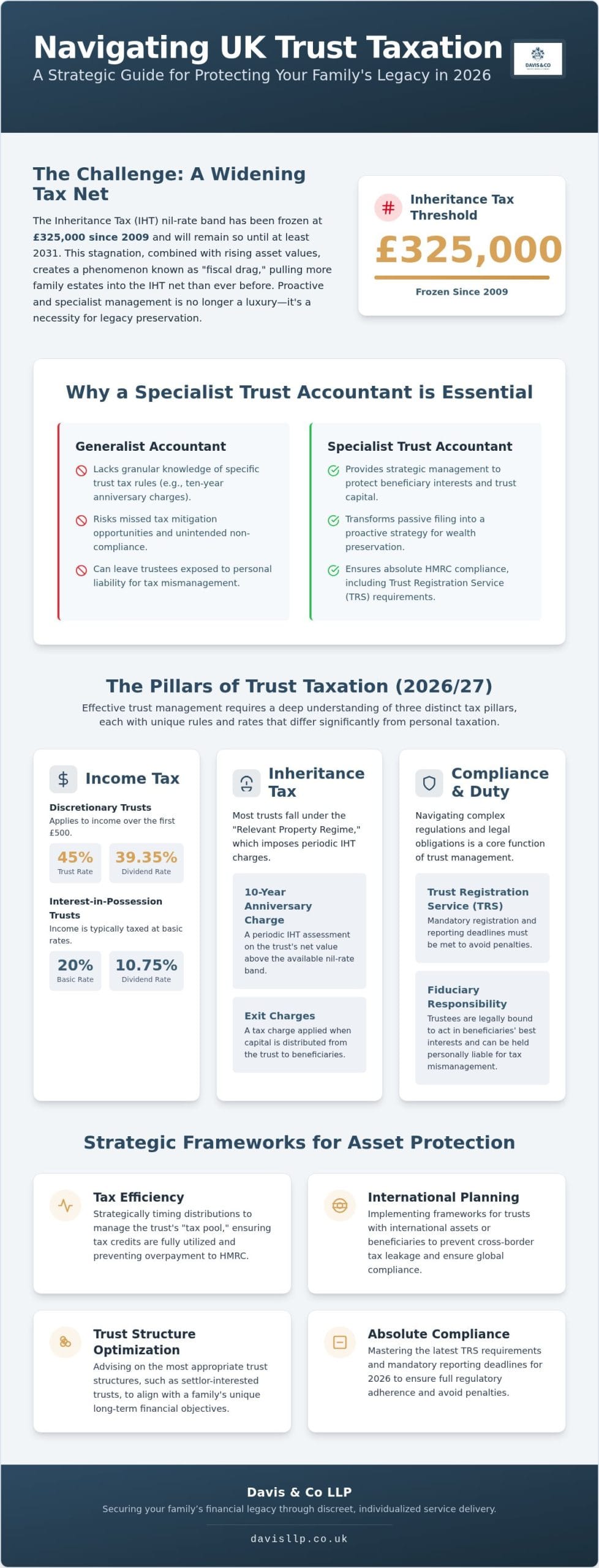
The tax landscape for trusts is fundamentally different from that of an individual. For example, discretionary trusts are subject to a 45% tax rate on income over the first £500, which is a stark contrast to the tiered bands of personal income tax. Reporting requirements are equally distinct, necessitating the use of Form SA900 rather than the standard personal return. Because these rules are so specialized, your expert tax advice in the UK must be grounded in trust-specific expertise. Without this focus, it’s easy to overlook the complexities of dividend-type income, which is taxed at 39.35% for discretionary trusts in the 2026/27 tax year, or the specific credits available within a trust structure.
Navigating the Pillars of Trust Taxation: Income, Capital, and Inheritance
The effective management of a trust requires a meticulous understanding of three primary tax pillars. For the 2026/27 tax year, the fiscal landscape remains demanding, with high headline rates and frozen thresholds that necessitate proactive planning. Engaging a trust tax accountant uk ensures these pillars are managed with precision, preventing the erosion of capital through avoidable tax leakage. Each trust type carries its own set of rules, and the distinctions between them often dictate the overall long-term viability of the structure.
Income Tax within Different Trust Structures
Income taxation depends heavily on whether the trust is discretionary or an interest-in-possession structure. For discretionary trusts, income exceeding the initial £500 threshold is taxed at the “Trust Rate” of 45% for general income and 39.35% for dividends. Conversely, interest-in-possession trusts usually see income taxed at the basic rate of 20%, or 10.75% for dividends, before it’s passed to the beneficiary. A critical technical detail is the “tax pool,” which tracks the tax paid by trustees. This pool must contain enough tax to cover the 45% credit provided to beneficiaries when they receive discretionary distributions. If the pool is insufficient, trustees must pay the difference to HMRC, a scenario we work diligently to avoid through careful timing of distributions.
Inheritance Tax: The 10-Year Anniversary and Exit Charges
Most modern trusts fall under the “Relevant Property Regime,” which imposes periodic charges regardless of whether a death has occurred. The 10-year anniversary charge serves as a periodic Inheritance Tax assessment on discretionary trusts, requiring a complex calculation based on the trust’s net value exceeding the available nil-rate band at the time of the anniversary. Because the nil-rate band is currently frozen at £325,000 until 2031, more trusts are finding their assets subject to this charge as property and investment values rise.
Professional valuation is essential every decade to ensure the maximum effective rate of 6% is applied accurately. Beyond the decennial charge, exit charges apply when capital is distributed to beneficiaries between anniversary dates. These charges are pro-rated based on the time elapsed since the last 10-year assessment. Managing the liquidity required to meet these events is a core component of our bespoke trust tax services, ensuring that the trust doesn’t have to liquidate core assets at an inopportune time to satisfy HMRC. This level of technical depth is mirrored in the Chartered Institute of Taxation syllabus, which underscores the complexity of these calculations for professional advisors.
Capital Gains Tax (CGT) adds a final layer of complexity. For 2026/27, the CGT rate for trustees stands at 24%, with a limited annual exempt amount of just £1,500. When assets are transferred into or out of a trust, “hold-over relief” may be available to defer the gain, but this requires specific elections and a clear understanding of the future tax implications for the recipient. Without this foresight, a well-intentioned distribution can trigger an immediate and substantial tax bill.
Strategic Trust Management: Optimising Efficiency for Settlors and Beneficiaries
Strategic trust management is not a static exercise; it’s a dynamic partnership between the settlor’s vision and the technical reality of the UK tax system. A proficient trust tax accountant uk identifies opportunities to align these interests while navigating the restrictive legislative changes taking effect in 2026. One such area is business succession. With Agricultural Property Relief (APR) and Business Property Relief (BPR) now capped at a combined £2.5 million for 100% relief from 6 April 2026, trusts have become vital vehicles for managing value that exceeds this threshold. By utilizing a trust, families can manage the transition of business assets over several years, ensuring that the next generation is ready for the responsibility without triggering an immediate, unmanageable tax event.
Hold-over Relief remains a cornerstone of this strategy. It allows for the deferral of Capital Gains Tax when assets are transferred into a trust, effectively shifting the tax liability to a future date. This is particularly useful for families looking to pass on trading company shares without triggering an immediate 24% CGT charge. By deferring the tax, capital remains within the family structure to fuel further growth rather than being diverted to the Exchequer. It’s a method that requires careful documentation and a clear understanding of the future tax implications for both the trustees and the eventual beneficiaries.
International Trusts and Cross-Border Considerations
Cross-border considerations are more complex following the abolition of the non-domiciled regime in April 2025. We now operate under a residence-based system, which significantly affects how offshore trusts interact with the UK tax net. Proper international tax planning is essential to prevent double taxation for non-resident beneficiaries and to manage the reporting requirements for foreign trusts that hold UK assets. The location of trustees is a critical factor here; if the majority are UK-resident, the trust itself is likely to be treated as UK-resident for tax purposes, regardless of where the assets are situated. This status triggers a different set of reporting obligations and tax rates that we must manage with absolute precision.
The Impact of “Settlor-Interested” Rules
HMRC maintains a rigorous stance on “settlor-interested” trusts. These are structures where the settlor, their spouse, or civil partner can still benefit from the trust’s assets or income. In these instances, the anti-avoidance legislation is uncompromising. Income is generally taxed as the settlor’s own income, and Capital Gains Tax protections are often limited. Understanding the UK government guidance on trust income tax is the first step, but the strategic value lies in structuring the trust to avoid unintended traps. We ensure that your trust is managed so that the settlor’s retained interests don’t inadvertently collapse the tax benefits the structure was designed to provide. This requires a composed, detail-oriented approach to every distribution and appointment to maintain the trust’s intended fiscal profile.
HMRC Compliance and the Trust Registration Service (TRS) in 2026
HMRC’s pursuit of transparency has transformed the Trust Registration Service from a simple database into a central pillar of UK tax compliance. By 2026, the scope of the TRS has expanded significantly, making it a mandatory requirement for almost all UK express trusts, regardless of whether they produce a tax liability. This digital register provides HMRC with a real-time map of beneficial ownership, which they use to cross-reference with other tax filings. A specialist trust tax accountant uk acts as the essential intermediary here, ensuring that the information held by the Revenue is both accurate and consistent with the trust’s broader financial reporting.
The penalties for failing to register or update the TRS are no longer a distant threat. Initial fixed penalties of £100 can quickly escalate for continued or deliberate non-compliance. Beyond the financial cost, an inaccurate register invites unwanted scrutiny into the trust’s affairs. To maintain your compliance, follow these five steps for a TRS update:
- Collate updated details: Gather full names, dates of birth, and National Insurance numbers for any new trustees, beneficiaries, or mental health representatives.
- Access the portal: Securely log into the HMRC Trust Registration Service using your Government Gateway credentials.
- Validate existing data: Review the current registration to identify any discrepancies in asset descriptions or personal information.
- Record the change: Input the specific modifications, ensuring you record the exact date the change occurred to satisfy the 90-day rule.
- Archive confirmation: Download and store the updated registration summary as proof of your fiduciary diligence.
Which Trusts Must Register?
The distinction between taxable and non-taxable trusts is vital. Taxable trusts are those liable for Income Tax, Capital Gains Tax, Inheritance Tax, or Stamp Duty. However, even non-taxable express trusts must register unless they fall under specific exemptions. These exemptions are narrow and typically include certain pension schemes, charitable trusts, or life insurance policies that only pay out on death. In the 2026 regulatory environment, bare trusts are generally caught within this net, requiring registration if they were created as express trusts. We also monitor the new 2026 low-value exemption, which applies only if the trust holds assets under £10,000 and earns less than £5,000 in annual income.
Maintaining the Trust Register: A Continuous Requirement
Compliance isn’t a one-time event; it’s a continuous obligation. HMRC requires that any changes to the trust’s details, such as a change of trustee address or a new beneficiary reaching a certain age, must be reported within 90 days. For taxable trusts, there’s an additional requirement to make an annual declaration that the register is up to date, even if no changes have occurred. Our bespoke trust tax services provide the professional oversight needed to manage this interface, ensuring that every deadline is met with the precision your family’s legacy deserves.
Special attention is required for non-UK trusts that acquired UK land or property before 6 October 2020. Under rules introduced in June 2026, these trusts are now required to register by 1 September 2027. Managing these overlapping deadlines requires a steady, measured approach to avoid the pitfalls of administrative oversight.
Bespoke Trust Tax Services: The Davis & Co LLP Approach
We believe that effective wealth preservation requires more than just technical accuracy. It demands a deep understanding of the human and organizational impact of every fiscal decision. As a specialist trust tax accountant uk, Davis & Co LLP operates as a strategic partner rather than a mere service provider. Our approach is defined by a sense of quiet excellence and a commitment to discretion that has been our hallmark since 1901. We recognize that for many entrepreneurial families, the trust is not an isolated entity but a component of a larger financial ecosystem. By integrating our trust tax services with high-level small business accounting, we ensure that your corporate growth and personal legacy are managed with a singular, cohesive vision. This synergy prevents the fragmented advice that often leads to tax leakage and administrative friction.
Our role as your trust tax accountant uk is to provide a sense of order and intellectual rigour that reinforces the credibility of your trust’s governance. We don’t just react to legislative changes; we anticipate their impact on your specific circumstances. This measured, deliberate pace of communication helps to build a sense of trust and stability. It suggests that our firm is a dependable constant in an often volatile environment, allowing you to focus on the long-term stewardship of your assets rather than the minutiae of HMRC correspondence.
Tailored Solutions for Family Offices and High-Net-Worth Individuals
Managing multi-layered financial structures requires a single point of contact who understands the full breadth of your interests. Our firm specializes in reconciling the demands of international tax planning with the specific obligations of UK trust law, a necessity in the post-2025 residence-based regime. As Chartered Certified Accountants, we maintain the highest professional standards, providing the intellectual rigour needed to handle complex cross-border issues without sacrificing clarity. This composed partnership allows family offices to delegate the intricacies of compliance, knowing that their sensitive commercial matters are handled with understated confidence and reliability. We provide the steady, deliberate oversight required to manage assets across jurisdictions while maintaining absolute regulatory adherence.
Next Steps: Securing Your Trust’s Future
The transition into the 2026/27 tax year presents both challenges and opportunities. To ensure your structure remains resilient, we recommend a comprehensive “Trust Health Check.” This process identifies latent tax risks, such as impending 10-year anniversary charges or misaligned residency statuses, before they become liabilities. We look beyond the balance sheet to understand the long-term intent of the settlor and the needs of the beneficiaries. Proactive planning is the only way to safeguard against the volatility of the current fiscal environment. We invite you to engage our services for a discreet, expert consultation where we can discuss your specific objectives and develop a customized strategy for your family’s future. Reliability isn’t just a promise; it’s the foundation of our practice.
Securing Your Legacy Through Strategic Professional Partnership
The 2026 tax landscape demands more than simple compliance; it requires a proactive and integrated strategy. We’ve explored how the intersection of Income Tax, Capital Gains, and Inheritance Tax can either erode or preserve your family’s capital depending on the precision of your management. By adhering to the rigorous standards of the Trust Registration Service and utilizing key reliefs, you’ll ensure your assets remain a source of stability for future generations.
As you navigate these complexities, the guidance of a dedicated trust tax accountant uk becomes an invaluable asset. Since 1901, Davis & Co LLP has served as a discreet and reliable strategic partner for family offices and individuals. Our status as Chartered Certified Accountants and our deep expertise in International Tax Planning provide the reassurance you need to manage sensitive financial matters with confidence.
Consult with our specialist Trust Tax Accountants to conduct a comprehensive review of your current structure. We’re here to help you transform technical obligations into a resilient strategy for wealth preservation. Your family’s future is built on the decisions you make today, and we’re ready to ensure those decisions are sound.
Frequently Asked Questions
Do I need a separate accountant for my trust and my personal taxes?
While you aren’t legally required to use different firms, the complexity of trust law often necessitates the specialized skills of a trust tax accountant uk. Trusts are separate taxable entities with their own unique rates and reporting deadlines. Using a single strategic partner who understands both your personal interests and the trust’s obligations ensures a cohesive approach to wealth preservation, preventing the conflicting advice that can arise from fragmented services.
How much tax do beneficiaries pay on income received from a trust in 2026?
Beneficiaries’ tax liability depends on the type of trust and the nature of the distribution. For discretionary trusts, payments are usually made with a 45% tax credit, which beneficiaries can use to offset their personal tax or claim a refund if they’re lower-rate taxpayers. In interest-in-possession trusts, the income is treated as the beneficiary’s own. They’re taxed at their marginal rate after receiving the income, which often carries a 20% or 8.75% credit depending on the source.
What is the Trust Registration Service (TRS) and is it mandatory for all trusts?
The TRS is a central digital register managed by HMRC to improve transparency in trust ownership. It’s mandatory for almost all UK express trusts, including those with no tax liability, and many non-UK trusts with UK connections. While a few narrow exemptions exist for certain pension or charitable structures, most trustees must register and provide regular updates. Failure to comply can lead to financial penalties and increased regulatory scrutiny of the trust’s assets.
Can a trust be used to reduce Inheritance Tax (IHT) liabilities?
A trust can be an effective vehicle for reducing IHT by removing assets from your personal estate, provided you survive the transfer by seven years. However, assets within most modern trusts are subject to the “Relevant Property Regime,” which includes 10-year anniversary charges and exit charges. A specialist trust tax accountant uk helps you balance these periodic trust taxes against the potential 40% saving on your personal estate to ensure the structure remains fiscally efficient.
What happens if a trustee fails to file a trust tax return on time?
HMRC imposes automatic financial penalties for late submissions of Form SA900. An immediate £100 penalty applies if the return is even one day late, with further charges of £10 per day if the delay exceeds three months. After six months, an additional penalty of 5% of the tax due or £300, whichever is greater, is applied. Consistent late filing can also damage your standing with HMRC and trigger more frequent audits of the trust’s accounts.
How are offshore trusts taxed if the beneficiaries live in the UK?
Offshore trusts are subject to complex anti-avoidance legislation designed to prevent tax deferral. UK-resident beneficiaries are generally taxed on any benefits or “stockpiled gains” they receive from the trust. Since the abolition of the non-domicile regime in April 2025, these structures are now managed under a residence-based system. We provide the steady, measured oversight required to navigate these cross-border rules, ensuring that distributions don’t trigger unintended tax charges for your family members.
What is hold-over relief and how does it apply to trusts?
Hold-over relief allows trustees and settlors to defer Capital Gains Tax (CGT) when transferring qualifying assets into or out of a trust. Instead of paying CGT at the time of the transfer, the gain is “held over” and only becomes payable when the recipient eventually sells the asset. This is a vital tool for business succession, allowing trading shares to pass through a trust without liquidating capital to meet an immediate tax bill.
Is a bare trust subject to the same tax rules as a discretionary trust?
No, a bare trust is treated differently because the beneficiary has an absolute right to the capital and income. For tax purposes, HMRC looks through the trust and treats the assets as belonging directly to the beneficiary. This means the beneficiary reports the income and gains on their personal tax return. In contrast, a discretionary trust is a separate taxable entity where trustees have the power to decide how and when to distribute assets.