The transition of your fiscal residence to the United Kingdom is no longer a simple matter of counting days; it’s a fundamental shift in how your global wealth is perceived by HMRC. With the definitive abolition of the non-domicile regime and the arrival of a residence-based system, the tax implications of moving to the uk have become significantly more nuanced for the 2026/27 tax year. It’s understandable if the complexity of modern compliance, particularly regarding the new 10-out-of-20 year rule for Inheritance Tax, feels like a significant hurdle to your international interests.
We recognise that the anxiety of double taxation or the misapplication of the Statutory Residence Test can often overshadow the strategic benefits of relocation. This guide provides a professional analysis of the current landscape, ensuring you have the clarity needed to mitigate tax leakage on your worldwide income. We’ll examine the mechanics of the four-year Foreign Income and Gains regime. We’ll also detail the application of Split Year treatment and the pre-arrival steps required to protect your assets before you enter the UK jurisdiction.
Key Takeaways
- Master the Statutory Residence Test framework to accurately determine your UK fiscal status and avoid unexpected residency triggers.
- Secure your global wealth by understanding the transition from territorial to worldwide taxation for all foreign income, dividends, and gains.
- Proactively address the tax implications of moving to the uk through strategic pre-arrival restructuring at least twelve months before your relocation.
- Protect your estate from the 40% Inheritance Tax rate by clearly distinguishing between your residence and permanent domicile.
- Establish a robust professional partnership to manage your HMRC compliance and ensure a seamless entry into the UK tax jurisdiction.
The Statutory Residence Test (SRT): Determining Your UK Tax Status
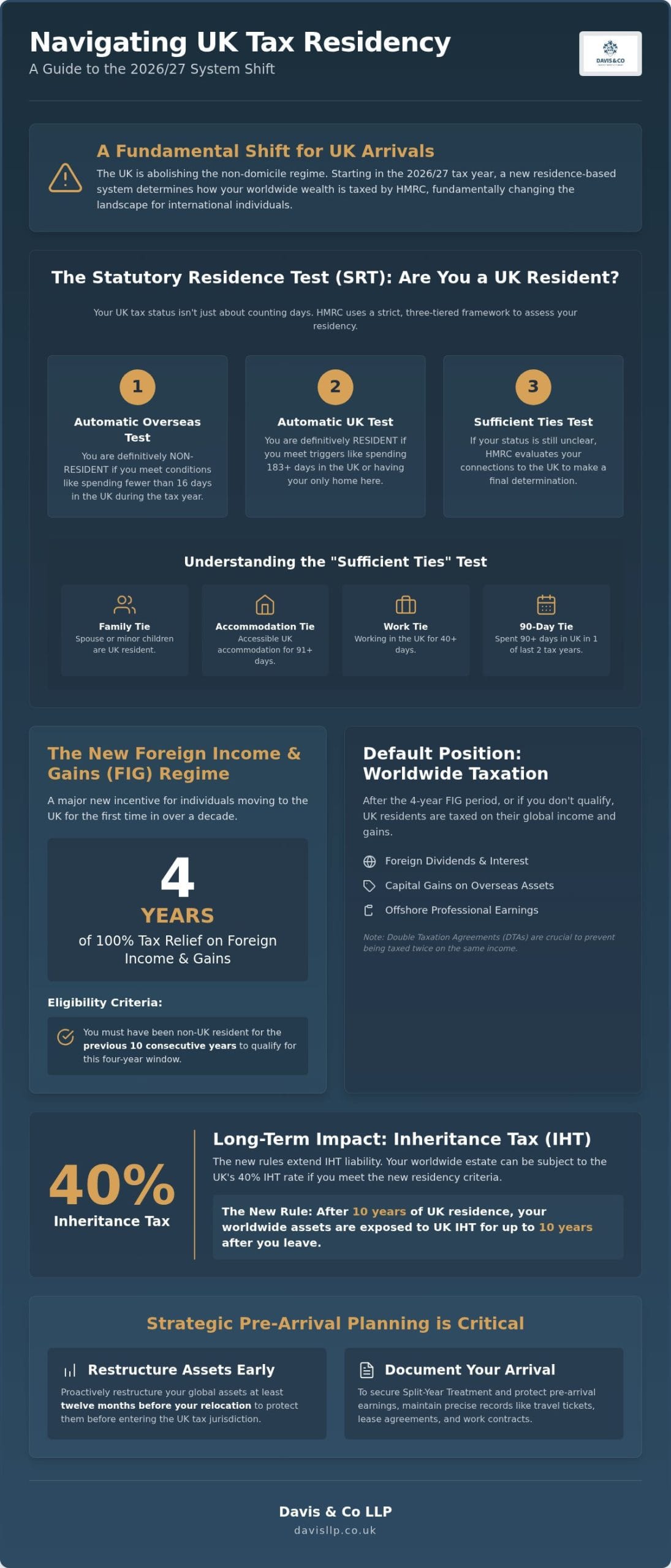
The Statutory Residence Test serves as the definitive framework for determining an individual’s UK tax liability based on their physical presence and connection to the country. While many people believe that staying under the 183-day limit provides a safe harbour from HMRC, the reality is far more complex. The tax implications of moving to the UK are dictated by a hierarchy of tests that assess not just your presence, but the quality and depth of your connection to the jurisdiction.
The SRT operates through three distinct tiers. First, the Automatic Overseas Test determines if you’re definitively non-resident; for instance, if you spend fewer than 16 days in the UK during a tax year. If these conditions aren’t met, the Automatic UK Test applies. Here, the 183-day rule sits alongside other triggers, such as having your only home in the UK for a period of 91 days or more. If neither test provides a clear result, the analysis moves to the Sufficient Ties Test. This structured approach ensures that residency isn’t left to chance, but it requires a meticulous understanding of how your personal circumstances align with HMRC’s criteria.
Understanding Split-Year Treatment
The UK tax year runs from 6th April to 5th April. Moving mid-year doesn’t automatically mean you’re taxed on your worldwide income for the entire twelve-month period. Split-year treatment allows you to divide the year into a resident and non-resident portion, provided you meet specific criteria, such as starting full-time work in the UK or moving into your only home here. We emphasize the need for precise documentation; travel tickets, lease agreements, and work contracts are vital for substantiating your arrival date and protecting your pre-arrival earnings from the UK tax net.
The Sufficient Ties Test: A Nuanced Analysis
If your residency remains ambiguous after the automatic tests, HMRC evaluates your “ties” to determine your status. These factors include:
- Family tie: Having a spouse, civil partner, or minor children resident in the UK.
- Accommodation tie: Having access to a place to live for at least 91 days, and staying there at least once.
- Work tie: Performing at least 40 days of work in the UK during the tax year.
- 90-day tie: Spending more than 90 days in the UK in either of the previous two tax years.
The number of days you can spend in the UK without becoming a resident decreases as your number of ties increases. Strategic management of these ties is a core component of effective international tax planning. It allows you to control your entry into the UK tax net and manage the tax implications of moving to the UK with foresight and precision.
Income and Capital Gains: Navigating Worldwide Taxation
Becoming a UK resident shifts your fiscal profile from a territorial focus to a global one. This transition carries significant tax implications of moving to the uk, as HMRC generally seeks to tax your worldwide income and gains regardless of where they’re generated. For the 2026/27 tax year, individuals must account for foreign dividends, offshore interest, and professional earnings within their UK Self Assessment. We utilize Double Taxation Agreements (DTAs) to ensure you aren’t taxed twice on the same pound; these treaties are essential for managing cross-border interests. For a deeper technical understanding of these interactions, you can consult the official UK government guidance.
Transparency is a cornerstone of the UK system. You’re required to disclose foreign bank accounts and significant overseas assets to HMRC. Failure to report these can lead to substantial penalties, particularly as international data-sharing between tax authorities has become more robust. If you’re concerned about how these rules apply to your specific portfolio, our team can provide a tailored review of your personal tax services requirements.
The Foreign Income and Gains (FIG) Regime
The regulatory environment has changed fundamentally following the abolition of the old non-domicile regime. For the 2026/27 tax year, the new “FIG regime” allows qualifying individuals to claim 100% tax relief on their foreign income and gains for the first four years of UK residence. This is available only to those who’ve been non-UK resident for the previous ten consecutive years. While this offers a significant window for tax-free growth, the election must be made carefully, as it may result in the loss of your personal allowance and capital gains tax exemption.
Capital Gains Tax (CGT) on Global Assets
UK residents are liable for CGT on gains realised from the disposal of overseas property, shares, and other investments. For the 2026/27 tax year, the annual exempt amount is set at £3,000. Gains exceeding this threshold are taxed at 18% for basic rate taxpayers or 24% for those in higher brackets. We often advise clients to consider the “rebasing” of assets; this involves recording the market value of your holdings at the time you become a resident to ensure you’re only taxed on growth that occurs during your time in the UK. Engaging in proactive international tax planning before your arrival is the most effective way to mitigate these long-term liabilities.
Pre-Arrival Tax Planning: Strategic Moves Before You Land
Most individuals focus on the logistical challenges of relocation, yet the financial architecture of your arrival dictates your long-term fiscal health. The twelve months preceding your move are the most critical period for wealth preservation. During this window, you possess the flexibility to restructure assets while remaining outside the UK’s tax jurisdiction. Understanding the tax implications of moving to the uk allows you to identify which income streams should be accelerated; for instance, realising capital gains while you’re still a non-resident ensures that historical growth is captured under your current, likely more favourable, regime.
We recommend establishing “clean capital” accounts well before your first day of residency. These are specific bank accounts containing only pre-residency wealth, strictly separated from any income or gains generated after you arrive. By maintaining this segregation, you can remit these funds to the UK without triggering a tax charge. Without this discipline, you risk creating “mixed funds,” where HMRC’s rules often assume that any money brought into the country consists of the most taxable elements first.
Timing the Relocation for Maximum Efficiency
Your choice of arrival date should align strategically with the UK tax year cycle, which begins on 6th April. Arriving late in the tax year may inadvertently trigger residency for the entire period unless you qualify for split-year treatment. This timing is particularly sensitive for professionals expecting substantial bonuses or deferred compensation. By consulting the Official Statutory Residence Test Guidance, we can help you calculate a precise entry date that protects your year-to-date earnings from UK liability.
Asset Restructuring and Realisation
Existing trust structures and corporate holdings require a rigorous review for UK compatibility. Offshore entities that operate efficiently in other jurisdictions may fall foul of UK anti-avoidance legislation, such as the Transfer of Assets Abroad rules. It’s often beneficial to distribute dividends from foreign companies prior to your entry to avoid the UK’s higher dividend tax rates, which are scheduled for an increase in April 2026. Securing expert tax advice in the UK during this transition ensures your global footprint is both compliant and optimised before you step onto British soil.
Domicile and Inheritance Tax: Long-Term Implications
While residency is determined by your physical presence, domicile is a deeper legal concept reflecting where you consider your permanent home to be. This distinction is the cornerstone of how the UK applies Inheritance Tax (IHT) to your global wealth. For those arriving in 2026, the tax implications of moving to the uk have undergone a fundamental shift. The previous “deemed domicile” rule, which triggered after 15 years, has been replaced by a residence-based system. Under these new regulations, your worldwide estate becomes subject to a 40% IHT rate once you’ve been a UK resident for 10 out of the previous 20 tax years.
This transition means that long-term residents must look beyond simple income tax compliance and consider the protection of their legacy. We often advise clients with international interests to explore the use of Excluded Property Trusts. When structured correctly before you meet the residency thresholds, these vehicles can effectively ring-fence overseas assets from the UK IHT net. Proactive structuring is essential; waiting until you’re approaching the 10-year mark often limits your options for effective asset protection.
Domicile of Origin vs. Domicile of Choice
Your domicile of origin is typically acquired from your father at birth and is remarkably resilient. Changing it requires you to demonstrate a clear intent to settle permanently in a new jurisdiction, severing ties with your original home. HMRC often scrutinises these claims with rigour. If you unintentionally acquire a “domicile of choice” in the UK through your lifestyle or asset acquisitions, you risk bringing your entire worldwide estate into the UK tax net prematurely. Maintaining non-domiciled status requires meticulous evidence of your ongoing international connections and future intentions.
Inheritance Tax Exemptions and Reliefs
The UK provides certain thresholds before IHT is applied. The Nil-Rate Band currently stands at £325,000, with an additional Residence Nil-Rate Band of £175,000 available when passing a main residence to direct descendants. For international couples, spousal exemptions are straightforward when both share a UK domicile. However, if one spouse is non-domiciled, the exemption is limited, which can create significant fiscal leakage. Strategic gifting also plays a vital role; under the “seven-year rule,” most gifts fall outside your estate if you survive the period. If you’re concerned about the longevity of your UK residency and its impact on your global estate, our International Tax Planning specialists can provide a comprehensive review of your position.
Professional Management of Your UK Tax Transition
The tax implications of moving to the uk require more than just a passing familiarity with HMRC’s rulebook; they demand a structured and proactive management strategy. Establishing a Unique Taxpayer Reference (UTR) is your first formal step into the UK tax system, serving as the essential gateway for all future communications with the authorities. Our personal tax services are designed to provide this level of oversight, ensuring that every filing, from the initial Self Assessment to complex foreign asset reporting, is handled with the precision your wealth deserves.
We view our role as a composed partnership. This means we don’t just process data; we provide a buffer between you and the complexities of the UK jurisdiction. In an environment where HMRC enquiries into expatriates are rising, having a representative with over 120 years of professional gravitas is a significant advantage. Our approach is steady and deliberate, focusing on the human and organizational impact of these sensitive financial transitions to make you feel secure and well-advised.
Bespoke Onboarding for International Clients
Our onboarding process is tailored to the specific needs of individuals with cross-border interests. We take on the administrative burden of HMRC registration and the meticulous preparation of split-year claims, which are vital for protecting your pre-arrival income. Coordination is key. We regularly work alongside our clients’ overseas advisors to ensure global tax harmony, preventing the overlaps that lead to double taxation. This commitment to quiet excellence and intellectual rigour ensures that your entry into the UK is as seamless as possible.
Securing Your Fiscal Future in the UK
Initial compliance is only the starting point. As your life in the UK evolves, we conduct regular reviews of your tax residency and domicile status to ensure your planning remains relevant to changing legislation. For entrepreneurs and investors, this often involves moving from individual support to more comprehensive commercial oversight. Engaging a small business accountant within our practice allows you to scale your operations with the same level of strategic rigour applied to your personal affairs. We provide the stability needed to navigate a volatile tax environment, ensuring your legacy is protected for the long term.
Securing Your Global Wealth for a UK Future
Navigating the tax implications of moving to the uk requires a deliberate transition from reactive compliance to proactive fiscal stewardship. The 2026/27 landscape demonstrates that the window for effective planning often closes the moment you establish residency; therefore, the months preceding your arrival are the most valuable for wealth preservation. By mastering the nuances of the Statutory Residence Test and the new FIG regime, you’ll ensure your global assets remain protected from unnecessary fiscal leakage.
Establishing a robust professional framework is essential for managing these sensitive commercial and personal matters. Since 1901, Davis & Co LLP has acted as a trusted advisor to individuals with complex cross-border interests, providing the intellectual rigour and discretion required for high-calibre tax management. Our status as Chartered Certified Accountants ensures that your transition is handled with the highest regulatory standards and bespoke care. We invite you to Consult Davis & Co LLP for Strategic International Tax Planning to discuss your upcoming relocation. With the right partnership, your move to the UK becomes a strategic opportunity for long-term growth.
Frequently Asked Questions
When exactly do I become a UK tax resident after moving?
Your residency status is determined by the Statutory Residence Test, which generally applies to the entire tax year from 6th April to 5th April. However, if you meet specific criteria for split-year treatment, you might only be considered a resident from the actual date you move into your only UK home or begin full-time work. Precise documentation of your arrival is vital to ensure you aren’t taxed on income earned before your physical entry.
Will I be taxed twice on the same income if I move to the UK?
Double taxation is typically mitigated through the extensive network of Double Taxation Agreements the UK maintains with other jurisdictions. These treaties allow you to claim relief for tax already paid in your country of origin on the same income. We analyse these agreements to ensure your global earnings are correctly apportioned, preventing fiscal leakage while maintaining full compliance with HMRC’s reporting standards for foreign dividends and professional fees earned abroad.
What is the “Statutory Residence Test” and how does it affect me?
The Statutory Residence Test is the objective legal framework used to determine your fiscal connection to the UK. It affects you by setting a clear threshold for when your worldwide income falls under HMRC’s jurisdiction. Beyond just counting days, it evaluates your family, work, and accommodation ties. Understanding these tax implications of moving to the uk allows you to manage your presence strategically, ensuring you don’t inadvertently trigger residency before your planning is complete.
Do I need to pay UK tax on property I own in another country?
Yes, as a UK resident, you’re generally liable for UK tax on rental income generated by overseas property and any capital gains realised upon its sale. For the 2026/27 tax year, property income rates are aligned with your income tax band, though you may claim credit for foreign taxes paid. We often recommend a formal valuation of the property at the point of your arrival to establish a baseline for future capital gains calculations.
Can I keep my non-domiciled status for tax purposes indefinitely?
The concept of non-domiciled status has undergone a fundamental shift following the 2025 reforms. While your domicile of origin remains, the tax benefits previously associated with it are now time-limited. Under the new residence-based system, you can only claim relief on foreign income and gains for your first four years of residence. After this period, or once you’ve been resident for 10 out of 20 years for inheritance tax, your worldwide estate is fully exposed.
What happens to my foreign pension when I move to the UK?
The taxation of foreign pensions depends heavily on the specific treaty between the UK and the source country. In many cases, once you’re a UK resident, your foreign pension is taxable here as regular income. However, certain lump-sum distributions might be treated differently. It’s essential to review the pension’s structure before you relocate, as some offshore schemes may require specific reporting or restructuring to remain tax-efficient under UK law for the 2026/27 tax year.
How much can I bring into the UK before I have to pay tax?
There is no limit on bringing “clean capital” into the country tax-free. However, any income or gains generated after you become resident are subject to tax if remitted, unless you’re within the initial four-year FIG regime window. The key is maintaining strictly segregated bank accounts to prevent “mixed funds.” Managing the tax implications of moving to the uk requires this level of discipline, as HMRC assumes the most taxable money is brought in first.
Do I need a UK accountant before I physically move?
Engaging a UK accountant at least twelve months before your move is a strategic necessity for wealth preservation. Pre-arrival planning allows you to restructure assets, accelerate income, or realise gains while you’re still outside the UK tax net. We provide a bespoke partnership that coordinates with your existing overseas advisors. This ensures your global interests are harmonised and your transition into the UK jurisdiction is handled with the professional gravitas and discretion your affairs require.