Receiving a distribution from a UK trust often feels like a windfall, but without a precise understanding of the 2026 HMRC framework, a significant portion of that benefit can be lost to avoidable tax traps. We understand that the distinction between capital and income distributions often feels frustratingly opaque. It’s natural to feel concerned about whether you’re overpaying or if you’ve correctly accounted for the tax credits attached to discretionary payments. We’ve designed this guide to help you master the tax treatment of income from a trust, ensuring you meet your reporting obligations with absolute certainty.
Our analysis provides a clear path through the complexities of the R185 form. We’ll examine how different trust structures dictate your personal liability and identify strategic opportunities for enhancing your tax efficiency. This involves a careful look at dividend versus non-dividend income and the specific calculations required for various tax credits. By the end of this guide, you’ll possess the clarity needed to manage your trust interests with the same precision and rigour we apply to our own professional practice.
Key Takeaways
- Differentiate between capital and income distributions to ensure you don’t miscalculate your personal tax liability or overpay HMRC.
- Master the tax treatment of income from a trust by learning how to “gross up” discretionary payments and correctly apply the 45% tax credit.
- Identify the specific reporting requirements for the 2026 tax year, including the essential use of the SA107 supplementary pages and R185 certificates.
- Recognise how the structure of your trust, whether discretionary or interest in possession, fundamentally changes your obligations and tax efficiency options.
Understanding the Framework of UK Trust Taxation
The 2026 regulatory environment has brought a renewed focus on transparency and reporting precision. For beneficiaries, the tax treatment of income from a trust depends heavily on how HMRC classifies the payment and the specific nature of the trust structure. It’s no longer sufficient to simply report a cash receipt; you must understand whether that payment represents the yield on trust assets or a distribution of the trust’s core capital. HMRC has significantly increased its scrutiny regarding the tax treatment of income from a trust to ensure that distributions are not mischaracterised as capital to avoid higher income tax rates.
The Distinction Between Income and Capital
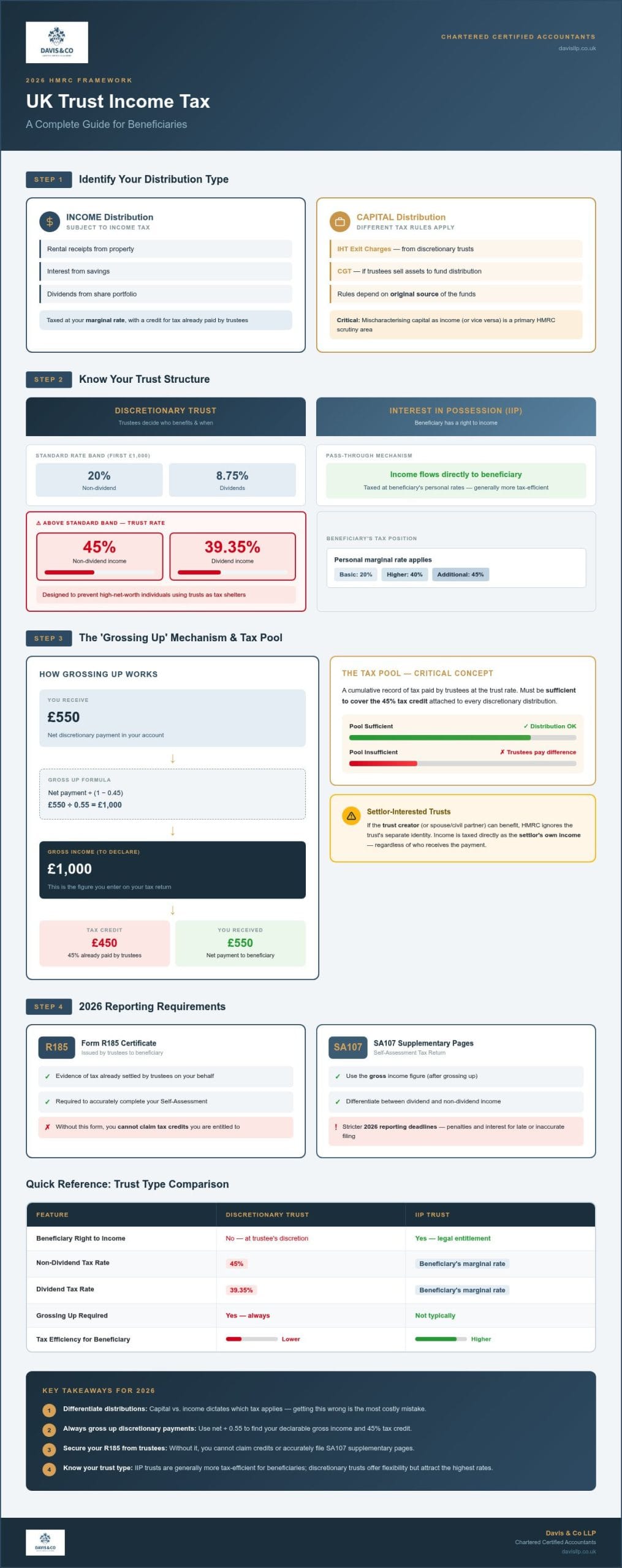
HMRC maintains a strict boundary between income and capital distributions. Income typically arises from the trust’s underlying investments, such as rental receipts from property, interest from savings, or dividends from a share portfolio. These payments are generally subject to Income Tax at the beneficiary’s marginal rate, often with a credit for tax already paid by the trustees.
Capital distributions, however, involve the payment of the trust’s actual assets or “corpus.” These are handled differently:
- Inheritance Tax (IHT): Capital payments from certain discretionary trusts may trigger “exit charges” under the IHT regime rather than Income Tax.
- Capital Gains Tax (CGT): If trustees sell an asset to provide a cash distribution, CGT may be due at the trust level before the funds reach you.
- Source Identification: The tax rules that apply to you are dictated by the original source of the funds, making precise accounting essential for every distribution.
Special rules apply to “settlor-interested” trusts. If the individual who created the trust, or their spouse or civil partner, can benefit from the assets, HMRC ignores the trust’s separate legal identity for income tax purposes. In these cases, the income is taxed as if it belonged directly to the settlor, regardless of who actually receives the payment. This prevents individuals from using trusts solely as a vehicle for shifting income into lower tax brackets.
The Legal Responsibility of Trustees
Trustees hold the primary legal responsibility for the trust’s tax affairs. They act as the initial buffer, calculating and paying tax on the trust’s income before any distribution is made to beneficiaries. For discretionary trusts, this often involves paying tax at the “trust rate,” which currently stands at 45% for non-dividend income.
A critical part of a trustee’s duty is providing you with a Form R185 (Trust Income). This certificate is your evidence of the tax the trustees have already settled on your behalf. Without this document, you cannot accurately complete your Self-Assessment or claim the tax credits to which you’re entitled. Failing to report trust income correctly, or missing the stricter 2026 reporting deadlines, can lead to significant HMRC penalties and interest charges. We often find that professional oversight at the trustee level is the most effective way to prevent these administrative failures and ensure the beneficiary’s position is fully protected.
Discretionary Trusts vs. Interest in Possession Trusts
The fundamental difference in the tax treatment of income from a trust lies in the level of control held by the trustees versus the rights of the beneficiary. In 2026, the distinction between discretionary and Interest in Possession (IIP) structures remains the primary factor in determining your effective tax rate. While discretionary trusts offer flexibility, they attract the highest rates of UK tax. Conversely, IIP trusts provide a more direct “pass-through” mechanism. Navigating these two paths requires a clear understanding of how HMRC views the flow of capital and income through the trust deed.
Taxation of Discretionary Trusts
Trustees of discretionary trusts are subject to the “trust rate” on income that exceeds the standard rate band. For the 2026 tax year, this band applies to the first £1,000 of income, which is taxed at 20% for non-dividend income or 8.75% for dividends. Once this threshold is surpassed, non-dividend income is taxed at a significant 45%, while dividend income is taxed at 39.35%. This high entry point is designed to ensure that trusts are not used as simple tax-sheltering vehicles for high-net-worth individuals.
A vital concept for any beneficiary to grasp is the “tax pool.” The tax pool is a cumulative record of tax paid by trustees at the trust rate, which must be sufficient to cover the 45% tax credit attached to any discretionary income distributions made to beneficiaries. If the trustees haven’t paid enough tax into this pool to cover a distribution, they must pay the difference to HMRC. This ensures that every pound you receive as a discretionary payment carries a non-refundable 45% tax credit, which you can often use to offset your own personal tax liabilities.
Taxation of Interest in Possession (IIP) Trusts
In an IIP trust, the beneficiary (often called the “life tenant”) has an immediate and legal right to the income as it arises. Because you have a “possession” interest, the tax treatment of income from a trust is generally more straightforward. Trustees typically pay tax at the basic rate of 20% (or 8.75% for dividends) before passing the income to you. You are then responsible for reporting this on your Self-Assessment return and paying any additional tax if you’re a higher or additional rate taxpayer.
Complexity often arises when dealing with multi-jurisdictional interests. If you’re a UK resident beneficiary of an offshore IIP trust, or a non-resident receiving income from a UK structure, double taxation treaties come into play. These treaties determine which country has the primary taxing rights and whether you can claim relief for tax already paid. Our trust tax services provide the necessary technical oversight to manage these international complexities. Whether the income is mandated directly to your bank account or collected first by the trustees, the underlying character of the income remains the same for your personal tax calculations.
How Tax Credits and ‘Grossing Up’ Affect Your Income
When you receive a payment from a discretionary trust, the cash in your bank account represents only a portion of the total taxable event. To understand the full tax treatment of income from a trust, you must look at the “grossed-up” amount. This is the total value before the trustees deducted the 45% trust rate tax. This gross figure is what you report to HMRC, but it also brings a significant advantage: a substantial tax credit that can often be used to reduce your overall tax bill.
The Step-by-Step Grossing Up Calculation
The calculation is precise. Because the trustees have already settled tax at the 45% rate, you must “gross up” the net payment to reflect its original value. You achieve this by dividing the net amount received by 0.55. This fraction represents the 55% of the income remaining after the 45% tax deduction. It’s a vital step because it ensures your total income is accurately represented in your personal tax bands.
For example, if you receive a distribution of £5,500, you divide this by 0.55 to arrive at a gross income figure of £10,000. The £4,500 difference represents the tax credit already paid by the trust. This gross figure of £10,000 is added to your other income sources to determine your total taxable income for the year. If your personal marginal rate is lower than 45%, you’ll find that this credit not only covers the tax on the trust income but may also offset tax due on your salary, dividends, or rental income.
Using the R185 Form Effectively
The R185 (Trust Income) certificate is the definitive record of these figures. It’s vital to ensure the data on this form matches your Self-Assessment supplementary pages, specifically form SA107. We often see errors where beneficiaries miscategorise trust income as standard dividend income; this can lead to HMRC questioning the validity of the 45% credit and potentially delaying any refunds due to you.
When reviewing your R185, you should pay close attention to several key areas:
- Net Income: This should match the actual cash distributions you received during the tax year.
- Tax Credit: Verify that the credit equals 45% of the grossed-up value for discretionary payments.
- Income Source: Ensure the income is correctly identified as coming from a UK trust rather than an estate or foreign entity.
For basic rate payers or those within the starting rate for savings, the 45% credit is often significantly higher than their actual liability. In these instances, you’re entitled to reclaim the overpaid tax from HMRC. This makes the tax treatment of income from a trust a powerful tool for cash flow management, provided the reporting is handled with the necessary professional rigour.
Reporting Trust Income on Your Self-Assessment Tax Return
The administrative process of filing your Self-Assessment is where the theoretical tax treatment of income from a trust becomes a practical compliance exercise. For the 2026 tax year, HMRC expects a high level of granular detail regarding your receipts. It’s not enough to list a lump sum; you must categorise each payment based on the data provided in your R185 certificate. Accuracy here is essential to ensure that any tax credits are correctly applied and that you don’t inadvertently trigger an automated compliance check. Proper reporting ensures you maintain a transparent relationship with the authorities while protecting your financial interests.
Navigating the SA107 Supplementary Pages
The SA107 supplementary pages are the designated arena for disclosing trust interests. You must distinguish between discretionary income, which carries the 45% credit discussed earlier, and non-discretionary income from Interest in Possession trusts. If income has been mandated directly to you by the trustees, it must be reported in the specific sections for untaxed income. You’ll also need to provide the name of the trust and the contact details of the trustees. This transparency allows HMRC to cross-reference your return with the trust’s own tax filing, ensuring consistency across the board and reducing the risk of administrative friction.
Managing International Trust Income
Offshore structures introduce a layer of complexity that requires a sophisticated approach to the tax treatment of income from a trust. Your personal status under the Statutory Residence Test determines how these distributions are viewed by HMRC. If you’re a UK resident, you’re generally taxed on your worldwide income, meaning payments from overseas trusts must be disclosed with the same rigour as domestic ones. In cases where the trust has already paid tax in a foreign jurisdiction, you may be eligible for Foreign Tax Credit Relief (FTCR) to prevent double taxation. For those with complex offshore interests, our guide to International Tax Planning offers deeper insights into these strategic challenges.
The deadline for submitting your online return for the 2025/26 tax year is 31 January 2027. We recommend maintaining robust records, including your R185 certificates and any correspondence with trustees, for at least five years after the filing deadline. This disciplined approach to record-keeping is your primary defence during an HMRC enquiry. If you find the reporting requirements for your trust interests are becoming increasingly burdensome, our Personal Tax Services can provide the professional oversight needed to ensure every box is ticked with precision.
Optimising Your Position with Professional Trust Tax Services
Passive trust management is a significant contributor to fiscal inefficiency. While the mechanical tax treatment of income from a trust is dictated by statute, the application of these rules allows for considerable strategic latitude. A “set and forget” approach often results in missed opportunities to utilise personal allowances or claim back overpaid tax credits. We believe that annual trust reviews are a prerequisite for any beneficiary seeking to maintain a compliant yet efficient financial position in the 2026 regulatory environment. This period of transition requires a steady hand to ensure that historical trust arrangements still align with contemporary HMRC expectations.
Strategic Planning for Beneficiaries
Proactive distribution planning can fundamentally alter your effective tax rate. For instance, timing a significant income payment to coincide with a year of lower personal earnings can allow you to absorb the distribution within your basic rate band, potentially leading to a substantial tax refund. Trusts also serve as highly efficient vehicles for funding specific life events, such as a descendant’s education or a first property purchase. Integrating these payments into your broader Expert Tax Advice in the UK ensures that trust income works in harmony with your inheritance tax and personal tax objectives. We look at the total picture, ensuring that a distribution today doesn’t create an unforeseen capital gains or inheritance tax liability tomorrow.
The Davis & Co Approach to Trust Compliance
Our role is to act as the technical bridge between trustees, beneficiaries, and HMRC. We provide the rigorous oversight necessary to ensure that every R185 is accurate and that the “grossing-up” calculations on your SA107 are beyond reproach. We understand that communication between trustees and beneficiaries can sometimes lack the necessary technical depth; we fill that gap by providing clear, actionable data that satisfies both parties’ reporting needs. This clarity is essential when dealing with the tax treatment of income from a trust, as it prevents the mischaracterisation of payments that could lead to overpayment.
If HMRC initiates an enquiry into the trust’s affairs, we manage the interface directly, providing the calm, evidence-based authority required to resolve complex technical disputes. This level of professional involvement is a defining marker of our client-centric approach. We invite you to consult our Trust Tax specialists to discuss how we can bring stability and precision to your trust interests. By aligning the tax treatment of income from a trust with your wider commercial realities, we help you secure a future that is both compliant and optimised for growth.
Securing Your Trust Interests for 2026 and Beyond
Mastering the tax treatment of income from a trust is not merely a matter of annual compliance; it’s a strategic necessity for protecting your long-term wealth. We’ve explored how the distinction between discretionary and interest in possession structures dictates your immediate liability, and why the “grossing up” of tax credits is essential for accurate reporting on your SA107. As HMRC’s oversight of 2026 regulations intensifies, the value of a proactive, data-driven approach cannot be overstated.
At Davis & Co LLP, we bring a century of professional gravitas to these complex matters. As Chartered Certified Accountants established in 1901, we provide the specialist expertise required to manage international tax planning and intricate trust structures with absolute discretion. We’re here to act as your steady partner, ensuring your distributions are optimised and your reporting is beyond reproach. Secure your financial future with expert Trust Tax Services from Davis & Co LLP. With the right professional oversight, you can manage your trust interests with confidence and clarity.
Frequently Asked Questions
How much tax do I pay on income from a discretionary trust?
You’re taxed at your marginal income tax rate on the grossed-up value of the distribution. Because trustees have already settled tax at the 45% trust rate, every payment you receive carries a non-refundable 45% tax credit. If your personal tax rate is lower than 45%, this credit covers your liability on the trust income and can often offset tax due on your other earnings.
What is an R185 form and why do I need it for my tax return?
The R185 is a formal certificate issued by trustees that details the net income you received and the tax already paid by the trust. You need this document to complete the SA107 pages of your Self-Assessment. It serves as your definitive evidence for claiming tax credits, ensuring the tax treatment of income from a trust is applied accurately to your personal return.
Can I reclaim tax paid by a trust if I am a non-taxpayer?
Yes, you can generally reclaim the tax paid by trustees if your total taxable income stays within your personal allowance. Since discretionary distributions are distributed with a 45% tax credit, HMRC will refund the difference between that credit and your actual liability. This process requires a formal claim through your tax return, supported by the figures provided on your R185 certificate.
Do I pay National Insurance on trust income distributions?
No, National Insurance Contributions are not due on trust income. HMRC classifies these payments as investment income rather than earned income from employment or self-employment. While these distributions increase your total taxable income and may push you into a higher tax bracket, they don’t attract the Class 1, 2, or 4 National Insurance charges typically associated with a salary or business profits.
How is dividend income from a trust taxed differently in 2026?
In 2026, dividend income within a discretionary trust is taxed at 39.35% for amounts exceeding the standard rate band. However, when these dividends are distributed to you as a discretionary payment, they’re treated as “trust income” and grossed up at the 45% rate. This distinction is vital, as the tax credit you receive is based on the 45% rate regardless of the trust’s internal tax source.
What happens if the trust is based outside the UK?
Distributions from offshore trusts involve additional complexity and must be reported on the SA106 foreign pages. Your UK residence status determines your liability, and you may be taxed on the full distribution. If the offshore trust has already paid tax in its home jurisdiction, we can often claim Foreign Tax Credit Relief to prevent you from being taxed twice on the same income.
Do I need to report a capital distribution on my income tax return?
Capital distributions are not typically reported on the income sections of your tax return because they aren’t classified as annual income. They’re instead managed under the Capital Gains Tax or Inheritance Tax regimes. It’s essential to distinguish between a payment of trust “corpus” and a distribution of accumulated income, as the tax treatment of income from a trust only applies to the latter.
How does the £1,000 standard rate band work for trusts?
The first £1,000 of a trust’s income is taxed at the basic rate of 20% for non-dividend income or 8.75% for dividends. This band is designed to simplify the tax affairs of smaller trusts. If the settlor has created multiple trusts, this £1,000 limit is divided equally among them, though each trust usually retains a minimum band of £200 to ensure basic tax efficiency.