Filing Form SH01 with Companies House does not confer legal ownership of newly created equity. Under UK company law, an investor only becomes a legal shareholder once their details are formally recorded in your company’s register of members. For directors raising growth capital or welcoming new partners, mastering how to issue shares in a private limited company requires far more than submitting routine paperwork after funds clear.
It is entirely natural to feel cautious. Balancing statutory pre-emption rights, managing founder dilution, and adhering to strict Companies House filing windows create real administrative pressure, especially when procedural missteps risk invalidating an allotment entirely. This definitive guide provides a clear, step-by-step statutory and strategic blueprint to issuing shares in full compliance with the Companies Act 2006. We outline director allotment authorities, essential board resolutions, statutory register maintenance, and the vital corporate tax implications you must anticipate before completion.
Key Takeaways
- Distinguish share allotments from share transfers, ensuring you understand how creating brand-new equity impacts corporate capitalization and dilutes existing holdings.
- Master how to issue shares in a private limited company by confirming director powers under statutory provisions and navigating mandatory pre-emption rights.
- Implement a structured procedural workflow that establishes robust documentary evidence through compliant board minutes, shareholder resolutions, and formal subscription agreements.
- Satisfy statutory compliance requirements without delay, from filing Form SH01 within one month to updating internal member registers and PSC records accurately.
- Mitigate unforeseen corporate and personal tax liabilities by managing Employment-Related Securities rules, Section 431 elections, and qualifying investor relief conditions.
Understanding Share Allotment: Statutory Principles and Key Distinctions
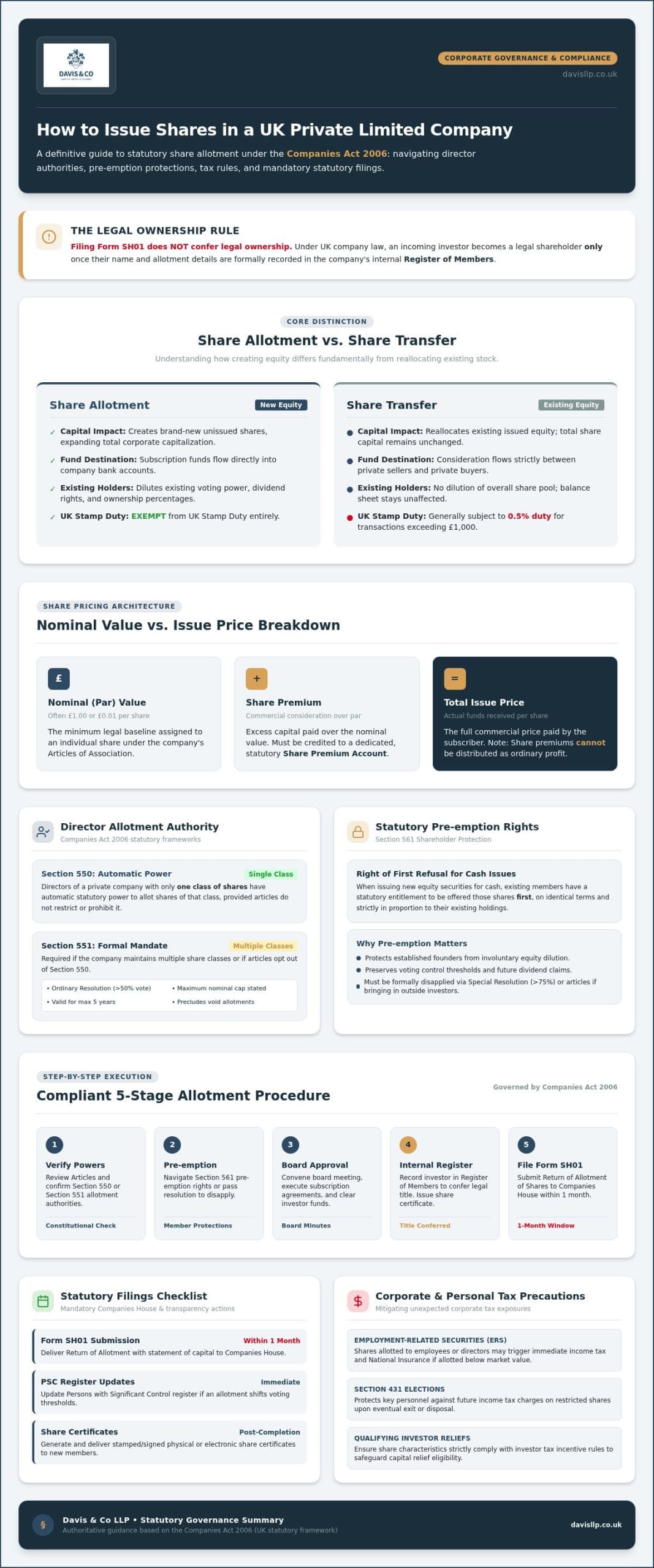
Expanding an enterprise often demands new equity. When corporate leaders evaluate how to issue shares in a private limited company, confusion frequently arises between creating brand-new shares and transferring existing ones. Under the Companies Act 2006, an allotment represents a formal statutory contract between the company and an incoming investor, creating unissued equity that expands the business’s overall capitalization base. Conversely, transfers merely shift existing equity between parties. Understanding these core mechanics ensures your corporate governance remains pristine.
Every newly allotted share inherently dilutes existing members by altering overall ownership percentages, voting thresholds, and future dividend distributions. Established founders frequently rely on statutory pre-emption rights to protect themselves against unwanted dilution before external investors contribute funds. Typically, companies execute allotments for specific strategic objectives:
- Securing growth capital: Injecting liquid equity directly into operations to fund expansion or strategic acquisitions.
- Incentivising leadership: Issuing equity awards to attract senior executives or retain mission-critical personnel.
- Rebalancing balance sheets: Converting outstanding director loans or third-party liabilities directly into permanent equity.
Share Allotment Versus Share Transfer
The distinction between an allotment and a transfer fundamentally alters balance sheet mechanics and regulatory liabilities. An allotment generates entirely new shares, directly increasing total issued share capital while channeling external funds straight into corporate bank accounts. A share transfer reallocates shares that already exist. In a secondary transfer, consideration flows directly between private sellers and buyers, leaving the company’s balance sheet unchanged. Crucially, allotments are exempt from UK Stamp Duty, whereas transfers over £1,000 generally incur a 0.5% duty.
Nominal Value, Issue Price, and Share Premiums
Navigating share valuation requires separating legal baselines from commercial pricing. The nominal or par value represents the minimum legal value assigned to a share under the articles, often £1.00 or £0.01. The issue price reflects the actual commercial consideration paid per share by the subscriber. When investors pay more than par value, this excess capital must be credited to a dedicated, statutory share premium account on the balance sheet, which cannot be treated as ordinary distributable profit.
Mastering these foundational distinctions is the first vital step in understanding how to issue shares in a private limited company securely, safeguarding your capital structure against procedural challenges.
Constitutional Authority and Statutory Pre-emption Rights
Directors cannot simply create equity at will. Determining how to issue shares in a private limited company requires establishing clear constitutional authority and respecting existing shareholder protections before any allotment occurs. Failing to confirm these legal powers can render an allotment void, leaving directors exposed to claims for breach of statutory duty.
Director Authority Under Section 550 and Section 551
The baseline authority for directors depends on your capital structure and Articles of Association. Under Section 550 of the Companies Act 2006, directors of a private company with a single class of shares hold automatic statutory power to allot shares of that class, provided the articles do not restrict or prohibit it. If your business maintains multiple share classes, or if the articles expressly exclude Section 550, directors require formal authorisation under Section 551. This mandate requires an ordinary resolution passed by a simple majority (>50%) of shareholders. The Section 551 resolution must state the maximum nominal amount to be allotted and cannot remain valid for more than five years.
Navigating Statutory Pre-emption Rights (Section 561)
Even when directors hold allotment authority, existing shareholders enjoy statutory pre-emption rights under Section 561. When issuing new ordinary shares for cash, the company must offer those equity securities to current members first, on identical terms and in proportion to their existing holdings. This mechanism protects established investors from involuntary dilution.
Under Section 562, this pre-emptive offer must stay open for acceptance for at least 14 days. If your commercial objective requires issuing equity directly to an incoming investor or lender, the business must formally disapply these pre-emption rights. Disapplication can be achieved in two ways:
- Special resolution: Shareholders pass a special resolution by a 75% majority under Section 569 or 570, waiving their pre-emptive entitlements for a specific allotment.
- Constitutional exclusion: The company adopts bespoke Articles of Association under Sections 567 and 568 that permanently exclude statutory pre-emption.
Copies of any Section 551 allotment authorities or Section 569 disapplication resolutions must be filed with Companies House within 15 days of passing. If your governance documentation requires formal review, our specialist company secretarial services ensure every resolution aligns strictly with statutory standards.
Step-by-Step Procedure: How to Issue New Shares in a UK Company
Precision matters at every stage of corporate governance. Navigating how to issue shares in a private limited company demands an unbroken chain of documentation, moving methodically from the initial commercial proposal to the formal creation of legal title. Overlooking a single procedural step, such as failing to document investor applications or omitting statutory resolution filings, can render an entire funding round defective.
Step 1: Share Application and Board Evaluation
The transaction initiates with a formal subscription letter or share application submitted by the proposed investor. This document confirms the investor’s identity, the agreed subscription price per share, the class of equity sought, and whether payment will be made in cash or non-cash assets. The directors then convene an initial board meeting to review the commercial merits of the proposal, verify their existing allotment authority, and confirm that statutory pre-emption rights have been properly addressed before putting formal proposals to existing members.
Step 2: Shareholder Approval and Special Resolutions
Whenever directors lack standing authority under Section 550, or whenever pre-emptive rights must be waived for external investment, shareholder consent becomes non-negotiable. Directors must circulate written resolutions or issue a formal notice of a general meeting to existing members:
- Allotment authority: An ordinary resolution passed by a simple majority under Section 551 to grant directors power to issue the designated tranche of shares.
- Pre-emption disapplication: A special resolution passed by a 75% majority under Section 569 or 570, waiving the statutory 14-day offer period.
Both resolutions must be delivered to the registrar within 15 days of passing to maintain statutory compliance.
Step 3: Formal Allotment, Payment, and Certificate Issuance
Once shareholder approvals are executed, directors hold a second board meeting to accept the application and formally allot the shares. Crucially, the board must confirm receipt of full subscription funds into the corporate bank account prior to allotment. Under Section 769 of the Companies Act 2006, the business must generate and deliver stamped or signed share certificates to the new shareholder within two months of allotment.
Following allotment, directors must complete their statutory disclosures by delivering Companies House Form SH01 within one month of the allotment date. Establishing this disciplined sequence ensures that every director understands how to issue shares in a private limited company with complete legal finality.
Statutory Filings, Register Updates, and Corporate Transparency
Submitting statutory returns is often treated as the final administrative formality. In reality, fulfilling statutory filings and maintaining transparency registers form the legal backbone of how to issue shares in a private limited company. Companies House no longer operates merely as a public registry; recent reforms empower the registrar to actively query filings, reject irregular particulars, and sanction non-compliant directors.
Completing and Submitting Form SH01
Within one month of the allotment date, the company must deliver Form SH01 (Return of Allotment of Shares) under Section 555 of the Companies Act 2006. While Companies House charges a £0 statutory fee for this specific submission, missing the one-month window is a criminal offence under Section 557, exposing every officer in default to potential fines. The return must include an exhaustive Statement of Capital reflecting the updated total share count, aggregate nominal value, and currency breakdown.
A frequent compliance pitfall involves the prescribed particulars of rights attached to the equity. Companies House regularly rejects submissions that state generic phrases like “rights as per articles.” You must articulate the full statutory particulars directly on the form:
- Voting rights, including whether shares carry single, weighted, or zero voting entitlements.
- Dividend rights, defining whether distributions are discretionary, fixed, or cumulative.
- Capital distribution rights, detailing entitlements on winding up or capital redemptions.
- Redemption provisions, specifying whether the shares are liable to be redeemed at the option of the company or the holder.
Updating the Register of Members and PSC Register
Filing Form SH01 informs the public record, but it does not establish shareholder title. Under Section 112 of the Companies Act 2006, legal ownership passes only when the allottee’s name, address, allotment date, and shareholding are inscribed into your internal Register of Members. Under the Economic Crime and Corporate Transparency Act (ECCTA), the previous option to elect to maintain this register solely on the central Companies House public ledger has been entirely abolished; your business must maintain its own internal statutory books.
Equally critical are the People with Significant Control (PSC) notifications. Whenever a new allotment causes an investor to cross statutory ownership or voting thresholds of 25%, 50%, or 75%, specific legal duties arise. You must update your internal PSC register within 14 days and submit the appropriate notification (such as Form PSC01 or PSC02) to Companies House within a further 14 days. Ensure your governance records remain flawless by engaging our experienced company secretarial services to oversee your statutory registers and mandatory filings.
Commercial Strategy, Tax Implications, and Governance Advisory
Equity decisions rarely exist in isolation from fiscal exposure. Knowing how to issue shares in a private limited company involves more than just satisfying corporate registries. It requires anticipating immediate tax triggers for both the business and the incoming allottee. A poorly structured allotment can inadvertently create dry tax charges, penalising key personnel with substantial income tax demands before the enterprise generates commercial liquidity.
Employment-Related Securities (ERS) and Valuation Risks
Issuing equity to directors or staff engages the complex statutory provisions of Part 7 of the Income Tax (Earnings and Pensions) Act 2003 (ITEPA). If an employee acquires shares for less than their actual market value, HM Revenue & Customs treats the discount as taxable employment earnings, subjecting the difference to income tax and potentially National Insurance contributions.
To mitigate future exposure when equity carries vesting conditions or forfeiture clauses, companies and participants should execute a joint election under Section 431(1) ITEPA within 14 days of acquisition. This election assesses tax on the initial unrestricted market value rather than exposing the individual to higher income tax charges as restrictions drop away over time. Every enterprise allotting shares to personnel must register the arrangement and file an annual online ERS return by 6 July following the close of the tax year. For comprehensive oversight on corporate tax exposure and structural planning, reviewing our strategic small business accountant guide provides valuable broader perspective.
Structuring Alphabet Shares and Commercial Dividend Planning
Many private businesses adopt multi-class or “alphabet” share structures (Class A, Class B, Class C) to introduce flexible commercial governance. Distinct classes allow directors to tailor voting participation, establish separate capital distribution waterfalls, and declare discretionary dividends to specific shareholder groups without altering the broader ownership foundation.
However, HMRC closely examines alphabet share models under the settlements legislation (Part 5, Chapter 5 of the Income Tax (Trading and Other Income) Act 2005) whenever dividend distributions appear designed primarily to divert income to non-working or lower-earning family members. Demonstrating genuine commercial rationale and ensuring shares carry substantial underlying rights, rather than merely representing a pure right to income, protects against revenue challenges. Securing early strategic counsel from a qualified chartered accountant guarantees that understanding how to issue shares in a private limited company translates directly into sustainable growth, robust corporate governance, and complete statutory resilience.
Executing Compliant Share Allotments for Long-Term Growth
Successfully expanding your equity base rests on procedural discipline. As outlined across this guide, mastering how to issue shares in a private limited company requires far more than completing electronic filings. It demands verifying director allotment authority under the Companies Act 2006, formally addressing pre-emption rights, and entering new members directly into your internal statutory registers to perfect legal ownership. When coupled with proactive planning around Employment-Related Securities and Section 431 elections, your capital expansion remains legally robust and tax-efficient.
Navigating these corporate governance demands doesn’t have to stall your commercial momentum. As Chartered Certified Accountants, we provide comprehensive guidance across corporate structuring, statutory register maintenance, and strategic tax planning. Whether you’re onboarding key talent or closing a substantial funding round, we ensure every allotment withstands statutory scrutiny. To safeguard your business and streamline your next equity release, consult Davis & Co LLP for strategic corporate advisory today.
Frequently Asked Questions
How long does a private company have to file Form SH01 after issuing shares?
A private limited company must deliver Form SH01 to Companies House within one month of the allotment date under Section 555 of the Companies Act 2006. Failing to meet this statutory deadline constitutes a criminal offence committed by every officer in default. While Companies House charges no statutory filing fee for Form SH01, submitting late or inaccurate statements of capital risks regulatory penalties and complicates future due diligence during corporate transactions.
Can directors issue new shares without obtaining shareholder approval?
Directors can only allot shares without member approval if the company has a single class of shares and the Articles of Association don’t prohibit it, pursuant to Section 550 of the Companies Act 2006. If the company maintains multiple share classes, or if the articles restrict standing powers, directors require prior shareholder approval via an ordinary resolution under Section 551. Understanding these constitutional boundaries is essential when exploring how to issue shares in a private limited company securely.
What is the practical difference between transferring existing shares and allotting new ones?
An allotment creates brand-new shares, expanding the total issued share capital and channeling cash directly into the company balance sheet. In contrast, a share transfer involves buying existing shares from a current holder, leaving the company’s capital pool unchanged while consideration passes directly between the private parties. Transfers above £1,000 attract a 0.5% Stamp Duty charge, whereas newly allotted shares remain exempt from UK Stamp Duty entirely.
Do private limited companies need to issue physical share certificates in 2026?
Companies must generate and deliver formal share certificates to subscribers within two months of allotment under Section 769 of the Companies Act 2006. While modern governance software allows companies to issue electronically signed digital certificates, the underlying statutory obligation remains absolute. Whether delivered as an executed PDF or a physical paper certificate, the document serves as prima facie evidence of legal title alongside the definitive internal Register of Members.
What happens if a company fails to update its statutory register of members?
The allotment remains legally incomplete until the subscriber’s details are entered into the internal Register of Members under Section 112 of the Companies Act 2006. Under the Economic Crime and Corporate Transparency Act, companies can no longer rely on central Companies House records. Failing to update internal books means the investor does not hold legal title, votes cast by them may be invalid, and company officers commit a statutory default offence.
Are there tax liabilities when issuing new shares to employees or directors?
Yes, income tax charges arise if an employee or director acquires shares at a discount to their genuine market value under Employment-Related Securities rules. HM Revenue & Customs treats the difference between the price paid and the market value as taxable employment earnings. To prevent punitive tax bills as vesting conditions lapse, participants should execute a joint Section 431 election within 14 days of acquisition, fixing tax strictly to the initial valuation.
What are statutory pre-emption rights and how can they be disapplied?
Statutory pre-emption rights under Section 561 grant existing ordinary shareholders a right of first refusal when new shares are issued for cash, preventing involuntary dilution. These rights require a formal 14-day offer period to existing members. To issue equity directly to external investors when learning how to issue shares in a private limited company, members can formally disapply pre-emption by passing a special resolution with a 75% majority or excluding it via bespoke articles.