What if the tax-efficient choice for your dental practice no longer reflects how it earns, retains or uses income? Tax planning for dental practices is not simply a year-end exercise or a comparison of headline rates. The relationship between practice profits and your personal income can shift as the practice grows, changes its mix of NHS and private work, invests in equipment or brings new owners into the business.
It can be difficult to know whether a sole-trader, partnership or limited-company structure still suits you, or which decisions need attention before they are put into effect. A choice that appears sensible for the practice can also affect when and how you receive income personally.
This guide explains how practice structure, profit extraction, investment, cash flow and personal tax interact in 2026. It outlines circumstances that may warrant a review and shows how to build a consistent approach to tax, compliance and business planning for dental associates, owners and practices.
Key Takeaways
- Approach tax planning for dental practices as an ongoing process that connects practice finances with personal income and business decisions.
- Assess whether your current structure still fits how the practice operates. Incorporation does not automatically mean a better tax position or higher take-home income.
- Use up-to-date records and forecasts to review investment, cash flow and tax decisions before taking action.
- Specialist dental tax advice can bring practice accounts, personal tax, VAT and business objectives into a more coherent plan.
What tax planning for dental practices covers, and why it is more than filing returns
Tax planning for a dental practice is the forward-looking process of reviewing how it earns, spends and retains income, and how business decisions affect the tax position of the practice and its owners. It connects decisions made during the year with accurate reporting and compliance, rather than treating the annual return as the whole task.
Practice receipts, operating costs, owner drawings, planned investment and personal income can affect one another. Reviewing them together helps owners understand the financial implications before committing to a decision. Sound planning relies on accurate records, evidence and compliance with current rules. It does not assume that a particular arrangement or transaction will produce a tax advantage.
How dental practices earn income shapes the planning questions
A practice’s income mix can raise different accounting questions. NHS, private and mixed activity may involve distinct records, agreements and reporting considerations. The tax treatment of a particular service or transaction depends on the facts and current rules, including the relevant VAT rules. The income model matters, but does not determine the answer on its own.
An associate may need to understand how their income and working arrangements are treated. An owner may also need to consider practice costs, retained profits and amounts drawn personally. A group may have additional entities or shared arrangements to account for. The right review depends on each person’s role, the practice’s records and agreements, and the rules in force.
Why year-round planning is different from year-end compliance
Year-end compliance reports transactions that have already happened. Planning gives you an opportunity to review a proposed decision while there is still time to assess its accounting, tax and cash-flow implications. If you are considering recruiting staff, investing in equipment or expanding, a forward review can help identify the records and forecasts needed to evaluate the decision. It will not make the decision for you, but it can give you a clearer financial picture.
Regular bookkeeping and timely management information help keep that picture current, so planning is not based only on figures assembled after the year has ended. For broader context on personal tax and how it may relate to business decisions, see our UK tax advice guide. If your practice operates through a limited company, understanding corporation tax fundamentals can help frame the questions to review alongside advice tailored to your circumstances.
How dental practice tax planning connects income, profits and business decisions
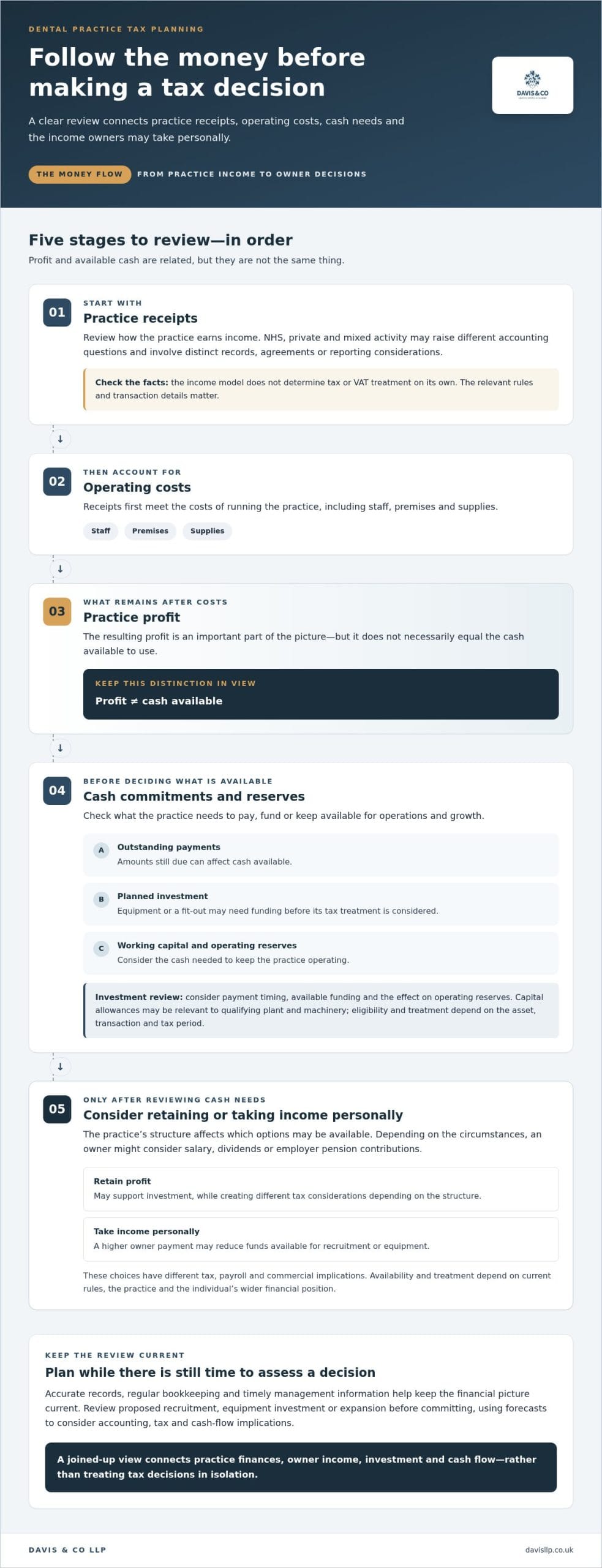
Tax planning should follow the movement of money through the practice while preserving the cash needed to operate and grow it. Receipts first meet operating costs such as staff, premises and supplies. The resulting profit is not necessarily the same as the cash available: outstanding payments, planned investment and working-capital needs also matter. Owners can assess what may be retained or taken personally only after considering these demands.
This sequence helps prevent tax decisions being treated in isolation. A higher payment to an owner, for example, may reduce funds available for recruitment or equipment. Retaining profit may support investment, while creating different tax considerations depending on the practice’s structure. Tax planning for dental practices is most useful when it reflects both the commercial purpose of a decision and its effect on cash flow.
Profit extraction, pension contributions and personal tax
Business profit and personal income are related, but they are not interchangeable. Depending on the structure, an owner might consider salary, dividends or employer pension contributions. Each has different tax, payroll and commercial implications, and not every option is available or appropriate in every situation. Eligibility, limits and treatment depend on current rules, the practice’s circumstances and the individual’s wider financial position.
For a limited company, the HMRC Corporation Tax overview explains the tax framework for company profits. It is one part of the analysis, not a complete comparison of what an owner may ultimately receive personally. Decisions should account for company cash requirements and personal tax together.
Equipment, VAT and investment decisions
An equipment purchase or fit-out can affect cash flow before its tax treatment is considered. The practice may need to plan for the payment date, available funding and the effect on operating reserves. Capital allowances may be relevant to qualifying plant and machinery, but eligibility and the applicable rules depend on the asset, transaction and tax period. Confirm the treatment under current rules before relying on it in a forecast.
VAT also calls for care. Treatment can depend on the nature of the supply and the facts of the transaction, so do not assume that every dental service or purchase receives the same treatment. Clear records support a more reliable review. For related reporting and growth considerations, see our small-business accounting guide.
Bringing tax advice together with bookkeeping, VAT compliance and cash-flow management can help turn these decisions into a practical plan. To review how tax decisions fit your practice’s operations, explore Davis & Co LLP’s dental tax advice.
Sole trader, partnership or limited company: assess the structure, not the tax myth
There is no single structure that suits every dental business. A limited company does not automatically reduce tax or increase an owner’s take-home income. The outcome depends on how profits are generated, retained and extracted, as well as administration, cash flow, ownership and future plans.
| Structure | Points to assess |
|---|---|
| Sole trader | The individual reports business profits as personal income. Consider how this fits the dentist’s records, personal tax position and plans for the practice. |
| Partnership | Partners share responsibility for the business and its profits under their arrangements. Review how profit allocation, drawings, decision-making and changes in partners are managed. |
| Limited company | The company is a separate entity, with its own accounts and reporting responsibilities. Consider the interaction between company profits, cash retained in the business and payments to owners. |
This is a starting framework, not a recommendation. A comparison should also account for administrative requirements, working-capital needs, ownership arrangements and plans to expand or change hands. Tax planning for dental practices means weighing these commercial factors alongside tax, rather than choosing a structure based on a headline rate alone.
When a dentist should review their current business structure
A review may be timely when the practice changes its mix of NHS and private work, brings in or loses owners, recruits more staff, expands, or considers a purchase or reorganisation. Assess the existing arrangements before committing to an ownership change or major transaction, so the likely accounting, tax and reporting implications can be considered in advance. No single income level automatically makes one structure preferable.
Practice owners, associates and dental groups have different needs
An associate’s focus may include personal income, records and the terms of their working arrangements. A practice owner must also consider practice-level accounts, costs, payroll, cash flow and how profits are allocated or retained. These responsibilities can differ substantially, even when both individuals work in the same practice.
Dental groups may need to coordinate records and reporting across multiple entities, alongside decisions about ownership and shared costs. The more involved the structure, the more important it is to maintain a clear view of each entity and how they relate. Review commercial objectives, operational responsibilities and personal circumstances together.
Restructuring can have consequences beyond the immediate tax calculation. Before making a change, obtain tailored advice and review the tax and reporting rules that apply at the time. A considered assessment can help clarify whether the proposed structure supports the practice’s plans as well as its current operations.
A practical year-round tax planning checklist for dental practices
A repeatable review turns tax planning for dental practices into a working process rather than a task reserved for year-end. Use this sequence through the year and revisit it when the practice’s circumstances change.
- 1. Keep records current. Organise records of practice income, operating costs, payroll, VAT and transactions between the business and its owners. Clear, up-to-date bookkeeping makes it easier to understand performance and prepare reliable accounts.
- 2. Review forecasts and management information. Compare actual results with forecasts and update expectations for income, costs and upcoming payments. Accounting profit is not the same as available cash. A forecast can show what funds are needed for tax, suppliers, payroll and planned investment.
- 3. Identify decisions on the horizon. Note possible purchases, equipment investment, refurbishment, recruitment, ownership changes, succession or expansion. Bring these into the planning conversation before committing, rather than reviewing their consequences only after the transaction.
- 4. Review tax and reporting obligations. Assess the practice’s and owners’ positions using the rules that apply to their circumstances and the relevant tax year. Check current rates, thresholds, allowances, filing and payment deadlines, and Making Tax Digital eligibility, scope and implementation details against HMRC guidance.
- 5. Record actions and follow up. Agree what information is needed, who will provide it and when decisions or forecasts should be revisited. This creates continuity between bookkeeping, tax review and business planning.
Records and forecasts to keep under review
Regular bookkeeping and management information provide a clearer view of income, costs and cash flow. Keep payroll and VAT records alongside owner transactions, and make sure forecasts reflect expected receipts and planned commitments. Digital reporting requirements can vary according to the taxpayer and relevant rules, so check current HMRC guidance rather than assuming one requirement applies to every practice.
Deadlines also need a current check. For the 2025/26 tax year, the Self Assessment deadlines are 31 October 2026 for paper returns and 31 January 2027 for online filing and payment. Verify these dates, and any applicable thresholds or digital reporting requirements, against current HMRC guidance before acting on them.
Questions to ask before a major decision
Before a practice purchase, refurbishment, equipment investment, recruitment or succession decision, consider: When will it happen? How will it be funded? What happens to working cash? What tax and reporting consequences may follow, and what information is needed to assess them? Reviewing these questions early can help owners weigh the decision against the practice’s operational and financial plans.
For a review shaped around your practice’s circumstances, explore tailored dental tax planning.
How specialist dental tax advice supports a more considered practice plan
Tax decisions are easier to assess when the practice’s accounts, the owner’s personal tax position and the business’s objectives are considered together. For dentists, that means looking beyond a single return or transaction to understand how the practice operates, who is involved and what the business is preparing to do next.
Davis & Co LLP provides specialist tax advice for dental professionals and practices, alongside accounting and business advice. As an independent partnership of Chartered Certified Accountants, the firm brings dental-sector understanding to the different circumstances of associates, practice owners and groups. Advice is tailored to each practice’s facts and objectives, without assuming that one structure or decision is right for every dentist.
What a tailored dental tax review can bring together
A review can consider income, business structure, cash flow, investment plans and relevant compliance obligations as parts of the same picture. Recommendations should be grounded in the practice’s records, plans and the current rules that apply. This helps owners evaluate decisions in context, rather than treating tax as separate from the day-to-day running of the business.
Supporting information matters. Bookkeeping and management accounts can show how the practice is performing, while payroll and VAT records contribute to the wider compliance picture. Bringing these areas together with tax advice can help keep financial information aligned with the decisions owners need to make. An associate’s concerns may centre on personal income and records; an owner may also need to consider practice finances, staffing and future investment.
For tax planning for dental practices, specialist input provides a structured way to examine connected questions, whether a practice is establishing its processes, adapting to change or considering its next stage of growth. It can clarify what information is needed and which decisions merit review, without promising a particular tax outcome.
Preparing for a useful conversation about your practice
A focused discussion can start with recent accounts, relevant tax records, forecasts and a short outline of decisions under consideration. These might include a purchase, investment, change in ownership or expansion. You do not need to have every answer in advance. Raising uncertainties early, before arrangements are finalised, gives more scope to assess the financial and tax considerations in context.
If you are considering how your practice’s tax position connects with its plans, discuss dental tax planning with Davis & Co LLP.
Make your next tax decision part of a clearer practice plan
Effective tax planning for dental practices connects how a business earns and uses income with the needs of its owners and its longer-term plans. Reviewing your structure as circumstances change can help establish whether it still supports the practice. Year-round records and forecasts also provide a stronger basis for decisions about investment, recruitment or growth.
Tax and business planning work best when considered together. Davis & Co LLP is an independent partnership of Chartered Certified Accountants, providing specialist tax services for dental professionals and practices. Its wider business support includes cash-flow management, bookkeeping, payroll and VAT compliance, helping connect financial information with practical decisions.
If you are considering a change or want a more joined-up view of your practice and personal tax position, discuss tailored tax planning for your dental practice. A considered conversation can help identify the questions to address and the information needed to plan your next steps. With a clear process in place, you can approach future decisions with greater clarity.
Frequently Asked Questions
What does tax planning for a dental practice involve?
Tax planning for a dental practice involves reviewing financial and business decisions before they are made, as well as meeting reporting obligations afterwards. It brings practice income, operating costs, cash flow, investment, business structure and owners’ personal tax positions into a connected view. For example, before buying equipment, an owner can consider funding, timing, records and potential tax treatment rather than relying on a year-end calculation alone.
Is incorporation always more tax-efficient for a dentist?
No. Incorporation does not automatically reduce tax or increase the amount an owner can take home. A comparison needs to consider company profits, how funds may be extracted, administration, cash retained for operations, ownership and the dentist’s personal circumstances. The right structure depends on the practice’s facts and plans, not a single profit figure or headline rate. Review the tax and reporting implications before changing structure.
Can dental practice owners claim tax relief on equipment?
Potentially, but tax relief is not automatic for every purchase. The treatment can depend on the item, how it is used, who buys it, the business structure and the rules applying in the relevant tax period. Keep invoices and clear purchase records, and assess the equipment’s tax treatment before building assumed relief into a budget. A forecast should also account for the cash outlay and the practice’s operating needs.
How does VAT affect a dental practice?
VAT treatment depends on the nature of the supply and the circumstances of the transaction, so practices should not assume every dental service or purchase receives the same treatment. The practice’s activities and records are important when assessing its position and compliance obligations. Keep supporting documentation and review VAT questions as services, suppliers or business arrangements change. A dental tax specialist can help assess the facts against current rules.
What tax records should a dental practice keep?
Keep organised records of practice income and expenses, invoices, payroll, VAT transactions, bank activity and transactions between the business and its owners. Retain relevant agreements and documents relating to investment or other significant decisions, too. Associates should maintain records supporting their own income and costs. Good bookkeeping and management information help reconcile the figures, prepare accounts and returns, and understand cash flow throughout the year.
When should a dentist seek tax-planning advice?
Seek advice before a decision is finalised if you are considering a practice purchase, equipment investment, refurbishment, recruitment, expansion, ownership change or restructuring. It is also useful to review your position as income, responsibilities or business plans change, rather than waiting until returns are due. Earlier discussion gives more opportunity to assess timing, funding, records and possible tax consequences using the practice’s circumstances and current rules.
Does tax planning apply to dental associates as well as practice owners?
Yes. Associates may need to consider their personal tax position, income records, allowable costs and working arrangements. Practice owners also have business-level responsibilities, including accounts, payroll, cash flow and decisions about practice profits. Their planning needs can therefore differ, even if they work in the same practice. Advice should reflect the individual’s role, relevant agreements, records and current tax rules, rather than assume every dental professional has the same position.