What if another tax adviser’s view could clarify your decision without turning it into a dispute? Getting a second opinion on tax advice is not necessarily a rejection of the original recommendation. It is a practical way to test whether the reasoning reflects your circumstances, the relevant tax rules and the information available.
It’s understandable to feel uncertain when an important recommendation rests on assumptions you don’t fully understand, or when you wonder whether a personal or business detail has been overlooked. You may also worry that a review will add cost, create friction or delay a time-sensitive decision. A focused second opinion should help clarify the issue, not simply introduce another unexplained conclusion.
This guide explains when another adviser’s perspective may be useful, what a review can examine and how to compare the advice you receive. You’ll learn how to identify assumptions, material risks, alternative approaches and missing information, then document your reasoning so you can decide on a practical next step with greater confidence.
Key Takeaways
- A separate tax assessment can test advice against your circumstances without treating the original recommendation as automatically wrong.
- Set a clear review question and scope, including the relevant tax period, transaction and supporting documents.
- When getting a second opinion on tax advice, compare the facts assumed, rules applied, evidence cited, risks and recommended actions.
- Gather relevant returns, calculations, correspondence and transaction records so the reviewer can assess the issue in context.
- A considered review can identify missing information or alternatives and help you document an informed next step.
When is getting a second opinion on tax advice worthwhile?
A second opinion is a separate professional assessment of a tax question, based on your circumstances and the advice already received. It isn’t an automatic rejection of that advice. The aim is to understand the reasoning, test whether its assumptions fit the facts and identify material risks or alternatives before you decide what to do.
Checking advice means examining its reasoning; asking someone to repeat it means hearing the same conclusion without testing how it was reached. A useful review considers the relevant documents, tax period and rules, rather than simply offering reassurance or a different answer.
Uncertainty by itself doesn’t show that advice is wrong. Tax outcomes can depend on details such as who owns an asset, when a transaction took place, an individual’s residence position or the terms of an arrangement. A Tax adviser may address a range of matters, so the right scope for a review depends on the specific question and evidence involved.
Which situations may justify an independent tax review?
Consider a separate assessment when the potential tax exposure is significant to you or a transaction has unusual features. Examples include selling or transferring property, dealing with trust assets, having income or assets connected with another country, or managing a complex personal tax position. Specialist tax planning, trust tax, property and international circumstances can involve details that need careful, individual consideration.
A review may also help if two sources appear to interpret the rules differently, your circumstances have changed since the advice was given, or a recommendation depends on assumptions that haven’t been checked. For example, advice based on a particular ownership arrangement may need reconsideration if the documents show something different. A straightforward request to explain a term or calculation may only need clarification; a question about how a transaction is treated may require analysis of records and applicable rules.
Does asking for another view undermine your current adviser?
Seeking clarity can be a prudent decision, not a dispute. Frame the request neutrally: explain the decision you need to make, identify what you’re unsure about and, where possible, share the original advice and its reasoning. This gives the reviewer a fair basis for assessing the issue instead of relying on a partial summary.
Different conclusions don’t automatically establish that one adviser has made an error. The opinions may rely on different facts, address different tax periods or interpret an uncertain point in distinct ways. The useful next step is to understand what explains the difference, what evidence could resolve it and whether the practical recommendations change. That leaves you better placed to make a considered decision without treating the process as a contest between advisers.
What should a second opinion on tax advice examine?
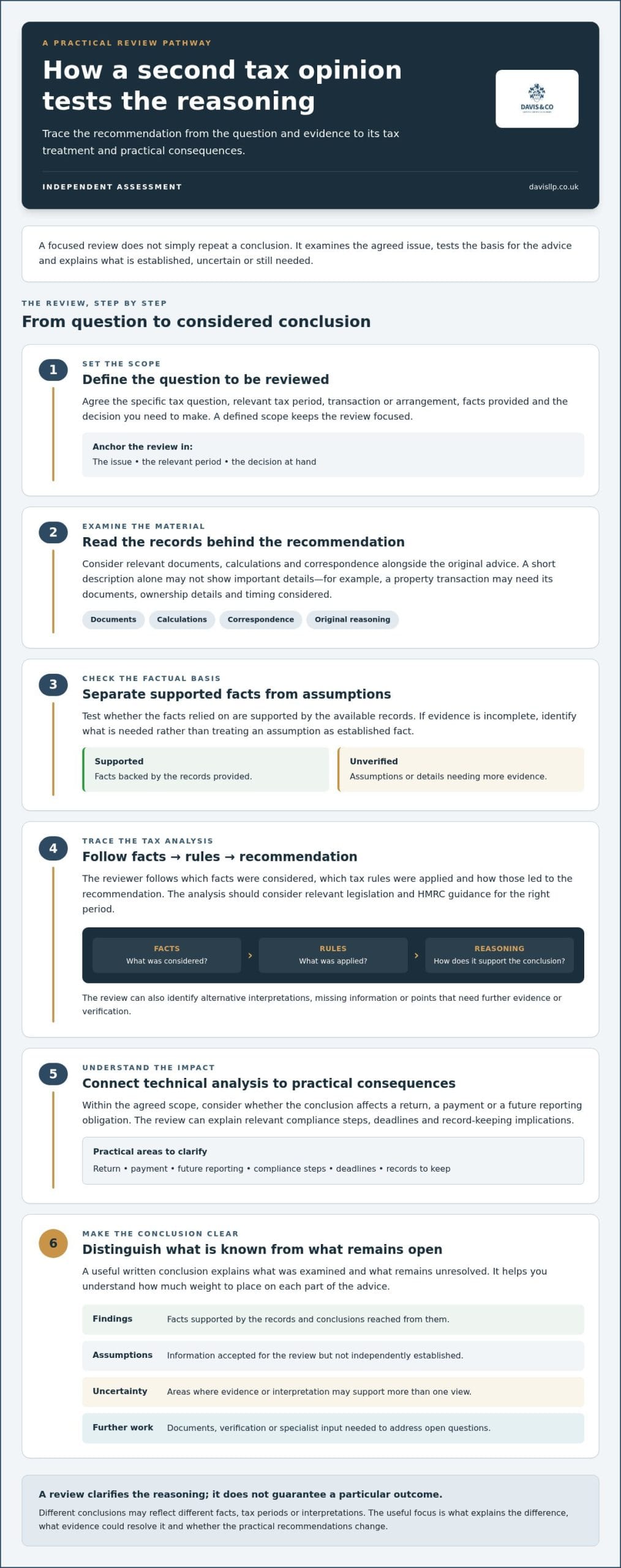
A useful review starts with a defined question, not a general request to decide which adviser is right. When getting a second opinion on tax advice, agree what is being examined: the relevant tax period, transaction or arrangement, the facts provided and the decision you need to make. The reviewer can then consider the relevant records, calculations and correspondence alongside the original recommendation.
An independent tax review traces a recommendation from the evidence and assumptions behind it, through the applicable tax treatment, to its practical consequences. That means checking whether the assumed facts are supported, whether relevant legislation and HMRC guidance have been considered for the right period, and whether the conclusion follows from that analysis. If evidence is incomplete, the reviewer should identify what is needed rather than treat an assumption as established fact.
How does an adviser test the original reasoning?
The reviewer should follow the reasoning step by step: which facts were considered, which tax rules were applied and how those led to the recommendation. They can then identify missing information, alternative interpretations or points that need further evidence or verification. A property transaction, for example, may need to be considered in light of its documents, ownership details and timing, rather than from a short description alone.
The review should also distinguish the technical analysis from the practical consequences. A conclusion may affect a return, a payment or a future reporting obligation. Within the agreed scope, the reviewer should explain any relevant compliance steps, deadlines and record-keeping implications without presenting a technical conclusion as a guarantee of a particular outcome.
What makes a review useful rather than repetitive?
A second opinion adds value when it explains what was examined and what remains unresolved. A clear written conclusion can separate:
- Findings: facts supported by the records and conclusions reached from them.
- Assumptions: information accepted for the review but not independently established.
- Uncertainty: areas where the evidence or interpretation may support more than one view.
- Further work: documents, verification or specialist input needed to address open questions.
This distinction helps you understand how much weight to place on each part of the advice. The reviewer should connect the technical reasoning to your decision, setting out relevant options and their implications within the agreed scope. If the review is limited to one issue, it should say so; it shouldn’t imply that every aspect of your tax position has been assessed.
For individuals seeking a considered assessment of their circumstances and records, Davis & Co LLP’s personal tax services provide a practical starting point for understanding the assumptions, options and compliance implications involved.
How to compare two tax opinions without guessing which is right
Two recommendations are directly comparable only if they address the same question. Check that each opinion concerns the same tax period and transaction, covers the same agreed scope and uses a consistent set of facts. If one adviser assessed an entire arrangement while the other addressed only a single tax treatment, their conclusions may not conflict as much as they first appear.
Use a side-by-side comparison to identify where the reasoning differs. Give more weight to a clear explanation supported by relevant evidence than to confident wording or the number of advisers who agree. When getting a second opinion on tax advice, the aim is to understand the analysis, not to take a vote.
What should you compare between the two recommendations?
Compare the foundations of each opinion before weighing its conclusion. Note any qualifications or uncertainty, and check whether practical consequences and relevant filing or decision timetables are explained. A difference may arise because an adviser has incomplete information, rather than because they interpret the same facts and rules differently.
| Compare | Questions to ask |
|---|---|
| Facts assumed | Do both opinions use the same information about ownership, timing, residence or the transaction? |
| Rules applied | Do they refer to the same tax period and explain the relevant tax treatment? |
| Evidence cited | Are the conclusions supported by the same documents, records and calculations? |
| Risks and uncertainty | Does each opinion identify qualifications, alternative interpretations or unresolved points? |
| Recommended actions | Are the practical steps, compliance implications and relevant timetable consistent? |
What if the second opinion conflicts with the first?
Don’t act on a single sentence or choose the conclusion that appears more favourable without understanding its basis. Identify the precise point of disagreement, then compare the evidence and reasoning behind each view. A focused follow-up on that issue may clarify whether the difference comes from the facts, the scope of each review or a genuine difference in interpretation.
Different conclusions may reflect different assumptions or scope, rather than proving that either adviser is wrong. Record what was considered, which evidence supports the decision, what uncertainty remains and why you chose the next step. This creates a reasoned basis for action and makes it easier to revisit the decision if new information emerges.
How to prepare for a second opinion on tax advice
A well-prepared review starts with a defined decision, not a pile of paperwork. Getting a second opinion on tax advice is more useful when the reviewer can see what you need to decide, what advice you have already received and which facts support it. A clear timeline and complete disclosure can also reduce avoidable assumptions and follow-up questions.
Which documents and background should you assemble?
Gather the records relevant to the issue rather than assuming every item is needed in every case. Depending on the question, these may include:
- The original written advice and any calculations or working papers shared with you.
- Relevant Self Assessment returns, tax computations and supporting schedules.
- Correspondence with your adviser or HMRC that relates to the question.
- Transaction documents, such as contracts, completion statements, trust records or ownership documents, where relevant.
- Key dates, including when decisions were made, events occurred and any upcoming filing or payment deadlines.
Add a short chronology to explain how the matter developed. Note the tax periods involved, important decisions and any changes in your personal or financial circumstances. Mark information that is incomplete, uncertain or different from what was originally provided. If a document is unavailable, say so rather than leaving the reviewer to assume it doesn’t exist.
For broader context on individual tax matters, see our UK personal tax advice guide.
How should you define the review scope and outcome?
Before analysis begins, describe the decision you need to make and frame the specific questions you want answered. For example, you might ask whether a particular transaction has been treated correctly for a stated tax period, or what evidence is needed to assess an assumption in the original recommendation.
Then agree which documents, periods and tax issues are in scope. A review of one transaction should not be taken to cover your entire tax position. Clarifying these boundaries helps you understand what the eventual conclusion can and cannot address.
Set out what would make the review useful. Ask for a clear explanation of the reasoning, the facts relied on, any assumptions or uncertainty, and the practical next steps. If the reviewer identifies a gap in the evidence, you can distinguish a provisional view from a conclusion supported by the available records.
If you’re ready to discuss an assessment of your circumstances and existing advice, explore Davis & Co LLP’s personal tax services.
Getting a second opinion on tax advice with Davis & Co LLP
Getting a second opinion on tax advice can help you understand not only what has been recommended, but why it may apply to your circumstances. Davis & Co LLP provides tailored personal tax assessments that consider your tax facts, relevant records and the advice you’ve already received. The aim is to clarify the reasoning and identify questions that need further evidence or analysis, not to criticise another adviser or promise a particular outcome.
Individual tax positions vary. A recommendation may depend on the timing of a transaction, ownership arrangements, income from different sources or personal circumstances that have changed. Davis & Co LLP’s personal tax services and specialist expertise in tax planning, trusts, property and international tax can help put those details into context. As an independent partnership of Chartered Certified Accountants, the firm has been advising clients since 1901.
What can a tailored tax review help you understand?
A considered review can explain the assumptions behind a recommendation, how the available facts relate to the tax treatment and what practical implications may follow. It can also distinguish established facts from information that still needs checking, and highlight where a document, calculation or further analysis could affect the view.
For example, if your circumstances involve income, assets or residence connected with more than one country, the relevant facts may extend beyond a UK return. Our international tax planning guidance provides broader context for cross-border considerations. A review can then focus on the particular question and records relevant to your position.
What happens after the review?
The findings should be presented in a clear format suited to the agreed scope. You should be able to see what was reviewed, the reasoning behind the conclusions, any assumptions or unresolved points, and the practical options available. Where information is incomplete or the position remains uncertain, that should be clear rather than hidden behind an absolute conclusion.
This gives you a documented basis for deciding whether to proceed, gather further evidence or revisit a particular part of the advice. The review can inform your decision, but it cannot guarantee how a tax matter will ultimately be treated.
If you’d like to discuss your tax question and define an appropriate review scope, contact Davis & Co LLP. Sharing the decision you face and the advice already received can help establish a focused starting point.
Make your next tax decision with greater clarity
Getting a second opinion on tax advice is a way to test the reasoning against your facts, not simply to seek a different answer. A useful review clarifies the assumptions and evidence behind a recommendation, checks that both opinions address the same question and identifies risks or information still needed.
Preparing the relevant records and agreeing the review’s scope can make the findings more practical. You can then compare the reasoning, understand the options and document why you’ve chosen your next step. Different conclusions don’t automatically mean that an adviser is wrong; the facts, scope and interpretation may differ.
Davis & Co LLP is an independent partnership of Chartered Certified Accountants, founded in 1901. Our personal tax services and specialist tax planning expertise support an assessment tailored to your circumstances and the advice you’ve received.
Discuss a tailored second opinion on your tax advice and take a measured next step with greater understanding.
Frequently Asked Questions
Is getting a second opinion on tax advice worth it?
It can be worthwhile when a tax position is complex, the consequences matter to you, assumptions are unclear or interpretations appear to conflict. An independent review can test the reasoning against your facts and relevant records, helping identify gaps and understand your options. It can’t guarantee a different or better outcome. Its value is greater clarity, so you can make and document an informed decision about what to do next.
Can I get a second opinion without telling my current accountant?
You can seek another professional view without automatically treating it as a formal dispute or replacing your existing arrangement. A review is usually more useful when you share relevant original advice and documents, so the reviewer can assess the reasoning rather than a partial summary. Explain the question neutrally and disclose material facts, including anything uncertain or previously omitted. Whether you involve your current accountant is a separate decision based on your circumstances.
How much does a second opinion on tax advice cost?
The fee depends on the complexity of the question, the records involved, the tax periods to be considered and the scope agreed. A focused question may require less analysis than a review involving several transactions or wider personal tax circumstances. Before work starts, agree what will be examined, what the review will deliver and the fee basis. This helps distinguish a limited assessment from broader analysis and makes the work involved clear.
What should I take to a second-opinion tax adviser?
Take the original advice and, where relevant, tax returns, calculations, transaction records and correspondence with HMRC. A concise chronology of key decisions, events, tax periods and upcoming deadlines can help put the documents in context. The precise records depend on the question. Include information that is incomplete, uncertain or has changed, rather than leaving the reviewer to infer it. Accurate, complete background reduces the risk of a view based on missing facts.
What happens if two tax advisers give different answers?
Different answers can reflect different assumptions, information, review scope or interpretations of the relevant rules. First identify the precise point of disagreement. Compare the facts each adviser relied on, the evidence cited and the reasoning behind their conclusions. If a question remains unresolved, seek clarification or a focused review of that issue before acting. Don’t choose an answer solely because it appears more favourable, and don’t assume disagreement alone proves an error.
Will a second opinion change my tax return or HMRC position?
No. Obtaining a review does not by itself amend a tax return, make a filing or resolve an issue with HMRC. Any action depends on your facts, the requirements that apply and the decision you make after considering the findings. If a return or response may need attention, verify the relevant deadline and procedural steps for your circumstances before acting. The review can inform your next step, but it doesn’t take that step automatically.
How long does getting a second opinion on tax advice take?
The time required varies with the complexity of the issue, how complete the records are and the scope agreed with the reviewer. A focused question supported by clear documents may be more straightforward to assess than one involving several tax periods or transactions. You can help the process by assembling the original advice, relevant calculations and correspondence, then preparing a concise chronology. The work and information needed determine the time involved.