Could your dividend tax rate depend on salary you’ve already earned? If you’re searching “how is dividend tax calculated uk”, the key point is that dividends aren’t taxed in isolation: they’re added to your other taxable income to establish which tax bands apply. That can make the calculation less straightforward than applying one rate to all your dividends.
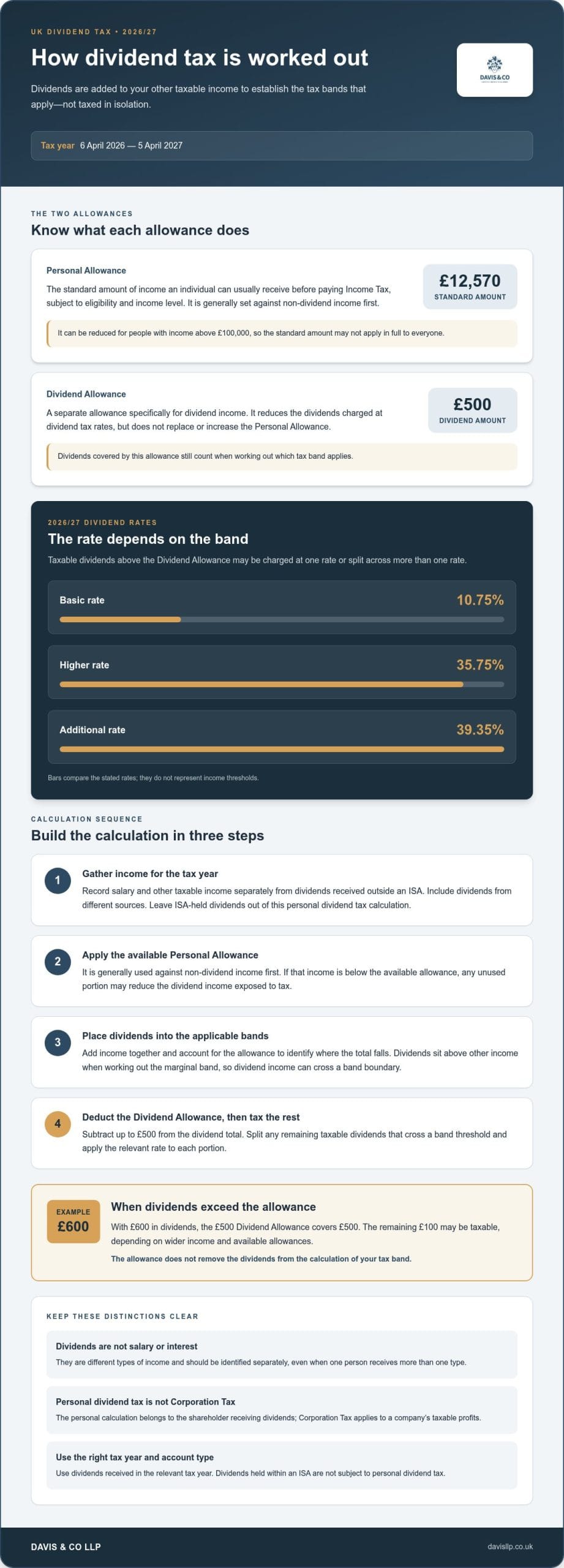
It’s understandable to be unsure how the Personal Allowance and Dividend Allowance fit in, particularly when income crosses more than one band. For 2026/27, the standard Personal Allowance is £12,570 and the Dividend Allowance is £500. Dividends above that allowance may be taxed at different rates, depending on your total income; the allowance itself still counts when working out your tax band.
This guide sets out the calculation in a clear sequence, using the 2026/27 rates and thresholds to show how other income, allowances and dividend bands affect the result. We’ll also outline when Self Assessment or individual personal tax advice may be relevant, since your circumstances can change what you need to report and pay.
Key Takeaways
- Distinguish dividend income from salary and interest, and keep personal dividend tax separate from Corporation Tax.
- To understand how is dividend tax calculated uk, follow the sequence from gathering your income to applying allowances and the relevant tax bands.
- See how dividend income can fall across more than one tax band, and which 2026/27 rates apply to each portion.
- Check whether ISA-held shares, multiple income sources or unused allowances affect your calculation or reporting position.
- Use a final checklist to review your figures and treat online calculator results as estimates based on accurate, complete inputs.
What counts as dividend income for UK tax?
Dividend tax is the personal tax an individual may owe on dividend income they receive from shares, after relevant allowances and income tax bands are taken into account. A dividend is a distribution a company makes to its shareholders, generally from its profits. The personal tax calculation belongs to the shareholder receiving the dividend; it is separate from Corporation Tax, which applies to a company’s taxable profits.
Dividends are not the same as salary or bank interest. Salary is paid for employment and is generally handled through employment tax processes, while interest is a return on savings. A company director who also owns shares may receive both salary and dividends, but the payments retain different tax treatments. The same principles apply to an individual receiving dividends from shares in companies they don’t work for.
For this guide, use the rules for the tax year in which the dividend is received. The 2026/27 tax year runs from 6 April 2026 to 5 April 2027. The broader Dividend tax in the UK overview provides historical context, but the figures used in a calculation must match the relevant tax year.
Which payments are treated as dividends?
Dividends generally arise because you own shares in a company. They may be paid as cash or, in some cases, as additional shares. They are not a guaranteed return: the company’s decision and the shareholder’s entitlement determine whether a dividend is paid. Dividends held within an ISA are treated differently for personal dividend tax and aren’t subject to it, so keep ISA investments distinct from shares held outside a tax-advantaged account.
This distinction matters when considering “how is dividend tax calculated uk”. Begin by identifying which receipts are actually dividends and which tax year they belong to. Don’t combine them with salary or interest as if all three were the same type of payment. However, other taxable income still matters when working out which tax band applies to dividends, a point covered in the calculation steps that follow.
What are the Personal Allowance and Dividend Allowance?
The Personal Allowance is the amount of income an individual can usually receive before paying Income Tax, subject to eligibility and income level. The standard Personal Allowance for 2026/27 is £12,570. It can be reduced for people with income above £100,000, so the standard figure won’t apply in full to everyone. In a dividend calculation, the Personal Allowance and the order in which it is used can affect how much income remains taxable.
The Dividend Allowance is separate: it applies specifically to dividend income, and it is £500 for 2026/27. It doesn’t increase the Personal Allowance or replace it. For example, if you receive £600 in dividends, the Dividend Allowance covers £500; the remaining £100 may be taxable depending on your wider income and available allowances. Dividends covered by the allowance still count when establishing your tax band, so the allowance doesn’t remove them from the overall calculation.
How to calculate dividend tax in the UK, step by step
To work out how is dividend tax calculated uk, treat it as a sequence rather than applying one rate to all your dividends. You’ll need the figures for a single tax year, a view of how your allowances apply, and the relevant dividend rates. The following method provides a structured estimate; your final position can differ if your circumstances affect your allowances or tax bands.
Gather the figures and establish taxable income
Start with income received from 6 April 2026 to 5 April 2027. Keep dividend income separate from salary and other taxable income, such as savings income. Exclude dividends held within an ISA from this personal dividend tax calculation. Use the amount you personally received as dividends, not company profits or amounts reduced by company expenses.
- List your income. Record salary and other taxable income, then total dividends received outside an ISA during the tax year. Include income from different sources so the calculation reflects your full personal position.
- Apply any available Personal Allowance. This is generally set against non-dividend income first. If that income is below your available allowance, the unused portion may reduce the amount of dividend income exposed to tax. Eligibility and income level can affect how much allowance you have.
- Identify your taxable income and band. Add income together and account for the allowance to see where the total falls against the applicable thresholds. Dividends sit above other income when working out the marginal band, so a dividend can cross a band boundary even if the earlier income did not.
Apply allowances and the relevant dividend rates
Next, apply the 2026/27 Dividend Allowance of £500 to your dividend income. It reduces the amount of dividends charged at dividend tax rates, but it doesn’t decide your marginal band: dividends covered by the allowance still count when establishing which band applies. Taxable dividends above the allowance may therefore be charged at one rate or split across more than one rate.
- Subtract the Dividend Allowance from your dividend total, up to the amount available.
- Divide the remaining dividends by tax band if they cross a threshold, then apply the rate for each portion. The 2026/27 dividend rates are 10.75%, 35.75% and 39.35% for the basic, higher and additional rates respectively. See Official UK government guidance on dividend tax for current rates and examples.
- Add the tax on each portion to estimate the dividend tax due. This is a personal tax calculation, not a calculation of the company’s Corporation Tax.
In short: total your income, apply the Personal Allowance, establish the marginal band, deduct the Dividend Allowance, then tax each remaining dividend portion at its applicable rate.
For example, an England, Wales or Northern Ireland taxpayer with £30,000 salary and £10,000 of dividends in 2026/27 has £17,430 of salary remaining after the standard Personal Allowance. The £10,000 dividend total brings taxable income to £27,430, within the basic-rate band. After the £500 Dividend Allowance, £9,500 is taxed at 10.75%, giving an illustrative dividend tax amount of £1,021.25. Different income, reduced allowances or a different band position can change the result; Scottish taxpayers also have different bands for non-dividend income.
If your figures involve several income sources, unused allowances or a band transition, tailored personal tax advice can help you assess the calculation against your circumstances.
Which dividend tax bands apply in 2026/27?
The dividend tax rate depends on where your income falls within the tax bands, not simply on the size of your dividend. For 2026/27, dividend rates are the same across the UK, but the income tax bands used for non-dividend income differ in Scotland. The table shows the dividend rates and the relevant taxable income bands for England, Wales and Northern Ireland.
| Band | Taxable income band | Dividend tax rate |
|---|---|---|
| Basic rate | £12,571 to £50,270 | 10.75% |
| Higher rate | £50,271 to £125,140 | 35.75% |
| Additional rate | Over £125,140 | 39.35% |
These are annual thresholds for the tax year running from 6 April 2026 to 5 April 2027. The standard Personal Allowance is £12,570, so taxable income starts above that amount for someone entitled to the full allowance. The allowance can be reduced when income exceeds £100,000, which may change the calculation. GOV.UK’s dividend tax guidance sets out the rates and worked examples for the year.
How dividends can cross more than one tax band
Dividends are added after other income when determining which marginal band applies. If your total income spans a threshold, different portions of your dividends can be taxed at different rates. It’s therefore not safe to assume every dividend is charged at your highest rate, or that one rate applies to the full amount.
For example, assume salary of £48,000 and £5,000 of dividends, with the full Personal Allowance available and no other income or adjustments. After the £12,570 allowance, £35,430 of salary uses the basic-rate band, leaving £2,270 before taxable income reaches £50,270. The £500 Dividend Allowance still counts towards the band, even though it isn’t taxed. Of the remaining dividends, £1,770 falls in the basic band and £2,730 in the higher band. At 10.75% and 35.75% respectively, the illustrative dividend tax is £1,167.25.
What changes the applicable band?
Salary and other taxable income use up the available bands before dividends are considered. The amount of Personal Allowance you can use, other income sources, and the total dividends received can all affect where the remaining dividends fall. For a straightforward example, HMRC uses wages of £29,570 and dividends of £3,000. With the full £12,570 Personal Allowance, taxable wages are £17,000, leaving the dividends within the basic-rate band. The first £500 is covered by the Dividend Allowance; the remaining £2,500 is taxed at 10.75%, giving £268.75.
Scottish taxpayers use different income tax rates and bands for non-savings, non-dividend income. Dividend rates remain the same across the UK, but Scottish income tax treatment can affect how much of the bands is used before dividends are assessed. If you’re asking “how is dividend tax calculated uk”, the key is to establish your complete income position before applying rates to dividend portions.
What can change your dividend tax calculation or reporting?
Your estimated tax and your obligation to tell HMRC are related, but they’re not the same question. A calculation can indicate whether tax may be due; it doesn’t, by itself, determine whether you must submit a Self Assessment tax return or use another reporting route. Requirements can depend on the tax year, the amount and type of income, and whether you already need to file a return for another reason.
That distinction matters when considering “how is dividend tax calculated uk”. A small change to your other income or available allowances can alter the tax estimate, while your reporting position may turn on separate HMRC criteria. Avoid assuming that one dividend figure automatically means the same thing for every taxpayer.
When might your circumstances alter the estimate?
Several details can change the figures before you apply the dividend rates. Check whether you’re entitled to the full Personal Allowance, whether your income affects its availability, and whether you have other taxable income that uses up part of a tax band. Unused Personal Allowance may affect how much income is taxable, while the Dividend Allowance reduces taxable dividends but doesn’t determine your marginal band.
Separate dividends from shares held outside an ISA from investments held in a qualifying ISA. ISA-held dividends aren’t subject to personal dividend tax, so including them in the taxable dividend total could overstate your estimate. Also consider whether dividends came from more than one company, and keep records that distinguish dividend receipts from salary, interest or other income.
Overseas dividends, changes in residence, or income connected with more than one country can raise additional questions about how income is treated and reported. These circumstances may need tailored analysis rather than a standard UK-only estimate. The same applies if your income sources or personal circumstances make it unclear which allowance or reporting rules apply.
How should you check whether HMRC needs to be told?
Use HMRC’s guidance for the specific tax year to confirm whether you need to report dividend income, and which route applies. For 2026/27, the current guidance states that dividend income above £10,000 must be reported through Self Assessment. If your dividends are £10,000 or less, you may be able to ask HMRC to adjust your tax code. You may still need to file a return for another reason, so don’t treat the dividend amount alone as a complete test. Review HMRC’s dividend tax guidance alongside its Self Assessment instructions before acting.
Keep supporting information together so you can reconcile your estimate with the income reported. This may include dividend vouchers, annual statements, records of ISA-held investments, payslips and details of other taxable income. Check that the documents relate to the same tax year and reflect amounts received, not just amounts declared or expected.
If your calculation or reporting position involves multiple income sources, overseas income or uncertainty about allowances, Davis & Co LLP can provide tailored personal tax advice to help you assess the relevant details.
How to check your dividend tax calculation and plan next steps
A calculation is only as dependable as the information entered. Before relying on an estimate, check that it reflects the correct tax year, all relevant income and your personal allowances. This final review helps catch common omissions, but it doesn’t replace checking how HMRC expects you to report your income.
What to check before relying on a dividend tax estimate
Work through the figures in a consistent order. Confirm the dividend amounts against company statements or dividend vouchers, and make sure they relate to the tax year you’re calculating. Include dividends received from all relevant shareholdings, while keeping qualifying ISA investments separate from dividends that may be subject to personal tax.
- Tax year: Check that the calculation covers the year in which the income was received and uses that year’s rules.
- Income totals: Reconcile dividends, salary and other taxable income against supporting records. Don’t rely on a dividend figure alone if other income affects your tax bands.
- Allowances: Check your available Personal Allowance and Dividend Allowance, including whether your circumstances affect the amount available.
- Bands and rates: Confirm where your taxable income falls and whether the dividends are split across more than one band.
- Reporting: Treat the tax estimate and the decision about whether or how to notify HMRC as separate checks.
Online calculators can help you test the figures, but their results are estimates based on their assumptions and the details you enter. Select the correct tax year, enter each income source accurately, and check how the tool treats allowances and tax bands. A calculator may not reflect every personal circumstance, such as overseas income or a reduced Personal Allowance. Compare its assumptions with current HMRC guidance before using the result to make a decision.
When tailored personal tax advice may help
Consider a closer review if you have several income sources, complex shareholdings, overseas dividends or questions about tax residence. These details can affect both the calculation and the way income needs to be considered for reporting. If you’re still asking “how is dividend tax calculated uk” for your particular circumstances, checking each assumption against your full income position is more useful than relying on a headline rate alone.
Davis & Co LLP provides personal tax services through Chartered Certified Accountants. Tailored advice can help interpret the rules in light of your individual circumstances; it shouldn’t be taken as a promise of a particular tax outcome or saving. With the calculation checked, you can make a more informed decision about your next steps.
To explore support relevant to your circumstances, visit Davis & Co LLP’s personal tax services.
Make your next tax decision with confidence
A dividend tax estimate is a useful point of reference, but your tax position can change as your income, investments or circumstances change. Keep your records organised and revisit your calculation when you receive new income or approach a tax-band threshold. That makes it easier to spot when a previous estimate may no longer reflect your position.
If you’re still asking “how is dividend tax calculated uk” in relation to your own circumstances, tailored interpretation may help you decide what to review and what to do next. Davis & Co LLP is an independent partnership of Chartered Certified Accountants, with a history dating back to 1901. Its personal tax services take account of the differing circumstances individuals may face, without assuming a particular outcome.
Explore Davis & Co LLP’s personal tax services to consider support for your situation. A clear understanding of your figures can help you approach your next tax decision with greater assurance.
Frequently Asked Questions
Is dividend tax calculated separately from salary?
Dividend tax uses specific rates, but your dividends aren’t assessed in isolation from salary. Your salary and other taxable income help establish how much of each tax band is already occupied, which determines the rate applied to your dividends. For instance, a pay rise during the tax year could mean more of your dividend income falls into a higher band. The calculation considers your overall income position, even though salary and dividends are different income types.
How much dividend income can I receive tax-free in 2026/27?
The Dividend Allowance is £500 for 2026/27, so you don’t pay dividend tax on the first £500 of dividend income covered by it. This is not necessarily the limit of dividends you can receive without paying tax: any available Personal Allowance may also affect the result. The answer depends on your other income, allowance eligibility and whether the shares are held outside an ISA. Check your complete income position rather than relying on the allowance alone.
Do dividends use up my Personal Allowance?
Yes, dividends can be covered by any Personal Allowance that remains after it has been applied to other income. In practice, the allowance is generally set against non-dividend income first, and an unused balance may reduce the dividends subject to tax. The standard Personal Allowance is £12,570 in 2026/27, but eligibility and income can affect the amount available. Dividends covered by the separate Dividend Allowance still count when determining your tax band.
What dividend tax rates apply in the UK in 2026/27?
For 2026/27, the dividend tax rates are 10.75% at the basic rate, 35.75% at the higher rate and 39.35% at the additional rate. These rates apply to taxable dividends after relevant allowances. The applicable rate depends on your total taxable income and how much of each band is already used. Dividend rates are the same across the UK, although Scotland has different income tax bands for non-savings, non-dividend income.
Can I pay more than one dividend tax rate in the same tax year?
Yes. If your taxable income crosses a band threshold, different portions of your dividends may be charged at different dividend rates. For example, salary and other income might leave only part of the basic-rate band available, with the remaining dividends extending into the higher-rate band. It’s the portion in each band that matters, rather than applying your highest rate to every dividend. A complete calculation helps show how the income is divided.
Do I need to tell HMRC about dividend income?
Possibly. For 2026/27, HMRC guidance says dividend income above £10,000 must be reported through Self Assessment; for dividends of £10,000 or less, you can ask HMRC to change your tax code. You may also need to file a return for another reason, so the dividend total alone doesn’t settle the question. Check current HMRC instructions for your tax year and circumstances, particularly if you already complete a Self Assessment return.
Are dividends held in an ISA subject to dividend tax?
No. Dividends from shares held within a qualifying ISA aren’t subject to personal dividend tax. Keep them separate from dividends received on investments held outside an ISA when preparing your figures. For example, if you hold shares both inside and outside an ISA, include the non-ISA dividend receipts in your personal calculation, while excluding the ISA-held dividends. This distinction can prevent you from overstating the dividend income relevant to your tax estimate.