A budget that stays unchanged can quickly lose its value. For businesses searching for “business budgeting and forecasting uk”, the more useful approach is to treat financial plans as working tools: base them on current information, review them regularly and adjust them as trading conditions change.
It’s understandable to want a clear view of future cash needs and financial performance, particularly when sales, operating costs, VAT and payroll all affect the numbers. A budget sets out the financial plan. A forecast updates that view as actual results and new information emerge. Used together, they can help you spot pressure points earlier and make more informed decisions.
This practical guide explains how to build a budget and forecast that reflect your business, connect assumptions to reliable records and remain useful throughout the year. It covers the information to gather, how to account for income and outgoings, and how to review performance and compare scenarios. The aim is a manageable process that supports decisions, not a spreadsheet that sits untouched after approval.
Key Takeaways
- Trace forecast assumptions from sales activity through costs and cash movements to see where timing could create pressure.
- Build a plan around your business’s records, priorities and decision-making needs.
- Compare a base case with stronger and weaker scenarios, and make the assumptions behind each clear.
- Set a practical review rhythm, assign responsibility for key inputs and record when forecasts are updated.
- Connect bookkeeping and regular management accounts with cash flow oversight to make financial information more useful for business decisions.
Business budgeting and forecasting in the UK: what each tool tells you
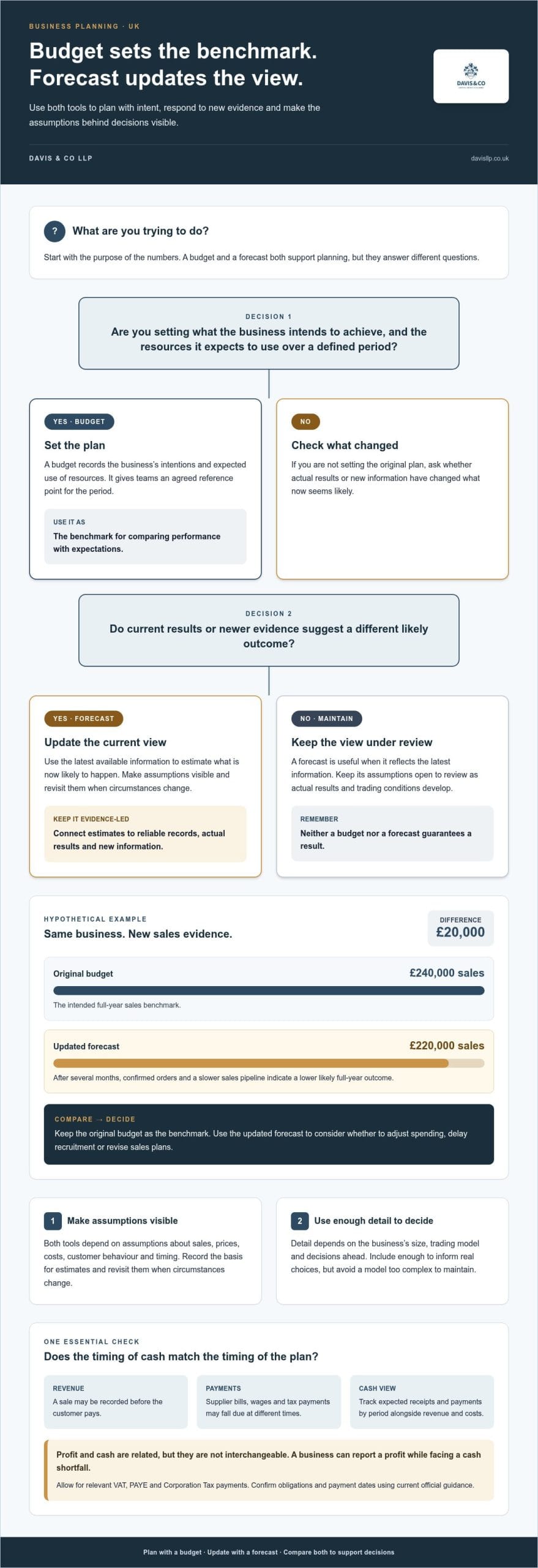
A budget and a forecast both help you plan, but they answer different questions. A budget sets out what the business intends to achieve and the resources it expects to use over a defined period. A forecast uses the latest available information to estimate what is now likely to happen. Put simply: a budget is the financial plan; a forecast is the current view of how the plan may unfold.
This distinction matters. Neither document guarantees a result. Both depend on assumptions about sales, prices, costs, customer behaviour and timing, so make those assumptions visible and revisit them when circumstances change. A Financial forecast brings expected revenue and costs into a structured view, but its usefulness depends on the quality of the information behind it.
Budget versus forecast: the practical distinction
Hypothetical example: A business budgets for £240,000 in sales over the year. After several months, confirmed orders and a slower sales pipeline suggest that full-year sales are more likely to be £220,000. The original budget remains the benchmark, while the forecast changes to reflect the newer evidence. Comparing the two helps management consider whether to adjust spending, delay recruitment or revise sales plans.
Both tools support planning and monitoring. The budget gives teams an agreed reference point; the forecast helps them respond to change rather than treating the original plan as fixed. A forecast should not quietly replace the budget. Comparing them shows where performance differs from expectations and prompts a decision about what to do next.
Why UK businesses use both
The right level of detail depends on the business’s size, trading model and decisions ahead. A business with a small number of predictable income streams may need a straightforward monthly view. A company managing seasonal sales, stock purchases, several teams or long customer payment terms may need more detail by product, department or timing. Include enough detail to inform real decisions, but avoid a model that is too complex to maintain.
Profit and cash are related, but they are not interchangeable. A sale may be recorded as revenue before the customer pays, while supplier bills, wages or tax payments may fall due at different times. A business can therefore report a profit while facing a cash shortfall. Track expected receipts and payments by period alongside revenue and costs to make the timing visible.
In the UK, cash planning should allow for relevant VAT, PAYE and Corporation Tax payments. Use current official guidance to confirm the business’s obligations and payment dates. These commitments affect available cash, even though they do not all appear as operating costs in the same way. A considered budget and regularly refreshed forecast can inform decisions about staffing, stock, investment and growth while keeping the assumptions behind each decision open to review.
How business forecasts connect sales, costs and cash flow
A useful forecast traces how trading activity becomes cash in the bank. Start with the factors that generate sales, then estimate the costs required to deliver them, the overheads needed to operate and the timing of money received and paid. For a practical business budgeting and forecasting process, this chain matters more than a set of isolated totals: a change in sales volume may affect stock purchases, staffing and cash needs at different points in the year.
Use consistent records as your foundation. Bookkeeping records transactions, while management accounts help explain performance against expectations and identify trends. Keep the forecast connected to those sources, and note material assumptions such as anticipated order volumes, price changes or customer payment patterns. This makes it easier to distinguish recorded facts from estimates that need review.
Build the forecast from business drivers
Choose drivers that reflect how the business earns revenue. A retailer might forecast units sold and average order value; a consultancy might use billable utilisation and contracted work; a business with recurring contracts could model renewals and new customers. These inputs make assumptions easier to test. If expected sales change, the forecast can show the likely effect on delivery costs and staffing instead of relying on a top-line figure alone.
Next, classify costs by behaviour. Fixed costs, such as regular premises or software commitments, may remain broadly steady over a period. Variable costs move with activity, such as materials or transaction charges. Keep one-off costs, including planned equipment purchases, visible rather than burying them in routine spending. Add payroll, tax and other expected payments to the relevant periods, using current records and applicable HMRC guidance for tax timing. Record who owns each key assumption and when it was last updated.
Make cash timing visible
Revenue in the accounts is not necessarily cash already received. If a business invoices when work is completed but customers pay later, forecast the invoice and expected receipt separately. Apply the same discipline to supplier bills: record when purchases are made and when payment is due under agreed terms. This matters particularly when stock must be bought before a busy trading period or seasonal sales create a gap between outgoing cash and customer receipts.
Positive profit does not guarantee immediate cash availability; the dates money comes in and goes out matter. A cash flow view should show opening cash, expected receipts, payments and the closing balance for each period. Include VAT and payroll cash movements where applicable, checking current HMRC rules and the business’s own payment schedule before relying on the figures. If a forecast indicates a funding requirement, UK government business finance support provides information on finance and support options.
Reliable bookkeeping and regular management accounts help keep this process grounded in actual results. Davis & Co LLP provides management accounting and cash flow support to help turn financial information into a clearer basis for business decisions.
Why a business budget is not a prediction, and how to compare scenarios
An annual budget gives the business a consistent plan to work towards, but it cannot anticipate every change in demand, costs or customer behaviour. Treating it as a prediction can make a variance feel like failure when it may simply signal that the underlying assumptions need updating. The practical aim of business budgeting and forecasting is not to know the future precisely. It is to understand how different outcomes could affect decisions.
Scenario planning helps you test those outcomes before they become urgent. Build a base case using your best current view, then compare it with plausible stronger and weaker cases. Each is a planning tool, not a promise. The value lies in understanding what might change, when it could matter and what choices would be available.
Choose assumptions that can be explained
Start with recent trading information, such as sales patterns, confirmed orders, customer payment history and known supplier terms. Separate these observed facts from expectations about future activity. A signed contract may provide firmer evidence than an early-stage sales opportunity; a planned supplier price change may be more certain than an assumed increase in demand.
Write down the source and date of each material assumption, who supplied it and how it affects the forecast. Avoid adopting an industry benchmark unless it is relevant and supported by reliable evidence. If you use illustrative figures to test a model, label them as hypothetical and do not present them as typical results. This makes the forecast easier to challenge and update.
Use scenarios to prepare, not to alarm
A weaker case should help identify when management action may be needed, not suggest that a difficult outcome is inevitable. Test a small number of plausible changes against the base case, keeping the assumptions clear:
- Sales delay: Move expected orders or project completions into later periods and assess the effect on receipts and planned spending.
- Cost change: Model a change in a significant input cost or overhead, then consider whether margins or cash balances need attention.
- Late customer payment: Shift expected receipts to reflect slower payment and examine whether supplier commitments still fall due first.
Use the stronger case to test whether additional work would require more capacity, recruitment, stock or investment. A favourable sales outlook can create operational pressure as well as opportunity, particularly if resources must be committed before customer cash arrives.
Scenario planning compares plausible outcomes so you can prepare decisions, not guarantee results. For each case, agree what would prompt a response, such as reviewing discretionary spending, changing a recruitment timetable or revisiting delivery plans. Keep the response proportionate and tied to evidence. As actual results emerge, update the assumptions and reassess whether the intended action remains appropriate. This keeps the budget useful as a reference point while the forecast reflects the latest view.
A practical UK business budgeting and forecasting process
A consistent process makes planning easier to maintain and more useful when decisions arise. Begin with the questions the plan needs to answer, such as whether the business can support recruitment, manage a seasonal cash requirement or fund a growth opportunity. Then build a clear baseline, test the assumptions and establish how results will be reviewed.
Keep the process proportionate. A small business may need a concise monthly view, while more complex operations may benefit from separate forecasts by team, product or income stream. The detail should support decisions, not create unnecessary administration. For wider context on how accounting can support business development, see this strategic small business accountant guide.
Prepare a budget and forecast that fit the business
Use this sequence to establish a plan that can be understood and maintained:
- Set the purpose and period. Decide which decisions the plan must inform and choose a time horizon and reporting intervals that suit them.
- Gather reliable records. Bring together recent bookkeeping, management accounts, sales information, payroll data, supplier commitments and other relevant records.
- Set out assumptions. Document expected trading activity, prices, costs, payment timing and planned changes. Distinguish confirmed commitments from estimates.
- Build and test the figures. Link sales drivers to costs and cash movements, then compare a base case with plausible alternative scenarios.
- Assign ownership. Make clear who provides or updates each important input, and record the date and key changes whenever the forecast is revised.
A written record of assumptions prevents later confusion about why figures changed. It also helps the business distinguish a genuine shift in trading conditions from a difference caused by incomplete or late information.
Review results and update the plan
Choose a review cadence that reflects how quickly the business changes. At each review, compare actual results with the budget and current forecast, then investigate material variances before changing assumptions. For example, lower sales may reflect delayed orders, fewer enquiries or a change in customer demand. Each cause suggests a different response, so avoid treating the variance itself as an explanation.
Record the reason for significant differences, the decision taken and whether the forecast changed as a result. This creates a useful trail from financial information to management action. Payroll assumptions also need attention as staffing plans or applicable employment costs change. When modelling relevant payroll costs, refer to the 2026 National Minimum Wage guide and check current official requirements before finalising figures.
Regular bookkeeping and management accounts provide a dependable basis for this review. Davis & Co LLP’s management accounting support can help make financial information more useful for planning and decisions.
Turn business forecasts into decisions with tailored management accounting
A forecast becomes more useful when it informs a decision rather than simply presenting a set of figures. Reliable bookkeeping and management accounts provide a clearer view of what has happened; cash flow oversight and updated assumptions help connect that information to what the business may need to do next. This is the practical value of budgeting and forecasting: turning financial information into a considered basis for action.
When management accounting can add value
Management accounting support may be useful when cash requirements are changing, the business is planning to grow or reported results are difficult to interpret. A variance in sales, for example, could reflect delayed work, fewer orders or a change in customer behaviour. Understanding the cause helps owners decide whether to adjust plans, investigate further or continue monitoring.
That analysis is most helpful when viewed alongside the organisation’s objectives. A recruitment decision, planned investment or expansion can be assessed against expected income, costs and cash timing rather than considered in isolation. The purpose is not to promise a particular saving or growth outcome, but to make the assumptions, risks and available choices clearer.
- Changing cash needs: Review expected receipts and commitments to understand when pressure may arise.
- Growth plans: Consider the financial information needed to assess capacity, resources and timing.
- Unclear performance: Examine meaningful differences between results and expectations, then identify their likely causes.
Make forecasts part of an ongoing management process
Regular management accounts give a business a consistent basis for reviewing performance. They can help show where actual activity differs from forecast assumptions, whether cash expectations remain realistic and which issues merit management attention. The forecast can then be updated with a record of what changed and why, keeping future decisions connected to current information.
Davis & Co LLP provides bookkeeping, regular management accounts, cash flow management, and tailored business growth and management accounting support. As an independent partnership of Chartered Certified Accountants founded in 1901, we work with businesses to make financial information more useful for their individual needs. Support can be proportionate to the organisation and its priorities, with reporting and forecasting linked to the decisions that matter to management.
With a clear reporting process, business owners can approach planning with a better understanding of performance, cash requirements and the assumptions behind future decisions. Discuss your business budgeting and forecasting needs with Davis & Co LLP.
Make your next financial decision with greater clarity
The value of business budgeting and forecasting lies in how it shapes the decisions ahead. Choose one upcoming decision, such as changing your staffing plan or committing to a new project, and identify the information you need to assess it. A clear question gives your financial review direction and helps keep the process proportionate.
Set a date to revisit the assumptions behind that decision. As new information comes in, consider whether the plan still fits, what has changed and whether action is needed. This turns forecasting into an ongoing management discipline rather than a document prepared and then set aside.
Davis & Co LLP can help make financial reporting and forecasting more useful to your business objectives through tailored management accounting, business growth and cash flow management support. Discuss how tailored management accounting could support your business decisions, and take a considered next step with greater confidence.
Frequently Asked Questions
How often should a UK business update its forecast?
Update your forecast whenever new information could materially affect a decision, and set a regular review date so it does not become stale. For a business with steady sales, a monthly review may be sufficient; volatile demand, tight cash headroom or rapid expansion may call for more frequent checks. Record the date and reason for each update, then compare the latest view with actual results to improve future assumptions.
Can a small business prepare a budget without an accountant?
Yes, a small business can prepare its own budget if it has consistent records and a clear purpose for the plan. Start with recent bank transactions, sales, supplier bills, payroll and committed payments, then keep assumptions straightforward and documented. An accountant may add value if the figures are difficult to interpret, tax treatment is uncertain or a major decision depends on the forecast. The business remains responsible for understanding its own commitments.
What should a business cash flow forecast include?
A cash flow forecast should show opening cash, expected receipts, expected payments and the resulting closing balance for each period. Include customer receipts by expected payment date, supplier payments, wages, tax payments, loan repayments and planned purchases where relevant. Separate confirmed amounts from estimates, and identify periods when the balance may become low. Comparing forecast closing cash with actual bank balances can reveal timing assumptions that need refinement.
What is the difference between a cash flow forecast and a profit forecast?
A profit forecast estimates income and expenses over a period, using the accounting treatment that applies to the business. A cash flow forecast tracks when money is expected to enter or leave its bank accounts. For example, a business may record a sale before a customer pays, so the sale can affect forecast profit earlier than forecast cash. Reviewing both helps distinguish trading performance from the ability to meet payments as they fall due.
How do you measure budget variance?
Measure budget variance by subtracting the budgeted amount from the actual result for the same period. For instance, if planned advertising spend was £2,000 and actual spend was £2,300, the variance is £300 over budget. Whether a variance is favourable depends on the item: lower sales are not favourable just because the figure is below budget. Investigate material differences, identify their cause and note whether they are one-off or likely to continue.
Should a business use a rolling forecast?
A rolling forecast can be useful when the business needs a current view beyond its original year-end, particularly if trading conditions or plans change often. As one period passes, add another future period so the planning horizon remains consistent. It takes discipline to maintain, so keep the model focused on decisions that matter. The business budgeting and forecasting approach should suit the pace of change and available records, rather than adding complexity for its own sake.
Which UK tax and payroll items should a business consider when forecasting?
Consider the timing and expected amounts of VAT, PAYE and employer National Insurance, as well as Corporation Tax where the business is a company. Payroll plans may also need to reflect pension contributions and changes in staffing or pay. The applicable obligations depend on the business and its circumstances, so check current HMRC guidance and payroll information before entering figures. Forecast payment dates as cash movements, not simply as accounting expenses.