What if being married isn’t enough to qualify for a tax allowance? That’s the point often missed when people search for married couple’s allowance explained: this relief is tied to age, not simply marital status. For the 2026-27 tax year, one partner must have been born before 6 April 1935. If you qualify, the allowance can reduce your tax bill by up to £1,170, although income rules may affect the amount.
It’s easy to confuse Married Couple’s Allowance with Marriage Allowance. They’re separate tax reliefs with different eligibility rules and claim processes, so assuming one applies when the other may be relevant could mean overlooking an opportunity or making the wrong claim.
This guide explains who may qualify for Married Couple’s Allowance, how the 10% tax reduction works and what the £39,200 income limit means. It also compares the relief with Marriage Allowance and outlines how to claim through Self Assessment or HMRC, what information to prepare and what to consider if you think you’ve missed a claim for an earlier year.
Key Takeaways
- Married Couple’s Allowance is an age-based tax relief for qualifying married couples and civil partners, not a general payment for being married.
- For 2026-27, the allowance can reduce tax by 10%; the amount may depend on income and the minimum and maximum limits.
- This guide to married couple’s allowance explained shows how its eligibility rules differ from Marriage Allowance and which relief may fit your circumstances.
- Learn which claim route to use and what personal and tax-year details to prepare before applying.
- Review changes in your relationship, income or tax circumstances to identify whether a current-year or earlier-year claim needs attention.
What is Married Couple’s Allowance, and who is it for?
Married Couple’s Allowance is a tax relief for certain married couples and civil partners in the UK. It isn’t a general payment for marrying or entering a civil partnership, and meeting the relationship condition alone isn’t enough. The key age test is whether one partner was born before 6 April 1935. Eligibility depends on the rules and circumstances for the tax year concerned.
Married Couple’s Allowance can reduce the tax bill of eligible married couples and civil partners when one partner was born before 6 April 1935.
The age and relationship conditions to check
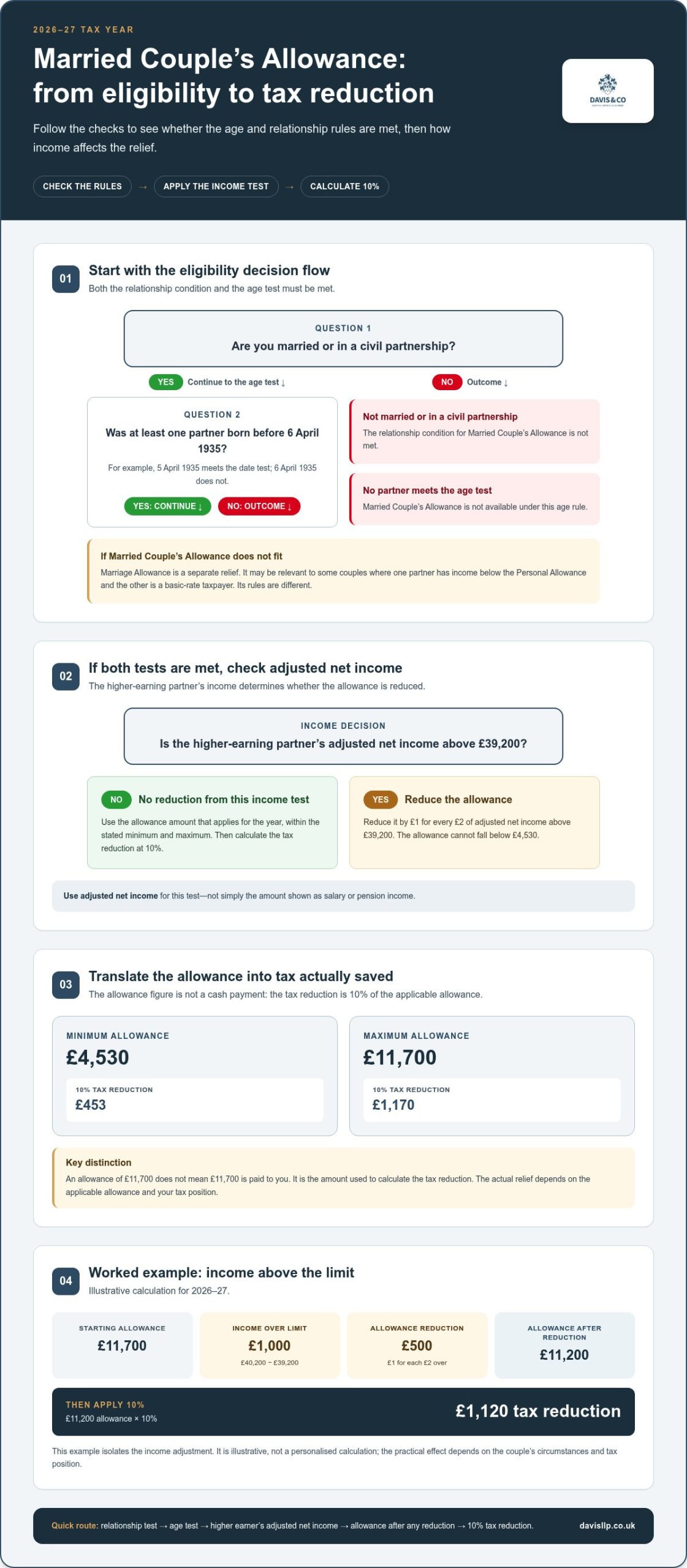
At least one partner must have been born before 6 April 1935. A person born on 5 April 1935 meets that date test; someone born on 6 April 1935 does not. The couple must also be married or in a civil partnership. Living together without being married or in a civil partnership doesn’t meet this relationship condition.
Check both tests for the particular tax year rather than assuming that a general reference to “couples” applies. If neither partner meets the age condition, Married Couple’s Allowance won’t be available. Marriage Allowance is a separate relief with different conditions. It may be relevant to some couples where one partner has income below the Personal Allowance and the other is a basic-rate taxpayer. The names are similar, but the eligibility tests aren’t interchangeable.
How the allowance affects a tax bill
The word “allowance” can be misleading: the figure associated with Married Couple’s Allowance isn’t necessarily the amount of money paid to you. The relief is calculated at 10% of the applicable allowance, reducing tax due rather than providing an automatic, separate cash benefit. For example, a £4,530 allowance corresponds to a £453 tax reduction, while an £11,700 allowance corresponds to £1,170, subject to the rules for the tax year.
Income can affect the amount available. For 2026-27, if the higher-earning partner’s adjusted net income is above £39,200, the allowance is reduced by £1 for every £2 above that limit, but not below the minimum allowance. Two couples who meet the age and relationship conditions may therefore receive different levels of relief. The allowance is also distinct from a Personal Allowance, which relates to how much income can be earned before Income Tax is due. See this guide to the Personal allowance in the UK tax system for a general overview.
For married couple’s allowance explained in practical terms, start by confirming both partners’ birth dates and relationship status. Then identify the relevant tax year and the higher earner’s income. These checks establish whether to move on to the detailed calculation and claim process.
How Married Couple’s Allowance is calculated in the 2026-27 tax year
For 2026-27, calculate Married Couple’s Allowance in two stages: first establish the allowance amount that applies, then work out the tax reduction at 10%. The allowance figure is not itself a cash payment or the amount automatically saved. Your actual benefit depends on the allowance available after any income-related reduction and on your tax position.
Allowance amount versus tax actually saved
For 2026-27, the allowance ranges from £4,530 to £11,700. Applying the 10% rate means those figures correspond to a tax reduction of £453 at the minimum and £1,170 at the maximum. These are potential reductions, not a guarantee that every eligible couple will receive the maximum. The applicable amount depends on the rules for the year and, where relevant, the higher earner’s income.
This distinction matters when budgeting: an allowance of £11,700 does not mean £11,700 is paid to you. It is the figure used to work out the reduction in tax payable. HMRC sets out the current amounts and calculation in its official guidance on Married Couple’s Allowance.
How income can change the available relief
For 2026-27, the income limit is £39,200 of adjusted net income for the higher-earning partner. If their adjusted net income exceeds that threshold, the allowance is reduced by £1 for every £2 of income above it. The reduction applies to the allowance amount, not directly to the tax bill, and the allowance cannot fall below the £4,530 minimum for the year.
Illustrative calculation, 2026-27: Assume a couple qualifies for the maximum £11,700 allowance before the income test, and the higher earner’s adjusted net income is £40,200. That is £1,000 above the £39,200 limit. The allowance is reduced by £500, leaving £11,200. At 10%, this would produce a tax reduction of £1,120, subject to the couple’s circumstances and tax position. This example isolates the income adjustment; it isn’t a personalised calculation.
Use adjusted net income for this test, rather than simply the amount shown as salary or pension income. Each partner’s tax position also matters when assessing the practical effect of the relief, so don’t treat the headline maximum as a guaranteed saving.
This is the central calculation behind married couple’s allowance explained: identify the applicable allowance, apply any income reduction, then calculate 10% of the resulting amount. If your income sources or tax circumstances make the figures harder to assess, tailored personal tax advice can help clarify which figures to use.
Married Couple’s Allowance vs Marriage Allowance: which rules apply?
The similar names refer to two separate tax reliefs with different eligibility tests and effects on tax. Being married or in a civil partnership is relevant to both, but doesn’t establish eligibility by itself. Age is central to Married Couple’s Allowance, while Marriage Allowance is based on the partners’ income and the transfer of part of one person’s Personal Allowance.
| Feature | Married Couple’s Allowance | Marriage Allowance |
|---|---|---|
| Main qualifying test | One partner must have been born before 6 April 1935, and the couple must be married or in a civil partnership. | One partner must have income below the Personal Allowance, and the other must meet the recipient’s basic-rate taxpayer condition. |
| How it affects tax | A tax reduction is calculated at 10% of the allowance available. | Part of the lower-income partner’s Personal Allowance is transferred to the other partner, potentially reducing their tax. |
| 2026-27 reference | Allowance ranges from £4,530 to £11,700 before the resulting tax reduction is calculated. | Up to £1,260 of Personal Allowance can be transferred, reducing tax by up to £252. |
The key differences in eligibility and purpose
For Married Couple’s Allowance, check whether either partner meets the qualifying birth-date condition. If neither does, that relief won’t apply, even if you’re married or civil partners. Marriage Allowance has no equivalent age test. For 2026-27, a partner whose income is below the £12,570 Personal Allowance may be able to transfer £1,260 to their spouse or civil partner, provided the recipient meets the relevant basic-rate taxpayer condition. The transfer can reduce the recipient’s tax by up to £252.
In practical terms, Married Couple’s Allowance provides a 10% tax reduction based on an allowance, while Marriage Allowance transfers part of one person’s tax-free Personal Allowance to the other. Neither is a general benefit for every married couple. Review income and tax position as well as relationship status before deciding which rules may fit. These figures and conditions apply to 2026-27, so use the rules for the specific year you’re considering.
Can a couple claim both allowances?
No. HMRC doesn’t allow a couple to receive Married Couple’s Allowance and Marriage Allowance for the same tax year. Start by checking the birth-date condition. If either partner was born before 6 April 1935, assess Married Couple’s Allowance. If not, consider whether the income conditions for Marriage Allowance are met instead. Don’t assume one relief will be available simply because the other isn’t.
If the choice depends on your personal circumstances, compare the details with HMRC’s Married Couple’s Allowance guidance and Marriage Allowance guidance. The essential point in having married couple’s allowance explained accurately is that the reliefs have different purposes, tests and claim routes. They aren’t interchangeable.
How to claim Married Couple’s Allowance and check earlier tax years
The claim route depends on whether you complete a Self Assessment tax return. If you do, claim Married Couple’s Allowance through the return for the relevant tax year. If you don’t file a return, contact HMRC to make a claim. Follow the instructions for the year you’re claiming so the route and tax calculation reflect the right circumstances.
A successful claim is reflected in your tax calculation. For someone paying tax through PAYE, HMRC may take the relief into account through their tax code. For someone completing Self Assessment, it can be included in the return calculation. The effect depends on the individual tax position, so check the resulting calculation rather than treating a claim confirmation as proof of a particular saving. HMRC’s guidance on claiming Married Couple’s Allowance sets out the current process.
The information to prepare before making a claim
Before starting, gather both partners’ identifying details and the information needed to establish eligibility for the tax year. HMRC may ask for names, dates of birth, National Insurance numbers, relationship information and income details. Follow the current HMRC instructions and keep the tax year clear throughout.
- Confirm which tax year the claim covers and whether you’re using Self Assessment or contacting HMRC directly.
- Have both partners’ relevant personal details and information about income for that year to hand.
- Keep a copy of the claim, any HMRC response and the tax calculation or code notice that follows.
Careful records make it easier to identify which year a decision relates to and resolve any difference between the claim and your tax records. If you amend a return or provide further information, keep that correspondence with the original claim.
Backdated claims and keeping records
Don’t assume that the backdating rules for Marriage Allowance apply to Married Couple’s Allowance. They are separate reliefs. Before claiming for an earlier year, check HMRC’s current Married Couple’s Allowance instructions for the permitted period, eligible tax years and any deadline.
For each past year, review the relationship and age conditions, relevant income information and whether the allowance was already included in a return or tax calculation. Keep supporting documents and HMRC correspondence together by tax year. If you’re unsure how an earlier claim interacts with Self Assessment or PAYE, discuss your personal tax position with Davis & Co LLP. A year-by-year review can help you understand what information HMRC needs and avoid confusing one allowance’s claim rules with another’s.
At the claim stage, married couple’s allowance explained means matching the correct relief to the correct tax year, using the appropriate HMRC route and keeping the supporting records. Check HMRC’s current rules before relying on a particular deadline or expecting an adjustment.
When to review your eligibility or seek personal tax advice
A useful review starts with four questions: are you married or in a civil partnership for the tax year concerned, does either partner meet the qualifying birth-date condition, what was the higher earner’s relevant income, and which tax year are you checking? A “yes” to one question doesn’t settle the others. Treat each year as its own assessment, particularly when reviewing an earlier claim or a change in circumstances.
This self-check can help identify whether further action is needed, but it doesn’t replace consideration of your full tax position. If the facts are straightforward, use the relevant year’s HMRC guidance to check the rules and claim process. If the answer depends on several income sources, adjustments or other reliefs, a detailed review can help prevent assumptions carrying through to a return or tax code.
Circumstances that may need a closer review
Changes in income, relationship status or the way you report tax can be a reason to revisit a claim. A new pension, investment income, a change in employment or a revised Self Assessment return may affect the figures or records relevant to a particular year. These changes don’t automatically create or end entitlement; they are prompts to check the rules against the facts for that year.
Earlier-year claims deserve particular care. Review eligibility, income and claim details separately for each tax year, rather than applying today’s circumstances retrospectively. Also consider whether another relief has been claimed or adjusted, since the interaction between reliefs can affect the overall tax calculation. If HMRC has issued an amended calculation or tax code, compare it with the records for the same period.
A considered next step for your personal tax position
Before seeking advice, bring together the tax years you want to review, both partners’ relevant personal details, income records and any Self Assessment returns, tax calculations or HMRC correspondence. Note what changed and when. This makes it easier to separate a question about eligibility from one about how a claim has been recorded or reflected in tax payable.
Where income comes from several sources, a previous return has been amended, or another relief may affect the calculation, tailored personal tax advice can help you assess the circumstances as a whole. Davis & Co LLP provides personal tax guidance to help you understand your position in a practical, measured way. You can also consult current HMRC guidance for the rules and claim instructions that apply to the relevant year.
For broader context before reviewing your circumstances, explore personal tax guidance. A careful, year-by-year check is the most reliable way to put married couple’s allowance explained into practice without assuming eligibility or the tax outcome is the same for every couple.
Make your next tax decision with confidence
Understanding married couple’s allowance explained is a useful starting point, but the value lies in applying it to the right tax year and your own circumstances. Review the relevant records and note any questions about eligibility, previous claims or how the relief appears in your tax calculation. This can help you decide whether to proceed with an HMRC claim or seek advice on a more complex position.
Davis & Co LLP is a firm of Chartered Certified Accountants. If you would like support assessing your personal tax circumstances, explore personal tax guidance and take the next step that best fits your needs.
With clear records and advice suited to your situation, you can approach the decision carefully and move forward with greater confidence.
Frequently Asked Questions
Can every married couple claim Married Couple’s Allowance?
No. Being married or in a civil partnership doesn’t automatically qualify you. The key age test is whether one partner was born before 6 April 1935, and the rules must be considered for the relevant tax year. For example, a couple who married recently may still meet the age condition, while a couple who have been together for decades may not. Check both partners’ dates of birth before starting a claim.
What is the difference between Married Couple’s Allowance and Marriage Allowance?
They are separate tax reliefs, not alternative names for the same allowance. Married Couple’s Allowance has an age-related test. Marriage Allowance instead concerns a transfer of part of one partner’s Personal Allowance to the other, subject to income and taxpayer conditions. For instance, a couple who don’t meet the age test might still assess Marriage Allowance separately. Check the rules for each relief rather than assuming eligibility for one establishes eligibility for the other.
How much is Married Couple’s Allowance in 2026-27?
For the 2026-27 tax year, the allowance ranges from £4,530 to £11,700. The tax reduction is 10% of the applicable allowance, so the corresponding reduction ranges from £453 to £1,170. The amount a couple can claim depends on their circumstances, including the higher-earning partner’s adjusted net income. These figures apply to 2026-27; use the relevant year’s amounts if you’re reviewing a different tax year.
Can I claim Married Couple’s Allowance for previous tax years?
You may be able to make a claim for an earlier year, but check the HMRC rules and deadlines that apply to Married Couple’s Allowance before proceeding. Don’t assume the backdating period for Marriage Allowance also applies here. For each year, gather the relevant income information and confirm that the relationship and age conditions were met at the time. GOV.UK’s Married Couple’s Allowance guidance explains how to make a claim and where to direct questions about earlier years.
Does Married Couple’s Allowance reduce my tax bill or pay me directly?
It reduces tax due; it isn’t automatically paid as a separate cash benefit. For example, the relief may be reflected through Self Assessment or your PAYE tax code, depending on how your tax is administered. Check the calculation or code notice after a claim to see how HMRC has applied it. The allowance amount itself shouldn’t be mistaken for the amount paid into your bank account.
Can unmarried couples or people who live together claim Married Couple’s Allowance?
No. Cohabiting without being married or in a civil partnership doesn’t meet the relationship condition for Married Couple’s Allowance, even if one partner meets the age test. If you later marry or enter a civil partnership, assess eligibility for the relevant tax year using the rules that apply to that period. Other tax reliefs have their own conditions, so don’t assume that living together gives access to a couple-based allowance.
What happens to Married Couple’s Allowance if a partner dies?
A partner’s death can affect the claim and the tax calculation, so review an existing claim rather than continuing it unchanged. Notify HMRC and keep records of the date of death, the tax year involved, previous claims and any notices received. Ask HMRC how the circumstances affect that year’s relief and whether an adjustment is needed. The outcome depends on the details and rules applicable to the relevant tax year.