What if the tax implications of being a company director depend less on your title than on how you take money from, or use, the company? Salary, dividends, benefits and transactions such as borrowing from the business can each affect your personal tax position in different ways.
It’s understandable to be unsure where your responsibilities as an individual end and the company’s compliance obligations begin. Even when tax is handled through payroll or company filings, you may still need to account for income or benefits personally. This guide explains the main considerations and the records and returns that may be relevant to your circumstances.
We’ll look at how salary and dividends are treated, when benefits or a director’s loan can have personal tax consequences, and how company transactions may affect both you and the business. Use the practical checks below to identify questions to address before changing how you draw funds or use company assets.
Key Takeaways
- The tax implications of being a company director depend on income, benefits, company transactions and your individual circumstances, not the director title alone.
- Salary, dividends and benefits in kind are treated differently for tax and reporting, so assess each according to its source and your situation.
- Compare salary, dividends, retained profits and director’s loans with both personal tax and company cash flow in mind.
- Keep clear records of pay, dividends, benefits, expenses and director loan account movements to support accurate reporting.
- Review relevant returns and deadlines, and consider tailored advice where personal and company tax decisions are connected.
What are the tax implications of being a company director?
Being appointed a company director doesn’t, by itself, determine what personal tax you owe. The relevant questions are what you receive from the company, what benefits or transactions arise, and how those interact with your wider financial circumstances. The tax implications of being a company director can therefore differ considerably between people with the same role.
A director’s personal tax position depends on the source and type of income or benefit received, together with their individual circumstances. Salary, dividends, a company-provided benefit and money borrowed from the business aren’t interchangeable. Each may have different tax treatment and reporting requirements.
It’s also important to separate your personal affairs from the company’s. The company has its own tax and reporting responsibilities, which may include Corporation Tax on its profits. That liability belongs to the company and is distinct from any tax you may owe personally on income or benefits. The overview of UK Corporation Tax provides background on how this tax applies to company profits, but it doesn’t determine a director’s personal position.
Does being a director automatically mean you owe personal tax?
No. The title alone doesn’t establish whether personal tax is due, how much may be payable or which returns are relevant. A director who receives one type of income may have a different position from someone who also takes dividends, uses a company asset privately or has other taxable income.
Individual circumstances matter too. Other employment, property or investment income may affect your overall tax position. Overseas residence, work or income can introduce additional considerations, so a director with international connections may need an assessment that takes those facts into account. Don’t assume another person’s filing obligations or tax outcome will apply to you.
Which parts of a director’s finances can create tax consequences?
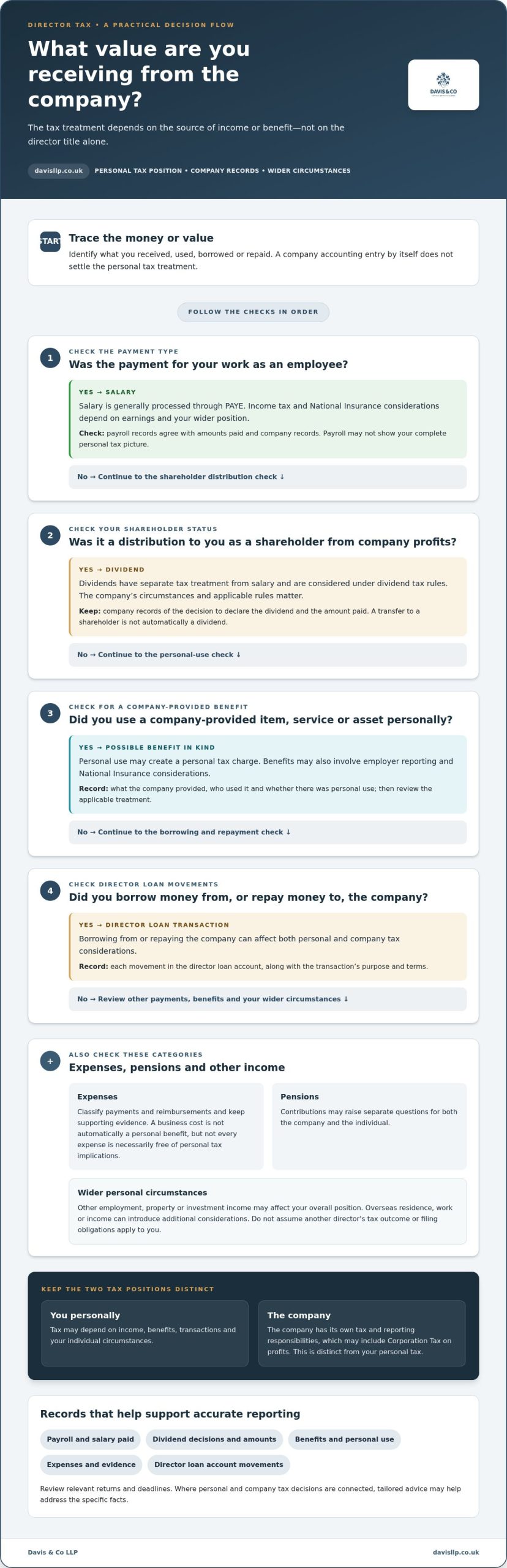
Start by identifying how money or value moves between you and the company. The main areas to consider include:
- Salary: pay received through employment, with relevant payroll and personal tax considerations.
- Dividends: distributions received as a shareholder, which have separate tax treatment and need supporting records.
- Benefits: goods, services or use of company assets for personal purposes, which may have tax and reporting implications.
- Expenses: payments or reimbursements that need to be classified and supported by appropriate evidence.
- Pensions: contributions that may raise separate questions for the company and the individual.
- Director loan transactions: money borrowed from or repaid to the company, which can affect both personal and company tax considerations.
These categories can overlap with company accounting, but recording a transaction in the accounts doesn’t, on its own, settle its personal tax treatment. For each transaction, note the purpose, recipient and terms, and keep the supporting paperwork. The next sections compare remuneration and borrowing in more detail, then explain records and reporting to consider.
How salary, dividends and director benefits are taxed
Salary, dividends and benefits can all transfer value from a company to a director, but they’re treated differently for tax and reporting. The tax implications of being a company director depend in part on identifying what each payment or benefit represents, rather than treating all company-funded value as one type of income.
Salary is payment for work as an employee, while a dividend is a distribution to a shareholder from company profits. They aren’t interchangeable. Salary is generally processed through payroll, whereas dividends need appropriate company records and are considered under dividend tax rules. The right treatment depends on the facts, company position and current rules.
Salary, PAYE and National Insurance for directors
Director salary is generally reported through PAYE, with income tax and National Insurance implications depending on earnings and the individual’s wider position. Payroll records show how pay has been processed, but they don’t necessarily provide a complete picture of personal tax. Other income and circumstances may also matter.
Check that the salary recorded in payroll agrees with the amounts paid and the company’s records. If your pay changes, keep the relevant payroll information together with records of other income, so the figures can be reviewed as part of your overall position. Directors’ pay administration sits within wider company responsibilities, outlined in Directors’ responsibilities in the UK.
Dividends, benefits and company-paid expenses
Dividends should be supported by company records, including the decision to declare them and the amount paid. Keep dividend paperwork distinct from payroll records, and don’t treat a payment as a dividend simply because it was transferred from the company to a shareholder. The company’s circumstances and the applicable rules matter.
Personal use of a company-provided item or service may count as a benefit in kind and can create a personal tax charge. Benefits may also involve employer reporting and National Insurance considerations. Record what the company provided, who used it and whether there was personal use, then review the applicable treatment for that benefit.
Company-paid expenses need careful classification. A cost incurred for business purposes is not automatically a personal benefit, but neither is every reimbursement tax-free. Keep receipts and a clear record of the business purpose. Distinguish business costs from private spending and mixed-use items, and consider the rules that apply to the specific expense.
- Salary: employment income, usually handled through PAYE, with income tax and National Insurance considerations.
- Dividends: shareholder distributions, supported by company records and potentially taxable personally.
- Benefits and expenses: assess whether personal use or the nature of a payment creates a taxable benefit or reporting duty.
Reviewing these categories together can help clarify both company administration and your personal position. A tailored review of personal and business tax considerations can help directors assess how remuneration, benefits and records fit their circumstances.
Salary, dividends or a director’s loan: what should you compare?
Choosing how to take value from a company is not simply a comparison of personal tax rates. Each option affects the director and the company differently. The tax implications of being a company director depend on the full picture: available profits, immediate cash needs, other income and the records needed to support each transaction.
Use the comparison below as a starting point, not a universal ranking. The treatment of each route depends on current rules and the company’s circumstances.
| Route | Personal tax considerations | Company cash flow and records |
|---|---|---|
| Salary | Employment income, with possible income tax and National Insurance implications. | Creates a payroll and cash-flow commitment; keep payroll records and payslips. |
| Dividends | May be taxable personally under dividend rules and in light of other income. | Uses company funds; maintain clear records of declarations and payments, and consider the company’s profit position. |
| Retained profits | Undistributed profits are not the same as personal income received by the director. | Leaves funds in the company, subject to company-level tax and future business cash requirements. Review the company’s UK Corporation Tax position as part of the wider decision. |
| Money borrowed from the company | A loan is not automatically equivalent to salary or a dividend, but borrowing and repayment can have personal tax consequences. | Record movements accurately in the director loan account and consider the effect on available company cash. |
When might salary and dividends be considered together?
Directors often review salary and dividends as parts of one remuneration decision, rather than making each choice in isolation. Relevant factors include other personal income, the company’s available profits, your need for regular cash and the rules applying in the relevant tax year. The company’s cash position matters too: a payment that suits personal planning still needs to be considered alongside operating commitments and tax obligations.
No route is automatically the most tax-efficient. Compare personal and company consequences, and revisit the decision when income, profits or circumstances change. Keep a record of the reasoning and the transactions that follow, so the figures can be checked against payroll, company accounts and your personal tax information.
Why director loan accounts need careful attention
A director loan account records money owed between the director and the company. It may show amounts you have borrowed, repayments made, or money you have put into the business. Treat it as an active record, not a miscellaneous balance. An overdrawn account or a change in how a payment is classified can bring tax and reporting consequences. Keep transactions supported and review their treatment under current HMRC rules.
Before deciding, compare the timing of cash receipts, your personal needs, company funds and the administration each option requires. For example, a personal payment made from the company should be identified promptly as salary, a dividend, a reimbursement or a loan, rather than left unexplained in the accounts. A tailored review can help bring these connected considerations into one clear decision.
What records and tax reporting should company directors consider?
Good records make it easier to understand how money and benefits have moved between you and the company, and to support the way they’ve been reported. A practical review follows a clear sequence:
- Identify income and benefits: list salary, dividends, benefits, expenses, pension contributions and any director loan movements.
- Maintain supporting records: keep evidence that explains each transaction and its purpose.
- Check reporting duties: consider both company reporting and your personal tax position.
- Review deadlines: confirm current filing and payment dates that apply to each return or report.
The tax implications of being a company director can involve records held by both the company and the individual. Keeping those records separate but consistent helps prevent a payment appearing differently in payroll, company accounts and a personal return. It also gives you a clearer basis for responding to questions or correcting an error.
Which records help establish a director’s tax position?
Organise records by transaction type, so supporting evidence can be traced from the company’s books to your personal position. The precise documents depend on what occurred, but a useful working file may include:
- Salary: payslips and relevant payroll information.
- Dividends: dividend statements and company records of declarations and payments.
- Expenses: receipts, invoices and a note of the business purpose.
- Benefits: details of company-provided goods or services and any personal use.
- Loans: director loan account records showing amounts advanced, repaid or outstanding.
Keep personal and company finances distinguishable. For example, record whether a payment is salary, a dividend, reimbursement or a loan, rather than relying on a bank description alone. Where a transaction has both business and personal elements, keep enough detail to explain how it was used. Clear classifications make the accounting and tax treatment easier to review.
When might Self Assessment or additional advice be relevant?
Director status alone doesn’t settle whether you need to file a Self Assessment return. Untaxed income and individual circumstances may affect your reporting responsibilities. HMRC’s criteria can include self-employment earnings over £1 000 before expenses, being a partner in a partnership, having a Capital Gains Tax liability or a High Income Child Benefit Charge liability, or receiving untaxed income such as rental income, interest, dividends or foreign income. Review the current criteria against your circumstances rather than assuming PAYE has covered everything.
Check reporting requirements and deadlines each tax year, particularly if your income or benefits change. HMRC’s compliance checks and investigations guidance provides broader context on the importance of accurate returns and supporting records. Where personal and company records don’t align, or a loan account has an unexplained balance, tailored advice can help clarify what needs attention.
For a considered review of your records and personal tax position, discuss your director tax responsibilities with Davis & Co LLP.
How Davis & Co LLP can support directors’ tax planning
A director’s personal tax position is closely connected to decisions made within the company. Davis & Co LLP brings Personal Tax Services and Tax & Business Advisory together to consider those questions in context, rather than viewing a salary, dividend or benefit in isolation. This can help clarify how company decisions and personal circumstances interact, while keeping the relevant reporting and records in view.
The tax implications of being a company director are shaped by more than remuneration alone. A considered review may take account of your benefits, other income, director loan transactions and the quality of supporting records. Where you have income, residence or business connections outside the UK, Davis & Co LLP’s UK and international tax expertise can help assess the wider issues involved.
What can a director discuss with a tax adviser?
You can discuss how remuneration choices fit your personal and business circumstances, whether a personal tax return is relevant, and how benefits or director loan account movements should be understood. A review can also consider other income and the records available to support each transaction. General guidance provides useful context, but the right application depends on your individual facts and current rules.
For example, a director considering a change to pay arrangements may need to weigh personal income alongside the company’s profits, cash requirements and payroll administration. A director with company-provided benefits or an outstanding loan balance may need a different review. Considering these matters together can bring attention to questions that might otherwise be missed when personal and company records are examined separately.
Advice can also help establish what information is needed to assess the position. The aim is to understand the relevant transactions, reporting responsibilities and possible options in light of your circumstances, rather than assume a particular outcome.
A considered next step for directors
Before a tax-planning discussion, gather information showing how you and the company have dealt with payments and benefits. This might include payslips, dividend documentation, benefit details, expense evidence, other income records and a current director loan account summary. Clear records make it easier to identify gaps and focus the discussion on the decisions that matter to you.
Davis & Co LLP is a firm of Chartered Certified Accountants established in 1901. Its advice is shaped around each client’s circumstances and goals, with personal and company considerations reviewed together where relevant. If you’d like to discuss your position, Discuss your personal and business tax position with Davis & Co LLP.
Make your next tax decision with greater clarity
The tax implications of being a company director can change as your role, income or business circumstances evolve. Review your current position before making a significant change to how you draw funds, use company assets or manage a loan account. That gives you the opportunity to consider personal and company consequences together, rather than addressing them only after a transaction has been made.
Bring the relevant personal and company records into one place, note questions about your plans, and identify where the treatment is uncertain. Davis & Co LLP can help you assess those questions in light of your circumstances, including any UK and international considerations that may apply.
Discuss your personal and business tax position with Davis & Co LLP, and take your next step with a clearer basis for decision-making.
Frequently Asked Questions
Is a company director automatically required to file a Self Assessment tax return?
No, being a director alone doesn’t establish that you must file a Self Assessment return. Filing may be relevant if you have untaxed income, a Capital Gains Tax liability or another reason under HMRC’s current criteria. For example, the criteria can include self-employment earnings over £1 000 before expenses, if you’re self-employed. Partnership income, the High Income Child Benefit Charge or foreign income may also matter. Check current HMRC rules against your circumstances.
How are company directors taxed on salary and dividends?
Salary is generally processed through PAYE, while dividends are treated separately as shareholder income. The tax implications of being a company director depend on both the company’s circumstances and your wider personal income, not simply which payment appears larger. For example, other employment or investment income may affect the overall picture. Keep payroll and dividend records distinct, and assess the combined position under current rules rather than assuming one method is always preferable.
Can a company director claim business expenses without paying tax on them?
Not automatically. The treatment depends on what the expense is for and whether it’s genuinely incurred for business purposes. A documented business journey, for example, is different from a personal trip paid for by the company. Mixed-purpose costs may need particular care, and reimbursing an expense doesn’t by itself make it tax-free. Keep receipts and explain the business purpose, then check current HMRC rules for the specific expense category.
What happens if a director borrows money from their company?
Money owed between you and the company should be recorded in the director loan account, including advances and repayments. A transfer used to pay a personal bill, for example, shouldn’t be left unclassified. Depending on the loan’s circumstances and treatment, tax and reporting consequences may arise for you or the company. Review the account before borrowing, making repayments or preparing year-end figures, and check current HMRC rules rather than relying on a general deadline or rate.
Are company-provided benefits taxable for directors?
They can be. A benefit provided by the company for personal use, such as private use of a company asset, may have tax and reporting consequences depending on its nature and current rules. That treatment differs from salary and from a genuine business expense incurred solely for work. Record what was provided, who used it and whether there was personal use. Then review the applicable HMRC treatment for that particular benefit, rather than assuming all benefits are treated alike.
Does a director need to pay tax on company pension contributions?
Not necessarily. The treatment depends on how the contribution is made, the recipient’s circumstances and the rules in force. A company contribution is distinct from a contribution paid personally by the director, and the tax consequences shouldn’t be assumed to be identical. Keep records identifying the payer, recipient and payment, then consider pension decisions alongside remuneration and the company’s position. Check current rules before relying on a particular tax treatment or relief.
Does the UK tax year affect a company director’s personal tax reporting?
Yes. The UK tax year runs from 6 April to 5 April, and personal income should be considered in relation to the relevant tax year. A company’s accounting period can follow different dates, so a company report and a director’s personal reporting period may not align. For instance, a company year-end doesn’t itself define the tax year for your personal income. Check current HMRC dates and requirements when preparing returns or reviewing transactions.