A confirmation statement is best treated as a structured review of your Companies House record, not a form to rush through once a year. The confirmation statement filing requirements ask directors to check that key company information is accurate and up to date, and recent reforms have made preparation more exacting.
It’s understandable to be unsure what belongs in this filing, particularly when a deadline is approaching or company details have changed. A confirmation statement and annual accounts are separate obligations, and some changes must be reported separately rather than left until the next statement.
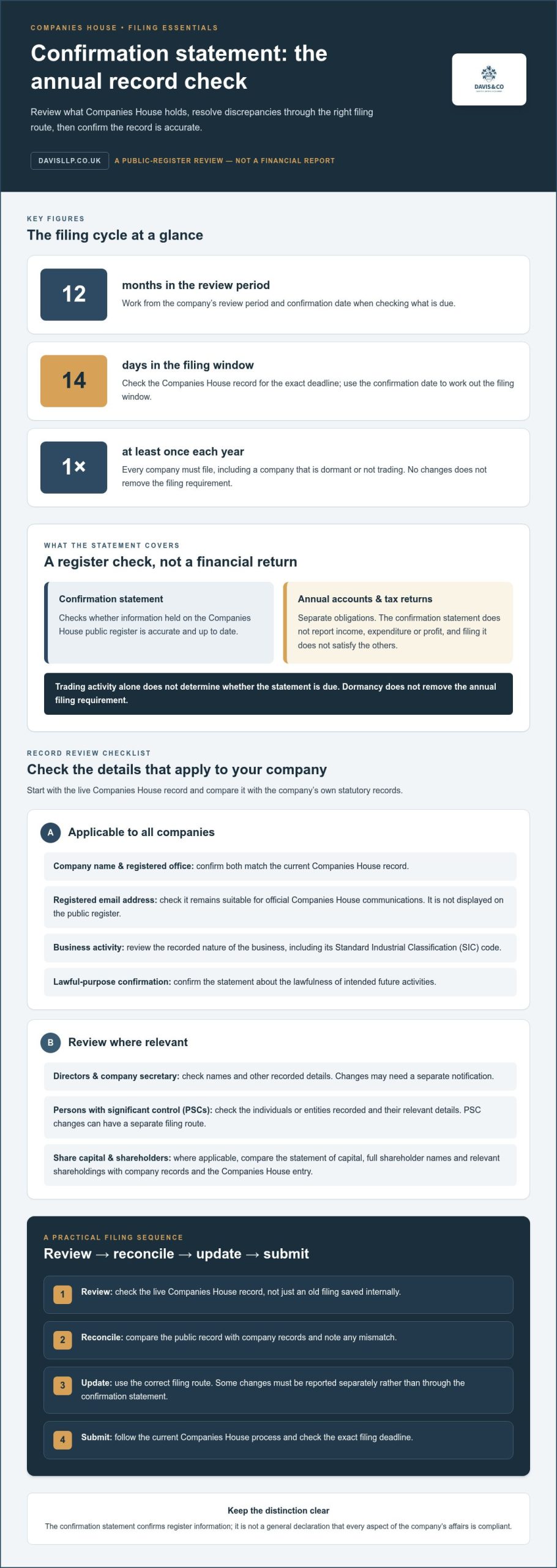
This checklist explains what to review, how the 12-month review period and 14-day filing window work, and which checks to complete before submission, including identity verification and the lawful-purpose confirmation. It also clarifies how the statement differs from annual accounts and other company updates, so you can prepare an accurate submission using the right process.
For wider compliance and record-keeping support, Davis & Co LLP is an independent firm of Chartered Certified Accountants established in 1901, providing tailored business advice to clients in the UK and overseas.
Key Takeaways
- Confirmation statement filing requirements apply to companies even when they’re dormant or not trading. Use the filing to check that the public register reflects the company’s current details.
- Review the company’s registered information, business activities and share details where applicable, and identify changes that need a separate filing.
- Work from your company’s review period and confirmation date, then check the Companies House record for the exact filing deadline.
- Prepare in order: review the register, identify discrepancies, make any required updates and submit using the current Companies House process.
- If a deadline has passed or a filing is rejected, check Companies House guidance promptly; failure to file can lead to prosecution or strike-off action.
Confirmation statement filing requirements: who must file and why?
A confirmation statement is a filing that checks whether the information held about a company on the Companies House public register is accurate and up to date. It gives the company an opportunity to review its recorded details and confirm them, rather than report its financial performance.
Companies House guidance requires every company to file a confirmation statement at least once each year, including a company that is dormant or not trading. The filing is sometimes described as an annual check of the company’s public record. If nothing has changed, the company still needs to submit the statement; if information is inaccurate, the appropriate update may need to be made as part of the filing or reported separately.
What does a confirmation statement confirm?
The statement concerns information recorded on the company register, not the company’s income, expenditure or profit. That distinction matters: a confirmation statement is separate from annual accounts, which report financial information, and from tax returns, which address tax obligations. Filing one doesn’t satisfy the others.
Think of it as a review of the company’s public-facing record. For example, a company that hasn’t traded during the year must still consider whether the details held by Companies House remain correct. Conversely, a company that has traded may still have no changes to report in a particular review period. Trading activity alone doesn’t determine whether the statement is due or whether register details need updating.
The confirmation statement was introduced to replace the annual return. Its purpose remains administrative and specific: to confirm the accuracy of information on the register and ensure required updates are dealt with. It shouldn’t be treated as a general declaration that every aspect of the company’s affairs is compliant.
Does a dormant company still have to file?
Yes. Dormant status or a lack of trading doesn’t remove a company’s annual confirmation statement obligation. A dormant company must still review its Companies House record and submit the statement when due, even if its details haven’t changed.
Dormancy and register accuracy are separate questions. A company may remain dormant while its registered details change, or it may continue to be dormant with no register changes during the period. Either way, the annual filing requirement remains. Dormancy also doesn’t, by itself, remove other company filing obligations, including any applicable accounts or tax requirements.
The confirmation statement filing requirements discussed here relate primarily to companies registered at Companies House. LLPs also have confirmation statement obligations, but their records and filing circumstances are distinct; use the guidance relevant to the entity type. Sole traders aren’t Companies House registered companies and don’t file a company confirmation statement. Where an organisation’s legal form is uncertain, establish its registered status before relying on a company checklist.
Confirmation statement checklist: which company details should you review?
Use the confirmation statement as a reconciliation exercise: compare the company’s current records with the information Companies House holds, then deal with any discrepancy using the correct filing route. Not every item applies to every company, and not every change can be made through the confirmation statement itself. The checklist below separates general checks from those that depend on the company’s structure or circumstances.
For each relevant item, confirm whether the public record is accurate and current:
- Applicable to all companies: Check the company name and registered office address against the current Companies House record.
- Applicable to all companies: Review the registered email address and confirm it remains suitable for official Companies House communications. It is not displayed on the public register.
- Applicable to all companies: Check the recorded nature of the company’s business, including its Standard Industrial Classification (SIC) code, and confirm the statement about the lawfulness of intended future activities.
- Where the company has relevant officers: Review the names and other recorded details of directors and any company secretary. Changes to officer information may require a separate notification rather than an update through the confirmation statement.
- Where the company has persons with significant control (PSCs): Check that the register reflects the individuals or entities recorded as PSCs and their relevant details. PSC changes can have a separate filing route.
- Where the company has share capital or shareholders: Review the statement of capital and shareholder information, including full shareholder names and relevant shareholdings, against the company’s records and Companies House entry.
Check registered company information
Start with the live Companies House record, not an old filing saved internally. Compare it with the company’s own statutory records and note any mismatch. An outdated entry shouldn’t simply be repeated in a new confirmation statement: it may need correcting, and the correction may need to be submitted separately before the statement. Follow the current Companies House instructions for the specific detail rather than assuming one route or form covers every change.
Review shareholders, shares and conditional information
Share details depend on the company’s structure and the information it is required to report. Check names and share information against current company records, and don’t assume that every company has the same shareholder or capital fields to review. PSC information is also conditional on the company having reportable PSCs. If records appear inconsistent, resolve the underlying information and confirm the applicable filing route before submission.
Keep a short audit trail of what was checked, which records were used and any updates made. This helps directors maintain consistent company information across Companies House filings and internal records. The confirmation statement filing requirements are one part of wider compliance, and well-kept books and supporting records can make that review more reliable. Davis & Co LLP provides bookkeeping and record-keeping support alongside tailored business advice.
Confirmation statement deadlines: understand the review period and filing cycle
A company’s confirmation statement deadline follows its own filing cycle. There isn’t one calendar date that applies to every company. Companies House uses a review period, typically a 12-month period beginning from the company’s incorporation anniversary or the date of its last confirmation statement. The statement must be filed within 14 days of the end of that review period.
That gives the company time after the review period ends to submit, but it isn’t a reason to leave preparation until the last moment. The confirmation statement filing requirements depend on the company’s own record and filing history, so use its Companies House information to establish the relevant dates.
How to identify your company’s confirmation date
Check the company’s Companies House record or account for its confirmation date and filing deadline. These dates are specific to the company and can differ from those of another business, even if both were incorporated around the same time. The annual cycle describes how often the filing recurs; it doesn’t mean every company files on the same day each year.
Once you’ve located the dates, record both the end of the review period and the final filing deadline in your compliance calendar. If the company uses Companies House email reminders, treat them as an additional prompt, not as the definitive record. Keep responsibility for checking the live company information and allowing time to resolve any discrepancies before submission.
What to consider if filing early
Companies House permits a company to file its confirmation statement before the end of its review period. An early filing is different from a late one: it is submitted ahead of the existing deadline, while a late filing misses that deadline. Early submission can also affect the next cycle. Under current Companies House guidance, the next review period begins the day after the early statement is filed.
For example, if a company files before its existing review period ends, it shouldn’t assume the following review period will still follow the original anniversary date. The early filing may bring the next cycle forward. Check the updated confirmation date and deadline on the company’s Companies House record after filing, then update internal reminders and responsibilities accordingly.
A practical way to manage the cycle is to:
- Locate the dates: Find the company’s confirmation date and filing deadline in its Companies House information.
- Plan the review: Work backwards from the deadline, leaving time to review records and address any required updates.
- Check after submission: Confirm the filing has been accepted and note any revised date shown for the next cycle.
These checks help prevent an early filing from creating an unexpected shift in future planning, while keeping the company’s annual filing obligation visible in its wider compliance calendar.
How to prepare and file a confirmation statement: a practical checklist
A reliable submission starts with preparation, not the online form. Work through the following steps in order so that discrepancies are identified and corrected through the appropriate route before the company confirms its information. The confirmation statement filing requirements also include submission checks that may depend on the directors’ identity verification status.
Prepare the company record before submission
Have the company number and access to the relevant Companies House account ready. Check the current Companies House guidance before beginning, as account access and authentication steps may change. Keep the company’s own records to hand so the person preparing the filing can resolve any differences rather than relying on memory or an old submission.
- Review the Companies House record. Compare the current public record with the company’s internal information and note any inaccuracies or changes that need attention.
- Identify the correct route for each discrepancy. Some details can be updated as part of the confirmation statement process, while others must be notified to Companies House separately, sometimes before the statement is submitted. Follow the current guidance for the specific change; don’t assume one filing will update every record.
- Check identity verification readiness. Companies House requires directors to complete identity verification before a company can file its confirmation statement. Verified individuals receive a personal code for use with future filings, so have the relevant codes available and follow the service instructions. PSCs are also subject to identity verification requirements. Check current Companies House guidance for the applicable timetable and steps, particularly for individuals completing verification during the transition period ending in November 2026.
- Confirm the filing is ready. Make sure required updates have been dealt with, the information in the statement matches the company’s records, and the person submitting has the necessary account access and authentication details.
Submit online and retain a clear record
Use the Companies House online filing service and follow its current instructions and on-screen prompts. Enter the company details requested, provide any required identity authentication, review the completed information carefully and submit. If a director’s personal code or another authentication detail is requested, use the code issued to that individual. The online route and any available filing options should be checked against current Companies House guidance.
Submission isn’t the end of the process. Keep the filing confirmation with the company’s compliance records, and check that Companies House has updated the public record as expected. Record the next confirmation date and deadline in the company’s compliance calendar, especially if the statement was filed early and the next review period may have shifted. If the submission is rejected or the record still appears incorrect, follow Companies House instructions to address the issue promptly.
Clear internal records make recurring compliance tasks easier to manage. For tailored help organising business records and wider compliance planning, speak with Davis & Co LLP about business support.
After filing: handle changes, missed deadlines and wider compliance
Submission is one stage in the company’s filing cycle. Keep a clear record of what was sent, check the Companies House record afterwards and act promptly if the statement is rejected, the deadline has passed or company information changes. The confirmation statement filing requirements are part of a wider responsibility to keep the company’s public record accurate, not a substitute for reporting changes as they happen.
If a filing is late, rejected or information changes
If the deadline has passed, check the current Companies House instructions for late filings and follow the steps that apply to your company. Failure to file can have serious consequences: Companies House identifies potential financial penalties and the risk of the company being struck off the register. Don’t assume a late submission will be accepted automatically or that a reminder resolves the issue.
If Companies House rejects a submission, read the notice carefully and use the stated process to address the reason for rejection. Check whether the filing needs correcting, whether additional information or authentication is required, and whether the deadline remains outstanding. Keep copies of the rejection notice, any corrected submission and subsequent correspondence with the company’s records.
Changes to company details may need to be reported separately rather than held over until the next confirmation statement. Use the current Companies House guidance for the particular change, since the notification route depends on the information involved. Once a change is reported, retain the supporting records and check that the public register reflects the update. If no details have changed, the company still needs to complete its scheduled annual review and filing.
Build confirmation statement checks into wider compliance
A simple internal process helps make follow-up dependable. Assign responsibility for monitoring Companies House correspondence, set calendar reminders for the review period and filing deadline, and keep a record of submissions and changes. Where responsibility is shared, make sure someone has clear oversight so that a message or task isn’t missed between directors, administrators and advisers.
These checks work best alongside organised financial and company records. A consistent record-keeping routine can help the business track changes, support accurate reporting and manage its broader compliance responsibilities. For a wider perspective on aligning records, compliance and business priorities, read our strategic small business accounting guide.
Davis & Co LLP is an independent firm of Chartered Certified Accountants, established in 1901, offering tailored business advice and compliance and record-keeping support. To discuss the wider needs of your business, explore tailored business advice and support.
Make company compliance part of your routine
A dependable filing process is built between submission dates, not only when a Companies House reminder arrives. Make register reviews part of your wider business calendar, and ensure responsibility is clear when company details change or the person overseeing filings moves on. That continuity can help keep compliance tasks visible as the business develops.
The confirmation statement filing requirements are one element of responsible company administration. Accurate records also support informed decisions and make it easier to respond to other reporting responsibilities. Consider whether your current processes give you a clear view of key company information, important deadlines and the records that underpin them.
Davis & Co LLP is a firm of Chartered Certified Accountants providing compliance and record-keeping support alongside tailored business advice. If you would value a considered perspective on your company’s wider needs, explore tailored business advice and support. With a consistent approach and appropriate support, you can make ongoing compliance more manageable and keep attention focused on the business’s next steps.
Frequently Asked Questions
Does a confirmation statement replace a company’s annual accounts?
No. A confirmation statement and annual accounts are separate filings with different purposes, and submitting one doesn’t meet the obligation to submit the other. For example, a company may have no changes to confirm on its public record but still need to prepare and file accounts for its accounting period. Keep separate records of both deadlines and check the relevant Companies House guidance for each filing.
Is a company’s confirmation statement available to the public?
Yes. The confirmation statement forms part of the company’s public Companies House record, so members of the public can search for and view filed information. Before submitting, review the details carefully and remember that information required on the public register may be visible beyond the company and its officers. The registered email address is not displayed publicly, but it must still be kept suitable for Companies House communications.
Can a director file a confirmation statement without being a shareholder?
Yes. A director doesn’t need to own shares to submit a company filing. The director must use the current Companies House filing process and meet any applicable identity verification and authentication requirements. Under current rules, companies can’t file a confirmation statement unless all directors have completed identity verification. A verified director receives a personal code for future filings. Follow Companies House instructions to establish who is submitting and which codes are needed.
What should a company do if Companies House rejects its confirmation statement?
Read the rejection notice first and identify the specific issue, such as missing information, a discrepancy or an authentication problem. Then follow the current Companies House instructions to correct and resubmit the filing, or make any separate update required. Check the company’s filing deadline and status while resolving the issue, and keep the notice and any resubmission confirmation with its records. Don’t assume a rejected submission has updated the public register.
Can a company change its registered office address through a confirmation statement?
No. A change of registered office address must be notified to Companies House through the separate address-change process, rather than relying on the confirmation statement to update it. Use the current Companies House instructions for the relevant filing and check the register afterwards to ensure the new address appears correctly. If the address has already changed, report it promptly rather than leaving the outdated entry until the next confirmation statement.
Does a confirmation statement filing requirement apply to limited liability partnerships?
Yes. LLPs have an annual confirmation statement filing obligation with Companies House, although their register information and filing details differ from those of a limited company. Use Companies House guidance specifically for LLPs rather than assuming every item on a company checklist applies. An LLP should also keep its confirmation statement timetable distinct from its accounts and other reporting obligations, since these are separate filings with their own requirements.
How can I find a company’s next confirmation statement deadline?
Search for the company on the Companies House register and review its filing history and confirmation statement details. The record shows the company-specific confirmation date and filing deadline, which may change after an early filing. Use the date displayed for that company rather than estimating from another business’s cycle. For dependable confirmation statement filing requirements management, keep the deadline in an internal calendar and verify it against the live register before submission.