Could a trust established to protect a vulnerable person still be taxed under the ordinary trust rules? The answer depends on more than the trust’s purpose. For vulnerable beneficiary trust tax UK treatment, eligibility, the trust terms and any required tax election all matter.
It’s understandable to assume that a trust benefiting someone who is disabled or bereaved will automatically receive special tax treatment. In practice, trustees need to distinguish between the trust structure and the formal steps needed to claim relevant treatment. The rules can also differ for Income Tax, Capital Gains Tax and Inheritance Tax, so a conclusion about one tax does not settle the others.
This guide explains the eligibility framework, how a Vulnerable Person Election may affect tax treatment, and which records and tax questions trustees should review. It also shows why the beneficiary’s circumstances, trust terms and administration need to be considered together. With a structured review, trustees can identify the questions to resolve and where specialist trust tax advice may help with their responsibilities.
Key Takeaways
- Understand why vulnerable beneficiary trust tax UK treatment depends on tax-specific eligibility and trust terms, not simply the trust’s stated purpose.
- See how Income Tax, Capital Gains Tax and Inheritance Tax raise distinct questions, and why special treatment may depend on a formal election.
- Compare trust structures by considering control, beneficiary access and the tax questions each may raise, rather than relying on the structure’s name.
- Use an ordered trustee review of the deed, beneficiary circumstances, income, gains, elections and reporting obligations, supported by clear records.
- Learn how tailored trust tax advice can connect the trust’s terms and the beneficiary’s circumstances with ongoing tax compliance.
What is a vulnerable beneficiary trust for UK tax purposes?
A trust may be created to provide for someone who needs support, protect assets or manage an inheritance. That purpose alone does not give the trust a special tax status. For tax purposes, “vulnerable beneficiary” is a defined category used in particular UK tax rules. The trust and beneficiary must meet the relevant conditions before trustees can claim special treatment.
For UK tax purposes, a vulnerable beneficiary is a person who falls within the statutory category of a qualifying disabled person or certain bereaved children, as defined by the specific rules being applied. This definition concerns tax eligibility. It does not replace the trust deed or determine the full legal rights and responsibilities of trustees and beneficiaries. General trust law provides background on how trusts operate, but it does not establish whether a trust qualifies for UK tax treatment.
Who may qualify as a vulnerable beneficiary?
The broad categories include certain disabled people and bereaved minors, generally children under 18 whose parent has died. For disabled people, HMRC’s criteria may involve their ability to manage their affairs or qualifying benefit-related conditions. Eligibility for a relevant benefit may be important, but the precise test and evidence depend on the rule being applied. A diagnosis, disability or benefit award should not be assumed to satisfy every condition. Trustees should refer to current HMRC guidance rather than rely on an outdated benefits list.
In practice, trustees should identify the category relied on and keep evidence that supports it. They should assess whether the beneficiary meets the relevant conditions for the period under review. If the beneficiary’s circumstances change, revisit the basis for the tax claim and retain a record of the review.
Does every trust benefiting a vulnerable person qualify?
No. The beneficiary’s status is only one part of the assessment. The trust deed and the beneficiary’s interest matter too. The terms can affect who may benefit, how income or capital can be applied, and whether the trust meets conditions attached to a particular tax provision. Describing a trust informally as being “for” a disabled person or bereaved child does not establish tax qualification.
Assess the position in stages: identify the beneficiary category, examine the trust terms, then determine the tax treatment being considered. These questions are connected, but they are not interchangeable. Meeting the conditions for one form of special treatment does not confirm that the same treatment applies under every tax rule.
Income Tax, Capital Gains Tax and Inheritance Tax each have distinct rules. A trust may meet conditions relevant to one tax question while requiring a separate assessment for another. The phrase vulnerable beneficiary trust tax uk describes an area of tax analysis, not a single status that automatically determines the outcome. Before making a return, election or other tax decision, identify the relevant facts and check the conditions that apply to that decision.
How special tax treatment can affect a vulnerable beneficiary trust
Special tax treatment can affect how a trust’s tax liability is assessed, but it does not create one set of rules for every tax. First identify the tax event. Then establish whether the relevant conditions are met and whether an election is available or required. The GOV.UK guidance on trusts for vulnerable people explains the categories and tax areas trustees need to consider.
Check Income Tax, Capital Gains Tax and Inheritance Tax separately. An election relevant to one tax does not necessarily determine the outcome for another. Use the summary below as a starting point, then compare the current rules with the trust deed and beneficiary’s circumstances.
| Tax area | What trustees should review | Condition to verify |
|---|---|---|
| Income Tax | Income received by the trust, how it is applied and how the liability is calculated. | Whether the trust and beneficiary meet the conditions for any special treatment, and whether an election is required. |
| Capital Gains Tax | Trust assets disposed of, gains arising and the circumstances relevant to the beneficiary. | Whether the relevant tax treatment applies to the trust and the specific disposal, including any election requirements. |
| Inheritance Tax | The trust’s terms and any events or transfers that may have IHT consequences. | Which IHT rules apply to this trust and event; Income Tax or CGT treatment does not settle this question. |
Income Tax and Capital Gains Tax: what trustees should understand
Trustees are generally responsible for accounting for tax on trust income and gains under the rules that apply to the trust. Where available, special treatment may take account of the vulnerable beneficiary’s personal tax position. It does not remove the need to keep records or meet the trust’s tax obligations. Income received and gains from disposals are different tax events, so review them separately and use the relevant supporting documents for each.
Before relying on an election, check current HMRC guidance for its scope, eligibility criteria, submission process and deadline. Keep evidence of the beneficiary’s relevant circumstances, along with the trust information used to support the claim.
Inheritance Tax: why it needs separate consideration
An Income Tax or Capital Gains Tax election does not establish the trust’s Inheritance Tax position. Review the deed and the specific IHT event, such as a transfer into the trust or a later change in its circumstances. The applicable conditions and consequences depend on the trust and the event. Do not assume that treatment available for one tax carries across to another.
Because the vulnerable beneficiary trust tax UK position depends on the trust, beneficiary and tax event, a joined-up review can help keep the analysis and reporting consistent. Davis & Co LLP provides trust tax services, including trust administration and compliance, to support trustees as they assess these connected obligations.
Vulnerable beneficiary trust types: how to compare the tax questions
Trust labels describe broad features, not a guaranteed tax result. A discretionary trust, a life interest trust or an arrangement intended to benefit a vulnerable person may raise different questions about control and access to funds. The name alone does not establish whether particular tax treatment is available. Read the deed and assess the beneficiary’s rights alongside the conditions for the tax treatment under consideration.
The comparison below is a starting framework, not a ranking. Trusts with the same label can have different terms, and a structure does not by itself establish qualification for special treatment.
| Structure | Trustee discretion | Beneficiary interest | Tax checks |
|---|---|---|---|
| Discretionary trust | Trustees generally decide whether and how to distribute income or capital, subject to the deed. | A beneficiary may be within the class of potential beneficiaries without having an automatic right to a particular payment. | Review the deed, distributions, beneficiary eligibility and the separate rules for each tax. |
| Life interest trust | Trustees administer the assets under the trust terms; their discretion may be more limited in relation to the life tenant’s entitlement. | A beneficiary may have a right to income or use of an asset, while capital is preserved for others or dealt with under the deed. | Establish the precise nature of the interest and consider how income, gains and relevant IHT events are treated. |
| Arrangement intended for a vulnerable beneficiary | Control depends on the trust terms; trustees may manage assets for the beneficiary’s needs. | The beneficiary’s access and rights depend on the deed and the arrangement’s purpose. | Check whether the structure and circumstances meet the conditions for any specific tax treatment or election sought. |
Discretionary and life interest trusts
The practical distinction is often the beneficiary’s entitlement. Under a discretionary arrangement, trustees decide how to apply trust property within the deed’s terms. Under a life interest arrangement, a beneficiary may have a defined entitlement, commonly to income or use of an asset, while another person may be entitled to capital later. These broad descriptions do not determine tax treatment. Examine the actual wording and rights created. Questions about legal interpretation or drafting require advice from a qualified legal adviser.
A vulnerable beneficiary trust and other qualifying arrangements
An arrangement intended to support a vulnerable beneficiary may be designed to provide for their needs while trustees manage the assets. But “vulnerable beneficiary trust” is not a shortcut around tax eligibility: the structure and the tax treatment sought are separate questions. A tax election, where relevant, does not itself change the trust’s legal terms. For wider personal tax context, trustees and families can consult this UK tax advice guide. Compare the practical details: who controls distributions, what rights the beneficiary holds, and which tax conditions apply to the specific trust and event.
Trustee checklist: elections, records and ongoing tax compliance
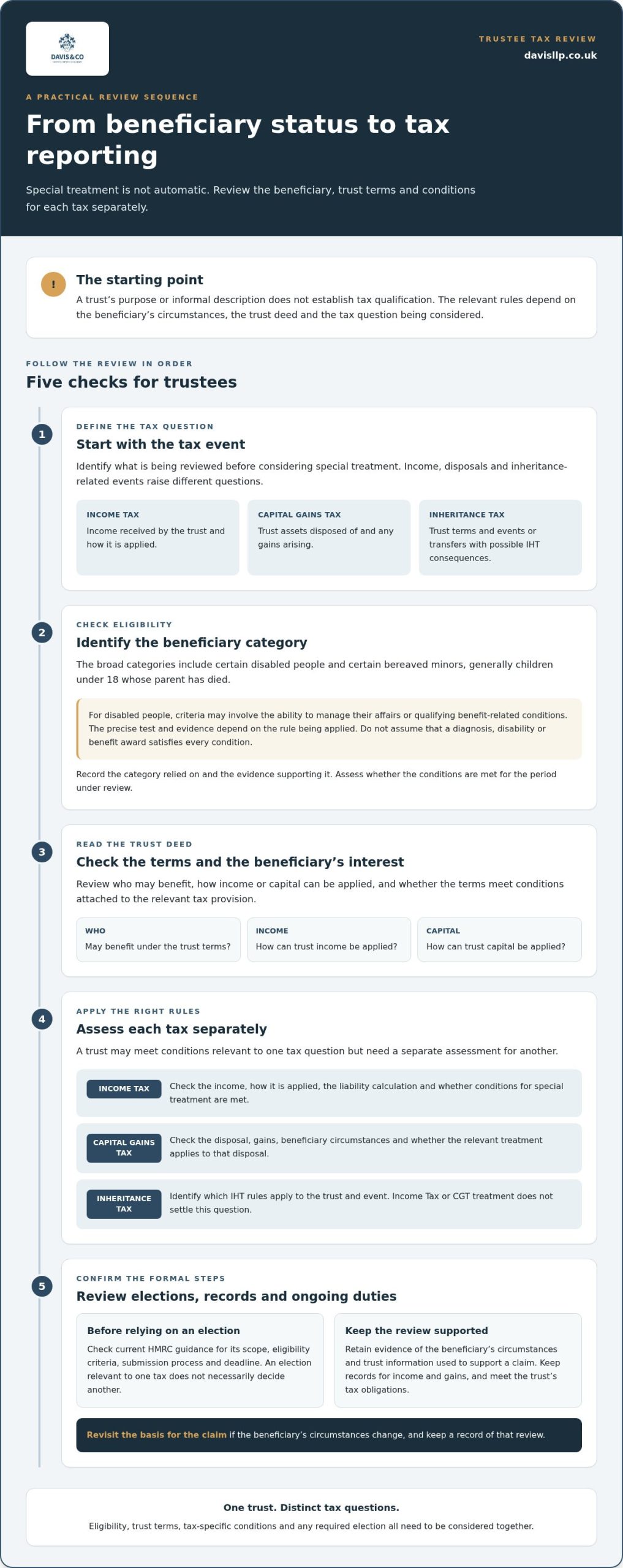
A reliable review follows the evidence from the trust deed through to the tax return. Start with the trust’s terms, then assess the beneficiary and relevant transactions before deciding whether an election or reporting action is required.
- Read the trust deed. Note who may benefit, what rights they hold, and how trustees can apply income and capital. Keep the relevant version and any amendments together.
- Review the beneficiary’s circumstances. Record the facts and supporting evidence relevant to any qualifying category. Note whether circumstances changed during the period under review.
- Reconcile income and gains. Gather statements, income records, documents for asset disposals, valuations where relevant, and details of distributions or payments from the trust.
- Identify the treatment being considered. Assess eligibility separately for the relevant tax. Check current HMRC guidance on any election, including the form, who must sign, the submission process and deadline.
- Complete the reporting review. Determine which trust returns, tax calculations or payments may be required for the trust’s circumstances. Check that figures agree with the supporting records.
What to review before claiming special treatment
Do not treat an election as general approval covering every tax. Match the treatment being claimed to the trust terms, beneficiary evidence and relevant tax conditions. Before submitting anything, check current HMRC instructions for the applicable form, required parties, timing and procedure. Do not assume paperwork used in a previous year remains appropriate. If the trust terms need to be created or varied, that is a legal matter, separate from tax administration.
What ongoing trust tax administration involves
Keep a clear record of income received, disposals, distributions, beneficiary information and the calculations behind tax return figures. Filing and payment obligations depend on the trust’s circumstances. Review what applies for each period rather than assuming the previous year’s position continues unchanged. If overseas income or other cross-border facts arise, consider their relevance to the trust’s reporting and wider tax position.
Review the trust’s activity for each tax year so that transactions, beneficiary circumstances and tax reporting remain aligned. For trusts with overseas connections, the UK international tax planning guide provides wider context for considering cross-border tax issues.
Trustees can manage records, reporting and tax elections without treating those tasks as authority to make legal decisions about the trust. Questions about the legal effect of a deed or a proposed variation are legal matters. Tax compliance should be assessed against the trust’s actual terms and circumstances. Davis & Co supports trustees with trust administration, compliance and returns through its trust tax services.
How specialist trust tax advice can support trustees and families
Trust tax decisions depend on the trust deed, the beneficiary’s circumstances and the transactions recorded during the relevant period. A tailored review brings these elements together so trustees can see which tax questions need attention and what information supports their reporting position. It can also identify where the tax analysis depends on a legal interpretation of the trust terms, keeping accounting and tax work distinct from legal advice.
When a trust tax review may be useful
A review may be useful when a beneficiary’s circumstances change, the trust receives a new type of income, assets are sold, or trustees are considering whether to claim special tax treatment. It can also help when the deed, past filings and current administration are difficult to reconcile. These events do not determine the tax result by themselves, but they may change the facts trustees need to assess and document.
For a vulnerable beneficiary trust tax UK review, the practical value lies in examining the specific trust rather than relying on a general description or a previous-year approach. A specialist can consider the trust terms, available records, treatment being sought and reporting obligations together. Where the position is uncertain or depends on detailed conditions, case-specific analysis can help trustees identify questions to resolve before filing or making an election. No review can guarantee eligibility, a particular tax saving or a specific outcome.
Trust tax returns, administration and next steps
Davis & Co provides Trust Tax Return Services, including trust administration and compliance. This support helps trustees organise information for trust tax returns, consider how income and disposals should be reflected, and maintain records that support tax figures and decisions. The work takes account of the trust and beneficiary’s circumstances rather than assuming the same treatment applies to every arrangement.
Davis & Co has been a firm of Chartered Certified Accountants since 1901. Its trust tax work covers accounting, tax returns, administration and compliance. Creating or varying a trust, interpreting legal rights under a deed, and obtaining legal representation are separate matters. Where required, trustees should seek qualified legal advice. Keeping these roles distinct helps families understand which questions concern tax reporting and which concern the trust’s legal terms.
To prepare for a review, bring together the deed and amendments, records of trust income and asset disposals, details of distributions, previous tax filings and relevant information about the beneficiary. A clear record helps focus the discussion and supports consistent administration over time. It also gives trustees a basis for identifying unresolved tax questions and next steps.
For support with trust tax returns, administration and compliance, explore Davis & Co trust tax support.
Take the next step with a clearer trust tax position
Turn uncertainty into a focused review. Note the questions that remain unresolved, gather the documents relevant to them and identify who is responsible for each decision. This gives trustees a practical basis for addressing the trust’s tax position without assuming a general explanation settles the circumstances of an individual trust.
For vulnerable beneficiary trust tax UK matters, a considered review can connect the trust’s purpose with the records and reporting decisions trustees need to manage. It can also identify issues that may need further tax analysis, while keeping tax administration distinct from legal decisions about the trust. The aim is a well-documented approach that reflects the family’s actual circumstances.
Davis & Co supports trustees and families with trust tax matters, including returns, administration and compliance. To discuss the practical tax questions arising from your trust, contact Davis & Co through its trust tax services.
Frequently Asked Questions
Can a trust for a disabled person receive special tax treatment?
Yes, some trusts may qualify if both the beneficiary and trust meet the conditions for the treatment being claimed. Disability alone does not automatically qualify a trust. Trustees considering treatment for trust income should assess that separately from a later asset sale or an Inheritance Tax event. Check current HMRC eligibility criteria and any election requirements before relying on special treatment.
Who counts as a vulnerable beneficiary for UK tax purposes?
Broadly, HMRC’s categories include certain disabled people and some children whose parent has died. These are defined tax categories, not a general label for anyone who needs support. Detailed conditions apply and may depend on the type of claim being considered. Consult current official guidance and assess the beneficiary’s circumstances against the specific test, rather than relying on a general description or incomplete benefits list.
Does a vulnerable beneficiary trust automatically qualify for tax relief?
No. Eligibility depends on the beneficiary, the trust’s terms and the conditions for the particular tax treatment sought. A name such as “vulnerable beneficiary trust” does not establish qualification. When reviewing the trust’s income position, do not assume the same conclusion applies to a disposal or an Inheritance Tax event. Examine the deed and current HMRC rules before making a claim or filing on the basis of special treatment.
What is a vulnerable person election, and who needs to make it?
A vulnerable person election is a formal step that may be required to claim certain special tax treatment. Trustees should establish that the trust and beneficiary meet the relevant criteria, then check current HMRC instructions to confirm who must make or sign the election and how to submit it. Do not assume one election covers every tax. Verify the current procedure rather than relying on a form name or deadline from an earlier claim.
How are Income Tax and Capital Gains Tax handled for a vulnerable beneficiary trust?
Income Tax and Capital Gains Tax have separate rules. Any special treatment depends on the trust and beneficiary meeting the relevant conditions. Review the source and amount of income separately from any asset disposal, then check whether an election is needed for the treatment being considered. The trust’s label does not determine the outcome. Use current HMRC guidance and the trust’s records to assess each liability.
Is Inheritance Tax treatment the same as Income Tax treatment for a vulnerable beneficiary trust?
No. Inheritance Tax requires its own analysis, even if trustees are considering special treatment for Income Tax or Capital Gains Tax. The trust deed, relevant qualifying conditions and particular event may all affect the position. A change involving trust assets, for example, may raise a different question from income received during the year. Check the current IHT rules for the trust and event before deciding how to report or proceed.
What records should trustees keep for a vulnerable beneficiary trust?
Keep the trust deed and amendments, statements showing income received, documents for asset disposals, records of distributions, relevant information about the beneficiary and copies of tax filings. For a disposal, retain the calculation and supporting documents, not just the final figure reported on the return. The records needed depend on the trust’s activities and reporting obligations. Organised files make it easier to explain trustee decisions and how figures were prepared.
Can trustees get professional help with vulnerable beneficiary trust tax returns?
Yes. Davis & Co provides Trust Tax Return Services covering trust administration and compliance, alongside related Inheritance Tax planning and personal tax advice. A case-specific review can help trustees identify reporting questions and organise the information needed to assess the trust’s tax position. This is tax and accounting support, not legal representation, and it does not guarantee eligibility or a particular tax outcome.