Could a missed confirmation statement deadline lead to a fine, or is the real risk something more serious? The penalties for late confirmation statement filing aren’t automatic in the way late annual accounts penalties are, but an overdue statement still needs attention. Failure to file is an offence, and Companies House may take enforcement action, including steps that could result in the company being struck off.
If you’ve just discovered the deadline has passed, it’s understandable to worry about what happens next, particularly if accounts are also due. These are separate filings: a confirmation statement updates key company information, while annual accounts report financial information. Each has its own deadline and consequences, so don’t assume the rules for one apply to the other.
This 2026 guide explains what may follow a missed confirmation statement deadline, what practical steps to take, and how to reduce the risk of further Companies House compliance issues. It distinguishes possible enforcement and director consequences from automatic accounts penalties, then outlines how to check the company’s position, address an overdue filing and assign responsibility for future deadlines. Organised records and a reliable filing calendar can help keep these obligations visible as part of sound business administration.
Key Takeaways
- The confirmation statement keeps Companies House information up to date and is required at least once a year, including for dormant companies.
- Understand the penalties for late confirmation statement filing by distinguishing possible enforcement action from automatic penalties for late annual accounts.
- Check the company’s Companies House record, filing status and review period first, then identify any outstanding information before submitting.
- A missed deadline can have consequences beyond a financial penalty, so acting promptly may help limit further compliance risks.
- Assign a named owner and maintain a forward calendar with reminders to make upcoming filing dates easier to manage.
What is a confirmation statement and when is it due?
A confirmation statement is a Companies House filing that allows a company to review and confirm key information held on the public register. Keeping this record current matters to people who rely on it, including lenders, suppliers and prospective business partners. Every company must file a statement at least once a year, even if it is dormant or has had no trading activity.
A quiet year does not remove the filing obligation. If the company’s details haven’t changed, it still needs to file and confirm that the existing information remains accurate. Leaving the statement unfiled because “nothing has changed” can create the same compliance problem as overlooking a filing after making changes. Understanding the timetable is central to managing the penalties for late confirmation statement filing.
What information does the confirmation statement confirm?
The statement is a check of information held about the company. This may include its registered office, directors, people with significant control (PSCs), business activity and, where relevant, shareholder details. It also includes confirmation of the company’s lawful purpose and a registered email address for Companies House communications. The registered email address is not displayed on the public register.
This filing is not a financial report. A confirmation statement does not replace annual accounts, which report the company’s financial position and performance. The two filings serve different purposes and have separate deadlines. The statement also does not replace separate notifications to Companies House when changes must be reported.
How do the review period and filing deadline work?
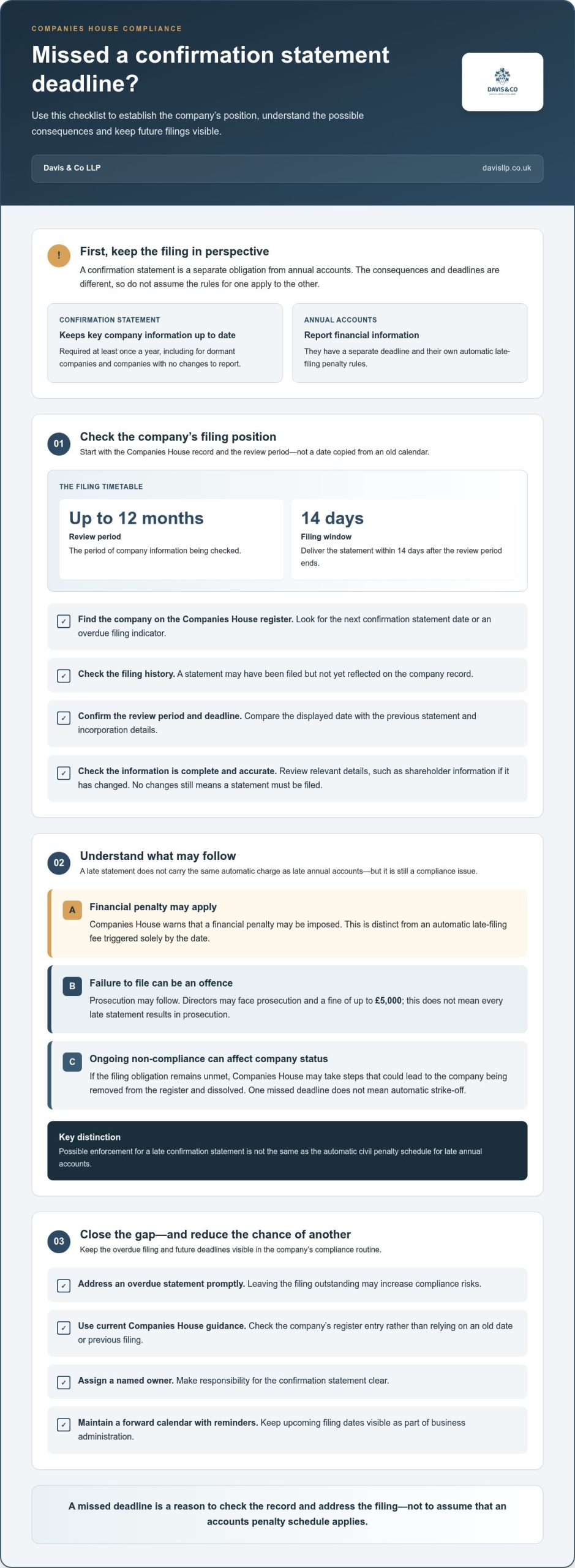
The review period is the period of company information being checked. It begins on the date of incorporation or the day after the previous review period ended, and runs for up to 12 months. The filing deadline comes after that period ends: under current Companies House guidance, the company must deliver its confirmation statement within 14 days of the end of the review period. The review period and filing deadline are connected, but they are not interchangeable.
To establish the company’s position, find its record on the Companies House register and look for the next confirmation statement date or any overdue filing indicator. Compare the displayed date with the company’s previous statement and incorporation details. If the date has passed, check the filing history to see whether a statement has already been filed but is not yet reflected on the record.
Before preparing a statement, confirm the review period and deadline shown for the company, then check that the information is complete and accurate. A company with no changes still needs to submit its statement. If shareholder information has changed, for example, check that the relevant details are reflected. Companies House requirements can change, so use its current filing guidance and the company’s register entry rather than relying on a date copied from an old calendar or previous filing.
What penalties and enforcement can follow a late confirmation statement?
A missed confirmation statement deadline doesn’t trigger the same automatic late-filing charge that applies to overdue annual accounts. That distinction doesn’t mean there is no risk. Companies House warns that a financial penalty may apply, and failure to deliver a required confirmation statement can also amount to a criminal offence. The consequences depend on the circumstances and the action taken by the registrar.
When assessing the penalties for late confirmation statement filing, separate three potential issues: a financial penalty, prosecution for failing to meet the filing obligation, and action affecting the company’s status on the register. They are not interchangeable, and none should be confused with the automatic civil penalty schedule for late accounts.
Is there an automatic late filing fee for a confirmation statement?
No standard automatic late-filing fee is applied to a confirmation statement in the same way as the statutory penalties for late annual accounts. Companies House guidance does warn that a financial penalty may be imposed, but that is distinct from an automatic charge triggered solely by the filing date. Check the official position and applicable requirements against current Companies House official guidance.
There is also a criminal consequence to consider. A company’s failure to file may lead to prosecution, and directors may face prosecution and a fine of up to £5,000. This is not an accounts late-filing fee, and it does not mean that every late statement results in prosecution. The possibility is a reason to address an overdue filing promptly rather than leave it outstanding.
Could missing the filing affect the company’s status?
One missed deadline does not mean that a company is automatically struck off. The concern grows if the filing obligation remains unmet: Companies House can take steps to remove a non-compliant company from the register. Strike-off is a serious outcome because it can result in dissolution, so treat an overdue status as a matter requiring attention, not a routine administrative delay.
Check the company’s public record for its filing status and any correspondence or action shown by Companies House. If the statement is overdue, address the outstanding filing and respond to any notices through the appropriate process. Submitting accounts will not resolve a missing confirmation statement, just as filing a confirmation statement will not meet the separate accounts obligation. Keep correspondence and submission records together to help establish what has been filed and what remains outstanding.
Clear responsibility for statutory dates and well-organised compliance records can help prevent an overdue filing from becoming a wider administration issue. Davis & Co LLP’s compliance and record-keeping support can help businesses maintain an orderly approach to ongoing obligations.
Late confirmation statement filing versus late accounts: what is different?
Both filings are required from companies, but they serve different purposes and have different consequences when late. A confirmation statement concerns the company’s information on the Companies House register. Annual accounts report its financial position and performance. Treating the filings as interchangeable can lead to the wrong response, especially if a company has missed both deadlines.
| Confirmation statement | Annual accounts |
|---|---|
| Purpose: Reviews company information held by Companies House, including relevant details about shareholders where required. | Purpose: Reports the company’s financial information for the relevant accounting period. |
| Filing obligation: Required at least once a year, including when there are no changes to confirm. | Filing obligation: A separate filing with its own accounts period and deadline. |
| Late consequences: A financial penalty may apply, and persistent failure to file can lead to prosecution or action to strike the company off the register. It is not subject to the automatic late accounts penalty schedule. | Late consequences: Late filing of a private company’s accounts triggers automatic civil penalties under the accounts rules. See Company annual accounts guidance for the accounts-specific requirements. |
In short: “A confirmation statement checks company information; annual accounts report financial information, and the late accounts penalty rules do not calculate the consequences of a late confirmation statement.” This distinction is central to understanding the penalties for late confirmation statement filing and deciding which obligation needs attention.
What does a confirmation statement filing cover?
The statement is a periodic review of details recorded for the company, rather than a set of financial statements. It remains due even if the company has nothing new to report. The information to review may include shareholder details, where applicable, and a registered email address. Check current Companies House requirements for the company’s circumstances so the statement reflects the information requested for that filing.
Why do late accounts penalties not answer this question?
Each filing has its own legal basis and enforcement approach. The accounts penalty regime applies to accounts submitted late; it cannot be transferred to a confirmation statement or used to estimate its consequences. For an overdue confirmation statement, distinguish the possibility of a registrar-issued financial penalty from prosecution for failing to meet the filing obligation and from potential strike-off action. These are separate outcomes, not a sliding scale of accounts fees.
If both filings are overdue, deal with each independently: check which documents remain outstanding, note their separate deadlines and confirm the relevant filing status. Submitting one does not satisfy the other. Keep a clear record of each submission to avoid assuming all Companies House obligations have been met when only one filing is complete.
What should you do after missing a confirmation statement deadline?
Once you discover that a statement is overdue, establish exactly what remains outstanding and deal with it in an orderly way. Don’t rely on an old reminder or assume that another Companies House filing has resolved the issue. Keep a clear record of the company’s status, the steps taken and any responses received to help manage the correction and avoid further confusion.
How can you check what is outstanding?
Start with the company’s Companies House record. Review its filing history and displayed confirmation statement dates, then compare these with your internal calendar and previous filing records. An email reminder can be useful, but it shouldn’t be your only way of identifying a missed deadline. If the record and your documents appear inconsistent, check the current official filing instructions before deciding what action to take.
- Check the public record and filing status. Confirm whether Companies House shows the statement as overdue or whether a filing has already been recorded. Note any correspondence or action displayed on the record, and keep a copy of what you reviewed.
- Verify the relevant dates. Review the due date shown for the company and the review period covered by the statement. Compare these with the last confirmation statement or incorporation information, rather than relying solely on an old diary or spreadsheet.
- Identify what information is outstanding. Establish whether the statement is overdue because it has not been submitted, or whether you also need to address incomplete or inaccurate company details. Check the current Companies House instructions for the filing.
- Prepare and submit the required filing. Make sure the information is consistent with the company’s records and follow the current submission process. If Companies House has sent a notice or request, read it carefully and follow the response instructions. Submitting annual accounts does not replace a confirmation statement.
- Retain evidence and follow up. Save the submission confirmation, a copy of the information filed and any relevant correspondence. Check the company record again to confirm the filing is reflected, and note any further action or communication that needs attention.
What should you prepare before submitting?
Gather the company’s current records and compare them with the information requested in the filing. Depending on the company’s circumstances, this may involve checking registered details, shareholder information and other applicable confirmation requirements. Resolve discrepancies before submission where possible, and use Companies House’s current instructions if a detail is unclear. Keep supporting records with the confirmation to maintain a reliable record of what was filed.
A missed deadline can also expose gaps in how filing dates and supporting information are managed. Assigning responsibility and keeping compliance records together makes it easier to identify what is due and demonstrate what has been done. Davis & Co supports businesses with compliance and record-keeping as part of sound administration.
How can businesses prevent future confirmation statement filing problems?
A dependable process makes filing dates part of routine business administration rather than a task that depends on one person remembering. Assign a named internal owner to monitor the company’s Companies House deadlines and coordinate the information needed for each filing. Make the responsibility clear to colleagues, including who should provide updates when company details change.
Use the next displayed filing date on the company’s Companies House record to create a forward calendar. Set reminders in advance, with a review date that gives the responsible person time to check the information and resolve gaps before the filing deadline. A second reminder or designated deputy can provide continuity if the owner is absent or their role changes.
Review the company’s details periodically against internal records, not only when a statement is due. Changes to directors, shareholders or other company information can otherwise be missed or recorded inconsistently. Keeping a central record of updates and who supplied them makes the annual review more orderly and supports wider compliance work. A consistent process can also help reduce exposure to the penalties for late confirmation statement filing by making responsibilities and deadlines visible.
What should a simple filing-control process include?
Keep the process practical and easy to maintain. The central record should show the next filing date, the person responsible, when information will be reviewed, and where evidence of submission is saved. Set more than one reminder, and identify a colleague who can take over if responsibility changes. Revisit the process after changes to company records, staff roles or internal procedures so the calendar and ownership remain accurate.
- Filing date: Record the date shown on the company’s Companies House record and schedule a review beforehand.
- Named owner and cover: Assign responsibility for checking dates and gathering supporting information, with a deputy who understands the process.
- Review and evidence: Record when details were checked and retain submission confirmations and relevant correspondence with company records.
When can professional compliance support be useful?
As a company grows, filing responsibilities can become less straightforward, particularly when information is held across different records or managed by several people. Organised documentation and clear accountability help keep statutory tasks visible alongside other business obligations. Our small business accounting and compliance guidance explores how sound processes can support business administration. For a considered approach to professional support, see our guidance on finding a Chartered Accountant.
If your filing calendar, records or responsibilities need a more structured approach, Davis & Co’s compliance and record-keeping support can help strengthen your wider business administration.
Make compliance ownership part of your next business review
A missed filing can be a useful prompt to strengthen how your business manages statutory responsibilities. Rather than relying on memory or a single reminder, make filing ownership, supporting records and follow-up checks part of your regular administration. That practical discipline can help keep future Companies House obligations visible and reduce the risk of further compliance issues. The aim isn’t simply to avoid the penalties for late confirmation statement filing, but to build a dependable process that supports the company as it develops.
Davis & Co LLP is a firm of Chartered Certified Accountants established in 1901, offering Compliance & Record-Keeping and Tax & Business Advisory services to businesses seeking a more organised approach to their obligations. We can help you consider how clear responsibilities and well-maintained records fit into your wider business administration.
Explore Davis & Co’s compliance and record-keeping support to take a considered step towards a more reliable compliance process.
Frequently Asked Questions
Is there an automatic penalty for filing a confirmation statement late?
Companies House guidance warns that a financial penalty may apply, but the automatic late accounts penalty schedule does not apply to confirmation statements. The penalties for late confirmation statement filing depend on the applicable rules and circumstances, so don’t assume a particular charge will follow. Check current Companies House guidance and the company’s public record for its filing status and any notices, then follow the instructions relevant to the company’s position.
Can a company be struck off for not filing a confirmation statement?
Persistent failure to meet filing obligations may lead to further Companies House action, including possible strike-off, subject to the applicable process. One missed deadline doesn’t mean the company is automatically removed from the register. Check the company record and any notices to understand whether action has begun, and address the outstanding filing promptly. Follow Companies House’s current procedure, as the appropriate steps depend on the company’s circumstances.
Do dormant companies still have to file a confirmation statement?
Yes. Official guidance says every company, including dormant and non-trading companies, must file a confirmation statement at least once every year. A company that has stopped trading still exists on the register, so inactivity alone doesn’t remove its filing obligation. Check the company’s record and current Companies House instructions. Dormant status may affect other company obligations, but it shouldn’t be treated as an exemption from this filing requirement.
Do I need to file a confirmation statement if nothing has changed?
Yes. A company must still file when its details haven’t changed during the review period. The statement confirms information held by Companies House; it isn’t a form used only to report amendments. For example, if the directors and other relevant details remain the same, the company still needs to complete the confirmation process. Check the company record for the current filing date and follow the instructions shown for the statement.
Are confirmation statement penalties the same as late accounts penalties?
No. A confirmation statement reviews company information, while annual accounts report financial information, and each is a separate filing obligation. The GOV.UK late-filing penalties guidance relates to accounts. Its penalty amounts, deadlines and procedures shouldn’t be used to calculate or describe a confirmation statement consequence. Check the current official guidance for each filing separately, particularly if both are overdue, so you can identify the correct outstanding requirement.
What should I do first after discovering a missed confirmation statement deadline?
First, check the company’s Companies House record and filing history to establish whether the statement is still outstanding and whether any notice has been issued. Review the relevant due date, then prepare accurate company information using the current submission instructions. Submit in accordance with those instructions and retain the confirmation and related correspondence. Prompt filing is a sensible next step, but it doesn’t guarantee that no penalty or other enforcement action will follow.
Can a company file a confirmation statement if its details have not changed?
Yes. Official guidance says the company must still file even if its details remain unchanged. The statement records that the information held about the company has been reviewed, rather than reporting changes alone. Follow the current Companies House requirements for the relevant review period and complete any declarations required for that filing. Checking the company’s record before starting can help ensure you use the correct filing date and process.