The relief’s name has changed, and so has the rate. Entrepreneurs’ Relief became Business Asset Disposal Relief (BADR) in April 2020; for qualifying assets disposed of from 6 April 2026, BADR applies an 18% Capital Gains Tax rate, according to HM Revenue & Customs. The lifetime limit is £1 million before 6 April 2027, then falls to £500,000 for qualifying disposals from that date.
When a business sale is in view, the key question is whether the disposal and your role in the business meet the relevant conditions, not simply what the relief is called. This guide explains how entrepreneurs’ relief on selling a business works under the current BADR rules, who may qualify and how the lifetime limit has changed. It also outlines the tax considerations to weigh as you plan a sale, including the distinction between selling a business and disposing of company shares.
Key Takeaways
- Understand how Business Asset Disposal Relief may reduce Capital Gains Tax when a business or qualifying assets are sold.
- See how the lifetime limit applies across multiple qualifying disposals, rather than resetting for each sale.
- Identify the ownership, trading and employment conditions that can affect eligibility for sole traders, partners and company shareholders.
- Consider how the structure and timing of a sale can shape tax planning and the support needed before completion.
What is Business Asset Disposal Relief?
Business Asset Disposal Relief (BADR) is a UK Capital Gains Tax relief for qualifying business disposals. It was called Entrepreneurs’ Relief until its name changed in April 2020. It can reduce tax on qualifying capital gains when an individual sells a business, shares or certain business assets. The rules depend on the disposal type and the seller’s connection to the business.
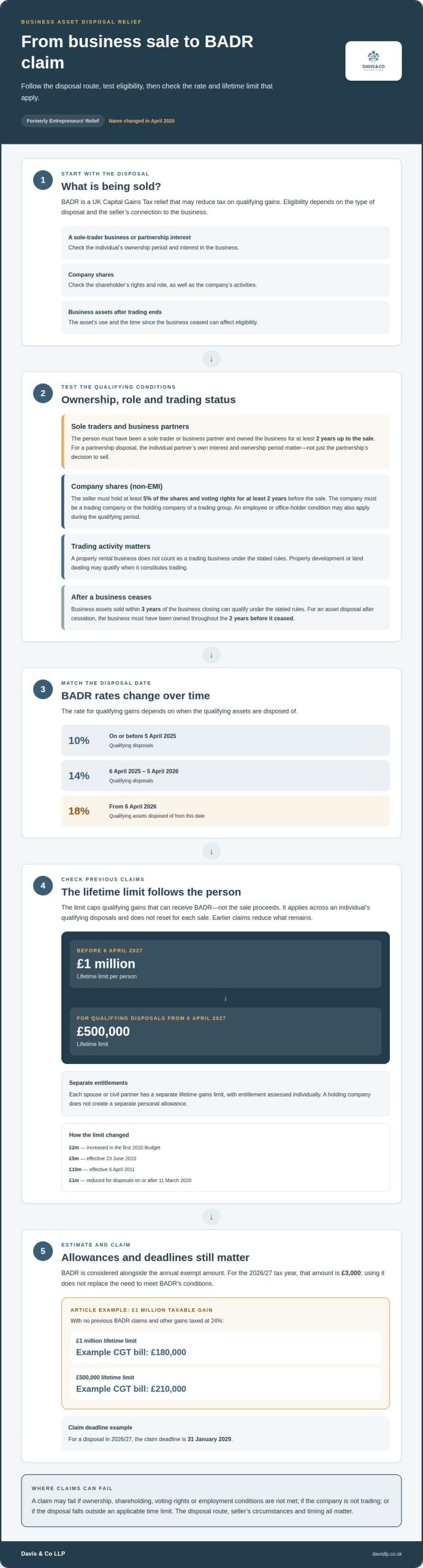
The rate depends on when the qualifying assets are disposed of. According to HM Revenue & Customs, BADR applies a 10% Capital Gains Tax rate to qualifying gains on disposals on or before 5 April 2025. For disposals between 6 April 2025 and 5 April 2026, the rate is 14%. For qualifying assets disposed of from 6 April 2026, HM Revenue & Customs sets the rate at 18%. The disposal date therefore matters when calculating tax for a particular tax year.
For company shares, eligibility depends on the shareholder’s rights and role, as well as the company’s activities. For non-EMI shares, the seller must hold at least 5% of the shares and voting rights for at least 2 years before the sale, according to HM Revenue & Customs. The company must also be a trading company or the holding company of a trading group. An employee or office-holder condition may apply during the qualifying period.
Business assets may still qualify after trading ends. Assets sold within three years of the business closing can qualify under the stated rules. A person may also qualify when selling company shares within 3 years after the company stops being a trading company. For an asset disposal after cessation, the business must have been owned throughout the two years before it ceased. Timing and the asset’s use in the business are therefore central considerations.
BADR concerns Capital Gains Tax, so the gain is considered alongside the annual exempt amount. For the 2026/27 tax year, that amount is £3,000. Using an allowance does not replace the need to meet BADR’s conditions. Each relief or allowance has its own eligibility rules, and the outcome depends on the disposal and the seller’s circumstances.
Claims can fail when a seller does not meet the ownership, shareholding, voting-rights or employment conditions, or when a company does not qualify as trading. A disposal outside the applicable time limit can also prevent relief. The claim must be made by the relevant deadline: for a disposal in 2026/27, the deadline is 31 January 2029.
How has the BADR lifetime limit changed?
The lifetime limit caps the qualifying gains that can benefit from BADR. It applies across an individual’s qualifying disposals, rather than resetting for each sale.
Allowance Across Multiple Sales
The lifetime limit is £1 million per person before 6 April 2027, shared across multiple qualifying sales. It does not reset for each business asset or disposal. An earlier claim reduces the allowance available for later gains. Each spouse or civil partner has a separate £1 million lifetime gains limit, with entitlement assessed individually. This matters when separate owners sell business interests at different times.
Lifetime Limit and CGT Savings
The limit determines how much qualifying gain can receive BADR’s rate, not how much sale proceeds are covered. For a £1 million taxable gain, with no previous BADR claims and other gains taxed at 24%, the example CGT bill is £180,000 under a £1 million limit. With a £500,000 limit, it is £210,000. This comparison shows why the available allowance and disposal timing matter when estimating tax on a sale.
The lifetime limit has changed substantially. It increased to £2m in the first 2010 Budget, then rose to £5m effective 23rd June 2010. It reached £10m effective April 6, 2011. For disposals on or after 11 March 2020, the limit was reduced to £1 million per individual. Previous qualifying claims therefore affect how much relief remains for a later disposal.
In 2026/27, the limit is £1 million, falling to £500,000 for qualifying disposals from 6 April 2027. The lifetime total is based on qualifying gains claimed, not the number of sales. A holding company does not create a separate personal allowance; company structure and individual eligibility are distinct considerations. Tax planning for a business sale can help assess how timing and previous claims affect the available relief.
Eligibility for sole traders and business partners
For a sole trader or business partner, ownership and timing are central. HM Revenue & Customs states that a person must have been a sole trader or business partner and owned the business for at least 2 years up to the sale. Qualifying disposals may involve selling all or part of the business. A sale before the required ownership period ends does not meet this condition.
For a partnership disposal, eligibility depends on the individual partner’s interest in the business, not simply the partnership’s decision to sell. A partner disposing of part or all of their interest must meet the ownership test personally. For example, someone who joined later than the other partners needs to assess their own ownership period. The partnership’s trading activity and the asset being sold also affect whether the disposal qualifies for BADR.
Distinguish a sole-trader or partnership sale from a company share sale. A director’s title alone does not establish eligibility for a sole-trader or partner disposal. Company shares have separate qualifying conditions, including tests concerning the seller’s shares, voting rights and role in the company. A holding company structure also differs from personally owning a trading business, so the disposal route matters.
Trading status affects whether the business being sold qualifies. A property rental business does not count as a trading business under the stated rules, while property development or land dealing may qualify when it constitutes trading. Profits or valuable assets alone do not settle the question. Consider the business activity alongside the seller’s ownership circumstances.
Trustee involvement requires particular care over who owns and disposes of the business interest. The sole-trader and partner test concerns a person who owned the business. A trustee’s role should not be treated as equivalent to personal ownership without examining the arrangement. Identify whether the disposal is made by an individual in their own capacity or by trustees, then assess the relevant ownership and qualifying conditions.
Entrepreneurs’ Relief and selling a business
Entrepreneurs’ relief on selling a business is now known as Business Asset Disposal Relief. The tax analysis starts with identifying what is being disposed of: personally owned business assets, a partnership interest or company shares. A company share sale is not assessed in the same way as a sole trader’s asset disposal, so the sale structure determines which qualifying conditions apply.
For non-EMI shares, the personal-company test requires the seller to hold at least 5% of the shares and voting rights for at least 2 years before the sale, according to HM Revenue & Customs. The company must also be a trading company or the holding company of a trading group. The seller generally needs to be an employee or office-holder during the qualifying period. Meeting the shareholding test alone is not enough.
Employee shareholders should distinguish ordinary share disposals from Enterprise Management Incentive (EMI) shares. For EMI shares to qualify, the option must have been granted at least 2 years before sale, and the shares must have been bought after 5 April 2013. These conditions can make the option grant date and the eventual disposal date material to the tax assessment.
For a partnership, the relief concerns the individual’s qualifying disposal, rather than the partnership’s decision to sell. A separate associated disposal of an asset used by the business has its own conditions. The individual must have owned the asset and let the business use it for at least one year up to the sale or closure. The seller must also dispose of at least 5% of their partnership interest or personal-company shares.
Before agreeing a sale, establish whether the transaction transfers business assets or shares, who owns each asset, and how long the relevant interests have been held. These details help identify which conditions and lifetime limit apply to each gain. Discuss tax planning for your business disposal as part of preparing for the transaction.
Davis & Co LLP: Business Growth Acceleration
Davis & Co LLP’s Business Growth Acceleration can support owners planning the next stage of their business, including decisions about a potential sale. As a disposal approaches, tax implications, business performance and personal financial considerations may need to be considered together.
International Tax Planning and Personal Tax Services can help address relevant tax considerations, while Cash Flow Management supports planning for the financial transition. The right focus depends on the transaction structure, the owner’s circumstances and their plans after the sale. Considering these matters early can help align business decisions with personal objectives.
If you are considering a sale, contact Davis & Co LLP to discuss the business and the planning support relevant to your circumstances.
Plan the next stage with clarity
A business sale is also a transition: decisions about proceeds, future plans and financial priorities can shape what follows. Planning for entrepreneurs’ relief on selling a business should therefore sit alongside a broader view of your objectives, rather than being considered in isolation.
Davis & Co LLP brings tax and commercial considerations into the same conversation through International Tax Planning, Business Growth Acceleration and Cash Flow Management. This support is relevant when a proposed disposal needs to align with the business’s future direction and your personal plans. Discuss the transaction’s structure, timing and intended outcomes with the firm so advice can be tailored to the decisions ahead.
Contact Davis & Co LLP to discuss planning for your business sale and the transition that follows.
Davis & Co LLP can help with the tax considerations of selling a business
Davis & Co LLP provides International Tax Planning and Personal Tax Services, alongside Business Growth Acceleration and Cash Flow Management. These services can help you consider the wider tax and financial aspects of a business sale.
Turn to Davis & Co LLP when you are planning a sale or reviewing its tax implications. The firm also offers Trust Tax Services, VAT Compliance, Management Accounts, Bookkeeping Services and Company Secretarial Services.
Frequently Asked Questions
How does the entrepreneurs’ relief work?
Business Asset Disposal Relief reduces the Capital Gains Tax charged on qualifying business gains; it does not make sale proceeds tax-free. It applies only when a disposal meets the relevant conditions, and the lifetime limit restricts the gains that can benefit. If a transaction includes both business assets and shares, classify each disposal separately before calculating the tax.
How can a tax professional calculate your BADR liability?
A tax professional identifies the assets or interests sold, calculates the chargeable gain and assesses which part meets BADR’s conditions. The calculation also considers the applicable tax-year rate, annual exempt amount, capital losses and any earlier BADR claims against the lifetime limit. Previous claims reduce the allowance remaining, so sellers receiving similar proceeds may face different tax liabilities.
What are the conditions?
The conditions depend on what is sold. A sole trader or partner must meet the business ownership test, while a share disposal involves tests relating to the seller’s shareholding, voting rights and role, as well as the company’s trading status. Enterprise Management Incentive shares have separate conditions. Match the applicable tests to the disposal rather than assuming they are identical for every business sale.
When selling a business, will you have to pay CGT?
Capital Gains Tax may be payable if selling a business or its assets creates a chargeable gain, but a sale does not automatically mean tax is due. The result depends on what was disposed of, the gain after relevant costs and losses, available allowances, and whether BADR applies. A share sale and an asset sale can produce different calculations, even within the same transaction.
When should a professional claim BADR and pay the tax?
BADR is usually claimed through the Self Assessment return for the tax year of disposal. For a disposal in 2026/27, the claim deadline is 31 January 2029. Capital Gains Tax on a qualifying disposal in that tax year is generally due by 31 January 2028. A professional can plan for both deadlines, which are separate.
What is Business Asset Disposal Relief (formerly Entrepreneurs’ Relief) in the UK?
Business Asset Disposal Relief is the UK name for Entrepreneurs’ Relief, renamed in April 2020. It is a Capital Gains Tax relief for individuals disposing of qualifying business interests or assets. Rather than exempting all proceeds, it applies a reduced rate to eligible gains, subject to the relevant conditions and lifetime limit. The applicable tests depend on the business interest or asset sold.