An interest-free director’s loan can create a personal tax bill as well as a company tax charge. The tax implications of taking a director’s loan depend on whether the account is overdrawn, how much is owed and when it is repaid. If a loan remains outstanding nine months after the end of the company’s accounting period, the company may have to pay a Section 455 charge; for loans made on or after 6 April 2026, the rate is 35.75%.
It’s easy to focus on the company’s repayment deadline, but the director’s personal tax position can matter too. If the amount owed exceeds £10,000 at any point in the tax year and the company charges no interest, or less than HMRC’s official rate, the loan may count as a benefit in kind.
This article explains how the company charge works, when repayment may lead to a refund, and how an interest-free loan can affect the director personally. It also covers the key thresholds and timing rules that determine the tax treatment, helping you understand the consequences before deciding how to manage a director’s loan account.
Key Takeaways
- The balance on a director’s loan account helps determine whether tax consequences arise for the company, the director or both.
- Repaying a loan may allow the company to reclaim a Section 455 charge, but the timing and any further borrowing can affect the outcome.
- Repayments followed by new withdrawals may fall within anti-avoidance rules, so the pattern of transactions matters.
- An interest-free or low-interest loan can create a taxable benefit for the director and National Insurance costs for the company.
What Are the Tax Implications of a Director’s Loan Account?
A director’s loan account records money moving between a company and its director. The balance, repayment date and accounting treatment determine whether tax applies to the company or the director.
Repaying Overdrawn Balances on Time
An overdrawn balance means the director owes money to the company, and repayment timing can affect the company’s tax position. HM Revenue & Customs says a company generally has to pay Section 455 Corporation Tax if the loan remains unpaid 9 months after the end of the accounting period. Repayment within that period can prevent the charge, but the date and amount repaid must be recorded accurately.
Section 455 Tax on Overdrawn Accounts
Section 455 is a company tax charge on certain loans to directors who are also shareholders. In many cases, HM Revenue & Customs says loans made from 6 April 2022 to 5 April 2026 remain subject to a section 455 rate of 33.75%. The charge is separate from the director’s personal tax, and later repayments may allow the company to claim relief. HM Revenue & Customs also says that taking another loan of £5,000 or more within 30 days before or after repayment can trigger Section 455 tax.
Reporting Loans in Accounts and Self Assessment
At the financial year-end, the company includes the amount owed by or to the director in its balance sheet and annual accounts. A repayable loan is not, by that definition, income under the Income Tax (Earnings and Pensions) Act 2003. The director’s Self Assessment position depends on the transaction: a taxable benefit or a written-off loan can have personal tax consequences, while salary and dividends are treated separately. Keeping dated records of withdrawals, repayments and interest helps ensure the accounting balance and tax return reflect the transactions.
Tax Consequences of Writing Off a Loan
Writing off or releasing a loan means the company no longer expects the director to repay that balance. The director must declare the written-off amount on a Self Assessment tax return and pay Income Tax on it. If the director is also a shareholder, the write-off is usually treated as a distribution for income tax purposes. The company must deduct Class 1 National Insurance through payroll when it writes off or releases the loan, making the treatment different from an ordinary repayment.
Refund of the company tax charge after repayment
Repaying an outstanding loan can allow a company to reclaim Section 455 tax, but the refund is subject to timing rules. The amount and date of repayment matter, particularly where the borrower is a participator.
Repaying and Reborrowing a Loan
Anti-avoidance rules can restrict a repayment followed by a fresh withdrawal, preventing a temporary repayment from automatically removing the company tax charge. HM Revenue & Customs says that, for a loan repaid after the accounting period, taking another loan of £5,000 or more within 30 days before or after repayment can trigger Section 455 tax on the original balance. The transaction pattern therefore matters, not just the repayment date.
Repayment Timing and Deadlines
Repayment timing determines when the company can seek relief and whether a charge remains payable in the meantime. A claim for Section 455 relief cannot be made until 9 months and 1 day after the end of the accounting period in which the loan was repaid, released or written off. The company should match the repayment date to the relevant period before submitting its claim.
Once eligible, the company can reclaim the tax paid on the loan, but not the interest. A claim generally needs to be made within 4 years. If the company is preparing or amending its Company Tax Return within 2 years of the end of the accounting period in which it made the loan, it can use form CT600A to claim relief. The return should show the relevant loan and repayment details.
Repayment decisions also have to account for the company’s financial position. Under section 172(3) of the Companies Act 2006, a director’s duty extends to creditors when the company is insolvent or likely to become insolvent. Returning funds to a director or participator in those circumstances calls for careful consideration of creditor interests and the company’s records.
For governance records alongside the accounting treatment, company secretarial support can help document formal decisions.
Section 455 Corporation Tax charge and repayment deadline
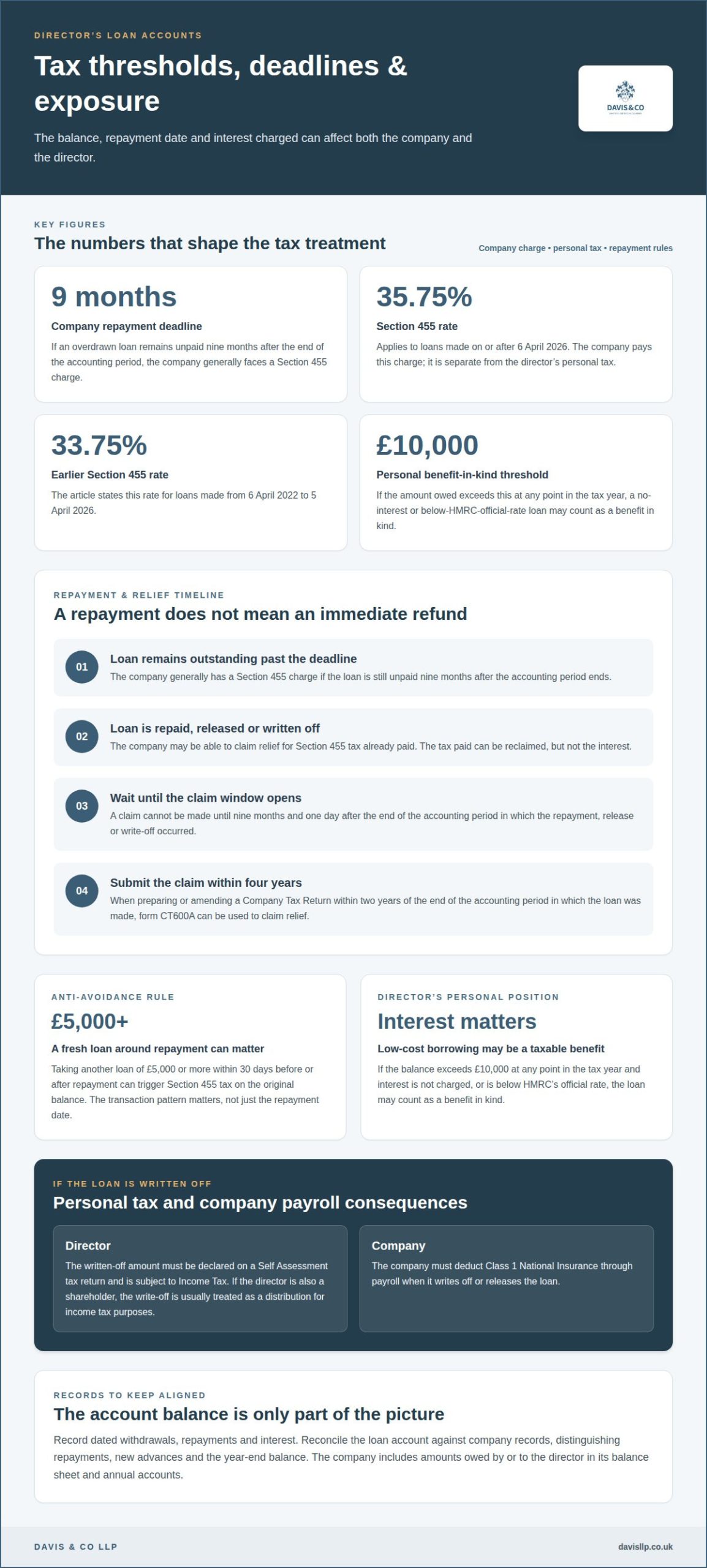
Section 455 Corporation Tax is a company charge on certain outstanding loans to participators. The tax implications of taking a director’s loan include this company liability, which is separate from the director’s personal tax position. For loans made on or after 6 April 2026, the Section 455 rate is 35.75%. The company, rather than the director personally, pays the charge.
The accounting period determines the repayment timetable. If a loan remains outstanding nine months after that period ends, the company generally faces a Section 455 charge. The tax implications of taking a director’s loan therefore depend partly on the balance at the deadline. Reconcile the loan account against company records, distinguishing repayments, new advances and the year-end balance.
If the director later repays, releases or writes off the loan, the company can seek relief for Section 455 tax already paid. A claim can be made no earlier than nine months and one day after the end of the accounting period in which that repayment or release occurred. The company must also submit its claim within four years.
For a claim made when preparing or amending a Company Tax Return within two years of the accounting period in which the loan was taken out, form CT600A can be used. The return should identify the loan and relevant repayment or release, matching the claim to the company’s records. The company can reclaim the tax charge, but not interest paid to HMRC.
Interest on a director’s loan is accounted for separately. A company may claim Corporation Tax relief on gross interest paid at a commercial rate, if it is paid or credited within 12 months of the year end. This relief relates to interest, not the Section 455 charge, so record the interest and loan balance separately.
Personal tax cost of an interest-free loan
An interest-free loan can create a personal tax bill even when the director repays it. If the amount owed exceeds £10,000 at any point in the tax year, it may be treated as a benefit in kind. HMRC’s official rate for beneficial loans is 3.75% from 6 April 2025. The threshold is assessed during the tax year, not solely at the company’s accounting period end.
The benefit is based on the interest the director would have paid at the official rate, minus any interest actually paid to the company. The calculation depends on the loan balance and how long it remains outstanding. A repayment during the year reduces the balance for the rest of the period, but does not necessarily remove a benefit that arose earlier.
The director pays Income Tax on the taxable benefit, while the company pays employer National Insurance. For 2026/27, the company’s Class 1A National Insurance rate on a taxable beneficial loan is 15%. The director’s personal tax cost depends on their applicable Income Tax rate and the benefit amount, rather than the full loan principal.
Charging interest at least equal to HMRC’s official rate can prevent a benefit in kind. If the company charges less, the shortfall may still produce a taxable benefit. Interest charged on an overdrawn loan should be paid by 6 July following the end of the tax year to avoid it being treated as unpaid for this purpose. A dividend used to clear the loan is a separate transaction: the director may owe Dividend Tax on it.
For a tailored assessment of the benefit and personal return treatment, discuss your personal tax position.
Davis & Co LLP
Davis & Co LLP helps business owners understand how company decisions affect both corporate finances and personal tax. Where a director’s loan creates questions about repayment, a Section 455 charge or a taxable benefit, its tax planning, cash flow management and personal tax services can help bring those considerations together. The appropriate approach depends on the loan account, the company’s position and the director’s circumstances. Considering these factors together can support informed decisions about the company’s cash flow and the director’s tax position. Contact Davis & Co LLP to discuss how a director’s loan affects your circumstances.
Make the next decision with clarity
Understanding the tax implications of taking a director’s loan is an important starting point when considering how company funds support business needs and personal circumstances. Before deciding on a repayment or withdrawal, consider the impact on the company’s cash flow and growth plans, as well as the director’s personal tax position. Looking at both sides helps you make a considered decision and plan the finances more clearly.
Davis & Co LLP offers International Tax Planning, Business Growth Acceleration and Cash Flow Management to support connected business and tax considerations. For advice tailored to your circumstances, contact Davis & Co LLP. A clear view of the relevant considerations can help you move forward with greater confidence.
Davis & Co LLP can help you manage a director’s loan
Davis & Co LLP provides tax and business services, including Personal Tax Services, Management Accounts, Bookkeeping Services and Managing Cash Flow & Profits. These services can help you assess the tax implications of a director’s loan in the context of your company’s finances and personal tax affairs.
Turn to Davis & Co LLP when you need help considering the loan alongside your company’s finances or personal tax affairs. The firm also offers Company Secretarial Services and Audit and Assurance.
Frequently Asked Questions
What are the risks for director’s loans?
A director’s loan can create company and personal tax exposure, and an unpaid balance may also affect how others view the company’s finances. For example, an outstanding loan may be a warning sign when the business seeks finance. The director should also consider the company’s ability to meet its obligations: under section 172(3) of the Companies Act 2006, duties extend to creditors if insolvency is likely.
What happens if you can’t repay the loan?
If repayment isn’t possible, the debt remains an amount owed to the company; it doesn’t disappear automatically. The company may face a Section 455 charge, and a later write-off or release can create personal tax and payroll consequences. If the company is insolvent or likely to become insolvent, decisions about its funds must also take account of creditors. A write-off should therefore be treated as a formal taxable event, not a substitute for repayment.
Can I cancel out a director’s loan with a dividend?
A company can clear a director-shareholder’s overdrawn account with a dividend if it has sufficient distributable profits and properly records the declaration. The dividend must be a genuine company distribution, not simply a retrospective accounting entry. Crediting the dividend reduces the loan balance, but the director may owe Dividend Tax. The company’s available profits and supporting records determine whether this approach is suitable.
Can I withdraw it again afterwards?
A fresh withdrawal soon after repayment can prevent the original repayment from avoiding Section 455 tax. HM Revenue & Customs says a new loan of £5,000 or more within 30 days before or after repayment can trigger the charge. A separate arrangements rule can apply where at least £15,000 is outstanding before repayment and there are arrangements for further loans of at least £5,000. That rule has no simple 30-day escape.
Debit or credit?
A debit balance generally means the director owes money to the company; a credit balance means the company owes money to the director. For example, a personal withdrawal not treated as salary, a dividend or an expense repayment may leave the account overdrawn. A director’s credit balance has no immediate tax implications, but it still needs to be recorded accurately in the company’s accounts so the amount owed is clear.
How do the beneficial loan rules and £10,000 threshold work?
The threshold applies if the director owes the company more than £10,000 at any point in the tax year. If the loan is interest-free, or charged below HMRC’s official rate, the difference can create a taxable benefit. HMRC’s official rate is 3.75% from 6 April 2025. The director may pay Income Tax on the benefit, while the company pays Class 1A National Insurance, at 15% for 2026/27.