The most tax-efficient way to use company profits may be to put some towards retirement before taking the money personally. For tax efficient investments for company directors, employer pension contributions can be deductible business expenses, and the annual pension allowance is £60,000 per tax year, subject to individual qualifying criteria, according to HM Revenue & Customs. Money taken as salary or dividends can also be invested through a personal ISA, subject to the applicable allowance.
Company directors often want surplus profits to work harder without losing sight of business and personal tax. The right approach depends on what the company can afford to commit, your income and when you may need access to the money.
This article explains how pension contributions and ISAs fit into a director’s wider plans for taking money from a company, including the tax treatment and trade-offs. It also considers how professional tax planning can align decisions about company profits with retirement goals and personal investment plans.
Key Takeaways
- According to HM Revenue & Customs, the annual pension allowance is £60,000, subject to individual qualifying criteria. How much of it is relevant depends on your circumstances.
- Salary, dividends and employer pension contributions each affect your company and personal tax position differently; the right mix depends on your profits and income needs.
- Consider pension contributions for retirement savings and an ISA for money you want to invest personally, weighing their different access and tax treatments.
- Bringing profit extraction, cash flow and company administration together can help make investment decisions more consistent with your wider business plans.
Annual pension allowance and corporation tax
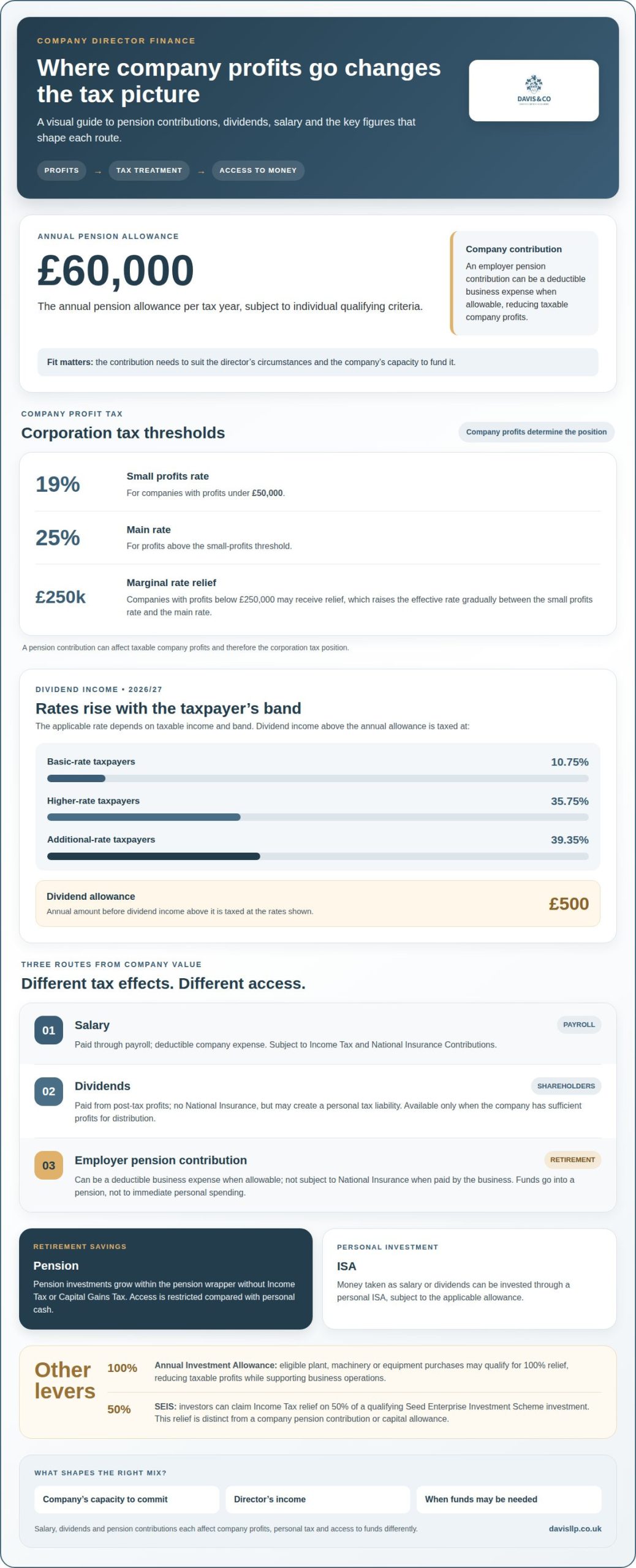
The UK annual pension allowance is £60,000 per tax year, subject to individual qualifying criteria, according to HM Revenue & Customs. For a limited company director, employer pension contributions can be deductible business expenses, reducing taxable company profits. The contribution also needs to fit the director’s circumstances and the company’s capacity to fund it.
Corporation tax depends on company profits. Companies with profits under £50,000 pay the 19% small profits rate; the main rate is 25% for profits above the small-profits threshold, with marginal rate relief where applicable. Companies with profits below £250,000 may receive marginal rate relief, which raises their effective rate gradually between the small profits rate and the main rate. A pension contribution can therefore affect the company’s taxable profit and its corporation tax position.
Reinvestment can also change the calculation. Eligible plant, machinery or equipment purchases may qualify for 100% Annual Investment Allowance, so capital spending can reduce taxable profits while supporting business operations. This is distinct from investing surplus funds in shares. Separately, HM Revenue & Customs states that investors can claim Income Tax relief on 50% of qualifying Seed Enterprise Investment Scheme investment. SEIS involves qualifying shares, so its relief is not interchangeable with a company’s pension contribution or capital allowance.
Personal income matters too. The personal allowance is usually £12,570 in the current tax year, and it is reduced when adjusted net income exceeds £100,000. The dividend allowance is £500 per annum. Dividend income above that allowance is taxed at 10.75% for basic-rate taxpayers, 35.75% for higher-rate taxpayers and 39.35% for additional-rate taxpayers. Salary, dividends and pension contributions can each affect adjusted net income differently.
Capital gains are taxed according to who owns the investment. If you sell investments personally, any taxable gain is considered under Capital Gains Tax. If the company sells investments it owns, gains are included in its corporation tax computation. Ownership therefore affects how investment returns are taxed, not just how funds are taken from the business.
Company Directors: What is the most tax efficient way to take money out of your business?
Salary, dividends and employer pension contributions affect company profits and personal tax in different ways. The right mix depends on the company’s profits, your personal income and whether you need money now or are saving for retirement.
Routes for Extracting Company Profits
These are three ways to direct value from a limited company, either to a director personally or towards retirement savings. Salary is paid through payroll and is a deductible company expense. Dividends distribute post-tax profits to shareholders. Employer pension contributions go into a pension rather than becoming money for immediate spending. The distinction matters because each route affects company profits, personal tax and access to funds differently.
Comparing Salary, Dividends and Pension Contributions
Salary is subject to Income Tax and National Insurance Contributions, but reduces the company’s taxable profits. Dividends do not attract National Insurance, but are paid from post-tax profits and may create a personal tax liability. Employer pension contributions are deductible business expenses and are not subject to National Insurance when paid by the business. They may suit directors prioritising retirement savings over immediate access to the money.
For 2026/27, dividend income is taxed at 10.75% for basic-rate taxpayers, 35.75% for higher-rate taxpayers and 39.35% for additional-rate taxpayers. The applicable rate depends on the director’s taxable income and band. Those rates make the personal effect of a dividend dependent on other income received during the tax year, rather than on the dividend alone.
A company can pay dividends only when it has sufficient profits available for distribution. A director who is also a shareholder receives dividends in that capacity, not as payment for work. Salary, by contrast, is employment income and must be handled through payroll. The company’s profits and the director’s income needs therefore shape the decision.
A pension contribution can redirect company funds towards retirement without first paying them to the director as salary or dividends. Pension investments grow within the pension wrapper without Income Tax or Capital Gains Tax, while pension access is restricted compared with personal cash. For a coordinated view of company performance and profit extraction, business growth planning can help connect remuneration decisions with the company’s wider financial position.
Using pension contributions to help company directors save surplus profits for retirement
Company pension contributions can direct surplus profits towards retirement savings without first paying the money to a director personally. Their suitability depends on the company’s tax position, the contribution and the director’s retirement plans.
A UK limited company can invest surplus cash, but its investment activity may affect its trading status and eligibility for reliefs. The corporation tax treatment of investment income and gains depends on the company’s circumstances and the type of return.
Employer pension contributions are deductible business expenses when treated as allowable, reducing taxable company profits. They are not subject to National Insurance when paid by the business. Personal tax effects differ depending on whether value is taken as pension contributions, salary or dividends.
SIPPs and Company Pension Contributions
A SIPP is a personal pension arrangement that can receive contributions from an individual or an employer. A company contribution can direct surplus profits into a director’s retirement savings without first paying the amount as salary or dividends. This matters because the company’s tax treatment differs from that of personal contributions, while the pension wrapper supports long-term investment.
SIPP investments can grow without Income Tax or Capital Gains Tax within the pension wrapper. Pension funds are generally accessible from age 55, rising to 57 from 2028, so contributions are not a substitute for cash needed earlier. The planned access date and company cash flow both shape how much profit is appropriate to commit.
Pension Contributions and Tax Relief
Tax relief depends on whether contributions are made by the company or personally by the director. Personal SIPP contributions can receive up to 45% tax relief, depending on income. Employer payments instead count as company expenses when eligible, so the two routes should not be treated as interchangeable.
For company-funded payments, consider the annual allowance and qualifying criteria alongside any other pension contributions. The contribution should also reflect retirement goals and the business’s need to retain working capital. Pension investments can grow free of Income Tax and Capital Gains Tax within the wrapper.
Reducing Corporation and Personal Tax
Director pension contributions can reduce corporation tax by lowering taxable company profits when treated as allowable business expenses. They can also avoid taking the same funds as salary or dividends, which have different personal tax consequences. The trade-off is that money goes into retirement savings rather than becoming immediately available personal cash.
Usually, 25% of pension benefits is tax-free when taken. A considered plan therefore weighs the company’s current profits, the director’s income and the timing of future pension access before setting contribution payments.
ISAs funded from drawn company money
Funding a personal ISA from company money may involve treating the funds as a personal withdrawal first. The money must first be drawn personally, and salary or dividends may create personal tax before the remaining amount is invested.
For 2024/25, the annual ISA allowance was £20,000, according to HM Revenue & Customs. An ISA contribution uses part of that personal allowance, so the amount available depends on contributions already made during the tax year. ISA investments can grow free from Income Tax and Capital Gains Tax, and withdrawals are not subject to either tax.
A Stocks and Shares ISA can hold investments such as shares, funds and investment trusts. Their value can rise or fall, so the assets you choose determine the investment risk, while the ISA wrapper determines how returns are taxed. The wrapper does not remove tax that may arise when company profits are first paid to the director.
ISAs and pensions suit different priorities. An ISA generally allows withdrawals without Income Tax or Capital Gains Tax, while pension savings are intended for retirement and access is restricted. Pension contributions may receive different tax treatment from ISA contributions, so your timing and personal income matter when choosing between them.
For company directors, tax planning means looking at the full sequence: company profits, personal extraction and then investment. Dividends come from post-tax company profits, and personal dividend tax may apply before the money reaches an ISA. Salary also has personal tax consequences. ISA contributions do not reduce the company’s corporation tax bill because they are made from personal funds.
Keep the company’s cash requirements separate from personal investment decisions. The balance between retaining profits, drawing income and funding an ISA depends on business needs and the director’s wider finances. Discuss your personal tax position to understand how personal extraction and ISA funding fit together.
Davis & Co LLP: Company Secretarial Services
Davis & Co LLP provides Company Secretarial Services to support company administration. This can be relevant when decisions about retaining profits, paying dividends or making pension contributions form part of wider director planning.
For directors balancing personal investments with business priorities, International Tax Planning can address cross-border tax considerations, while Cash Flow Management and Business Growth Acceleration relate to the company’s finances and plans. Considering these areas together helps put decisions about taking money from the company in context, rather than treating an ISA or pension contribution in isolation.
If you would like to discuss how these considerations relate to your company, contact Davis & Co LLP.
Make your next investment decision part of a wider plan
Tax efficient investments for company directors involve more than deciding where to put surplus funds. Business commitments, personal priorities and future plans all affect how much capital to retain, contribute to a pension or draw for personal investment. Weighing these competing demands helps make the next decision more considered.
Davis & Co LLP can bring business and personal considerations together through International Tax Planning, Business Growth Acceleration and Cash Flow Management. This support can be useful when investment choices intersect with cross-border matters, growth plans or the company’s available cash. The focus is a tailored assessment of your circumstances, rather than treating each decision in isolation.
If you are considering how to align company funds with personal investment goals, contact Davis & Co LLP to discuss your position and the next steps. A well-considered plan can help you move forward with greater clarity.
Davis & Co LLP and tax-efficient investment decisions
Davis & Co LLP provides Personal Tax Services and Business Growth Acceleration for company directors considering tax-efficient investments. These services help put personal tax questions in the wider context of your business.
Turn to Davis & Co LLP for support reviewing the tax considerations around an investment. Depending on your needs, the firm also provides International Tax Planning, Trust Tax Services, Property Accounting and Management Accounts.
Frequently Asked Questions
Family Investment Company (or Partnership)?
A Family Investment Company and a family partnership are different ways to organise family investments. The right structure depends on ownership, control and how returns will be used. A family seeking centralised oversight, for example, may consider a company structure, while shared participation may point towards a partnership. Tax outcomes depend on the arrangement and each participant’s circumstances, so compare these features before deciding.
What are the most tax efficient investments for business owners?
No single investment is the most tax efficient for every business owner. The choice depends on whether your priority is retirement saving, access to personal funds or investment within the business. Pensions and ISAs have different tax treatments and access conditions. Consider tax efficient investments for company directors alongside extraction plans, cash-flow needs and investment risk, not tax treatment alone.
What tax-efficient investments are available to UK company directors?
UK directors may consider pensions, ISAs and qualifying investments through schemes such as Venture Capital Trusts, the Enterprise Investment Scheme and the Seed Enterprise Investment Scheme. These options differ in eligibility, tax relief and investment risk. An ISA is funded personally, while a company pension contribution follows a different route. The appropriate choice depends on your objectives, available funds and capacity to accept risk.
What are the tax rules for company directors investing in venture capital trusts and enterprise investment schemes?
Qualifying VCT investments can provide Income Tax relief, and HM Revenue & Customs sets the annual investment limit at £200,000. VCT shares generally need to be held for five years to retain relief. For qualifying EIS investments, HM Revenue & Customs states that Income Tax relief can be 30%. These schemes involve specific conditions and investment risks, so eligibility and holding intentions matter.
How can a tax professional help you choose a tax-efficient mix of dividends, salary and director bonuses?
A tax professional can assess how proposed pay affects company profits and your personal tax position, then compare remuneration options with the business’s cash needs. For example, a director planning a larger personal investment may need a different approach to taking money from the company than one retaining funds for working capital. The assessment should also consider other income and payment timing, so decisions fit together across the tax year.
What are the tax implications of directors investing through a family investment company?
A family investment company holds investments within a company structure, so its investment income and gains form part of the company’s tax position. Personal tax may also arise when value is distributed to shareholders. The overall outcome depends on who owns the shares, how returns are generated and whether funds stay invested or are paid out. These details should inform comparisons with personal investment routes.