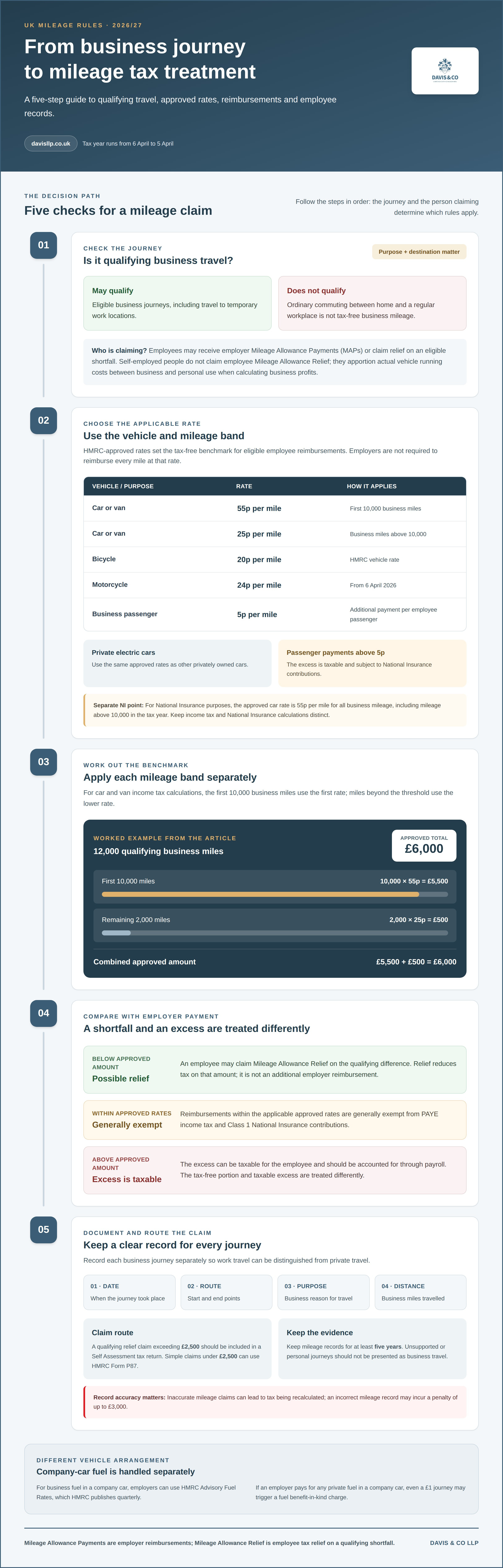
For the 2026/27 tax year, the business mileage allowance rules in the UK set HMRC’s approved rate for cars and vans at 55p per mile for the first 10,000 business miles, then 25p per mile above that. According to HM Revenue & Customs, reimbursements within the applicable approved rates are generally exempt from PAYE income tax and National Insurance contributions; payments above them can be taxable.
It’s easy to assume every work-related journey qualifies, but the purpose and destination matter. Ordinary travel between home and a regular workplace does not qualify for tax-free mileage reimbursement, while eligible business journeys may. This article explains how the business mileage allowance rules in the UK apply to Mileage Allowance Payments, who can claim relief and how the rates affect tax when an employer pays less or more than the approved amount. It also distinguishes employee claims, passenger payments and other vehicle-related tax considerations, so you can identify which rules apply to your circumstances.
Key Takeaways
- Separate qualifying work journeys from ordinary commuting before deciding whether mileage can be claimed.
- Compare reimbursements with the applicable HMRC rates: an eligible shortfall may support Mileage Allowance Relief, while an excess can affect tax.
- Keep clear records of each journey’s date, route, business purpose and distance to support accurate claims and payroll treatment.
- Review mileage arrangements alongside wider business planning, particularly where travel expenses affect cash flow or growth decisions.
What Are Mileage Allowance Payments (MAPs)?
For UK employees, Mileage Allowance Payments reimburse qualifying business travel in a privately owned vehicle. HMRC’s approved rates help determine whether payments are tax-free or whether an employee may claim tax relief.
Approved Payments for Private Cars
Approved Mileage Allowance Payments are employer reimbursements for qualifying business miles driven in an employee’s own car. The approved rates set a benchmark for tax treatment, but they do not require employers to reimburse every mile at that amount. Qualifying travel can include journeys to temporary work locations. Ordinary commuting to a regular workplace does not qualify for tax-free mileage reimbursement.
Payments and Mileage Allowance Relief
Mileage Allowance Payments are amounts an employer pays; Mileage Allowance Relief is tax relief an employee may claim when those payments fall below the approved amount. Under Section 231 of ITEPA 2003, relief applies to the qualifying difference, rather than returning the full mileage amount. For example, an employee driving 8,000 business miles and receiving 30p per mile could claim £1,200 in Mileage Allowance Relief.
That distinction matters: tax relief reduces tax on the qualifying amount; it is not an additional reimbursement from the employer.
Approved Mileage Payment Rates
HMRC’s approved mileage rates set the tax-free limit for eligible employee reimbursements. From 6 April 2026, the car and van rate is 55p per mile for the first 10,000 business miles, then 25p per mile above that threshold. These rates apply to privately owned electric cars as well as other private cars.
For National Insurance purposes, the approved rate is 55p per mile for all business mileage, including mileage above 10,000 in the tax year. Keep the income tax and National Insurance calculations distinct.
Rules for Employees and Self-Employed People
Employees may receive mileage payments from their employer or claim relief if reimbursement is below the approved amount. If an employer pays above the approved amount, the excess is taxable. The tax-free portion and any taxable excess are treated differently.
Self-employed people do not claim employee Mileage Allowance Relief. Instead, they can apportion actual vehicle running costs between business and personal use when calculating business profits. The key distinction is whether someone receives employer payments or deducts eligible costs as a self-employed person.
Tax treatment of mileage reimbursements above or below HMRC rates
Tax treatment depends on the vehicle, qualifying mileage and amount reimbursed. Fuel for a company car is treated separately from mileage in an employee-owned vehicle.
Rates by Vehicle Type
HMRC’s vehicle-specific rates provide a benchmark for employee reimbursements. From 6 April 2026, the car and van rate is 55p per mile for the first 10,000 miles, with a separate rate above that threshold. Privately owned electric cars use the same rates as other cars. HM Revenue & Customs sets the bicycle rate at 20p per mile. From 6 April 2026, the motorcycle rate is 24p per mile.
An employer may pay an additional 5p per mile for each employee passenger travelling on business. A passenger payment above 5p per mile is taxable and subject to National Insurance contributions. These distinctions matter when employees claim for different vehicles or carry colleagues.
Mileage Rates and the Threshold
HM Revenue & Customs applies the car and van mileage rate to the first 10,000 business miles annually, with a separate rate above that threshold. HM Revenue & Customs sets the rate above the first 10,000 miles at 25 pence per mile. For example, 12,000 qualifying miles calculate as 10,000 miles at 55p, plus 2,000 at 25p, totalling £6,000.
Reimbursements within approved rates are generally exempt from PAYE income tax and Class 1 National Insurance contributions. If an employer pays more than the approved amount, the excess is taxable for the employee and should be accounted for through payroll. If reimbursement falls short, an employee may be able to claim relief on the qualifying difference.
Company-car mileage is treated differently: employers can use HMRC’s Advisory Fuel Rates to reimburse business fuel. HMRC publishes these rates quarterly. If an employer pays for any private fuel in a company car, even a £1 journey may trigger a fuel benefit-in-kind charge.
Where mileage records feed into wider expense reporting, an expense-control review can help bring the treatment into focus.
What is HMRC’s new mileage rate?
HM Revenue & Customs set the annual car and van rate for the first 10,000 business miles at 45 pence per mile before 6 April 2026. From 6 April 2026, the rate is 55 pence per mile. The change applies across the 2026/27 tax year, including qualifying journeys made before the announcement.
For an expense claim, a rate alone is not enough. Keep a mileage record showing the travel date, start and end points, business purpose and distance. These details help separate work journeys from private travel and support the claim. For example, record a client visit separately from a personal stop instead of combining both journeys.
The tax year runs from 6 April to 5 April the following year. Keep mileage records for at least five years, so the evidence remains available for tax reporting. If an employee’s qualifying relief claim exceeds £2,500, it should be included in a Self Assessment tax return. Simple claims under £2,500 can use HMRC Form P87.
Personal mileage and unsupported journeys should not be presented as business travel. Only qualifying business journeys support mileage relief; inaccurate claims can lead to tax being recalculated, and an incorrect mileage record may incur a penalty of up to £3,000.
A reliable log also makes expense reviews easier. Record each journey’s route, purpose and distance at the time, and retain supporting expense information with the claim. If a passenger travels for work, note the business context clearly. This helps explain the journey and supports the mileage calculation if HMRC requests evidence.
If journeys span a rate change, organise records by date and tax year. This helps match the correct rate to each eligible mile instead of applying one figure to every journey. Accurate records also help employees identify whether tax relief may be due when employer reimbursements fall short.
Who can claim business mileage allowances
Employees can receive mileage payments for qualifying business travel in their own vehicles. The business mileage allowance rules in the UK depend on the journey’s purpose and destination, not simply on whether it involves driving. Ordinary commuting between home and a regular workplace does not qualify for tax-free mileage reimbursement. A trip to a client may qualify if the employee’s office is at home.
Travel to a temporary or non-regular work location may qualify when the journey is necessary for the job and would not have happened without that requirement. A temporary workplace is a location visited for a limited period of less than 24 months. By contrast, a permanent workplace is where an employee regularly spends at least 40% of working time.
Consider an employee travelling from a hotel to a client location during a work trip. That journey may qualify, unlike the employee’s usual commute. Employers are not legally required to reimburse mileage at HMRC’s approved rates. If payment is below the approved amount, the employee may be eligible for Mileage Allowance Relief on the qualifying difference.
Employees with multiple jobs should distinguish connected from unconnected employers. Where employers are not connected, each job can have a separate annual 10,000-mile AMAP limit per tax year. Connected employers share one 10,000-mile limit across the affected jobs. The distinction may affect how mileage is treated for allowance purposes, even when every journey is for work.
Self-employed people use a different method: they can apportion actual vehicle running costs between business and personal use. They do not claim employee Mileage Allowance Relief through an employer. Applying the business mileage allowance rules in the UK therefore means first identifying whether the claim is for employee reimbursement or self-employed deductions. In either case, ordinary private journeys are not business miles. Any taxable excess on employer reimbursements above approved rates is handled through payroll.
If your organisation needs help aligning employee mileage payments with payroll processes, discuss your payroll arrangements.
Davis & Co LLP: Business Growth Acceleration
Davis & Co LLP’s Business Growth Acceleration can help businesses consider how operating costs, including employee travel, fit into wider plans. If mileage policies affect cash flow, budgeting or payroll decisions, it may be useful to review them alongside the business’s growth objectives.
For businesses with cross-border activity, International Tax Planning can address wider tax considerations. Cash Flow Management can help clarify how reimbursements affect available funds, while Personal Tax Services can help individuals understand personal tax matters relevant to their circumstances.
The right support depends on the issue: a growing business may need to consider travel expenses as part of its plans, while an individual may need help understanding their personal tax position. Contact Davis & Co LLP to discuss the support relevant to your circumstances.
Make mileage policy part of informed planning
A mileage policy can do more than guide expense claims. Consider how travel arrangements relate to business growth, tax planning and available cash, particularly as operations change. Applying the business mileage allowance rules in the UK consistently can support clear internal processes and more informed financial planning.
Davis & Co LLP offers Business Growth Acceleration, International Tax Planning and Cash Flow Management. These services may be relevant when you’re considering how travel costs relate to wider business priorities or when personal and business tax matters overlap. The right focus depends on the decisions you need to make and your circumstances.
If you would like to discuss how these considerations fit your plans, contact Davis & Co LLP. A considered approach can help you move forward with greater clarity.
Davis & Co LLP can help with business tax and finance
Davis & Co LLP offers tax, accounting and business services, including VAT Compliance, Payroll Services, Bookkeeping Services and Management Accounts. These services can support your next steps after reviewing the business mileage allowance rules and considering how business travel fits into your records.
Turn to Davis & Co LLP for support with business tax planning, cash flow or accounting. Services also include International Tax Planning, Business Growth Acceleration, Personal Tax Services, Property Accounting and Company Secretarial Services.
Frequently Asked Questions
Are the same rates used for electric cars?
Yes. A privately owned electric car uses the same approved mileage rates as other private cars. Its power source does not create a separate AMAP rate. For an employee driving an electric car, the calculation depends on qualifying business miles and the applicable mileage bands, not whether the car is electric, petrol or diesel.
Is commuting from home to the office a business journey?
No. Ordinary travel between home and an employee’s regular workplace is commuting, not qualifying business mileage for tax-free reimbursement. The treatment may differ if the employee’s office is at home and they travel from home to a client location. The journey’s purpose and workplace arrangements matter: travelling during working hours alone does not make a commute a business journey.
What qualifies as business mileage?
Business mileage is travel required for the job, rather than private travel or an ordinary commute. A journey to a temporary or non-regular work location may qualify if the work requires it. For example, travelling from a temporary hotel to a client site may count. A regular journey to the employee’s usual workplace does not qualify simply because work follows on arrival.
What should employers do now?
Employers should set a clear process for recording business journeys and applying the correct rate to each claim. Record the travel date, start and end points, business purpose and distance, then separate approved-rate amounts from any excess for payroll treatment. Employers are not legally required to reimburse mileage at HMRC’s approved rates, but consistent records help ensure expenses are processed accurately.
When does the 55p rate apply?
The 55p rate applies to the first 10,000 qualifying business miles in a car or van per year from 6 April 2026. HM Revenue & Customs states that the increase applies to the 2026/27 tax year, including eligible mileage travelled before the change was announced. Keep journey dates in the expense record so the applicable rate can be matched to each claim.
What are the UK HMRC approved mileage allowance rates for cars and vans?
From 6 April 2026, the approved car and van rate is 55p per mile for the first 10,000 business miles, then 25p per mile above that. These are the rates for qualifying business use of a privately owned vehicle. HM Revenue & Customs also sets a separate rate for bicycles and motorcycles, so vehicle type matters when calculating a claim.