A crypto-to-crypto swap can trigger Capital Gains Tax, even if no pounds change hands. UK tax on cryptocurrency and Bitcoin may apply when you sell or exchange tokens, spend them on goods or services, or give them away. Gifts to a spouse, civil partner or charity are excluded from these listed disposals. For individuals who are not trading, crypto disposals are generally treated as capital disposals, with tax based on the gain after allowable costs and any available reliefs.
It is easy to focus on whether you have cashed out, but a disposal can have tax consequences without a sale for sterling. The treatment also differs when crypto is received as employment income, a reward, or a return from staking or mining.
This article explains when Capital Gains Tax may apply, how crypto salary is treated and what proposed stablecoin rules could mean. It also covers record-keeping and reporting, including the UK’s cryptoasset reporting arrangements, so you can identify which rules apply to your transactions and what to consider next.
Key Takeaways
- Work out gains using the relevant token pool and allowable disposal costs; same-day and 30-day matching rules can affect the calculation.
- Crypto paid for employment is generally subject to Income Tax, and National Insurance treatment depends on how the assets are received and whether they are readily convertible.
- HM Revenue & Customs states that the annual Capital Gains Tax allowance is £3,000 for the 2025/26 tax year. Separately, the inheritance tax threshold is £325,000, with a 40% rate above it.
- Understand what transaction and personal information may be reported under cryptoasset reporting rules, and distinguish current requirements from proposed stablecoin tax treatment.
Do I have to pay capital gains tax on my crypto?
For individuals who are not trading, UK tax on cryptocurrency and Bitcoin generally treats disposals as capital disposals. The key point is that selling, swapping, spending or gifting tokens can create a Capital Gains Tax liability.
Cryptoasset Disposals Subject to Capital Gains Tax
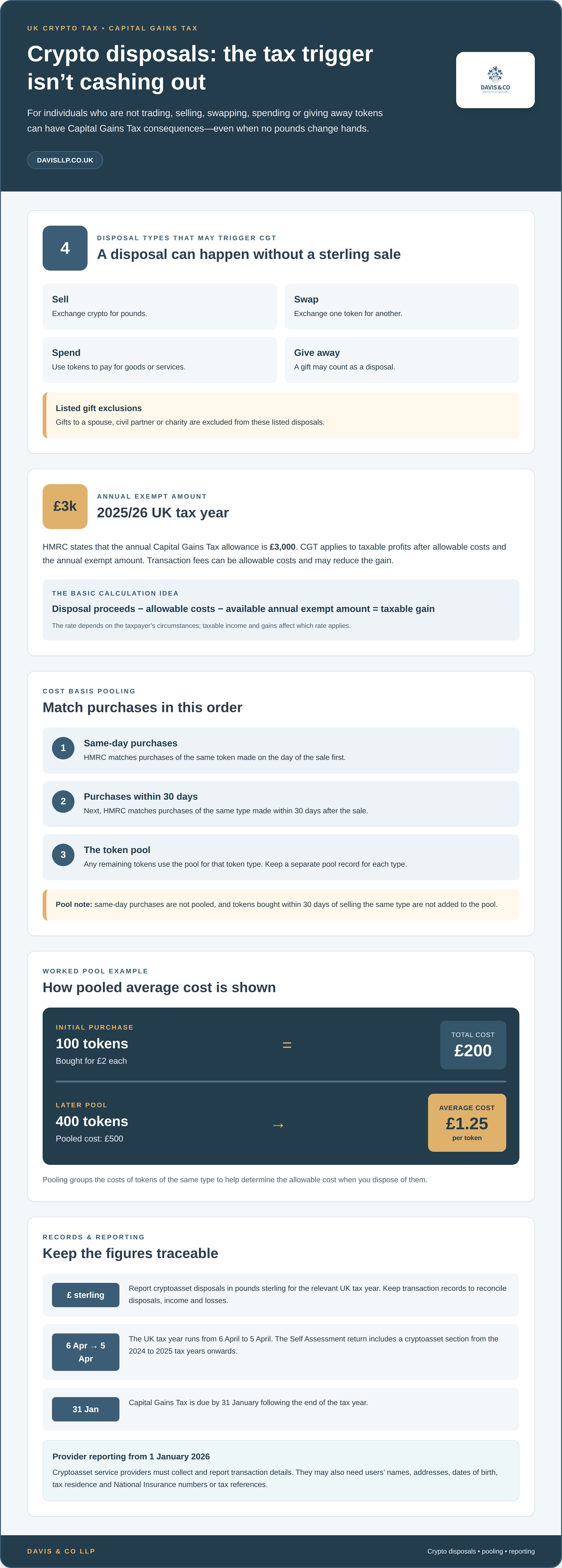
A disposal includes selling crypto for pounds, exchanging it for another token, spending it on goods or services, or giving it away. Gifts to a spouse, civil partner or charity are excluded from these listed disposals. Allowable costs, such as transaction fees, can reduce the gain.
NFT disposals can also have Capital Gains Tax consequences; there is no express tax-deferral regime for exchanging NFTs for other NFTs or crypto. For decentralised finance, draft legislation published on 13 July 2026 proposes rules intended to apply from 6 April 2027. Those changes aren’t legislated, so current tax treatment still applies.
If Income Tax has already been paid on a token’s value when you received it, Capital Gains Tax applies only to gains made after receipt. Crypto received as income can therefore have separate income and capital tax treatment.
Crypto Tax Rates and Annual Exempt Amount
Capital Gains Tax applies to taxable profits after allowable costs and the annual exempt amount. HM Revenue & Customs states that the annual Capital Gains Tax allowance is £3,000 in the UK 2025/26 tax year.
Capital Gains Tax rates on cryptocurrency can vary according to a taxpayer’s circumstances. Your taxable income and gains affect which rate applies. Separately, HM Revenue & Customs states that the UK inheritance tax standard threshold is £325,000, with a 40% rate above the threshold.
Cryptocurrency Cost Basis Pooling
Pooling groups costs for tokens of the same type, helping determine the allowable cost when you dispose of them. HMRC matches same-day purchases first, then purchases made within 30 days after a sale; remaining tokens use the pool.
For example, 100 tokens bought for £2 each have a total cost of £200. If the pool later contains 400 tokens with a pooled cost of £500, its average cost is £1.25 per token. Same-day purchases aren’t pooled, and tokens bought within 30 days of selling the same type aren’t added to the pool. Keep separate records for each token pool to calculate gains accurately.
What is the tax treatment of employee salary in cryptocurrency?
Crypto received through employment is subject to Income Tax, even if an employer pays in tokens rather than pounds. The treatment depends partly on whether the cryptocurrency is a readily convertible asset. This distinction affects how tax is collected and whether you must report the income through Self Assessment.
If the crypto is readily convertible, PAYE applies. If it isn’t readily convertible, it’s treated as a benefit in kind: the employer has no PAYE obligation, the employee reports and pays Income Tax through Self Assessment, and the employer pays Class 1A National Insurance contributions. Employment income is assessed separately from any later capital gain on a disposal.
Crypto received through mining, staking or lending may be taxed as income, either as trading income or miscellaneous income, depending on the activity. HMRC may consider whether the activity has a profit-seeking motive and is systematic and repetitive when deciding whether it amounts to a trade. Crypto activity carried on as a trade is treated as trading income.
Rewards and airdrops should be considered in light of why they were received. For example, an airdrop linked to promoting a project on social media may relate to an activity rather than being an unexplained token receipt. Mining uses computing assets to solve mathematical problems, while staking locks tokens for a period in return for rewards. These receipts can have Income Tax consequences.
National Insurance treatment depends on the income category. Class 4 National Insurance isn’t payable on miscellaneous income from cryptocurrency rewards. A capital loss on a disposal is considered in the Capital Gains Tax calculation; lost or stolen crypto requires a separate assessment of whether ownership was disposed of or the asset remains held. Transaction and custody records help establish what happened.
Crypto tax reporting and voluntary disclosures
Crypto reporting covers taxable gains and income, recorded in pounds sterling for the relevant UK tax year. Accurate records help distinguish taxable disposals, income and losses.
Reporting Cryptoassets for Tax
UK Self Assessment returns include a cryptoasset section from the 2024 to 2025 tax years onwards. Individuals can report gains through Self Assessment or the Capital Gains Tax real time service. Cryptoasset disposals must be reported in pounds sterling, with the tax year running from 6 April to 5 April. Capital Gains Tax is due by 31 January following the end of the tax year.
From 1 January 2026, cryptoasset service providers must collect and report transaction details. They may also need users’ names, addresses, dates of birth, tax residence and National Insurance numbers or tax references. Cryptoasset service providers may request identifying information from users. This reporting framework gives HMRC information to compare with tax returns.
If earlier returns omitted crypto income or gains, the Cryptoasset Disclosure Service allows taxpayers to disclose unpaid tax for previous years. A disclosure should identify the relevant tax years and transactions, including disposals, income and losses. Reconcile the figures with transaction records and sterling values so the disclosure accurately reflects what was taxable.
Penalties for Failing to Report Crypto Tax
Failing to report crypto tax can lead to penalties and interest on unpaid tax. Unpaid tax on cryptoassets can incur a penalty of up to 100% of the tax due, plus interest. The amount depends on the circumstances of the failure, including the tax owed and disclosure.
From January 2026, users who fail to provide required details risk a fine of up to £300. Cryptoasset service providers could also face a penalty of up to £300 per user for failing to report information or submitting inaccurate or incomplete reports. A voluntary disclosure of earlier unpaid tax can put omitted transactions before HMRC, rather than leaving them unreported.
What is the UK Capital Gains Tax annual exempt amount and current crypto tax rates?
According to HM Revenue & Customs, the annual Capital Gains Tax allowance for the UK 2025/26 tax year is £3,000. It applies to an individual’s total eligible capital gains, not separately to Bitcoin, each cryptoasset or each exchange. Calculate gains and losses across relevant disposals before assessing whether gains exceed the allowance.
For the 2025/26 tax year, the listed Capital Gains Tax rates on cryptocurrency are 10% for basic-rate taxpayers and 20% for higher-rate taxpayers. The applicable rate depends on the taxpayer’s circumstances and the amount of taxable income. A crypto gain is not automatically taxed at one flat rate, so the same disposal proceeds can have different tax consequences for different individuals.
The allowance has changed over time, making the relevant tax year important when reviewing older transactions. It was £12,300 in the 2021/22 and 2022/23 tax years, then £6,000 in 2023/24. Those earlier amounts shouldn’t be used to calculate gains for 2025/26. Each return must use the allowance and rates for the tax year in which the disposal occurred.
For example, someone calculating gains from a sale in 2025/26 should first establish the gain in pounds, account for allowable costs and relevant losses, then apply the annual £3,000 allowance. Any remaining taxable gain is assessed at the relevant rate. The calculation concerns the gain, not the full amount received when disposing of Bitcoin or another token.
For businesses with crypto-related reporting requirements, discuss audit and assurance support where financial reporting and assurance are relevant. This is distinct from calculating an individual’s Capital Gains Tax bill, which depends on their own transactions, costs, losses and applicable tax position.
Davis & Co LLP
Davis & Co LLP can help individuals understand crypto income, disposals and reporting obligations in the context of their wider tax position. Personal Tax Services can support the assessment of personal tax matters, while International Tax Planning may be relevant if your tax affairs cross borders. The right focus depends on how you acquired the crypto, whether it generated income and what transactions took place.
For business owners, crypto activity may also intersect with cash flow management or business growth planning. Bringing those considerations together can help clarify how personal and business finances relate, without treating every crypto transaction as having the same tax outcome. If you’d like to discuss your circumstances, contact Davis & Co LLP.
Make your next crypto tax decision with clarity
Crypto activity can grow from occasional investing into a wider part of your personal or business finances. As it does, records, income sources and tax considerations may become more closely connected. Review how your crypto holdings fit into your broader financial position rather than treating each transaction in isolation.
Taking a considered approach to tax on cryptocurrency and Bitcoin in the UK can help you plan for future activity and align personal and business decisions. Davis & Co LLP provides tax planning and business services, with advice shaped around your circumstances.
If you’d like to discuss how your crypto activity fits into your wider financial affairs, speak with Davis & Co LLP. A clear, well-organised approach can help you move forward with greater confidence.
Davis & Co LLP can support your UK cryptocurrency tax needs
Davis & Co LLP offers Personal Tax Services for individuals considering the tax treatment of cryptocurrency and bitcoin. After reviewing how your transactions may need to be reported, the firm can help you address the personal tax aspects.
For cryptocurrency activity connected with a business, Davis & Co LLP also offers business tax and accounting support through services including Management Accounts, Bookkeeping Services and VAT Compliance. International Tax Planning may also be relevant when your circumstances involve more than one tax jurisdiction.
Frequently Asked Questions
How are gifts of cryptocurrency taxed, including in-game rewards?
Gifts to a spouse, civil partner or charity are excluded from the listed crypto disposals that may trigger Capital Gains Tax. Other gifts can count as disposals, so the circumstances and the token’s value matter. In-game crypto received as a reward may instead be income, depending on why it was awarded. If you later sell or exchange that reward, a separate gain may arise after receipt.
Is there a tax-deferral when exchanging cryptocurrency/assets?
There is no general deferral simply because you exchange one cryptoasset for another; the exchange can be a disposal for Capital Gains Tax. NFTs also have no express tax-deferral regime for exchanges into other NFTs or crypto. Draft proposals for eligible stablecoins would introduce different treatment, but those rules are not enacted. Record what was exchanged and when, as these details shape the tax calculation.
Is there any transfer tax on the acquisition of cryptocurrencies?
A purchase is not the same event as a later disposal for Capital Gains Tax, although crypto received as payment or a reward may have income tax consequences. VAT treatment is separate: exchanges of cryptocurrency for legal tender are exempt from VAT under VATA 1994 Schedule 9 Group 5. The tax result therefore depends on whether you bought tokens, received them for services, or exchanged them.
Are there obligations to declare cryptocurrency to tax authorities?
Taxable crypto income and gains may need to be reported through Self Assessment or the Capital Gains Tax real time service. In addition, cryptoasset service providers must collect and report transaction information under the UK’s reporting framework. HMRC is expected to receive and share relevant data with participating jurisdictions for tax purposes from 2027. Keep exchange statements and wallet records to explain how reported figures relate to your activity.
Is cryptocurrency subject to yearly mark-to-market valuation?
For an individual who is not trading, HMRC generally treats crypto disposals as capital disposals. Merely holding a token through the tax year does not itself establish a disposal gain. A valuation may still be needed when a taxable event occurs, such as spending or exchanging tokens. Keep dated transaction records and sterling values so you can calculate the gain for the relevant event.
Are NFTs taxed differently to cryptocurrencies?
NFTs do not have a blanket exemption from Capital Gains Tax. Their treatment depends on the transaction and the holder’s circumstances; there is no express tax-deferral regime for exchanging an NFT for another NFT or crypto. An NFT received as payment or a reward may also raise income tax considerations. Record why you received it, the transaction date and its sterling value to support the tax treatment.