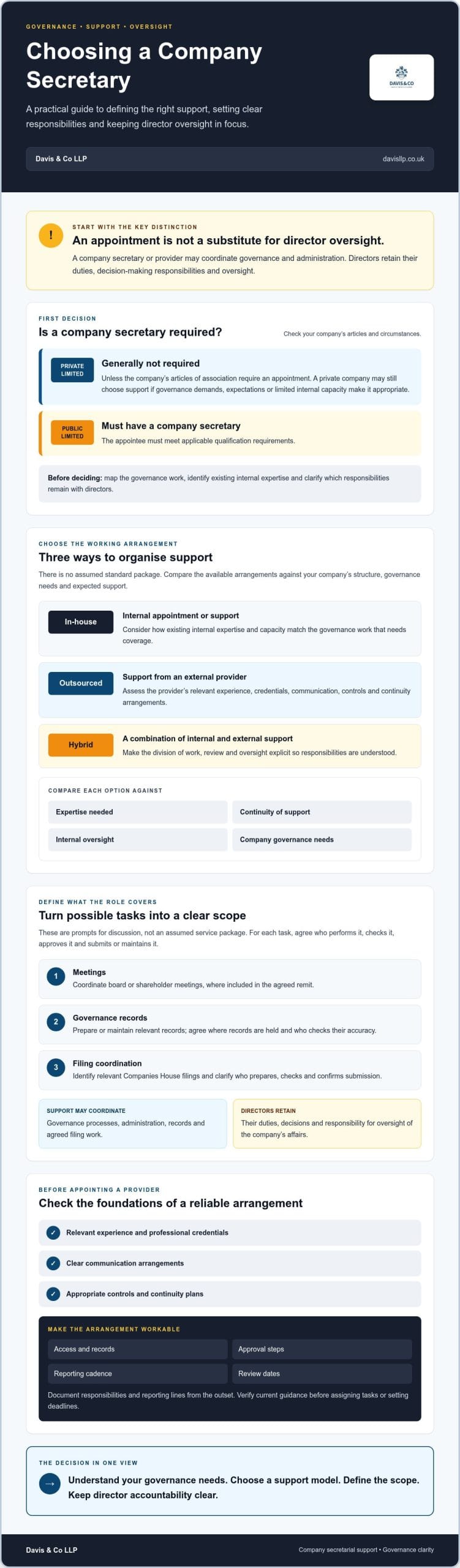
The obvious choice may not be the right one: a private limited company doesn’t generally have to appoint a company secretary, unless its articles of association require one. Directors remain responsible for their duties and oversight. Choosing a company secretary is therefore less about filling a title and more about deciding who will provide the right expertise, support and continuity.
It’s understandable to focus first on the task list, particularly when unclear responsibilities or missed filings could create avoidable risk. An in-house appointment, outsourced service or hybrid arrangement can each suit different organisations. The right fit depends on your company’s structure, governance needs and the support it expects.
This guide explains what company secretarial support can involve and how to compare in-house and outsourced options. You’ll learn how to assess providers by scope, expertise, accountability and continuity, then agree responsibilities and a practical working arrangement. It also explains how to define a service scope that fits your organisation, including when company secretarial support alongside wider accounting and compliance advice may be worth considering.
Key Takeaways
- Start by assessing your company’s type, governance complexity and internal expertise. Appointment requirements can differ, so check your articles of association.
- When choosing a company secretary, compare in-house, outsourced and hybrid support against your needs for expertise, continuity and internal oversight.
- Define the provider’s scope clearly, separating agreed support from directors’ continuing legal duties and decision-making responsibilities.
- Before appointing a provider, review relevant experience, professional credentials, communication arrangements, controls and continuity plans.
- Make the relationship practical from the outset by documenting access, records, approval steps, reporting cadence and review dates.
Choosing a company secretary starts with your organisation’s governance needs
Before deciding whether to appoint someone internally or seek external support, identify the governance work your organisation needs covered. A company secretary is a governance and administration role that helps organise corporate processes and maintain appropriate records. The precise remit varies, so choosing a company secretary should begin with your company’s circumstances, not an assumed standard task list.
Needs can depend on the company’s legal form, the complexity of its governance, stakeholder expectations and the expertise already available internally. A business with straightforward arrangements may need help with specific administrative tasks. A company with more involved board processes may need broader support. The role of a company secretary has an international history, but UK appointment requirements and expectations should be considered in their specific context.
What does a company secretary do in practice?
Depending on the agreed remit, company secretarial work may include coordinating board or shareholder meetings, preparing or maintaining governance records, and coordinating relevant Companies House filings. These are examples, not a standard service package. Clarify who prepares documents, who checks their accuracy and who is responsible for submitting them. Directors retain their own duties and oversight responsibilities. Delegating administrative work doesn’t remove the need to make decisions and supervise the company’s affairs.
Does every UK company need a company secretary?
No. Under the current UK position, a private limited company generally isn’t required to appoint a company secretary, unless its articles of association say otherwise. A public limited company (PLC) must have one, and the appointee must meet applicable qualification requirements. Check your company’s articles and circumstances rather than relying on a general rule. If the position is uncertain, ask an appropriately qualified adviser to confirm what applies.
This distinction is a starting point, not a complete answer to whether support would be useful. A private company may still choose to appoint someone or engage support if governance demands, investor or lender expectations, or limited internal capacity make it appropriate. An appointment alone, however, won’t provide effective oversight unless responsibilities and reporting lines are understood.
Before comparing arrangements, map the work that needs attention, such as meeting administration, records, filing coordination or other governance processes. Then identify which tasks remain with directors and what expertise is already available inside the organisation. This gives you a practical basis for deciding what support to seek and defining its scope.
Company secretary responsibilities: establish the legal and practical boundaries
A clear scope helps prevent an important distinction from being lost: a company secretary or external provider may coordinate governance and compliance work, but that work still needs defined review, approval and oversight. Separate statutory obligations from internal governance processes and administrative support. Confirm which activities are included in the proposed arrangement rather than assuming a role title guarantees particular coverage.
For UK appointment requirements, consult the legal requirements for a company secretary on GOV.UK and check how they apply to your company. Companies House filings and company records need particular care. Responsibilities, procedures and requirements can change, so verify current guidance before assigning a task or setting a deadline.
Which company secretarial tasks should you define?
Use these potential workstreams as prompts for a scope discussion, not as an assumed service package. For each item, agree who performs the work, who reviews it, who approves it and who submits or maintains it.
- Filing coordination: identify relevant Companies House filings, who prepares them and who confirms submission.
- Company records: specify which records need attention, where they are maintained and who checks them for accuracy.
- Meeting administration: clarify responsibility for arranging meetings, preparing papers, recording decisions and circulating minutes.
- Governance calendar: agree how key dates, review points and approval steps will be tracked and brought to directors’ attention.
These prompts help make gaps visible. For example, a provider might prepare a filing for review while a director retains approval authority. Record that division explicitly, including how queries or missing information will be escalated.
How do company secretarial support and directors’ duties differ?
A provider can help organise compliance work and governance processes within an agreed remit. Directors, however, retain their own legal duties and responsibility for oversight and company decisions. Outsourcing administrative tasks does not transfer those responsibilities. If a question concerns legal interpretation, a dispute or obligations beyond an accountant’s confirmed service scope, seek advice from a suitably qualified legal adviser.
Support can coordinate the work; directors remain accountable for their duties and decisions.
Before appointing support, use this concise responsibility check:
- What work is in scope, and what is expressly excluded?
- Who prepares, reviews, approves and submits each filing or document?
- Who maintains or checks relevant company records?
- How will missing information, deadlines or concerns be escalated?
- Who provides director oversight and makes final decisions?
Organisations considering external company secretarial services can use this checklist to frame a discussion about the support they need, then confirm the precise tasks available before agreeing an arrangement.
In-house or outsourced company secretary: compare the right arrangement
There’s no single model that suits every organisation. In-house support offers close day-to-day involvement, while outsourcing can provide access to external expertise without creating a dedicated internal role. A hybrid arrangement combines internal ownership with external support for defined work. Choosing a company secretary means weighing these options against your governance workload, expertise and oversight needs, rather than treating one as the default.
| Arrangement | Possible benefits | Trade-offs and suitable circumstances |
|---|---|---|
| In-house | Close knowledge of the organisation, direct access to decision-makers and day-to-day continuity. | Requires suitable internal expertise and capacity, with cover considered for absence or staff changes. May suit organisations with sustained governance activity or complex internal processes. |
| Outsourced | Access to external expertise and an agreed scope of support, which may help where internal capacity is limited. | Work depends on clear instructions, information-sharing and oversight. Confirm service coverage, escalation routes and continuity arrangements. May suit organisations seeking defined support without an in-house appointment. |
| Hybrid | Combines an internal point of contact with external support for selected workstreams or specialist input. | Responsibilities can become unclear unless handovers and approvals are documented. May suit organisations with some internal capability but specific gaps to address. |
When might an in-house company secretary be appropriate?
Consider the volume and complexity of governance work, how closely it needs to connect with board and operational activity, and whether suitable expertise is already available. Continuity matters too: assess how work would be covered during absence, staff turnover or periods of heavier demand. There’s no universal size threshold. The question is whether an internal role can be supported with enough meaningful work and appropriate oversight.
When could outsourced company secretarial support make sense?
External support may be worth considering if internal capacity is limited or you need expertise for a defined scope. Ask who will handle the work, how questions are escalated, how cover is managed and how the service is reviewed. Compare proposals on scope and working arrangements, not cost alone, and request a tailored proposal so you can make a like-for-like comparison.
Outsourcing changes who carries out agreed tasks, not who directs the company. Directors still need appropriate oversight, timely information and clear approval responsibilities. Establish these arrangements before work begins, including how internal staff and the provider will communicate. Where company secretarial support needs to sit alongside broader operational advice, small business accounting and growth services may be relevant to consider as part of the wider picture.
How to assess a company secretary provider before appointing them
A careful assessment should test more than whether a provider can complete a list of tasks. You also need to understand who will do the work, how it will be checked, what information they need from you and what happens if circumstances change. Ask each prospective provider the same questions so you can compare proposals on a consistent basis.
Work through these due-diligence steps before agreeing an appointment:
- Check relevant experience. Ask about work with organisations of a similar type or governance complexity. Request examples of relevant experience without expecting confidential client information, and check any professional credentials the provider chooses to cite. Don’t assume a particular credential is mandatory unless you’ve verified that it applies to your circumstances.
- Define the scope. List the tasks included and excluded, what is reviewed or approved, and what depends on your team providing timely information. Confirm who prepares, checks and submits each document or filing.
- Agree communication and reporting. Establish your day-to-day contact, reporting cadence and how upcoming deadlines, changes in company circumstances or urgent queries will be raised. Ask what response arrangements apply and how issues are escalated.
- Review controls and accountability. Read the engagement terms for responsibilities, deliverables, approval steps and how errors or missing information are handled. Check any claims about professional membership, insurance or service standards directly with the provider or relevant body.
- Test continuity. Ask how work is covered if the usual contact is unavailable, how records and handovers are managed, and what happens if the relationship ends or the scope changes.
Questions to ask before appointment
Use the discussion to test how the proposal would work in practice. Ask which tasks rely on information from your directors or staff, how changes will be communicated, and who is responsible for following up unanswered questions. A clear response should explain both the provider’s part and the organisation’s part, rather than leaving responsibilities implicit.
How should you judge service quality and accountability?
Look for engagement documentation that matches what was discussed. It should identify responsibilities, expected deliverables, reporting arrangements, escalation routes and termination provisions. Confirm how a mistake, missing information or proposed change in scope will be raised and resolved. If the provider refers to credentials or standards, verify the specific claim instead of relying on a general assurance.
For wider professional support, how to find a Chartered Accountant offers a related selection perspective. If you’re assessing a tailored company secretarial scope, you can also discuss company secretarial services with Davis & Co LLP.
Appointing a company secretary: agree the scope and make the next step clear
Once you’ve selected an arrangement, turn the proposal into a workable handover. A written scope and responsibility matrix help prevent tasks from falling between your organisation and its provider. They also give directors a clear basis for oversight, without suggesting that an external appointment transfers their responsibilities.
What information should you prepare before engagement?
Bring together the information that will help a prospective provider understand your current position and define a realistic scope. This may include:
- Company details and existing governance documents, including relevant articles of association.
- Available filing history and records relating to current governance processes.
- A list of known deadlines, internal contacts and existing responsibilities.
- Your approval process, including who can authorise documents or provide instructions.
- Areas of uncertainty, gaps in records or changes the company expects to make.
Ask what else the provider needs to assess the work before confirming what can be included. Don’t assume that access to a document or system is required. Agree what access is appropriate, how it will be managed and who is authorised to use it.
How should you document the working arrangement?
Record the agreed tasks, exclusions and points where your team must supply information or make a decision. A simple responsibility matrix can make the handover concrete:
- Task: identify each agreed workstream and its owner.
- Preparation and approval: name who prepares information, who reviews it and who gives final approval.
- Access and records: specify the systems or documents required, access permissions and where records will be maintained.
- Reporting and escalation: set the communication cadence, how issues are raised and who receives them.
- Review: agree when to revisit the scope, responsibilities and working arrangements.
Keep the matrix alongside the engagement terms, and update it if responsibilities or company circumstances change. This makes it easier to identify a gap before it becomes a missed handover.
How can Davis & Co LLP support your decision?
Davis & Co LLP offers company secretarial services alongside accounting and business advisory services. Confirm the precise tasks available with the firm so you can establish a tailored scope rather than assume a standard package. Preparing your company details, current processes and areas of concern will help make an initial discussion more focused.
If you’re choosing a company secretary, you can discuss company secretarial support with Davis & Co LLP to clarify what support your organisation needs.
Set up company secretarial support with confidence
Choosing a company secretary is ultimately about finding an arrangement that fits your organisation’s governance needs and makes accountability clear. Compare in-house, outsourced and hybrid support by expertise, continuity and oversight, then agree exactly what work is in scope. Directors still need to retain oversight and make decisions, so document who prepares, reviews and approves each task.
Before engagement, gather your governance documents, filing history, known deadlines and internal responsibilities. Agree access, reporting, escalation routes and review dates with your provider. These practical steps help turn a selection decision into a working relationship with fewer assumptions.
Davis & Co LLP offers company secretarial services alongside accounting and business advisory work. The firm is an independent partnership of Chartered Certified Accountants, founded in 1901. Discuss and confirm the precise scope to ensure it fits your requirements.
Discuss your company secretarial requirements with Davis & Co LLP and clarify what support may suit your organisation. With a carefully defined scope and clear responsibilities, you can move forward with greater confidence.
Frequently Asked Questions
Does a UK private limited company have to appoint a company secretary?
No, a UK private limited company generally doesn’t have to appoint a company secretary, unless its articles of association require one. A public limited company must have a company secretary who meets the applicable qualification requirements. Even where an appointment isn’t compulsory, a business may choose to arrange support for governance or administration. Check your company’s articles and circumstances, and confirm any uncertainty with an appropriately qualified adviser.
Can a company director also act as company secretary?
For a private company, a director can generally take on company secretarial tasks, provided the company’s articles and circumstances allow it. A public limited company must have a company secretary who meets the relevant qualification requirements, so check the rules carefully before combining roles. Whichever arrangement you choose, define who prepares and checks documents, who authorises decisions, and how directors will maintain effective oversight.
What does a company secretary do for a small business?
A company secretary may support governance administration within an agreed scope. This could include coordinating meetings, maintaining company records or coordinating relevant Companies House filings. These are examples, not a standard package, and the precise work varies with the company’s needs. Directors remain responsible for their own duties and oversight. A small business should clarify which tasks need support, who approves actions and what information it must provide.
Should a company appoint an in-house or outsourced company secretary?
Choose according to the company’s governance workload, complexity, internal expertise and need for continuity. In-house support can offer close day-to-day involvement, while outsourcing may provide external expertise for an agreed scope. A hybrid model can combine internal ownership with external assistance. None removes the need for director oversight. Compare responsibilities, communication, cover and escalation arrangements, then choose the model that fits your organisation rather than relying on a universal rule.
What qualifications should I look for when choosing a company secretary?
There isn’t one qualification required for every company secretary appointment. A public company secretary must meet applicable statutory qualification requirements. For other arrangements, assess relevant governance experience and the provider’s ability to deliver the agreed scope. Ask about professional memberships or credentials and verify any claims. Choosing a company secretary also means considering communication, continuity and accountability, not credentials alone. Seek specific advice if you’re unsure which requirements apply.
Can a company secretary be held responsible for Companies House filings?
A company secretary or provider can be assigned responsibility for coordinating or submitting particular filings, if that falls within their agreed role. However, delegating the work doesn’t automatically transfer directors’ legal duties or remove the need for oversight. The allocation of responsibility and any consequences depend on the company’s circumstances and the relevant legal requirements. Set out who prepares, checks, approves and submits each filing, and verify current Companies House procedures.
What should a company secretary engagement letter include?
An engagement letter should describe the agreed scope, exclusions, deliverables and responsibilities, including what information the company must provide. It should identify contacts, approval steps, reporting arrangements, escalation routes and how changes to scope or termination are handled. Where filings or records are involved, make clear who prepares, reviews, approves and submits or maintains them. Agree access arrangements and review dates too, so the working relationship remains clear as circumstances change.