What if an SMP error starts weeks before the first payment is due? Managing statutory maternity pay means getting the qualifying dates and earnings calculation right from the outset, particularly when an employee’s pay varies or changes. For UK employers, that can make an apparently straightforward payroll task less certain than it seems.
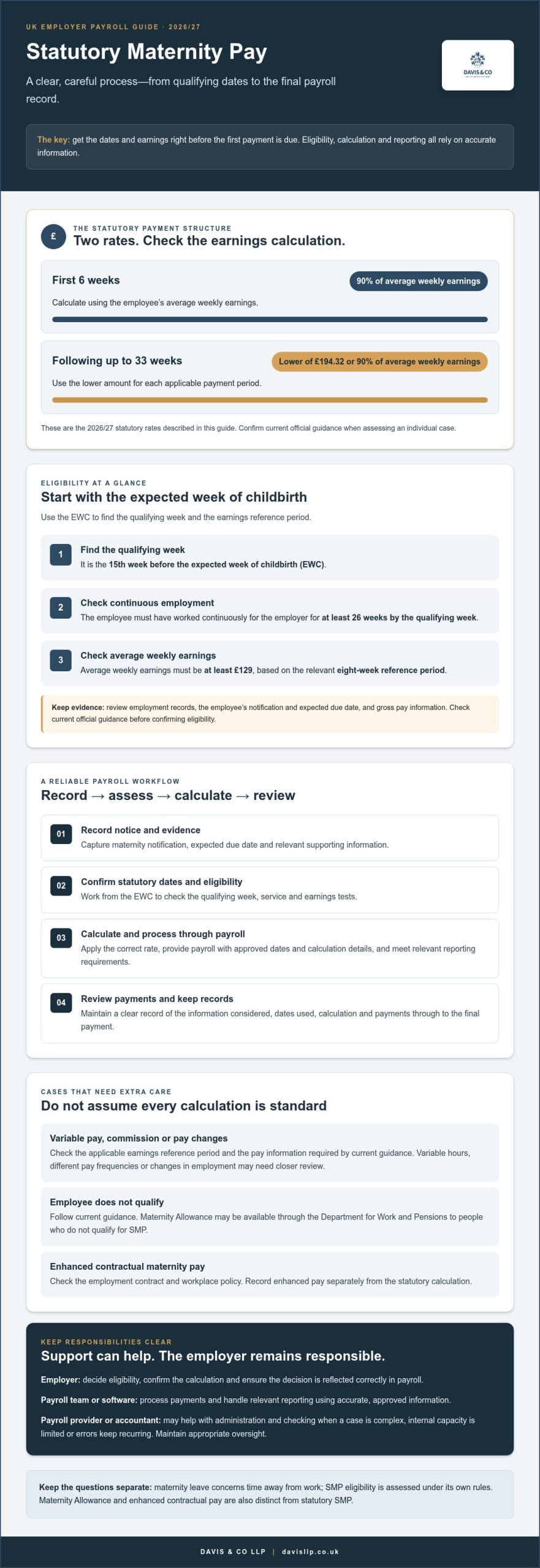
SMP must be paid through payroll, but confirming eligibility, applying the correct rate and meeting reporting requirements all depend on accurate information. For the 2026/27 tax year, eligible employees receive 90% of average weekly earnings for the first six weeks, followed by the lower of £194.32 or 90% of average weekly earnings for up to 33 weeks.
This guide explains a practical process, from recording an employee’s notification and checking the qualifying week to calculating average weekly earnings, processing payments and keeping records. It also covers what to do when earnings or pay change, when an employee doesn’t qualify, and when payroll or professional support may help with a more complex case.
Key Takeaways
- Understand how SMP differs from maternity leave, Maternity Allowance and any enhanced contractual maternity pay.
- Use the expected week of childbirth to identify the relevant dates, then assess employment and earnings against the statutory eligibility rules.
- When managing statutory maternity pay, take extra care with variable earnings, commission and pay changes. Follow current guidance if an employee isn’t eligible.
- Use a consistent payroll process: record the employee’s notice and evidence, check dates and calculations, then review payments and records through to the final payment.
- Consider payroll support if internal capacity is limited, a case is complex or errors keep recurring. Maintain appropriate oversight of your payroll.
Managing Statutory Maternity Pay starts with understanding employer responsibilities
Statutory Maternity Pay (SMP) is a government-set payment that an employer must pay through payroll to an employee who meets the statutory eligibility conditions. It is separate from maternity leave: leave concerns time away from work, while pay is assessed under its own rules. An employee’s leave arrangements therefore don’t, by themselves, establish whether they qualify for SMP.
For a concise overview of the scheme’s background and administration, see Statutory Maternity Pay. When deciding whether an employee qualifies, use current official guidance. The eligibility tests, dates and payment rules determine what applies to each individual case.
What is Statutory Maternity Pay, and how does it differ from maternity leave?
Maternity leave and maternity pay are related but distinct. An employee may be entitled to maternity leave without meeting the conditions for SMP. Assess the pay entitlement separately, using the employee’s circumstances and the relevant statutory dates. Don’t assume that approval or notification of leave settles the pay question.
SMP is also different from Maternity Allowance, which may be available through the Department for Work and Pensions to people who don’t qualify for SMP. An employer’s maternity pay policy may offer more than the statutory minimum; this is usually described as enhanced or contractual maternity pay. Check the employment contract and workplace policy, and record enhanced pay separately from the statutory calculation.
Who is responsible for managing SMP?
The employer is responsible for deciding whether an employee qualifies, calculating any SMP due and making sure the decision is reflected correctly in payroll. Keep a clear record of the information considered, the dates used, the calculation and the payments made. Payroll staff or software can process payments and handle relevant reporting, but the employer should make sure the underlying information and setup are accurate.
Assign an owner to each stage. The employer or an authorised team member should confirm eligibility and give payroll the approved dates and calculation details. Payroll can then process payments and maintain the associated records. If a case involves variable earnings, a pay change or uncertainty about the rules, a payroll provider or accountant may help with administration and checking. This support can be useful when internal capacity is limited, while the employer remains responsible for its decision.
In short, managing statutory maternity pay is an employer responsibility supported by accurate payroll administration. Treat eligibility, leave, statutory pay and any enhanced policy as separate questions to establish a sound basis for the process.
Check SMP eligibility, qualifying dates and pay calculations carefully
Start by using the expected week of childbirth (EWC) to work out the statutory dates. The qualifying week is the 15th week before the EWC. To qualify, an employee must have worked continuously for the employer for at least 26 weeks by that week and have average weekly earnings of at least £129, based on the relevant earnings reference period. Check the current SMP eligibility criteria and GOV.UK guidance before confirming a decision, especially if the employment pattern is unusual.
Which eligibility checks should an employer complete?
Work through the tests in sequence and keep evidence for each one. Payroll records can help establish employment dates and gross pay. The employee’s maternity notification and expected due date help identify the relevant statutory dates. For earnings, check the applicable eight-week reference period and include the pay information required by current guidance. Variable hours, commission, different pay frequencies or changes in employment may need closer review. Don’t assume a standard salary calculation applies.
| Check | Evidence to review | Follow-up action |
|---|---|---|
| Employment and service | Employment records and start date | Check continuous service against the qualifying week |
| Qualifying dates | Expected week of childbirth and notification | Calculate the qualifying week and relevant reference period |
| Average weekly earnings | Gross pay records for the applicable period | Compare earnings with the statutory threshold using current rules |
How should employers calculate and schedule SMP?
For the 2026/27 tax year, eligible employees receive 90% of average weekly earnings for the first six weeks. The following 33 weeks are paid at the lower of £194.32 a week or 90% of average weekly earnings. Confirm the rates and rules that apply to the employee’s case before setting up payroll. Don’t rely on a prior-year configuration.
Hypothetical example: If an employee’s average weekly earnings are £300 and the 2026/27 rates apply, the first six weeks are paid at £270 a week. For the next 33 weeks, the lower amount is £194.32 a week. This illustrates the rate structure only. The actual calculation must use the employee’s verified earnings and circumstances.
Pay SMP through the usual payroll cycle, recording the statutory amount and dates accurately. The pay frequency affects how payments appear in each run, not the employee’s statutory entitlement. A clear calculation record makes managing statutory maternity pay more reliable, particularly when earnings vary. If your team needs help reviewing payroll administration, explore payroll services.
Managing SMP exceptions: variable pay, ineligibility and common errors
Standard payroll assumptions may not work when an employee’s earnings or circumstances are unusual. Commission, irregular hours, a pay rise or a disputed eligibility decision should prompt a review of the dates and calculation inputs, not a guess. Check current GOV.UK guidance for the specific situation and record the basis for your decision.
What if earnings vary or employment circumstances change?
Start with the relevant earnings reference period and gather the payroll records needed to verify gross pay, such as payslips, payroll reports and details of commission or other payments. Don’t assume every payment is treated the same way. Check current statutory guidance to establish what counts and how it affects average weekly earnings. If pay changes during the relevant period or maternity leave, check whether a recalculation or adjustment is required.
Keep a short calculation note showing the dates used, earnings included or excluded, assumptions made and guidance consulted. This makes the decision easier to review and helps prevent common errors, such as using the wrong reference period, omitting variable pay or relying on an outdated payroll setting. If employment circumstances are unusual or the rules remain unclear, check current official guidance or seek professional payroll advice before finalising the calculation.
What should an employer do if the employee is not eligible?
Explain the SMP decision clearly and in writing, giving the reason in terms the employee can understand. If an employee doesn’t qualify, provide form SMP1 within seven days of the decision, as required by current guidance. Keep a copy of the explanation and form with the records supporting the assessment, and check current HMRC instructions for related payroll reporting duties.
An SMP decision doesn’t determine eligibility for every other maternity-related benefit. The employee may be able to apply to the Department for Work and Pensions for Maternity Allowance, subject to its separate rules. Signpost them to current official information rather than assessing that entitlement on their behalf.
Keep statutory SMP separate from any enhanced contractual maternity pay. A workplace policy may provide additional pay, but it doesn’t replace the need to check and meet statutory obligations. Review the policy alongside the statutory calculation, and make sure payroll records show which amounts are statutory and which are contractual.
Managing statutory maternity pay well means identifying exceptions early, checking each one against current rules and documenting the outcome. If an employee disputes the decision or the case involves complex pay or employment circumstances, don’t make assumptions. Seek appropriate professional or official guidance.
How to manage Statutory Maternity Pay through each payroll stage
A consistent workflow connects the employee’s notification to the final payment and makes each decision traceable. Use this checklist as an operational framework, and confirm current HMRC requirements for evidence, reporting and record retention before applying it to a case.
- 1. Record the notification. Note when the employee gives notice, their expected week of childbirth and intended maternity leave start date. Record any supporting evidence received, such as a MATB1 certificate, and check current rules on notice and documentation.
- 2. Establish the statutory dates. Calculate the qualifying week and relevant earnings reference period from the expected week of childbirth. Keep the dates and method on file so another reviewer can follow the assessment.
- 3. Assess and document eligibility. Check employment service and average weekly earnings against current statutory criteria. Record the evidence considered and the decision. If the employee doesn’t qualify, follow current guidance on explaining the decision and providing the required documentation.
- 4. Check the calculation independently. Verify the relevant earnings, applicable rates and payment period before the first affected payroll run. A second reviewer can help spot an incorrect reference period, omitted pay or outdated rate settings. Keep the calculation and the source used.
- 5. Set up and process payroll. Enter the confirmed start date, payment schedule and SMP amounts in the payroll system. Process payments through the normal payroll cycle, then check that the payslip and payroll records show the correct amount and period.
- 6. Reconcile, report and close the record. Check payroll totals against payslips and employer submissions, and follow current HMRC instructions for reporting and any SMP recovery. Correct errors using the applicable process, recording what changed and why. At the end of the SMP period, verify the final payment and retain the complete case record in line with current requirements.
Payroll controls should sit alongside other routine checks. For example, the firm’s National Minimum Wage compliance guide can help inform wider payroll review processes.
Keep a clear audit trail: the notification, evidence, eligibility decision, dates, calculation, payslips, reporting checks and any corrections. Rates and rules can change, so check current HMRC guidance for each case, including the treatment of recovery and any effect on cash flow. If internal capacity is limited or a case needs additional payroll oversight, consider professional payroll support to help maintain a controlled process.
When payroll support can make managing SMP more reliable
There’s no single approach that suits every employer. In-house administration offers close control and direct access to employee information, provided the team has capacity, suitable payroll systems and a reliable review process. External payroll support may help when staffing is limited, cover is uncertain, calculations are difficult to manage or errors recur. Either approach still depends on accurate information and clear oversight.
Should an employer manage SMP in-house or use payroll support?
Check whether your current arrangements can handle each task consistently, including reviewing calculations, updating payroll settings and maintaining records. Consider who can review a case if the usual payroll contact is absent, and how the team will check current rules. A payroll provider or accountant can support administration, but the employer remains responsible for providing accurate employee details and making sure decisions are appropriately reviewed.
Professional assistance may be useful when earnings vary, employment circumstances are unusual or there’s uncertainty about a calculation or correction. It can also help when SMP administration competes with other payroll deadlines. The aim is not simply to transfer processing, but to define responsibilities: who supplies evidence, who checks the calculation, who authorises payroll and who follows up on exceptions.
Davis & Co LLP is an independent firm of Chartered Certified Accountants with payroll services among its offerings. The firm can be a source of payroll support when internal capacity or case complexity is a concern. Discuss the support required to establish whether it fits your circumstances.
What information should an employer prepare before seeking help?
A well-organised file makes an initial review more focused. Gather the employee’s employment dates, expected-week information, relevant payroll records and any workplace policy covering enhanced maternity pay. Include the calculation already completed, the dates and rate sources used, unresolved questions and any decision or payment information already shared with the employee.
Also note upcoming payroll deadlines and any corrections that may be needed. This gives an adviser a clearer picture of both the technical question and its practical timing, while reducing the risk of decisions being made from incomplete records.
If additional capacity or a second perspective would help, you can discuss payroll support with Davis & Co LLP. A clear brief and supporting records provide a sound starting point for discussing your approach to managing statutory maternity pay.
Build a consistent approach for future payroll cycles
Reliable SMP administration depends on a process your team can apply consistently, not just a correct first calculation. Clear ownership, documented decisions and regular checks of current official guidance help make each case traceable, particularly when circumstances change or an employee’s pay is not straightforward.
Review your process after each case. Check whether responsibilities were clear, payroll records supported the decisions made and questions were resolved before they affected a payment. These practical reviews can help make managing statutory maternity pay more controlled and give your team a sound basis for future cases.
If additional payroll capacity or a considered review would help, Davis & Co LLP offers payroll services as part of its business support. Discuss payroll support with Davis & Co LLP to explore whether its services suit your organisation’s needs. A clear process and appropriate support can help your team manage SMP administration with confidence.
Frequently Asked Questions
How do employers manage Statutory Maternity Pay?
Manage SMP through a documented process: record the employee’s notice and relevant dates, assess eligibility, calculate pay under current rules and set up payments in payroll. Keep the evidence and calculation, check payslips and payroll reporting, and review any changes or exceptions. When managing statutory maternity pay, verify current rates, thresholds, deadlines and HMRC procedures with GOV.UK before confirming a decision or configuring payroll.
Who is eligible for Statutory Maternity Pay?
An employee may qualify if they meet the statutory employment, continuous-service and average-earnings conditions. The qualifying week and earnings reference period are central to the assessment, so check each test against current official guidance using the employee’s employment history and payroll records. If the employee doesn’t qualify, explain the decision and follow the required process. An SMP decision doesn’t automatically determine eligibility for other maternity-related support.
How much Statutory Maternity Pay should an employer pay?
The amount depends on the employee’s average weekly earnings and the statutory payment rules for each part of the SMP period. Statutory rates and thresholds can change, so check the GOV.UK figures and effective dates that apply before calculating pay or updating payroll software. Keep the earnings calculation and rate source on record, particularly if pay varies or includes commission, so the amount can be reviewed if needed.
When should an employer start paying Statutory Maternity Pay?
The start date depends on the employee’s maternity leave dates and the statutory rules, including circumstances that can affect when SMP begins. Record the expected and actual relevant dates, check eligibility and confirm the first payment date using current GOV.UK guidance. Check payroll cut-off dates early so the payment can be included in the appropriate run. If dates change, review the payroll setup and update the records.
What happens if an employee does not qualify for Statutory Maternity Pay?
Tell the employee clearly why they don’t qualify, provide the required documentation and follow current HMRC reporting instructions. The employee may be able to apply for Maternity Allowance, which has separate eligibility conditions and is assessed by the Department for Work and Pensions. An SMP refusal doesn’t establish that the employee is ineligible for every form of maternity-related support, so signpost them to current official information.
Can an employer recover Statutory Maternity Pay from HMRC?
Employers may be able to recover SMP through HMRC, but the amount and process depend on current rules and the employer’s circumstances. Check GOV.UK guidance to confirm the applicable recovery method and any relief before including an expected recovery in cash-flow planning. Keep payroll records supporting both the SMP paid and the amount claimed, and reconcile recovery entries with payroll and employer submissions.
What records should employers keep when managing SMP?
Keep the employee’s notification, relevant dates, evidence used for the eligibility decision, earnings calculation, payment records and communications about the outcome. Retain payroll reports and notes supporting any corrections or HMRC recovery. Check current record-retention and reporting requirements before setting your schedule, and limit access to sensitive employee information to people who need it for their role. A clear record makes decisions easier to review consistently.