A low payroll fee can hide the costs that matter most. The cost of outsourced payroll in the UK depends on employee numbers, pay frequency, the work included and any setup or additional charges. The headline fee is only part of the picture: time and resources spent running payroll in-house also affect the overall cost.
It’s reasonable to want a clear figure before deciding whether to outsource. This article explains what drives payroll prices, how setup fees compare with ongoing charges, and how outsourcing compares with in-house payroll. Two businesses with similar headcounts can face different costs because their payroll arrangements and support needs differ. A tailored fee depends on the circumstances; key factors include headcount, pay frequency, setup requirements and service scope.
Key Takeaways
- Outsourcing quotes can be structured per employee, per payslip or as a fixed monthly fee, so compare like-for-like service scope as well as the headline price.
- Setup and onboarding can add a one-off cost; the work involved depends on payroll complexity and the information that needs transferring.
- Compare outsourcing with the full in-house commitment, including software, staff time and payroll administration, rather than software costs alone.
- Pay frequency, headcount, pension administration and additional processing can all affect the final bill, making your payroll pattern central to a useful cost comparison.
- Davis & Co LLP’s payroll services can form part of a broader view of business finances, including cash flow management and growth planning.
In-house versus outsourced payroll costs
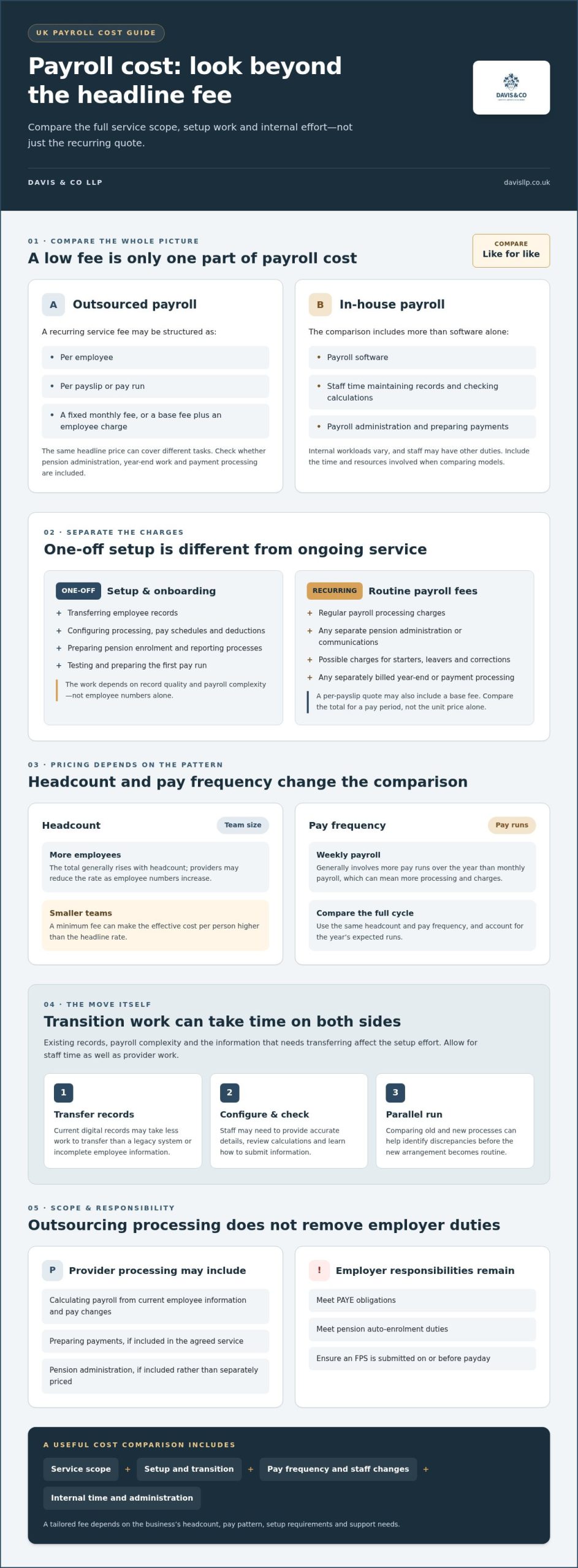
Outsourcing replaces some internal processing with a recurring service fee. In-house costs include software, staff time and administration. Compare transition work and pension handling as well as the monthly headline price.
Setup and Transition Expenses
Setup and transition expenses cover transferring payroll records, configuring processing and training the people involved. The move can take time from both the business and its payroll provider, before routine payments even begin.
A parallel run, where old and new processes are compared, can help identify discrepancies before the new arrangement becomes routine. Allow staff time to provide accurate employee details, review calculations and learn how to submit information. The work involved depends on existing records and payroll complexity.
Pricing by Employee Count
Employee count affects outsourced payroll costs, but minimum fees can make the cost per person higher for smaller teams.
Compare the cost of outsourced payroll in the UK using the same headcount and pay frequency. A fixed fee can make budgeting straightforward for a stable small team, while a per-employee charge changes as staff numbers shift. Weekly payroll may also be priced differently from monthly processing.
Employers retain responsibility for PAYE obligations when payroll is outsourced. They must still meet pension auto-enrolment duties and ensure an FPS is submitted on or before payday, even if a provider handles processing.
In-house payroll software adds a separate cost. The software price alone excludes staff time spent maintaining employee records, checking calculations and preparing payments.
That cost is not directly comparable with outsourcing, since employees may have other duties and internal workloads vary.
Pension administration is another point to compare. Check how it is handled in each model, since it may be included in a per-employee fee or priced separately. Compare the total cost of accurate processing, internal time and payment administration.
Payroll setup and onboarding fees
Payroll onboarding covers the initial work of transferring employee records, configuring payroll processing and preparing the first pay run.
These are one-off setup costs, separate from recurring payroll fees. Transferring current digital records may require less work than moving from a legacy system or correcting incomplete employee information. Setup may also involve configuring pay schedules, deductions, pension enrolment and reporting processes. Employee numbers alone do not determine the work involved.
Ask what the initial charge covers. A quote may itemise data transfer, payroll configuration and testing, or combine them into one onboarding fee. These charges are separate from ongoing pension administration.
Per-payslip pricing can add charges beyond the setup fee. The final bill depends on how payslips are counted and whether a base fee applies. Compare the total for a typical pay period, not the unit price alone.
Starters, leavers and corrections can also affect the invoice. If staff changes are frequent, transaction fees can make a low headline rate less representative of the total.
Pension costs need separate attention. Pension communications may also be billed separately. Check which enrolment tasks are included in the recurring payroll service and which incur an extra charge.
P45s are generally linked to leaver administration; the charge to examine is the provider’s leaver processing fee, rather than assuming a separate P45 tariff.
Before comparing payroll services, map each one-off and recurring charge against your actual pay cycle, staff changes and pension administration. This makes it easier to distinguish onboarding costs from the ongoing cost of payroll processing.
How Much Does Payroll Outsourcing Cost?
UK payroll pricing depends on headcount, pay frequency and the processing included. A per-employee monthly fee can simplify routine budgeting, while per-payslip or per-run pricing ties charges more directly to payroll activity.
Per-employee and per-payslip pricing
The total rises with headcount, but providers may reduce the rate as employee numbers increase. For a small team, a minimum monthly fee can make the effective cost per employee higher than the headline rate.
Per-payslip pricing offers a different basis for comparison. A provider may instead combine a base charge with a fee for each active employee per pay run.
Pay frequency changes the annual total. Weekly payroll generally involves more pay runs over the year than monthly payroll. Weekly payroll can therefore generate more processing and charges, particularly under per-run or per-payslip pricing. Compare the full year’s expected runs, rather than multiplying a monthly quote without considering frequency.
What shapes the quote?
Complexity also affects pricing. Variable hours, commission, pension deductions and employee changes require accurate payroll data. The employer supplies current employee information and pay changes; the provider uses these details to calculate payroll and prepare payments. Clear, timely records help prevent avoidable corrections and extra work.
Ask how the quoted service handles pension administration, year-end work and payment processing. These may be included or billed separately, so offers with similar monthly fees can cover different tasks. For example, a fee that covers calculations but excludes managed payment submission is not directly comparable with one that includes both.
Employer National Insurance and payroll cost
Employer National Insurance affects the employer’s payroll bill, but it is separate from the provider’s service charge. HM Revenue & Customs says the UK employer National Insurance secondary threshold dropped to £5,000 from April 2025. This change matters when forecasting employment costs alongside payroll processing fees.
In-house payroll still requires employers to provide accurate data, review outputs and arrange payments, even when software handles calculations. Compare the software subscription and internal time with the provider’s monthly, per-run or per-employee charge. Use the same headcount, pay frequency and service scope for both options.
What Is the Cheapest Way to Manage Payroll?
The lowest-cost model depends on headcount, pay frequency and the tasks included. Providers, accountants and managed payroll services can quote differently because their service scopes and pricing structures vary.
Pricing Models and Minimum Fees
UK payroll pricing commonly uses a per-employee fee, a fixed monthly charge or a per-run rate. Minimum charges matter because, for a small workforce, they can outweigh a low per-employee rate.
Fixed monthly pricing generally suits smaller businesses with steady headcount, while a per-employee model changes as staff numbers rise or fall. Compare the total charge for your expected payroll activity, not just the quoted unit price.
Per-Payslip and Fixed-Fee Pricing
Per-payslip pricing charges for each payslip processed; fixed-fee pricing charges a set monthly amount. Each model suits different payroll patterns, so the cheaper option depends on payment frequency and whether headcount stays consistent.
Weekly payroll can involve four or five runs in a month, compared with one monthly run. A fixed charge may be easier to forecast, while per-payslip pricing reflects each processing cycle. Check whether the fee includes payments, pension handling and filing, since separate charges can change the overall comparison.
Choosing a Pricing Model
Choose a model by matching the quote to your actual payroll pattern. Compare monthly and weekly schedules, expected headcount changes, pension administration, integration needs and year-end filing.
For example, a business with stable staffing may value a fixed monthly fee, while seasonal hiring can make a per-employee charge more responsive. Differences in service scope mean these rates are not direct substitutes.
Fully Managed Payroll Costs
Fully managed payroll generally covers more processing than a limited or part-managed arrangement. Full-service providers handle calculations, payments and tax filing, while the employer supplies employee data. This distinction matters when comparing a provider’s quote with an accountant’s payroll charge or a managed service.
These examples show how scale can affect unit pricing, but the total also depends on pay frequency and service scope. Check which tasks are included in the quoted fee before comparing options.
Factors affecting outsourced payroll prices
Headcount is only one part of the price. Outsourced payroll costs also reflect pay frequency, payroll complexity, pension administration, data handling and the work included in the service. Compare these factors with your actual payroll pattern instead of focusing on a single headline rate.
Pay frequency directly affects processing volume. A weekly payroll involves 52 pay runs per year, while a monthly schedule has one run each month. Providers may charge per employee per pay run, per payslip or through a monthly fee. Weekly payroll can therefore produce more chargeable processing, especially when the quote uses a per-run structure.
Variable pay adds work. Bonuses, commission, overtime and changing hours require current information and accurate calculations for each pay period. Regular salaries are generally simpler to process than frequent adjustments. This can affect service scope and the quote, even when businesses have the same number of employees.
Pensions and specialist payroll requirements also shape fees. These items may be charged separately from basic processing.
Look for additional costs in setup fees and ongoing terms. A low starting price may differ from the cost of a typical month that includes changes and extra processing.
Year-end and benefits work can also change the total. Check whether payslips, pension tasks, corrections, year-end work and payment submissions are included in the service. Compare the same tasks across pricing models to identify genuine differences.
Payroll software and integration needs matter when payroll data must move between systems. An existing system may require setup or continuing data syncing, while a simpler process may not. The Employment Rights Act 2025 is identified as a change contributing to rising UK payroll costs, making it sensible to account for evolving payroll requirements in longer-term budgeting.
For a quote that reflects your payroll pattern and service requirements, discuss payroll support with an adviser.
Davis & Co LLP: International Tax Planning
Davis & Co LLP can help businesses weigh payroll costs against wider financial priorities. Its Payroll Services support payroll processing, while Cash Flow Management can help you assess how recurring payroll commitments fit your business finances.
For organisations with international operations, International Tax Planning may also be relevant to broader financial arrangements. Businesses reviewing staffing and growth plans can also consider Business Growth Acceleration. The right focus depends on your circumstances and the decisions you need to make; payroll costs are one part of the wider picture.
Contact Davis & Co LLP to discuss your business’s payroll and financial needs.
Make payroll decisions with the wider business in view
Payroll arrangements should support the business you are building, not just the process you use today. As staffing, ownership or trading activity changes, review whether your payroll model still fits your operational priorities and financial planning. The cost of outsourced payroll in the UK is one consideration, alongside the time your team needs for other work and the clarity you need over cash flow.
Davis & Co LLP offers Cash Flow Management and Business Growth Acceleration to support wider business planning. For organisations with international considerations, International Tax Planning can also be part of that picture. The right focus depends on your business’s upcoming decisions and how payroll fits within them.
Take the next step by discussing your business priorities with Davis & Co LLP. Contact Davis & Co LLP to explore how considered financial support can help you plan with confidence.
Davis & Co LLP for payroll support
Davis & Co LLP provides Payroll Services for businesses considering the cost of outsourced payroll in the UK.
Turn to Davis & Co LLP to compare payroll costs with your business’s needs or discuss payroll support. The firm also offers bookkeeping, management accounts, VAT compliance and other tax and business services.
Frequently Asked Questions
What’s Included in Payroll Services?
Payroll services typically process employee pay, calculate deductions and prepare tax submissions using information supplied by the employer. The scope may also cover payslips, payment files, pension administration and year-end records. For example, a business with commission-based pay should distinguish routine salary processing from variable-pay calculations. Clarifying which records the employer must provide and which outputs the service prepares helps define responsibilities before payroll begins.
What are the pros and cons of running payroll in-house?
In-house payroll gives a business direct control over employee records, processing schedules and access to payroll information. Internal staff may also handle software, calculations, payment preparation and reporting alongside their other responsibilities. This approach may suit a team with the time and knowledge to manage these tasks consistently. The trade-off is that continuity depends on internal capacity, especially during absences or periods of change.
What are typical setup costs?
Setup costs depend on workforce size and the configuration or data transfer required. Pension setup may be charged separately. For a more useful budget, separate one-off onboarding work from recurring processing fees, and check whether integrations or data migration are part of setup.
How much does outsourced payroll cost per employee per month in the UK?
The comparison depends on whether the quote includes pension administration, payments and year-end work. Check whether the provider charges per employee, per payslip or through a monthly minimum.
What are typical UK payroll bureau setup fees and minimum monthly charges?
These charges serve different purposes: setup covers initial configuration, while the monthly minimum applies to ongoing service. Small employers should account for both when estimating first-year spending, then separate recurring fees from one-off onboarding costs in later periods.
How do UK payroll providers price services for weekly, fortnightly and monthly payroll?
Providers may charge by employee, payslip, pay run or a fixed monthly fee. Pay frequency affects the number of processing cycles, so compare quotes on a full-year basis. With fortnightly payroll, compare quotes on a full-year basis, since a per-run fee responds to the number of processing cycles. Confirm how the provider treats months with additional weekly pay runs and whether the price includes payment processing.
What is included in UK outsourced payroll services, and what costs extra?
Outsourced services commonly cover payroll calculations and tax filing, with payments included in full-service arrangements. Extras can include pension administration, employee communications, corrections, P60s and year-end processing. Compare the included tasks against your payroll needs, so optional work isn’t mistaken for part of the standard fee.
How do outsourced payroll costs compare with running payroll in-house or using payroll software in the UK?
Outsourcing replaces some internal payroll work with a provider fee, while in-house processing combines software costs with staff time and administration. Compare the total resources required for each approach, including who handles routine processing and how payroll continues when internal capacity is limited.