A Will is often perceived as the final, immutable word on an estate’s distribution, yet the law provides a sophisticated mechanism for a strategic “second chance” known as a deed of variation for inheritance. If you find yourself concerned that an existing Will doesn’t reflect current financial realities or risks an unnecessary Inheritance Tax burden, you aren’t alone. Many families feel a palpable anxiety regarding the strict two-year HMRC deadline and the potential for disputes over asset distribution during an already difficult time.
We understand that your primary goal is to preserve wealth and maintain family harmony. This guide explains how to legally reconfigure an estate to improve tax efficiency and ensure assets reach those who need them most. By utilizing this strategic instrument, you can achieve a significant reduction in the total Inheritance Tax (IHT) burden and secure clearance from HMRC without the stress of a protracted investigation. We’ll examine the 2026 regulatory requirements, the specific criteria for a valid variation, and the logical steps required to protect your family’s long-term financial interests.
Key Takeaways
- Understand how to utilise unused Nil Rate Bands and Residence Nil Rate Bands to minimise the impact of Inheritance Tax on the estate.
- Learn the formal requirements for a deed of variation for inheritance, including the mandatory two-year window from the date of death.
- Explore strategies for bypassing a beneficiary’s own estate to protect wealth for the next generation while managing Capital Gains Tax exposure.
- Discover how to correct omissions in a Will or equalise distributions among children based on their current financial circumstances.
- Recognise why detailed financial modelling is essential to ensure that any legal changes to asset distribution remain sustainable and tax-efficient.
Understanding the Deed of Variation: Reconfiguring an Inheritance Post-Death
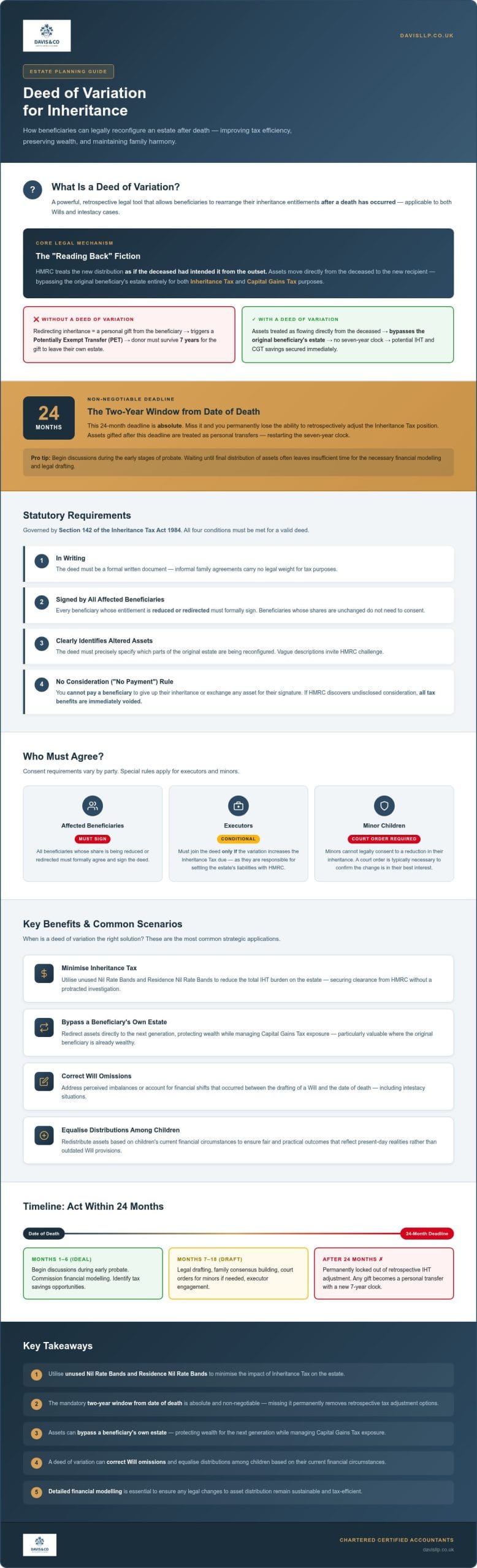
A deed of variation for inheritance serves as a powerful, retrospective tool for estate management. While many assume a Will is the final word, UK law permits beneficiaries to rearrange their entitlements after a death has occurred. This flexibility isn’t restricted to estates governed by a formal Will; it applies equally to cases of intestacy. We often find that families utilise this instrument to correct perceived imbalances or to account for financial shifts that occurred between the drafting of a Will and the date of death. Our role as strategic partners is to provide the professional gravitas required to navigate these sensitive family financial decisions, ensuring every adjustment is logical and well-constructed.
The Legal Fiction of “Reading Back”
Tax efficiency is the primary driver behind most variations. The mechanism relies on a “reading back” fiction, where HMRC treats the new distribution as if the deceased had intended it from the outset. Without this provision, a beneficiary redirecting their inheritance would be making a personal gift. This could trigger a Potentially Exempt Transfer (PET), requiring the donor to survive seven years for the gift to fall outside their own estate. By using a deed of variation for inheritance, the assets move directly from the deceased to the new recipient, bypassing the original beneficiary’s estate entirely for Inheritance Tax and Capital Gains Tax purposes. To be effective for these tax benefits, the deed must be executed within the strict two-year window following the date of death.
Who Must Agree to the Variation?
The validity of a variation depends on the consensus of those it affects, and our collaborative partnership approach ensures all voices are heard while maintaining legal precision. Any beneficiary whose entitlement is reduced or redirected must formally agree and sign the deed. You don’t need the consent of beneficiaries whose shares remain unchanged, though transparency is usually preferred to maintain family harmony. Executors also play a pivotal role. They must join the deed if the variation increases the Inheritance Tax due, as they are responsible for settling the estate’s liabilities with HMRC. Special care is required when minor children are involved. Since minors cannot legally consent to a reduction in their inheritance, a court order is typically necessary to confirm the change is in their best interest. We provide the intellectual rigour needed to manage these complex requirements, protecting all parties involved.
The Statutory Framework: Requirements and Time Limits
For a deed of variation for inheritance to be legally effective for tax purposes, it must adhere to a rigid statutory framework. It isn’t enough to simply reach an informal agreement among family members. The document must be in writing, signed by all beneficiaries whose interests are being reduced, and it must clearly identify which parts of the original estate are being altered. This clarity is essential to prevent HMRC from questioning the intent or the scope of the reconfiguration. Precision in these early stages ensures the variation stands up to rigorous professional scrutiny.
This process is governed primarily by Section 142 of the Inheritance Tax Act 1984, which provides the legal basis for treating the changes as if they were made by the deceased. One of the most critical, yet often overlooked, rules is the “no consideration” requirement. You cannot pay a beneficiary to give up their inheritance or offer them any asset in exchange for signing the deed. If HMRC discovers that money or value has changed hands outside the terms of the variation to encourage agreement, the tax benefits are immediately voided. We ensure all parties understand these boundaries to protect the integrity of the estate.
The Two-Year Deadline: A Non-Negotiable Window
The 24-month window following the date of death is absolute. If you miss this deadline, you lose the ability to retrospectively adjust the Inheritance Tax position. While you can still gift assets after this period, those gifts will be treated as personal transfers from the beneficiary, potentially creating a new seven-year clock for tax purposes. We advise starting this conversation during the early stages of probate. Waiting until the final distribution of assets often leaves too little time for the necessary financial modelling and legal drafting. A proactive approach is the only way to guarantee you don’t find yourself locked out of these strategic advantages.
HMRC Compliance and Documentation
Accuracy in documentation is vital to ensure clearance without investigation. The deed must include specific statutory declarations stating that the relevant sections of the Inheritance Tax Act 1984 and the Taxation of Chargeable Gains Act 1992 apply. If the variation results in more tax being owed, you must notify HMRC within six months of the deed’s execution. Failure to maintain a precise audit trail within the estate accounts can lead to significant delays and unnecessary scrutiny. Our personal tax services are designed to provide the intellectual rigour required to manage these filings with total discretion. We focus on ensuring your family’s financial arrangements remain secure and compliant, protecting both the executors and the beneficiaries from future liability.
Strategic Tax Advantages: Inheritance Tax and Capital Gains Efficiency
Effective estate planning requires more than just following a Will; it necessitates a rigorous analysis of how assets interact with current tax thresholds. By implementing a deed of variation for inheritance, we can ensure the estate fully utilises the deceased’s Nil Rate Band of £325,000 and the Residence Nil Rate Band of up to £175,000. If these allowances were underutilised in the original Will, a variation can redirect assets to the appropriate parties to maximise tax relief, potentially saving the estate substantial sums in immediate liabilities. This flexibility is paramount when managing complex family portfolios.
Mitigating Inheritance Tax (IHT) through Generation Skipping
For many high-net-worth families, the “double tax” problem is a significant concern. If a wealthy individual inherits assets they don’t strictly need, those assets simply increase their own estate’s value, leading to a 40% tax charge when they eventually pass away. A variation effectively “skips” this middle generation. By redirecting the inheritance directly to grandchildren or into a trust, the capital is only taxed once at the first death rather than twice. On a multi-million-pound estate, this strategic move can preserve hundreds of thousands of pounds for future generations. Seeking expert tax advice uk is essential here to model these outcomes accurately before committing to a legal change.
Capital Gains Tax: The Hidden Benefit of Variations
While IHT often takes centre stage, the Capital Gains Tax (CGT) implications are equally vital. When an individual dies, their assets receive a “step-up” in basis to their market value at the date of death. A deed of variation for inheritance allows the new beneficiary to inherit the asset at this “death value” base cost. This is a significant advantage over a standard gift from one person to another, which would typically be treated as a disposal at market value.
Consider a scenario involving highly appreciated stocks or property. If the original beneficiary inherits the asset, keeps it for a period, and then decides to gift it to a family member, they may be liable for CGT on any growth since the date of death. However, because the variation is “read back” for tax purposes, the new beneficiary is treated as having received it at the death value. This eliminates the intermediate CGT charge that would otherwise arise. It’s a sophisticated method of moving wealth without triggering unnecessary tax events, provided the documentation is executed with precision.
Common Scenarios: When is a Deed of Variation the Right Solution?
While the tax efficiencies discussed previously are compelling, a deed of variation for inheritance is often utilised to address the human complexities of estate distribution. Wills are snapshots in time. They don’t always reflect the reality of a family’s circumstances at the moment of death. Perhaps a grandchild was born after the Will was last updated, or a loyal friend was unintentionally omitted. In cases of intestacy, where no Will exists, the law applies rigid, pre-determined rules that may not align with the deceased’s known wishes. A variation allows beneficiaries to correct these outcomes with discretion and precision.
Equalising the distribution among children is another common application. One sibling may have faced significant financial hardship, while another has achieved substantial independent wealth. Through a collaborative partnership, siblings can agree to redirect portions of their inheritance to ensure a more equitable outcome that reflects their current needs. This process can also involve moving assets into trusts to facilitate long-term international tax planning, protecting the capital from future external claims and ensuring wealth is preserved for future generations.
Charitable Giving and the 36% IHT Rate
A variation can also unlock unique incentives for philanthropy. If you choose to donate at least 10% of the estate’s baseline value to charity, HMRC reduces the Inheritance Tax rate on the remaining taxable assets from 40% to 36%. This mathematical advantage is significant. In certain estate brackets, the tax saving generated by the lower rate can almost entirely offset the cost of the charitable gift. It’s a way to support meaningful causes while simultaneously preserving more of the net estate for the family. We provide the intellectual rigour required to calculate these thresholds exactly, ensuring the variation meets all statutory criteria for the reduced rate.
Cross-Border Estates and International Beneficiaries
The complexity increases when beneficiaries reside outside the UK. While a UK deed of variation for inheritance is effective for HMRC, it may not be recognised by foreign tax authorities or succession laws in the beneficiary’s home country. This can lead to unforeseen tax liabilities abroad. Managing these cross-border nuances requires a small business accountant with specific international expertise. We work to ensure that any variation doesn’t inadvertently trigger a tax event in a secondary jurisdiction, maintaining a global perspective on your family’s wealth.
If you are considering a variation to address a complex family or international scenario, we invite you to contact our personal tax specialists for a confidential consultation to explore your options.
Navigating the Process: Professional Support for Beneficiaries
Executing a deed of variation for inheritance requires a seamless collaboration between legal and financial advisors. While a solicitor handles the formal drafting of the deed, the underlying strategy is most effective when guided by the analytical rigour of a Chartered Certified Accountant. We act as strategic partners to ensure that every reconfiguration is not only legally sound but also financially optimal for the long term. Our approach focuses on removing the anxiety associated with HMRC deadlines and complex asset distribution, providing a clear, discreet path forward that prioritises your family’s stability.
Davis & Co LLP brings over a century of expertise to these sensitive matters, offering the professional gravitas required to manage multi-generational wealth. We understand that probate is often an emotionally taxing period. By providing a structured, logical progression from the initial assessment to the final HMRC clearance, we help beneficiaries and executors feel secure and well-advised. This composed partnership ensures that the final distribution of assets is both equitable and tax-efficient, reflecting a deep-seated commitment to wealth preservation.
The Importance of Financial Modelling
Financial modelling is the essential first step before any legal drafting begins. You shouldn’t sign a deed of variation for inheritance without first reviewing a comprehensive tax impact statement that projects the outcome of the proposed changes. We compare multiple distribution scenarios to identify the most efficient path, accounting for both immediate Inheritance Tax savings and potential future Capital Gains Tax liabilities. This level of detail ensures that the variation isn’t a reactive measure but a considered component of your broader personal tax plan. Without this foresight, you risk making changes that solve a short-term problem while creating a larger tax burden in the years to follow.
Next Steps for Executors and Beneficiaries
Initiating the process requires a systematic gathering of information. Executors should begin by compiling the most recent estate valuations and a copy of the original Will or a summary of the intestacy position. Once this data is in place, we recommend a consultation to assess the feasibility of a variation and to ensure all affected beneficiaries are in agreement. Our role is to manage the administrative burden of probate with a calm, reassuring authority, allowing you to focus on family matters. We’ll guide you through the 24-month statutory window, ensuring every document is filed correctly and every tax allowance is fully utilised. Taking this first step early provides the breathing room necessary to make informed, strategic decisions without the pressure of a looming deadline.
Implementing a Strategic Estate Reconfiguration
A deed of variation for inheritance is a vital instrument for those who recognise that a legacy should reflect the living needs of its beneficiaries. By acknowledging the practical realities of your family’s current financial landscape, you can mitigate unnecessary tax burdens and ensure that wealth reaches the intended recipients with precision. Whether you’re seeking to utilise unused Nil Rate Bands or redirect assets into a trust for long-term protection, the two-year statutory window remains the most critical factor for success. Taking action within this timeframe allows for a logical reconfiguration that benefits everyone involved.
We offer a discreet and professional partnership for family wealth, providing the analytical depth required for complex trust and international tax compliance. As Chartered Certified Accountants since 1901, we bring a history of reliability and intellectual rigour to every estate we manage. We invite you to consult with our personal tax specialists to explore a Deed of Variation and discover how a well-constructed plan can protect your legacy. Managing sensitive financial matters doesn’t have to be a source of anxiety when you have a strategic partner by your side. We look forward to helping you secure your family’s future.
Frequently Asked Questions
How much does a deed of variation cost to implement?
Professional fees for a deed of variation for inheritance depend on the complexity of the estate and the depth of financial modelling required. You’ll typically incur costs from both an accountant, who ensures the tax efficiency of the new distribution, and a solicitor, who drafts the formal deed. While we don’t provide fixed quotes, the investment often represents a small fraction of the potential Inheritance Tax savings achieved through strategic reconfiguration and expert planning.
Can I use a deed of variation if there was no will?
You can implement a variation even if the deceased did not leave a Will. When someone dies intestate, the law dictates a rigid distribution of assets that may not suit the family’s current needs. A variation allows the legal beneficiaries under the intestacy rules to redirect their shares, ensuring a more logical and tax-efficient outcome that better reflects the family’s actual circumstances and their specific long-term financial goals for wealth preservation.
Does a deed of variation need to be registered with the court or HMRC?
This document does not need to be registered with a court, and you only need to notify HMRC in specific circumstances. If the changes result in a different amount of Inheritance Tax being due, you must send a copy to HMRC within six months of the deed being executed. Otherwise, the document is kept with the estate accounts as a formal record of the altered distribution for future reference by executors and beneficiaries.
Can I change a deed of variation once it has been signed?
Once a deed has been signed and executed, it is a legally binding document that cannot be easily changed or revoked. Because the “reading back” fiction for tax purposes can only be used once for the same assets, it’s vital to ensure the distribution is correct before signing. This is why we emphasise the importance of detailed financial modelling and professional consultation during the initial planning stages to avoid any future complications or tax errors.
What happens if one beneficiary refuses to sign the deed of variation?
Only the beneficiaries whose entitlement is being reduced or redirected are required to sign the deed. If one beneficiary refuses to participate, the variation can still proceed for the shares of the other consenting beneficiaries. However, you cannot force a change upon someone who does not agree to give up part of their inheritance. This highlights the need for a collaborative partnership approach to maintain family harmony while navigating these sensitive financial decisions.
Can a deed of variation be used to avoid paying for care home fees?
Using a variation to avoid care home fees is a complex area and carries significant risks regarding “deprivation of assets” rules. Local authorities may investigate any redirection of inheritance if they believe the primary motive was to reduce your capital for means-testing purposes. We recommend seeking specific advice to ensure any variation is part of a broader, legitimate estate planning strategy rather than a reactive attempt to bypass social care obligations or financial responsibilities.
Is a deed of variation the same as a disclaimer of inheritance?
A deed of variation for inheritance is distinct from a simple disclaimer. While a disclaimer is a refusal to accept an asset, it doesn’t allow you to choose who receives it instead; the asset simply passes to the next person in line according to the Will or intestacy rules. A variation provides you with the strategic control to specifically redirect assets to a chosen individual or trust, offering far greater flexibility for long-term tax planning.
How does a deed of variation affect my own personal tax position?
A correctly executed variation ensures that the redirected assets never legally enter your own estate for Inheritance Tax or Capital Gains Tax purposes. This is particularly beneficial if you are already over the IHT threshold, as it prevents the inheritance from increasing your future tax liability. It allows you to provide for others while maintaining your own tax efficiency, effectively bypassing the “double tax” problem often associated with multi-generational wealth transfers and estate management.