Why do two seemingly identical clinics often receive valuation figures that differ by hundreds of thousands of pounds? This discrepancy typically arises when an assessment fails to account for the subtle interplay between clinical performance and fiscal structure. We understand the frustration of receiving inconsistent appraisals or the fear that hidden tax liabilities might surface during a sale. Mastering the various dental practice valuation methods uk is essential, particularly following the April 2026 contract reforms and the increased scrutiny from the Competition and Markets Authority.
Our objective is to provide a clear understanding of how adjusted EBITDA multiples, which can range from 4.2x for solo practices to over 11.0x for premium groups, dictate your actual market standing. We’ll move beyond basic turnover percentages to explore the expert accounting insights that reveal your practice’s true worth. You’ll gain a roadmap for increasing value before a sale and a strategy for a tax-efficient exit. This guide ensures your final transition is as financially rewarding as it is professionally sound.
Key Takeaways
- Understand the shift from turnover-based appraisals to EBITDA-led models and why this evolution is critical for a precise valuation in 2026.
- Master the dental practice valuation methods uk professionals use to determine “investment-grade” status, focusing on associate-led profitability and hygiene production.
- Learn the importance of normalising your accounts to eliminate non-recurring expenses, presenting a clear and attractive financial picture to potential buyers.
- Evaluate how the latest NHS contract reforms and revenue mix, between private, plan, and NHS income, directly impact your practice’s multiple.
- Identify the strategic steps required during a three-year preparation window to maximise market value and secure a tax-efficient exit.
Understanding Dental Practice Valuation Methods in the UK (2026)
The UK dental market has undergone a fundamental transformation in how business worth is calculated. Traditionally, a simple percentage of annual turnover served as a shorthand for value. However, as we move through 2026, this approach has been largely superseded by more rigorous business valuation principles that prioritise net profitability. Understanding the various dental practice valuation methods uk is no longer just about finding a sale price. It requires a deep dive into the interplay between tangible assets, such as surgery equipment and freehold property, and the intangible value of Goodwill.
A professional accounting valuation differs significantly from a standard broker’s market appraisal. While an appraisal focuses on current buyer appetite, our analytical approach examines the quality of earnings. We scrutinise the sustainability of your cash flow to ensure the final figure is defensible. This level of rigour is essential when dealing with sophisticated buyers who expect transparency and a clear justification for any premium paid.
The Shift from Turnover to Profit-Based Valuations
Turnover is often a misleading metric. Rising operational costs, including staff wages and clinical consumables, mean that high-revenue practices aren’t always the most profitable. Buyers now focus on EBITDA margins as the primary indicator of health. This is especially true following the April 2026 NHS contract reforms. These changes have shifted the focus from simple UDA volume to the actual margin achievable under the new remuneration structures for complex patient care and preventive treatments.
Why an Accurate Valuation Matters in 2026
Precision is vital as the final phases of Making Tax Digital (MTD) mandate higher levels of financial transparency. Having your records in order doesn’t just satisfy HMRC; it prevents “deal fatigue” during the due diligence process. If your data is messy, buyers may lower their offers or walk away. Whether you’re considering a partnership buy-in or a total exit, applying the correct dental practice valuation methods uk provides the clarity needed to protect your wealth and ensure a smooth transition.
The EBITDA Multiple Method: The Industry Gold Standard
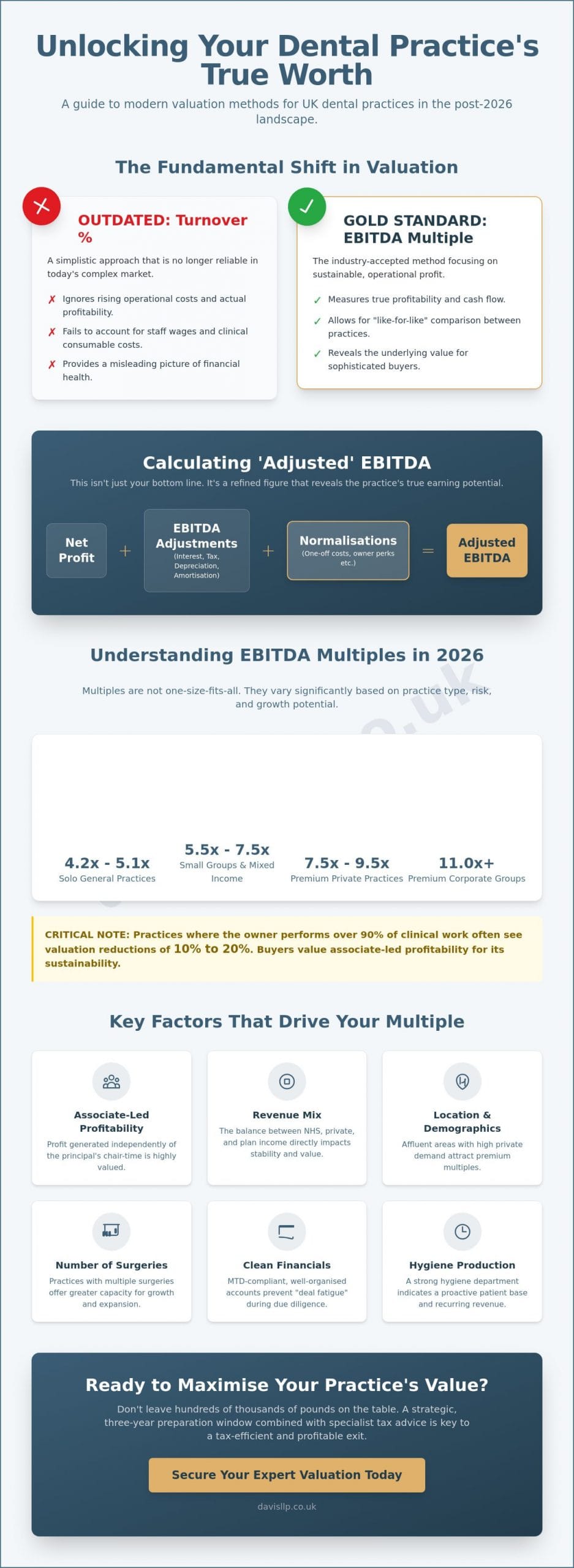
EBITDA remains the cornerstone of modern dental practice valuation methods uk, providing a standardised measure of operational performance. While the acronym stands for Earnings Before Interest, Taxes, Depreciation, and Amortisation, its application in dentistry requires specific, expert adjustments. We must look beyond the bottom line of your statutory accounts to find the “adjusted” or “normalised” EBITDA. This process removes non-recurring expenses and owner-specific costs to reveal the practice’s true underlying profitability to a potential buyer. Applying Specialist Dental Tax Advice ensures that these normalisations align with broader fiscal standards, protecting you from the risk of over-valuation or unexpected tax liabilities during due diligence.
Relying on generic industry averages is a common error when exploring dental practice valuation methods uk. A “6x multiple” might be the talk of the industry, but it’s rarely applicable without context. We’ve seen that practices where the owner performs 90% or more of the clinical production often face valuation reductions of 10% to 20% compared to their associate-led counterparts. As a dental tax specialist, we often find that the most significant value is uncovered when we meticulously adjust for these operational nuances.
Defining Associate-Led EBITDA
Associate-led EBITDA is the profit remaining after all clinical costs are accounted for at market rates. This figure is vital because it demonstrates the business’s ability to generate profit independently of the principal’s chair-side time. To calculate this, we must strip out the principal’s drawing or salary and replace it with a market-rate associate commission, typically 35% to 45% of gross fees. Common pitfalls include failing to account for the principal’s administrative duties or underestimating the cost of replacing specialist clinical skills.
Understanding Multiples in the 2026 Market
In the 2026 market, multiples are highly sensitive to practice composition and location. Solo general practices typically see multiples between 4.2x and 5.1x, whereas premium private practices with multiple surgeries can command between 8.0x and 11.0x. These figures reflect the perceived risk and growth potential. Multi-site groups often achieve 12.0x or higher because they offer immediate scale to private equity-backed buyers. While interest rates dictate the cost of capital, high-quality “investment-grade” practices continue to attract competitive bidding, with some Manchester practices attracting over 25 offers in recent cycles.
Critical Factors Influencing Your Practice Multiple
While the EBITDA figure provides the financial foundation, the multiple applied to it acts as a strategic lever, significantly swinging the final valuation. Buyers use various dental practice valuation methods uk to assess the inherent risk and longevity of the business model. A practice that commands a high multiple is one where the income is predictable, scalable, and resilient to regulatory shifts. In the 2026 market, the distinction between a “standard” and a “premium” multiple often rests on the quality of the revenue streams and the modernisation of the clinical environment.
Location and demographics continue to dictate buyer appetite. A practice situated in a high-growth urban hub or an affluent suburban area will naturally attract more competitive bidding. For instance, we’ve observed practices in high-demand regions like Manchester attracting over 25 offers in a single sale cycle. Beyond geography, the physical state of the practice matters. Buyers look for CQC compliance and modern equipment, as outdated facilities imply significant “day one” capital expenditure that will be deducted from the final offer price.
Revenue Quality: NHS vs. Private vs. Plan Income
Private capitation plans, such as Denplan or Practice Plan, are the gold standard for recurring revenue. These plans provide a level of financial certainty that fee-per-item private work cannot match. In the 2026 regulatory landscape, NHS-heavy practices are viewed with more scrutiny. While the April 2026 contract reforms introduced higher payments for complex patient needs, the mandated 8.2% allocation for unscheduled care has introduced new operational complexities. To demonstrate revenue growth potential, you must show a consistent trend of patients migrating from NHS to private or plan-based care.
Operational Efficiency and Principal Dependency
The “Principal Trap” is perhaps the most significant factor that can depress a valuation. If you, as the owner, perform 90% or more of the clinical production, buyers will view the business as high-risk, often leading to a 10% to 20% reduction in the multiple. Conversely, practices where hygiene production accounts for 25% to 35% of total collections consistently achieve better offers. Modern software systems and digital transformation also play a vital role here. Accurate, real-time data from practice management software allows buyers to verify patient retention and staff performance, reducing the perceived risk during due diligence.
The Accounting Perspective: Adjustments and Tax Efficiency
A headline offer from a corporate buyer is often a starting point, not the final destination. When applying dental practice valuation methods uk, we focus on the net proceeds, which is the actual capital that reaches your bank account after all adjustments and liabilities are settled. A strategic accountant looks for “hidden” EBITDA that a generalist broker might overlook, ensuring your practice is presented in its most profitable light. This involves a meticulous process of normalising your accounts to reflect a true operating profit that is sustainable under new ownership. Understanding these fiscal mechanics is essential because buyers will aggressively scrutinise your cost base during due diligence.
Our role as a dental tax specialist is to ensure that your financial narrative is both accurate and optimised for the highest possible net return. By addressing accounting nuances early, you eliminate the risk of “price chipping” where a buyer reduces their offer late in the process. We aim to present a clean, transparent financial history that justifies your chosen multiple and protects your wealth post-completion.
Normalising Accounts for a “True” EBITDA
Normalising accounts involves stripping away non-recurring expenses and personal costs that won’t continue post-sale. We frequently identify personal vehicle costs, non-clinical travel, and family members on the payroll as primary candidates for “add-backs.” If you own the freehold of your practice, we must adjust the accounts to reflect a market-rate rent; failing to do so can artificially inflate or deflate your EBITDA. We also scrutinise lab fee variations and stock adjustments. If your stock levels were unusually high at year-end, it might mask the true clinical cost base, skewing the results of the dental practice valuation methods uk applied to your business.
The Impact of “Cash-Free, Debt-Free” on Net Proceeds
Most dental transactions in 2026 are structured on a “cash-free, debt-free” basis. Cash-free, debt-free is a standard deal structure where the seller keeps the cash but settles all business debts before completion. This means any outstanding bank loans, hire purchase agreements on surgery equipment, or tax liabilities must be cleared from the sale proceeds. We recommend managing your directors’ loan accounts at least 12 to 24 months before a valuation. If these accounts are overdrawn, they can create complex tax charges that significantly erode your final payout. Maintaining a healthy working capital position is also vital, as buyers will expect a specific level of “net current assets” to remain in the business to cover day-to-day operations.
Maximising Value with Specialist Dental Tax Advice
Achieving a premium exit requires more than just a snapshot of your current accounts. We recommend a three-year preparation window to ensure your practice is sale-ready from both an operational and fiscal perspective. During this period, we apply various dental practice valuation methods uk to identify value-leakage points, such as high associate turnover or under-utilised hygiene capacity. This proactive approach allows you to implement changes that directly influence the multiple buyers are willing to pay. Early preparation is vital. It provides the necessary time to clean up balance sheets and demonstrate a consistent trend of profitability that sophisticated buyers demand in 2026.
Strategic planning is the bridge between a high headline price and a high net payout. We integrate Expert Tax Advice in the UK into your exit strategy to protect your wealth from unnecessary erosion. This is particularly relevant as tax bands and regulatory requirements continue to evolve. By aligning your business structure with your personal financial goals, we ensure that the value you’ve built over decades is preserved through the transition.
Strategic Planning for a Tax-Efficient Exit
A primary focus for any retiring principal is Business Asset Disposal Relief. In 2026, qualifying for this relief requires meticulous record-keeping and a clear distinction between business and personal assets. The Strategic Small Business Accountant plays a vital role here, ensuring your corporate structure is optimised for sale long before the first offer arrives. We also advise on the balance between initial cash payments and earn-out structures. These earn-outs often depend on the practice hitting specific EBITDA targets post-completion, making accurate baseline reporting essential.
Why Davis & Co LLP is Your Strategic Partner
Complex dental transactions require a level of precision that generalist firms cannot provide. Our niche expertise ensures that we don’t just calculate a number; we build a defensible case for your practice’s value. We understand the nuances of the 2026 market, from the impact of NHS contract overrides to the specific due diligence requirements of private equity groups. We act as a composed partner, guiding you through the complexities of dental practice valuation methods uk to ensure your transition is successful. Speak with our dental tax specialists to begin your valuation journey today.
Securing Your Professional Legacy in 2026
Navigating the sale of your life’s work requires more than just a cursory glance at the balance sheet. We’ve explored how the evolution of dental practice valuation methods uk now demands a rigorous focus on associate-led EBITDA and the strategic normalisation of accounts. It’s evident that the 2026 regulatory environment, particularly with NHS contract shifts and tax band updates, rewards those who prepare with precision. By addressing principal dependency and revenue mix early, you position your practice as an investment-grade asset that’s attractive to the most serious buyers.
As Chartered Certified Accountants with a history spanning over 120 years, Davis & Co LLP offers the niche expertise required to navigate these complex financial waters. We provide a composed, expert partnership that ensures the value you’ve built is protected through a tax-efficient exit. To ensure your practice reaches its true market potential, Consult our Specialist Dental Tax Accountants and begin your strategic valuation today. Your future security is built on the decisions you make now.
Frequently Asked Questions
How is EBITDA calculated for a dental practice?
EBITDA is calculated by taking your net profit and adding back interest, taxes, depreciation, and amortisation. In the context of dental practice valuation methods uk, we also adjust for “normalisation” items. These include one-off repairs, non-recurring legal fees, or personal expenses that won’t continue under new ownership. This provides a clearer picture of the true operating profitability that a buyer can expect to maintain.
What is a typical EBITDA multiple for a UK dental practice in 2026?
Typical multiples in 2026 vary significantly based on the practice type and its revenue mix. Solo general practices often see multiples between 4.2x and 5.1x, while premium private clinics or multi-site groups can command between 8.0x and 12.0x. These figures are applied to the adjusted EBITDA to determine the Goodwill value. High-quality, associate-led practices in desirable locations consistently sit at the higher end of these ranges.
Does the value of my dental practice include the freehold property?
No, the business valuation and the freehold property valuation are treated as separate components. The practice value focuses on Goodwill, equipment, and patient lists. If you own the freehold, it’s valued independently by a commercial surveyor. However, the business must then account for a market-rate rent within its EBITDA calculations to ensure the operational profit figure remains accurate for a potential buyer.
How does an NHS contract affect the valuation of my practice?
NHS contracts provide a stable, guaranteed income stream, which many buyers find attractive for cash flow security. However, following the April 2026 reforms, buyers scrutinise the contract’s delivery costs and UDA rates more closely. Practices that demonstrate a consistent ability to meet targets while maintaining a healthy private growth trend command the best multiples. Stability is key, but buyers also look for the flexibility to expand private services.
What is the difference between a principal-led and associate-led valuation?
Associate-led valuations assume the principal doesn’t provide significant chair time, making the business more sustainable for a new owner. Principal-led practices, where the owner performs over 90% of clinical work, are often seen as higher risk. This dependency can lead to a valuation reduction of 10% to 20%. Buyers pay a premium for systems and teams that can function effectively without the constant presence of the owner.
Can I increase my practice value in the 12 months before a sale?
You can certainly enhance your practice value by focusing on operational efficiency. Increasing hygiene production to represent 25% to 35% of total collections is a proven way to attract better offers. Modernising your digital systems and ensuring all staff contracts are up to date also reduces perceived risk. Small improvements in your EBITDA margin can have a magnified effect once the multiple is applied to the final figure.
What documents do I need for a professional dental practice valuation?
You’ll need at least three years of full statutory accounts, current management accounts, and detailed UDA performance reports for NHS work. We also require associate contracts, equipment maintenance records, and information regarding your property lease or freehold status. Having these documents organised prevents deal fatigue. It also ensures that the due diligence process doesn’t uncover any financial discrepancies that could lead to price chipping.
Why should I use a specialist dental accountant instead of a general practice valuer?
Specialist dental accountants understand the specific “add-backs” and tax structures unique to the profession. We identify hidden value in your accounts that generalists might miss, such as specific clinical cost normalisations or tax-efficient deal structures. Using a specialist ensures that the dental practice valuation methods uk applied to your business are defensible. Our niche expertise helps you secure the highest possible net proceeds from your sale.