A company director’s role extends beyond submitting forms: the Companies Act 2006 sets out seven general duties, and directors remain responsible for the company’s records and required filings. Director responsibilities at Companies House include ensuring that key company information is kept up to date, with a confirmation statement filed at least once every 12 months, according to Companies House.
It is easy to treat Companies House obligations as administrative tasks, especially when an accountant or company secretary handles the day-to-day work. But directors remain responsible for the company’s filings. Knowing what must be filed, what appears on the public record and how decisions should be managed is essential in practice.
This guide explains directors’ core duties, including how to manage conflicts of interest and company property, and which personal and company details may appear on the public record. It also covers how accurate financial records and timely filings support ongoing compliance.
Key Takeaways
- Understand how a director’s statutory duties shape decisions, oversight and responsibility for company filings.
- Keep company assets, records and confidential information separate from personal interests and use.
- Know which director details may appear on the public record and why accurate board minutes matter.
- Recognise when a personal interest or third-party benefit could create a conflict, and how to address it openly.
- See how the duty to promote the company’s success informs strategy and consideration of stakeholders.
What Is the Role and Duties of a Company Director?
A director oversees the company’s affairs and remains responsible for required filings, even when others prepare them. The Companies Act 2006 sets out seven general duties, alongside practical obligations for accounts, records and accurate company information.
Companies House Filing Obligations
Director responsibilities at Companies House include ensuring the company submits accurate statutory information on time. UK limited companies must file a confirmation statement at least once every 12 months, according to Companies House. This filing confirms key company details, helping maintain transparency on the public record. Directors should also oversee notifications about changes to officers or their details, the registered office, share allotments and company charges. A filing calendar can help the board assign responsibility and track deadlines.
Directors’ Accountability for Filings
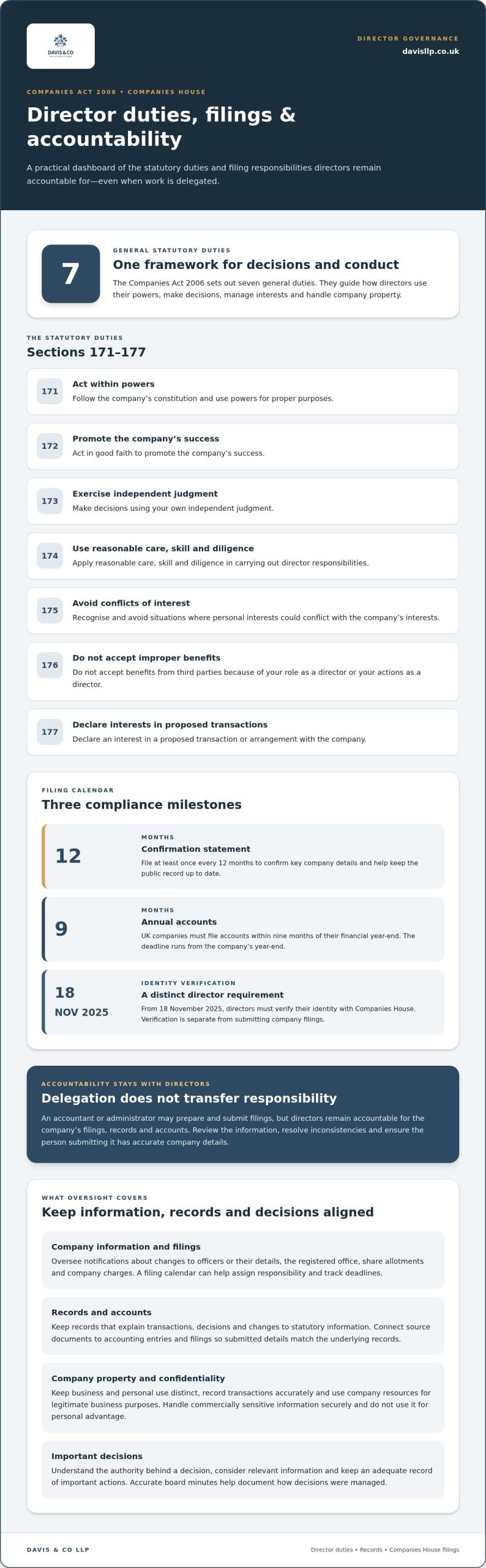
Directors remain accountable for company filings, even when an accountant or administrator prepares and submits them. Delegating the work does not transfer responsibility for the company’s records, accounts or performance. Because filings affect the public record and the company’s compliance position, directors should review the information, resolve inconsistencies and ensure the person submitting it has accurate company details. Clear oversight can also help identify missed obligations before they become recurring problems.
Filing and Record-Keeping Responsibilities
Directors must ensure the company keeps accurate records to support its filings and financial accounts. Records should explain transactions, decisions and changes to statutory information. For example, a share allotment should be reflected consistently in the company’s records and the relevant Companies House filing. A reliable process connects source documents to accounting entries and filing information, making it easier to prepare annual accounts and show that submitted details match the underlying records.
Annual accounts are a separate central obligation. UK companies must file them within nine months of their financial year-end, according to Companies House. Directors remain responsible for the filing, including where another person prepares the accounts or the company is dormant. The deadline runs from the company’s financial year-end, so directors should establish that date and plan preparation accordingly. Timely, consistent records help the board review the accounts before submission and address discrepancies rather than carrying them into the public filing.
From 18 November 2025, directors must verify their identity with Companies House. Identity verification is a distinct requirement from submitting company filings, so directors should account for both obligations when managing their compliance responsibilities.
The wider legal framework also guides how directors exercise their authority. Section 171 of the Companies Act 2006 requires directors in England and Wales to follow the company’s articles and use their powers for proper purposes. Section 173 requires independent judgment, while section 174 requires reasonable care, skill and diligence. In practice, director responsibilities at Companies House sit alongside these duties: directors should understand the authority behind a decision, consider relevant information and keep an adequate record of important actions.
Other duties, including protecting company property and confidentiality
The Companies Act 2006 sets out seven general statutory duties for company directors. These duties guide how directors use corporate powers, handle company property and make decisions. They apply to directors whether they perform every task personally or delegate operational work. In practice, protecting company assets means keeping business and personal use distinct, recording transactions accurately and ensuring company resources serve legitimate business purposes.
Confidentiality is also part of good day-to-day governance. Directors may encounter commercially sensitive information in board papers, financial records or negotiations. Access should be limited to people who need the information for their role, and information should be handled securely rather than used for personal advantage. For example, a director should not share a confidential pricing proposal with another business without proper authority. Clear access controls and documented procedures help protect information and the company’s interests.
The seven general duties address different aspects of a director’s conduct:
- Section 171: act within the company’s constitution and use powers for proper purposes.
- Section 172: act in good faith to promote the company’s success.
- Section 173: exercise independent judgment.
- Section 174: exercise reasonable care, skill and diligence.
- Section 175: avoid conflicts of interest.
- Section 176: not accept improper benefits from third parties.
- Section 177: declare an interest in a proposed transaction or arrangement.
Together, these statutory duties mean a director must act for the company’s benefit, not treat corporate property as personal property. A practical safeguard is to document why an asset or confidential record is accessed, who authorised the use, and how the transaction supports the business. Keeping accounting records up to date also helps distinguish company expenditure from a director’s personal spending. Where property assets are part of the business, property accounting support can help maintain clear financial records.
Financial distress changes whose interests directors must consider. When a UK company becomes insolvent, directors’ responsibilities apply towards the company’s creditors instead of the company. Decisions about payments, asset sales and further commitments therefore require particular care. Directors should assess the company’s financial position using current records and avoid treating creditor funds or company assets as available for personal or unrelated use.
A breach can have serious consequences. A director may be fined, prosecuted or disqualified from acting as a company director for failing to meet responsibilities. The Company Directors Disqualification Act 1986 is the law cited for director disqualification. Accurate records, careful handling of company assets and well-documented decisions provide a practical basis for demonstrating responsible conduct.
What Details of a Company Director Can Be Found on the Public Record?
Companies House records may show a director’s appointment and other company information filed with the registrar. To review filings and personal information, search for the company on the Companies House register and check its officer details and filing history. Compare these entries with the company’s current records, then arrange any necessary corrections or updates.
The public record helps shareholders, creditors and others understand who is responsible for a company and what its official details are. It may show director appointments and resignations, changes to officers’ details, the registered office address, share allotments and registered company charges. As these entries can affect how others assess the company, directors should ensure filings accurately reflect its records.
A company’s filing history is a practical way to review what has been submitted. Check that the latest confirmation statement and annual accounts appear, then compare their information with current company records. If a director’s details or the registered office has changed, align the records with the relevant filings. This comparison can reveal inaccuracies before they cause confusion for shareholders or other readers.
Board records are different from the Companies House public record. Companies must keep board meeting minutes and resolutions, and UK board minutes must be kept for 10 years. The minutes should give a clear account of decisions, the considerations behind them and any agreed actions. For example, a record of a decision to issue shares can help explain the corresponding share information and filing.
Useful board minutes identify the meeting, attendees, matters discussed and resolutions made. They should distinguish proposals from decisions and record any director’s declared interest where relevant. This provides a reliable account if the board later needs to explain its actions, particularly if the company’s financial position changes or it becomes insolvent. Keep approved minutes with the company’s other statutory records.
Share records should also match company filings. When shares are allotted, the company must report the allotment to Companies House. Directors should ensure the internal record agrees with the submitted information, including the relevant share details. A mismatch can make it harder for shareholders to understand ownership or voting rights from the company’s records.
Information about people with significant control is another important record. A person may be a PSC if they own or control more than 25% of the company’s shares or voting rights, according to Companies House. Changes to the PSC register must be notified to Companies House within 14 days. Keeping the company’s PSC information accurate and current supports a consistent public record alongside director and share details.
Conflicts of interest and third-party benefits
A conflict can arise when a director’s personal interest competes with the company’s interests. The Companies Act 2006 addresses both conflicts and benefits that could influence a director’s decisions.
Identifying Conflicts of Interest
Section 175 of the Companies Act 2006 requires directors in England and Wales to avoid conflicts of interest. A conflict may involve a director’s separate business, a family connection or an opportunity the company could pursue. For example, a director considering a contract with an entity they own has a personal interest alongside their corporate role. Identifying that overlap early helps the board consider the matter transparently.
Managing Conflicts and Third-Party Benefits
Section 177 of the Companies Act 2006 requires directors in England and Wales to declare any direct or indirect interest in proposed company transactions or arrangements. Section 176 prohibits accepting third-party benefits that could reasonably be seen to influence decisions. A director should disclose relevant interests promptly, record the declaration and follow the company’s articles of association when the board considers the matter.
Start by identifying the connection between the director and the decision. It could be a financial interest, a personal relationship, a competing business or access to an opportunity through the director’s role. Then disclose the nature and extent of that interest to the appropriate board members. Under section 177, the duty concerns a proposed transaction or arrangement, so disclosure should occur before the company proceeds.
A clear record supports consistent handling of conflicts. Minutes can note the interest, when it was declared, what information was considered and the resulting decision. For example, if a director’s separate entity bids for company work, the board can document the relationship and how it managed the director’s involvement. The record should distinguish the disclosure from the board’s decision on the proposal.
Review the articles of association alongside the relevant statutory duties. They provide the company’s constitutional framework and may guide how the board handles a disclosed interest. Directors should follow the required process rather than assume that informal awareness among colleagues counts as a declaration. Other shareholders may also need to be told if a director could personally benefit from a company transaction.
Third-party benefits require careful judgement, even when no payment is involved. A gift, hospitality or other advantage may raise concerns if it could reasonably appear to influence a director’s judgement. Consider its connection to a current or anticipated company decision, disclose it through the appropriate company process and keep a record of how it was handled. The key question is whether the benefit could compromise independent decision-making.
Managing conflicts protects the company’s interests and supports confidence in board decisions. A consistent approach is to disclose the interest, follow the articles and statutory duties, document the board’s response and keep the relevant record with the company’s governance papers.
Promoting the company’s success
Section 172 of the Companies Act 2006 requires directors in England and Wales to act in good faith to promote the success of their company, according to The National Archives (legislation.gov.uk). The duty informs how directors assess proposals, set priorities and record their reasoning.
A board puts this duty into practice by setting strategic objectives and policies, monitoring progress and appointing senior management. Directors should understand how a proposal supports the company’s objectives, what resources it requires and how the board will assess results. Before approving a new service, for example, directors can consider its commercial rationale, who will oversee implementation and how progress will be measured.
Good decision-making is not simply about approving growth. Directors need reliable information and a clear record of how the board reached its conclusion. This may include management reports, cash-flow forecasts, operational updates and identified risks. If the available information raises questions, the board can request clarification before deciding. A considered process supports better-founded decisions and helps the company track whether its strategy remains appropriate.
Directors can put this duty into practice by building these habits into board discussions:
- Connect each significant proposal to the company’s stated objectives.
- Identify the information and assumptions behind the recommendation.
- Assign responsibility for implementing approved actions.
- Set a review point and compare progress with the original rationale.
- Record the discussion and decision in the board minutes.
These steps help directors distinguish strategic decisions from routine administration. For example, when considering expansion, the board can document the expected operational changes, the resources involved and who will report on progress. A later review can compare actual performance with the assumptions recorded when directors approved the plan.
Annual reporting provides another point of accountability. Companies with more than 250 employees must explain in their annual report how their directors have fulfilled the duty to promote the company’s success. A clear record of board actions and review processes can help support that explanation. It also gives directors a structured account of how decisions developed over the reporting period.
The confirmation statement has a different purpose: it confirms that key company information is accurate and up to date. Directors should include it in the company’s governance calendar while keeping strategic oversight distinct from annual reporting. Each record helps explain how the company is governed and how directors meet their responsibilities.
For directors reviewing the quality of financial information behind board decisions, discuss your company’s reporting needs and how clearer management information can support oversight.
Davis & Co LLP: International Tax Planning
Davis & Co LLP provides International Tax Planning for businesses and individuals with cross-border tax considerations. Directors managing overseas activities may need to understand how international arrangements affect company finances and their personal tax position. Coordinating tax planning with reliable business records and financial oversight can support informed decisions.
Where broader operational planning is relevant, Davis & Co LLP offers Business Growth Acceleration and Cash Flow Management. Its Personal Tax Services can help directors address their personal tax affairs alongside company responsibilities. The right support depends on the issues involved and whether they relate to the business, the director or both.
For advice on international tax planning or related financial matters, contact Davis & Co LLP.
Make governance part of your forward plan
Strong governance is about more than meeting formal obligations. It gives directors a clearer basis for decisions as the business changes, enters new markets or reviews its priorities. Treating director responsibilities at Companies House as part of a wider governance plan helps connect oversight with the company’s financial and commercial direction.
Consider where specialist financial support fits your circumstances. Davis & Co LLP offers International Tax Planning for cross-border matters, Business Growth Acceleration for businesses focused on development and Cash Flow Management to support financial oversight. The right focus depends on the questions facing your company and the decisions ahead.
If you would like to discuss support for your business or personal tax position, contact Davis & Co LLP. A considered approach can help you move forward with greater clarity and confidence.
Davis & Co LLP can support your company’s ongoing responsibilities
Davis & Co LLP provides Company Secretarial Services to support company administration. If you have questions about directors’ responsibilities at Companies House or need help with related company secretarial work, contact the firm to discuss the next step.
The firm also offers Audit and Assurance, VAT Compliance, Payroll Services, Bookkeeping Services and Management Accounts. For tax or financial support, its services include International Tax Planning, Personal Tax Services, Trust Tax Services, Property Accounting and Cash Flow Management.
Frequently Asked Questions
What Is a Corporate Director?
A corporate director is a company or other corporate entity appointed as a director of another company. This does not remove the requirement for an individual director: a company with a corporate director must also have at least one natural-person director. The corporate entity acts through people authorised to make decisions for it, while the individual director remains part of the company’s board.
What Is the Difference In Functions Between a Shareholder and a Company Director?
A shareholder owns shares in a company, while a director manages and oversees its affairs. Shareholders may exercise rights attached to their shares, such as voting on matters put to them. Directors make board decisions and oversee the company’s operations. One person can hold both roles, but their responsibilities remain distinct. For example, when considering a board proposal, a director should assess it in that role, not simply as a shareholder seeking a personal return.
Who Is Eligible to Be a Company Director of a Limited Company?
A UK limited company must have at least one director who is over 16 years old. UK company law does not set a statutory maximum number of directors a limited company may appoint. A corporate director may also be appointed, but the company must still have at least one natural-person director. The board’s composition should be understood alongside the company’s articles of association, which can set out how directors are appointed and how board decisions are made.
Who qualifies as a director?
A director may be formally appointed, but a person can also carry director responsibilities without a formal appointment. This can include someone who acts as a director in practice or a person whose instructions the board follows. An inactive director doesn’t automatically escape the duties attached to the role. For example, someone who remains appointed but takes no part in daily decisions may still have responsibilities for the company’s governance and oversight.
What are a UK company director’s legal responsibilities under Companies Act 2006?
The Companies Act 2006 sets out seven general duties owed by directors to their company. These cover acting within the company’s constitution, promoting its success, exercising independent judgment, and applying reasonable care, skill and diligence. They also require directors to manage conflicts, avoid improper third-party benefits and declare interests in proposed transactions. Together, these duties guide both major board decisions and ordinary conduct, such as assessing a contract connected to a director’s personal interests.
What duties do directors owe to their company and its shareholders?
Directors’ seven statutory duties are owed to the company, not directly to individual shareholders. Decisions should be made in good faith to promote the company’s success, taking account of relevant factors such as employees’ interests and the effects of decisions on the community and environment. Shareholders may have rights under company law and the articles, but a director should not treat one shareholder’s preference as a substitute for proper board judgement.
What are directors’ responsibilities for filing annual accounts and confirmation statements with Companies House?
Directors are responsible for ensuring the company files its annual accounts and confirmation statement, even if an accountant prepares the documents. Companies House states that annual accounts are due within nine months of the financial year-end, and a confirmation statement must be filed at least once every 12 months. Directors can assign preparation tasks, then review the completed information against company records before submission, including where the company has had little activity.
What information must directors report to Companies House, and by when?
Companies must notify Companies House of changes to directors or their personal details within 14 days. An individual director’s appointment is reported on form AP01 within 14 days of appointment; a resignation is reported on form TM01 within 14 days. Changes to the PSC register must also be notified within 14 days. Other reportable information includes a registered office change, share allotments and company charges, so directors should track each change and its applicable filing requirement.