A certificate of residence for tax purposes is evidence that HMRC considers you UK tax resident for a particular period or date. It can support a claim for relief under a double taxation agreement, but it does not itself establish that relief is due. Your application must specify the period required, and HMRC may take several weeks to process it.
If an overseas tax authority or customer asks you to prove where you are tax resident, you’ll need to understand what the certificate confirms and how to apply. This article explains what information HMRC may require, how to apply online or on paper, and how residence evidence can support a treaty-relief claim. It also covers why the receiving country’s requirements matter, so you can prepare an application that meets the purpose of the request.
Key Takeaways
- Identify the applicant type and the exact period for which you need proof of UK tax residence before preparing your request.
- Give HMRC clear details about the relevant income, country, treaty and reason for applying; missing information can delay a response.
- Use the certificate as evidence to support a treaty-relief claim, and check what the overseas authority requires for its own process.
- HM Revenue and Customs says a person is usually non-resident in the UK if they spend fewer than 16 days there, or fewer than 46 days if they weren’t UK resident for the previous 3 tax years.
- Distinguish proof of UK residence from entitlement to relief: the applicable treaty and the facts of the income determine whether a claim can be made.
What is a Certificate of Residence (CoR)?
- A UK Certificate of Residence is HMRC evidence that a person or organisation is UK tax resident for a specified period or date. It can support a claim for treaty benefits abroad, but it is not an assessment of all the taxpayer’s obligations in a foreign country.
HMRC issues a certificate when, to the best of its knowledge, the taxpayer is UK resident. Residence and entitlement to treaty benefits are separate questions: the relevant treaty may set additional conditions, and some foreign authorities ask HMRC to confirm those conditions.
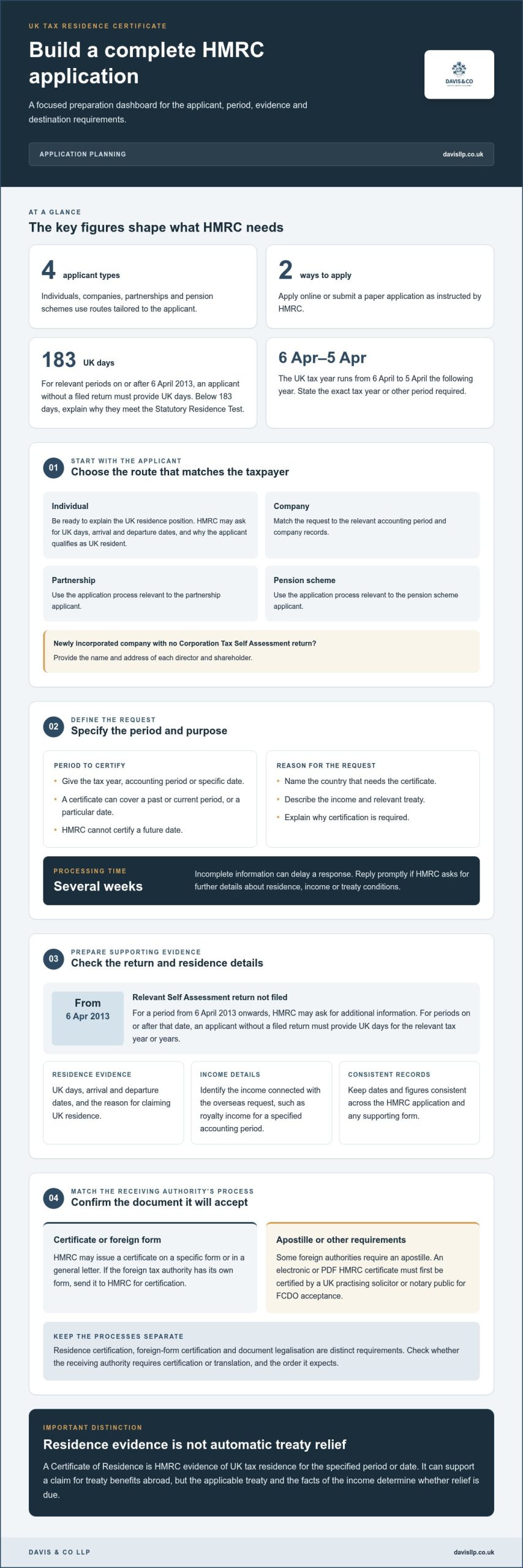
- First, identify the applicant and the period the certificate needs to cover. HMRC processes applications differently for individuals, companies, partnerships and pension schemes, so use the route and provide the information relevant to the applicant type.
A certificate can cover a specified past or current period, or confirm residence on a particular date. It cannot cover a future date. There is no single validity period for every certificate: the stated period or date defines what it evidences, while the receiving authority decides what proof it accepts.
The UK tax year runs from 6 April to 5 April the following year. State the required tax year or other period clearly, rather than assuming a certificate covers an entire year.
- Next, prepare the details HMRC may need: the country, income, relevant treaty, tax year or accounting period, and reason for the request. HMRC assesses residence and treaty eligibility using the initial request and other available information, taking a risk-based approach.
If you haven’t filed a relevant Self Assessment return for a period from 6 April 2013 onwards, HMRC may ask for additional information. This can include UK days, arrival and departure dates, and why you qualify as UK resident. For a period on or after 6 April 2013, an applicant without a filed return must give the UK days for the relevant tax year or years. If they spent fewer than 183 days in the UK, they must explain why they believe they meet the Statutory Residence Test.
- Apply online or submit a paper application as instructed on GOV.UK. HMRC may issue a certificate on a specific form or in a general letter. If a foreign tax authority provides its own form, send it to HMRC for certification.
An HMRC application is separate from any foreign-form certification or document legalisation process. Keep those requirements distinct from your residence request, as the application information does not establish whether HMRC charges a fee.
HMRC may take several weeks to process an application. If there is a delay, respond promptly to requests and provide any missing details about residence, income or treaty conditions. If HMRC refuses the request, review its reasons and address the specific evidence or eligibility issue in further correspondence. Professional tax advice can help with complex residence or treaty questions.
Information required for an application
- Choose the correct applicant route. HMRC handles applications for individuals, companies, partnerships and pension schemes according to the applicant type. Identify who needs the certificate before completing an application, then use the relevant online or paper process. An individual’s residence evidence differs from a company’s accounting-period details, so do not assume one application suits every entity.
If an accountant or other authorised agent prepares the request, make sure the information reflects the taxpayer’s circumstances. The applicant remains the person or organisation whose UK residence HMRC is being asked to certify.
- Set out the period and purpose precisely. State the tax year, accounting period or date required. HMRC applications cannot request a future date. Explain which country needs the document, what income is involved, which treaty applies and why you need certification. For example, an overseas authority may need evidence relating to royalty income for a particular accounting period.
Check the receiving government authority’s instructions before applying. It may ask HMRC to complete a foreign tax form rather than issue a general letter. Including the correct form with your application can help avoid a mismatch between the evidence requested and the document issued.
- Gather supporting details for the applicant type. Individuals may need to explain their UK residence position, particularly if they have not filed the relevant Self Assessment return. HMRC may ask for UK days, arrival and departure dates, and the reason the applicant qualifies as UK resident.
A newly incorporated company that has not filed a Corporation Tax Self Assessment return must provide the name and address of each director and shareholder. Set out these details clearly. If the company has filed a return, give the relevant accounting period and ensure the application matches its records.
- Review the form and any legalisation requirements before sending. Common errors include requesting a future period, omitting the country or income, and submitting an individual’s details for a company application. Incomplete information can delay HMRC’s response. Keep figures and dates consistent across the application and any supporting form.
Some foreign authorities require an apostille. An electronic or PDF HMRC certificate must first be certified by a UK practising solicitor or notary public for FCDO acceptance. The FCDO must be able to verify the relevant HMRC signature, stamp or seal before legalising an HMRC letter. Confirm the receiving authority’s document requirements, including whether certification and translation are needed and in what order.
For a company application, company secretarial support can help maintain clear corporate records alongside the details submitted to HMRC.
Using a certificate to claim double tax treaty relief
- Match the certificate to the income and treaty. A UK certificate of residence can support a claim for relief abroad if you are UK resident and pay UK tax on foreign income. The country must have a double taxation agreement with the UK, and you must qualify for treaty benefits. The certificate is evidence of UK tax residence; it does not determine the overseas tax treatment or establish every condition for relief.
Before making a claim, identify the country, income type and relevant period. For example, an overseas payer may withhold tax from interest, dividends or royalties. The treaty terms determine whether relief applies and what evidence the foreign authority requires.
- Check whether the treaty requires further declarations. Some treaties require you to confirm that you are the beneficial owner of the income and subject to UK tax on all income covered by the claim. Include the information requested by the overseas authority and ensure it is consistent with the certificate and your accounting records.
HMRC assesses the information in the initial request alongside other available information. If it has reason to doubt your treaty entitlement, it may request further details. If uncertainty remains, HMRC may exchange information with the other treaty state to help decide whether treaty benefits can be granted.
- Account for a move into or out of the UK. When someone moves, the UK tax year is usually split into a non-resident part and a resident part under split-year treatment. Foreign income may be treated according to the period the person lived in the UK. A certificate for the relevant period should match the residence evidence and the foreign authority’s request.
Split-year treatment does not apply if you live abroad for less than a full tax year before returning to the UK. This matters when a treaty claim relates to income received around a move: identify the dates, income period and residence position before submitting supporting evidence.
- Follow the receiving country’s process. A certificate can support a claim for reduced withholding tax on dividends, interest or royalties, but the treaty and local process determine how to make the claim. Some authorities ask for a document covering a specific tax year. Others may require an apostilled certificate or a form completed by HMRC.
For international treaty partners, a new apostilled Certificate of Residence is often required each tax year for double taxation agreement relief. Use the period requested and keep the certified document with the related income and accounting records. This gives the foreign authority consistent evidence when it assesses the treaty claim.
Why overseas customers request certificates of residence
- Establish why the overseas customer needs proof. A payer or foreign tax authority may request an HMRC certificate to assess UK residence and apply a relevant double taxation agreement. The document can support a claim for relief on income such as dividends, interest or royalties. First, identify the country, income type and period involved. Then establish whether the request is for the customer’s records, a withholding-tax claim or a form required by the overseas authority. These details help ensure the evidence relates to the transaction being assessed.
For example, a UK resident receiving royalties from abroad may be asked to provide proof of residence before the payer considers treaty treatment. The certificate supports the claim, while the applicable treaty and the foreign authority’s process determine the relief available.
- Consider UK residence before preparing the evidence. The Statutory Residence Test uses automatic UK tests, automatic overseas tests and, in some cases, the sufficient ties test. Spending 183 days in the UK is not the only route to UK residence. Residence can also depend on homes, work and connections with the UK.
HM Revenue and Customs says a person is usually non-resident in the UK if they spend fewer than 16 days there, or fewer than 46 days if they weren’t UK resident for the 3 previous tax years. An automatic overseas test also applies to some people working full-time abroad: they must spend fewer than 91 days in the UK during the tax year. Review the relevant days and work pattern before requesting residence evidence.
- Prepare the document for its destination. Ask the receiving authority what period the certificate must cover and whether it requires an apostille, translation or its own form. Requirements vary between countries. Not every overseas authority requires an apostille, and the order of apostille and translation depends on the receiving authority.
The FCDO Legalisation Office checks a document’s signature, stamp or seal and legalises it by attaching an apostille. The apostille confirms the recognised UK signature, stamp or seal. For an HMRC letter, the FCDO must be able to verify the relevant HMRC signature, stamp or seal. A country that does not accept an apostille alone may require further embassy or consular legalisation.
- Match the evidence to the overseas claim. Keep the HMRC certificate with the foreign income records and the customer’s correspondence. Check that the name, income category, country and covered period align across the documents. If an overseas authority provides a form, include it for HMRC certification as part of your preparation.
Some authorities require renewed evidence for each tax year. For example, Greek authorities require a new apostilled Certificate of Residence each tax year for double taxation agreement relief. A complete document set gives the receiving authority relevant residence evidence when considering a claim for tax relief.
Purpose of a UK Certificate of Residence
- Use it as evidence of UK residence, not as a tax decision. HMRC’s certificate confirms UK tax residence for the stated period or date. It can support a claim under a double taxation agreement, but it does not itself grant foreign tax relief. The overseas authority applies the relevant treaty and considers its conditions alongside the certificate.
This distinction matters if tax has been withheld abroad. The certificate helps establish residence; it does not confirm that every item of income qualifies for reduced withholding tax or repayment.
- Match the evidence to the treaty and income. A UK resident paying UK tax on foreign income may use the certificate to support a treaty claim in the other country. The UK and that country must have an applicable agreement, and the applicant must qualify for its benefits.
For example, a payer may request proof of residence before applying treaty treatment to dividends, interest or royalties. The treaty may set conditions for the income, including beneficial ownership or liability to UK tax. Check that the certificate period matches the income and claim period, rather than treating it as general proof for every tax year.
- Consider whether another form of confirmation is needed. Confirmation of UK tax residence may be required when no double taxation agreement applies or when proof is needed for another purpose. A foreign authority may request its own form, a specific HMRC letter or evidence for a particular tax year.
Follow the receiving authority’s instructions and identify the purpose before applying. For instance, a bank or public authority may need evidence of residence for its records rather than proof to support a withholding-tax claim. A certificate confirms the residence position HMRC certifies, not every separate fact the recipient may need.
- Keep the certificate distinct from tax returns and accounting evidence. A certificate does not replace a Self Assessment tax return or a company’s accounting records. Use the relevant tax year or accounting period consistently across the HMRC request, income records and foreign claim. This is particularly important when a company’s profits or an individual’s income involve more than one country.
UK double tax treaties usually provide that business profits are taxable only where the business is tax resident, subject to a permanent establishment in the other location. The certificate can help evidence residence, while the treaty and business facts determine the treatment. For help assessing how residence evidence fits your wider tax position, discuss your circumstances.
Davis & Co LLP: International Tax Planning
Davis & Co LLP provides International Tax Planning for individuals and businesses with cross-border income, residence questions or treaty considerations. If you are unsure how a UK residence certificate fits your wider tax position, advice can help you consider the income involved, the countries concerned and the applicable treaty alongside your UK tax obligations.
For individuals, Personal Tax Services can address tax matters connected with foreign income or a change in residence. Businesses managing overseas income can consider how international tax planning aligns with their accounting and commercial arrangements. The right focus depends on your circumstances and the questions you need to resolve.
For tailored guidance on your UK and international tax position, contact Davis & Co LLP.
Make your next cross-border decision with clarity
A certificate of residence for tax purposes is one part of managing international tax exposure. Its practical value depends on how it fits your wider position, including the income involved, your UK tax obligations and the commercial decisions that shape future overseas activity.
As your circumstances change, consider how tax planning connects with business growth and cash flow. Davis & Co LLP offers International Tax Planning, Business Growth Acceleration and Cash Flow Management. These services can help individuals and businesses consider cross-border tax issues alongside wider financial plans.
If you’re deciding how residence evidence fits your personal or business circumstances, a tailored discussion can help clarify the next steps. Contact Davis & Co LLP to discuss your position and move forward with greater confidence.
Davis & Co LLP and tax residence support
Davis & Co LLP offers International Tax Planning and Personal Tax Services. If you need help understanding how a certificate of residence for tax purposes fits your circumstances, these services are a practical next step.
For related business or trust matters, Davis & Co LLP also offers Business Growth Acceleration, Cash Flow Management, Trust Tax Services, Property Accounting, Audit and Assurance, Company Secretarial Services, Payroll Services, VAT Compliance, Management Accounts and Bookkeeping Services. It also offers specialist tax services for dental professionals.
Frequently Asked Questions
Can you be a tax resident in 2 countries?
Yes. Domestic rules in two countries can treat the same person as resident during the same period. A double taxation agreement may then determine which country treats the person as resident for treaty purposes and how each country taxes relevant income. The outcome depends on the agreement and the person’s circumstances. Keep records of residence, work, home and income in both countries to support the assessment.
Does the Foreign Tax Authority Require Its Own Form?
It may. A foreign tax authority can ask HMRC to certify its own form rather than accept a general residence letter. Obtain the receiving authority’s form and instructions, then submit the form with your HMRC request. Check the required period and whether further certification or legalisation is needed. The authority’s requirements determine which document format supports the intended claim or administrative process.
How Do You Know If You Need One?
You may need a certificate if an overseas payer or tax authority asks for evidence of UK residence, particularly when you are seeking treaty treatment for income. It can also confirm residence for another purpose where proof is required. Start by identifying who requested the document, the income or transaction involved, and the period it must cover. These details help clarify whether a certificate is relevant to your next step.
How is tax residency determined?
In the UK, individual residence is determined under the Statutory Residence Test, which has governed tax residency since April 2013. A person must meet an automatic UK test or the sufficient ties test, and must not meet an automatic overseas test. The assessment considers relevant facts such as UK days, homes and work. Spending 183 days in the UK isn’t the only route to UK residence.
What does tax residency mean?
Tax residence is a status used to determine how a country taxes a person’s income and gains. In the UK, residence can affect whether UK tax applies to foreign income as well as UK income. It is distinct from citizenship, nationality or simply having a UK address. For someone with income from several countries, residence helps establish which tax rules and treaty provisions may be relevant.
What is a certificate of residence for tax purposes in the UK?
It is a document from HMRC confirming UK tax residence for a stated period or date. Individuals and organisations can use it as evidence when a foreign authority or overseas payer requests proof. The document can support a relevant tax treaty claim, but does not itself grant relief or determine the foreign tax result. The receiving authority applies its own process and the terms of the applicable agreement.
Who can apply for a UK certificate of residence?
Applications are available for individuals, companies, partnerships and pension schemes, with a process suited to each applicant. HMRC issues a certificate when, to the best of its knowledge, the taxpayer is UK resident. A company should ensure the requested accounting period matches its records. A newly incorporated company without a Corporation Tax Self Assessment return must include the name and address of each director and shareholder.
How to apply to HMRC for a certificate of residence for tax purposes?
Apply online or submit a paper application using the process set out on GOV.UK. Select the correct route for the applicant, state the period required, and explain the country, income and reason for the request. You cannot request a future date. If you have not filed the relevant Self Assessment return, prepare residence details, including UK days, in case HMRC asks for them.