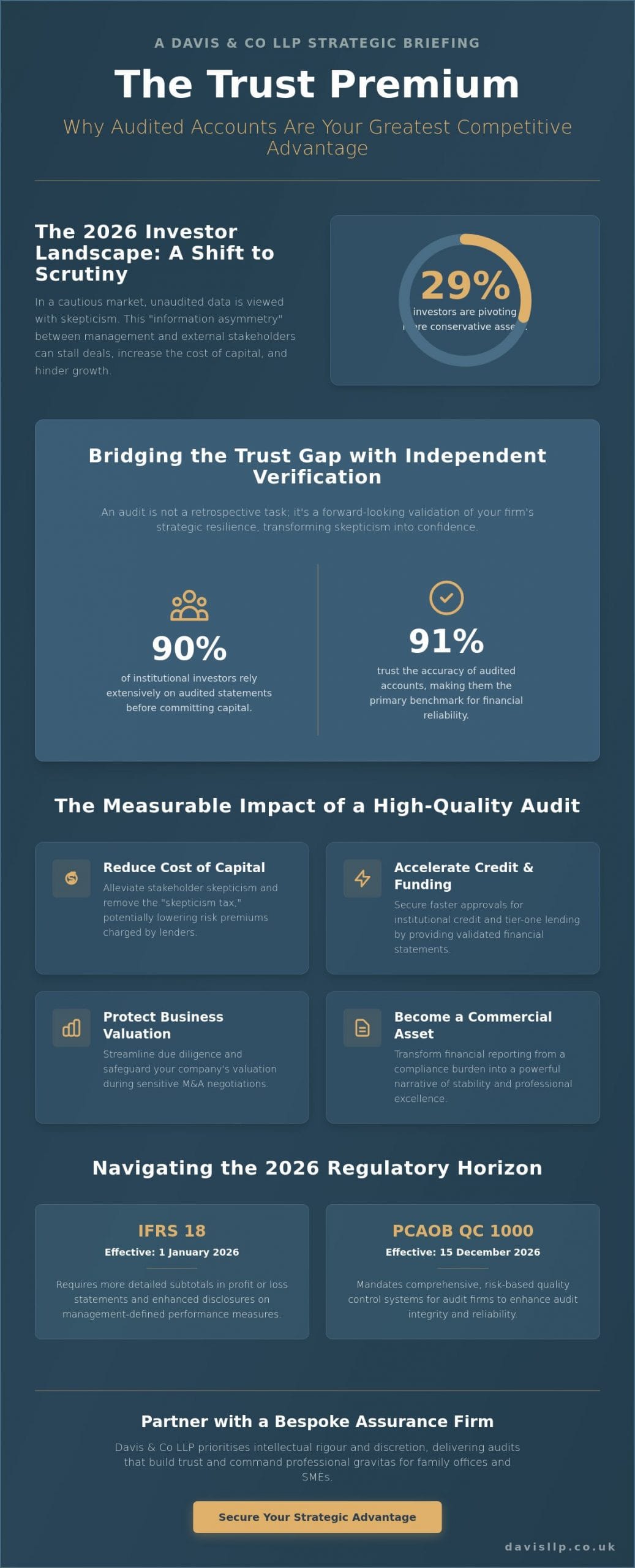
When 90% of institutional investors report that they rely on audited financial statements to a great extent before committing capital, the quality of your reporting becomes your most significant competitive advantage. In the current 2026 market, where 29% of investors are shifting toward more conservative positions, the clarity of your balance sheet is often the difference between a stalled deal and a successful exit. We understand the pressure of managing multi-jurisdictional reporting and the skepticism that often meets internal data during due diligence. Improving investor confidence with audited accounts requires a shift in perspective; it’s about viewing the audit not as a retrospective compliance task, but as a forward-looking validation of your firm’s strategic resilience.
You’ve likely felt the weight of increasing scrutiny, especially with the implementation of IFRS 18 and the new PCAOB QC 1000 standards taking effect this year. We’ll show you how a rigorous, bespoke audit process can eliminate the fear of hidden liabilities and streamline your transition through investor due diligence. This guide examines the strategic application of 2026 reporting taxonomies to help you achieve a higher business valuation and secure credit facilities with greater speed. We’ll provide a clear framework for turning statutory requirements into a powerful narrative of stability and professional excellence.
Key Takeaways
- Understand how independent verification bridges the trust gap, potentially reducing your cost of capital by alleviating stakeholder skepticism.
- Identify the strategic advantages of improving investor confidence with audited accounts to secure faster approvals for institutional credit and tier-one lending.
- Learn to transform your financial reporting from a compliance burden into a commercial asset by aligning asset valuations with your firm’s long-term strategic goals.
- Master a pragmatic pre-audit health check designed to streamline due diligence and protect your business valuation during sensitive M&A negotiations.
- Understand the value of a bespoke assurance partner who prioritises intellectual rigour and discretion for the unique needs of family offices and SMEs.
Bridging the Trust Gap: Why Investor Confidence Relies on Audited Accounts
Investor anxiety isn’t just a byproduct of market volatility; it’s a direct result of uncertainty regarding data integrity. As of early 2026, the psychological shift among capital providers is pronounced. A January 2026 MarketWise survey revealed that 29% of American investors intended to pivot toward more conservative assets this year. In such a cautious environment, the role of improving investor confidence with audited accounts cannot be overstated. When an external stakeholder reviews your financial position, they aren’t just looking at profit margins. They’re looking for a reason to trust your narrative.
An audit creates what we call the “Trust Premium.” This isn’t an abstract concept; it has a measurable impact on your cost of capital. Institutional investors are often willing to accept lower risk premiums when they have absolute clarity on a firm’s statutory standing. By providing an objective independent examination of financial statements, you essentially remove the “skepticism tax” that lenders apply to unverified data. According to a March 2026 CAQ survey, 91% of institutional investors trust the accuracy of audited accounts, making them the primary benchmark for financial reliability.
The Reality of Information Asymmetry
Management always possesses more granular insight into a business than external shareholders. This gap, known as information asymmetry, naturally breeds doubt. While your internal reports might be meticulous, they lack the external credibility required for high-stakes decisions. Investors often view unaudited figures in a pitch deck as aspirational rather than factual. This skepticism frequently leads to protracted due diligence or, in worse cases, a complete withdrawal from funding rounds. A robust audit closes this gap by providing a neutral perspective that aligns management’s claims with financial reality.
Independent Verification as a Market Signal
Choosing to undergo a voluntary audit signals corporate maturity. It demonstrates that your leadership team prioritises transparency and ethical governance over mere compliance. In a competitive 2026 landscape, this commitment differentiates high-growth firms from those that are merely surviving. It tells the market that you’re ready for institutional-grade scrutiny. Improving investor confidence with audited accounts serves as a powerful signal that your commercial narrative is backed by intellectual rigour and professional standards, positioning your firm as a secure partner for long-term capital.
The Anatomy of a High-Quality Audit: Beyond the Balance Sheet
A high-quality audit transcends the simple checking of ledgers; it involves a rigorous, intellectual interrogation of a company’s financial infrastructure. Professional scepticism serves as the cornerstone of this process. It’s a disciplined mindset that assumes nothing and verifies everything through empirical evidence. This approach is vital for improving investor confidence with audited accounts, especially as we transition into the more demanding regulatory environment of 2026. By scrutinising the logic behind financial entries, an auditor provides the “reasonable assurance” that institutional lenders require before extending significant credit facilities.
Adherence to the latest statutory requirements is non-negotiable for maintaining credibility. Effective 1 January 2026, IFRS 18 replaces IAS 1, requiring more detailed subtotals in profit or loss statements and enhanced disclosures regarding management-defined performance measures. Additionally, the PCAOB Auditing Standard QC 1000, which mandates comprehensive, risk-based quality control systems, takes effect on 15 December 2026. Ensuring your reporting aligns with these specific updates demonstrates a commitment to “quiet excellence” and precision. Empirical research highlights The Value of Audited Financial Reports in providing this necessary layer of protection for both shareholders and directors.
Robust Internal Control Assessments
Investors often value the “management letter” as much as the formal audit opinion itself. This document provides a candid assessment of your internal financial systems, identifying potential weaknesses before they manifest as liabilities. Strong internal controls are a prerequisite for business scalability; they ensure that as your transaction volume grows, your risk of fraud or clerical error remains suppressed. If you require a bespoke audit solution that reflects your firm’s unique commercial objectives, a considered evaluation of these controls is the first step toward long-term stability.
Valuation Accuracy and Revenue Integrity
Auditors play a critical role in verifying complex revenue streams, particularly in service-based industries where timing and recognition policies can vary. They also provide an independent check on asset valuations, ensuring that the balance sheet reflects a pragmatic reality rather than an optimistic projection. Materiality represents the threshold at which financial omissions or misstatements could reasonably be expected to influence the economic decisions of a prudent investor. By establishing clear materiality levels, the audit ensures that stakeholders can focus on the figures that truly impact the firm’s valuation and strategic direction.
Audited Accounts as a Catalyst for Strategic Business Growth
An audit is not a static document; it’s a dynamic instrument for expansion. For businesses seeking to move beyond organic growth, improving investor confidence with audited accounts acts as a necessary gateway to tier-one lending. Most major financial institutions require at least three years of verified financial history before considering large-scale credit facilities or revolving credit lines. Without this independent verification, your firm is often relegated to higher-interest, secondary market lenders. By presenting a clean audit report, you provide the assurance that allows banks to offer more competitive rates and flexible terms, reflecting your lower risk profile.
The impact on company valuation is equally significant. A “valuation hair-cut” occurs when a potential buyer applies a discount to your EBITDA multiple to account for perceived financial risk. If your revenue recognition or asset valuations haven’t been independently verified, a buyer might discount your valuation by 10% to 15% simply to hedge against the unknown. Conversely, a history of rigorous audits supports a premium multiple by validating the sustainability of your earnings. This preparation often begins with the guidance of a small business accountant who ensures that your daily bookkeeping aligns with the intellectual rigour required for a full statutory audit.
Attracting Institutional and Venture Capital
For private equity firms and venture capitalists, audited accounts are a non-negotiable prerequisite for investment. These entities are accountable to their own Limited Partners; they cannot justify significant capital deployment based on unverified internal data. Assurance de-risks the investment thesis by confirming that historical growth patterns are legitimate. In the 2026 market, where 90% of institutional investors rely on audited statements to a great extent, showing a verified, resilient financial history is essential for attracting high-calibre capital and building long-term trust.
Maximising Value in an Exit or Sale
A clean audit history can accelerate a sale process by several months. In M&A, the due diligence phase is where most deals falter; discrepancies in unaudited figures often lead to a loss of trust that negotiation rarely repairs. By maintaining “clean” accounts through regular audits, you ensure a seamless transition through the buyer’s scrutiny. This proactive approach eliminates the need for expensive, last-minute “look-back” audits and positions your firm as a mature, professionally managed entity ready for its next chapter.
Strategic Preparation: Optimising Financial Reporting for Investor Scrutiny
Preparation for an audit shouldn’t be a frantic year-end scramble. It’s a deliberate, year-round process of refinement that transforms your financial records into an investment-ready asset. Improving investor confidence with audited accounts begins with the integrity of your monthly reporting cycles. When your internal data is consistently accurate, the final audit becomes a validation of your excellence rather than a search for errors. High-quality management accounts serve as the foundation of this readiness, allowing you to identify trends and reconcile anomalies long before they’re presented to external stakeholders.
Investors in 2026 are particularly sensitive to “red flags” that suggest a lack of transparency. Related-party transactions and contingent liabilities are often scrutinised with the most intensity during due diligence. Proactively addressing these areas by ensuring all transactions are conducted at arm’s length and clearly documented prevents awkward questions during a funding round. If you’re preparing for a significant capital event, we recommend a bespoke pre-audit consultation to ensure your reporting aligns with the sophisticated expectations of institutional investors.
Conducting a Pre-Audit Gap Analysis
A rigorous internal health check is the first step toward a seamless audit. This involves a meticulous review of the trial balance to ensure no unallocated items or inconsistencies remain. You should ensure all statutory filings, including VAT and payroll reconciliations, are up to date and supported by a clear audit trail. Gathering empirical evidence for significant accounting estimates, such as bad debt provisions or the valuation of intangible assets, is essential. Providing this documentation upfront demonstrates professional gravitas and reduces the time auditors spend on basic verification.
Narrative Reporting: Telling the Story Behind the Numbers
The numbers in your financial statements tell the “what,” but your Strategic Report must explain the “why.” Investors look for a cohesive commercial narrative that links financial performance with your broader business objectives. This means ensuring your Key Performance Indicators (KPIs) are relevant to your specific sector and consistently applied. If your management commentary highlights a shift toward a subscription-based model, your revenue recognition policies must reflect that transition with precision. Consistency between the board’s narrative and the audited figures is a hallmark of a mature, well-governed firm.
Bespoke Assurance: The Davis & Co LLP Approach to Professional Gravitas
At Davis & Co LLP, we believe an audit should reflect the same intellectual rigour you apply to your commercial strategy. We don’t view assurance as a commodity. Instead, we treat it as a cornerstone of your firm’s reputation. Improving investor confidence with audited accounts is a delicate process that requires more than technical accuracy; it demands a partner who understands the nuances of your industry and the specific anxieties of your stakeholders. Our approach is defined by “quiet excellence,” providing a steady, reliable presence that reinforces your credibility. By the time the 2026 audit cycle concludes, our goal is to ensure your financial statements are viewed as a testament to your firm’s resilience and maturity.
The 2026 regulatory environment, marked by the introduction of IFRS 18 and the PCAOB’s QC 1000 standards, leaves little room for error. We provide a composed partnership that helps you meet these stringent requirements while maintaining the discretion essential for sensitive commercial matters. Whether you’re an SME or a family office, our process is tailored to the practical realities of your business. We don’t just identify engagement deficiencies; we provide the intellectual framework to resolve them before they impact your market standing.
The Value of a Strategic Audit Partner
Our firm avoids the transactional distance typical of larger, less personal practices. We focus on providing pragmatic business advice alongside statutory assurance, helping you navigate complex growth phases with a sense of security. Our experience shows that investors respond best to firms that demonstrate a proactive approach to risk management. Davis & Co LLP maintains the rigorous independence essential for statutory integrity while providing the bespoke, strategic insights that allow your leadership team to navigate complex commercial challenges with confidence.
Assurance for International and Specialist Sectors
For businesses with cross-border interests, the complexity of multi-jurisdictional reporting can be a significant barrier to capital. Integrating international tax planning with your audit ensures that your global operations are both tax-efficient and fully compliant with 2026 standards. We’ve developed niche expertise in sectors requiring specialised accounting, including property development and dental practices, where revenue recognition rules are particularly intricate. By ensuring your accounts meet the highest standards of UK and international scrutiny, we help you project a badge of professional standards that resonates with the 90% of institutional investors who now rely almost exclusively on audited data for their decision-making.
Securing Your Commercial Advantage through Strategic Assurance
The transition from simple compliance to strategic readiness is the defining challenge for leadership teams in 2026. We’ve explored how a rigorous audit reduces information asymmetry and eliminates the valuation discounts that often plague unverified financial statements. By aligning your commercial narrative with statutory precision, you position your firm to capture institutional interest and secure tier-one credit facilities with greater efficiency. Improving investor confidence with audited accounts is a deliberate choice to prioritise transparency and long-term stability over short-term expediency.
As Chartered Certified Accountants since 1901, we bring 125 years of expertise to every engagement, specialising in international tax and business growth. Our history of strategic success is built on a foundation of intellectual rigour and professional discretion. We invite you to secure your business’s future with bespoke audit and assurance services from Davis & Co LLP. Our team remains a dependable constant in a volatile market, providing the composed partnership your commercial objectives deserve. We look forward to helping you transform your financial reporting into a powerful instrument for growth.
Frequently Asked Questions
Is an audit mandatory for all UK companies in 2026?
No, an audit isn’t mandatory for every UK entity. Small companies generally qualify for an exemption if they meet at least two of the following criteria: an annual turnover of no more than £10.2 million, a balance sheet total of no more than £5.1 million, or an average of 50 or fewer employees. Although the 2026 Audit Reform Bill was halted in January 2026, leaving 81% of the proposed reforms unlegislated, many exempt firms still opt for a voluntary audit to demonstrate professional standards.
How much does a statutory audit typically cost for an SME?
Audit fees vary based on the complexity of the business and the quality of its internal controls. According to data released in April 2026, non-accelerated public filers paid an average of $734,000 for their annual audits, while accelerated filers saw costs average $1.62 million. For private SMEs, the investment is typically lower but remains a strategic cost. Improving investor confidence with audited accounts often pays for itself by securing more competitive interest rates from tier-one lenders.
Can an audit actually increase my company’s valuation?
Yes, a clean audit history can significantly enhance your business valuation by removing the “skepticism tax” applied to unverified data. Investors frequently apply a valuation discount of 10% to 15% when they encounter unaudited financial statements during due diligence. By providing an independent verification of your EBITDA and asset valuations, you provide the empirical evidence necessary to support a higher multiple and justify a premium price during an exit or funding round.
What is the difference between an audit and an independent examination?
An audit provides “reasonable assurance” through a rigorous, intellectual interrogation of your entire financial infrastructure. In contrast, an independent examination offers “limited assurance” and is a less intensive review often used by smaller charities. Institutional investors and venture capital firms almost exclusively require a full audit. They value the substantive testing of internal controls and transactions that an independent examination simply doesn’t provide.
How long does a full financial audit usually take to complete?
A standard financial audit typically requires four to eight weeks to complete from the start of fieldwork to the signing of the report. The duration depends heavily on the complexity of your multi-jurisdictional reporting and the readiness of your internal team. Maintaining accurate management accounts throughout the year can reduce this timeline. A well-prepared firm ensures the process remains steady and measured, avoiding the need for hurried, last-minute reconciliations.
What are the most common red flags auditors find that worry investors?
Investors are most concerned by inconsistencies in revenue recognition and undisclosed related-party transactions. Auditors also frequently identify weaknesses in internal controls that could potentially lead to fraud or clerical error. In the cautious 2026 market, where 29% of investors are moving toward safer assets, these red flags can stall a deal. Improving investor confidence with audited accounts involves proactively identifying and resolving these issues before they reach the due diligence phase.
Do I need an audit if I am not planning to sell my business?
Even if an exit isn’t on your immediate horizon, an audit is a powerful tool for securing institutional credit. Most tier-one banks require a verified financial history before they’ll approve significant revolving credit lines or expansion capital. It also provides the board with a pragmatic assessment of the firm’s financial health. This internal oversight ensures that your business remains resilient and ready for any strategic opportunity that may arise.
How does international tax planning affect the audit process?
International tax planning adds a layer of complexity that auditors must verify to ensure global statutory compliance. The audit process involves scrutinising transfer pricing arrangements and ensuring that tax provisions are accurately reflected across all jurisdictions. This verification is essential for businesses with cross-border interests. It confirms that your tax strategy is robust and won’t lead to unexpected liabilities that could damage your reputation or your standing with international investors.