The UK rules for non-domiciled tax status changed on 6 April 2025: the former non-dom regime ended, and inheritance tax liability on overseas assets now depends on residence rather than domicile. According to HM Revenue & Customs, an individual is long-term UK resident for inheritance tax purposes if they have been UK resident for at least 10 out of the last 20 tax years. After leaving, some former long-term residents can remain within the UK inheritance tax net for up to 10 years.
It’s understandable to ask what has changed and whether leaving the UK ends inheritance tax exposure. This guide explains how the residence test works, how the residence tail is calculated and what the transition may mean if you have overseas assets or existing trusts. It also sets out practical points to review, including your residence history and asset arrangements, so you can identify the issues relevant to your circumstances.
Key Takeaways
- The former non-dom regime ended in April 2025, so review how the new residence-based rules affect your tax position.
- Your UK residence history can affect how long overseas assets remain within the scope of inheritance tax after you leave.
- Past remittance-basis arrangements and existing trusts may still need attention under transitional rules.
- Review your residence timeline, overseas assets and estate arrangements together to identify the planning decisions that matter now.
Changing rules for non-doms – what to do now?
Since 6 April 2025, the former remittance basis has been replaced by a residence-based approach to foreign income and gains. The practical priority is to distinguish historic income from amounts arising under the new rules.
Four-Year Foreign Income and Gains Regime
The Foreign Income and Gains regime can provide relief on qualifying foreign income and gains for up to four years. It is available to individuals who were non-UK resident for at least the previous ten tax years before becoming UK resident. People already resident on 6 April 2025 for fewer than four tax years may claim for the remainder of that period. Eligibility therefore turns on residence history, not non-dom status. A claim can also mean losing entitlement to the personal allowance and capital gains tax annual exempt amount.
Reporting Foreign Income and Gains
Reporting requirements differ between the former regime and the rules from 2025/26. For tax years up to 5 April 2025, individuals had to report foreign income or gains of £2,000 or more, or any money brought into the UK, in a Self Assessment tax return. According to HM Revenue & Customs, before 6 April 2025, a UK non-domiciled resident did not pay UK tax on foreign income or gains under £2,000 a year if they did not bring them into the UK. From tax year 2025/26, UK residents who do not claim FIG relief are taxable on worldwide income and gains. Separate records for the period and source of each amount help distinguish historic balances from new income.
Remittance Basis Treatment
The remittance basis taxed foreign income and gains when they were brought into the UK, rather than when they arose. It was available under the former non-dom regime, with the 2024/25 tax year the last in which it could be claimed. Foreign income and gains arising before 6 April 2025 can remain taxable if brought into the UK on or after that date, subject to any applicable Temporary Repatriation Facility relief. The treatment of older funds therefore depends on when they arose, whether they were remitted, and whether a relief election applies.
Risks of Incorrect Tax Claims
An incorrect non-dom or foreign income claim can leave taxable amounts omitted from a return and create an underpayment. Inaccurate Self Assessment may also lead to interest and penalties, with the consequences depending on the error and its disclosure. Keep residence records, source documents and remittance histories aligned with the relevant tax year. In particular, separate pre-6 April 2025 funds from later foreign income before reporting or transferring money into the UK.
The inheritance tax residence tail after leaving the UK
Inheritance tax exposure on overseas assets can continue after you leave the UK. The key factors are your residence history, the transitional rules and the length of any residence tail.
Domicile, Nationality and Residence
Domicile concerns a person’s enduring home, while nationality and tax residence describe different connections. A person’s domicile is usually the country their father considered his permanent home when they were born, and it may change if they move abroad without intending to return. Since 6 April 2025, residence status, rather than domicile, determines whether overseas assets may be subject to UK inheritance tax. This distinction matters when assessing an internationally mobile person’s estate.
Long-Term UK Residence Test
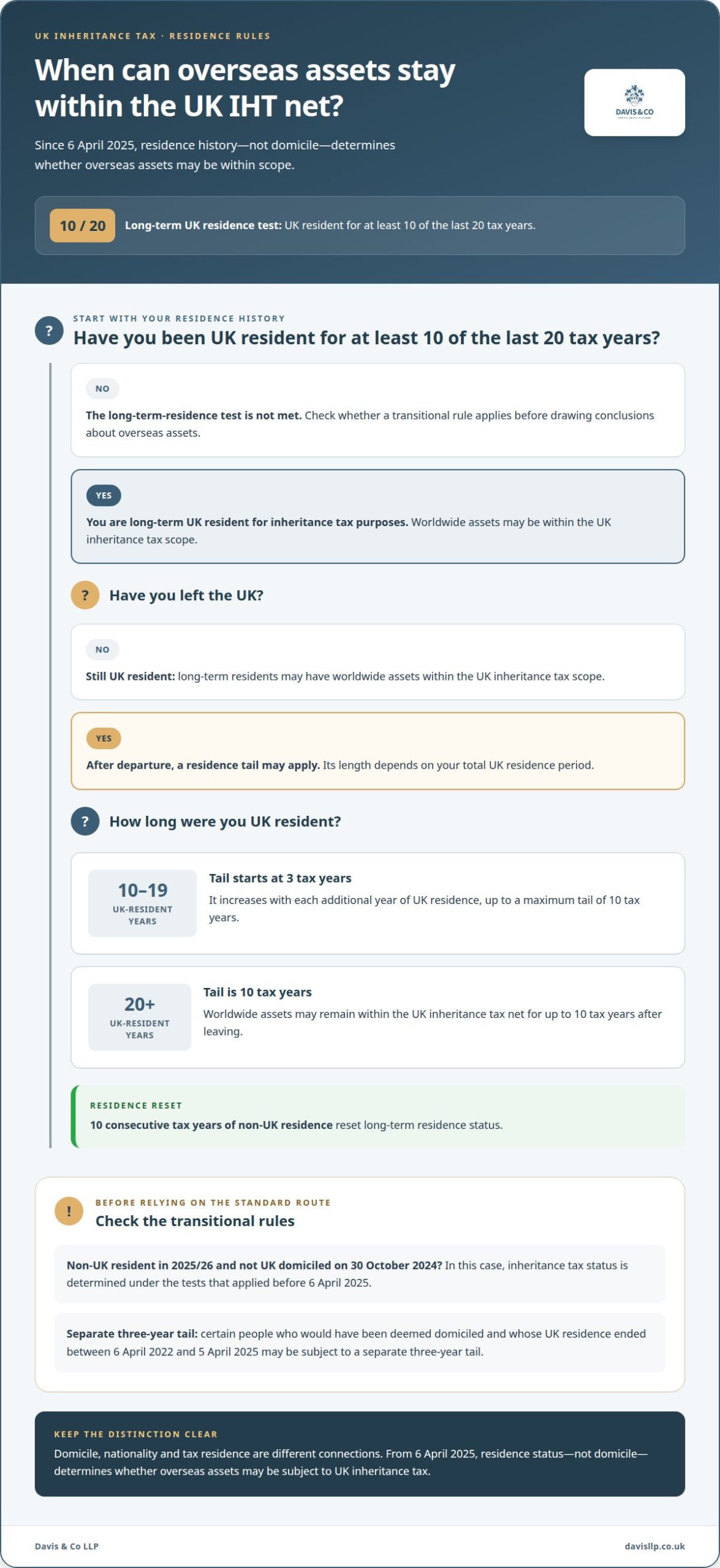
HM Revenue & Customs defines an individual as long-term UK resident for inheritance tax purposes if they were UK resident for at least 10 out of the last 20 tax years. This test can bring worldwide assets within the UK inheritance tax scope. The residence tail after departure depends on the total UK residence period: for 10 to 19 years, it begins at three tax years and increases with each additional year, up to 10. A period of 20 years or more brings a 10-tax-year tail.
Transitional Rules for Existing Residents
Transitional rules can change which test applies to people already outside the UK or resident during the changeover. A person who was non-UK resident in 2025/26 and not UK domiciled on 30 October 2024 has their inheritance tax status determined under the tests applying before 6 April 2025. A separate three-year tail applies to certain people who would have been deemed domiciled and whose UK residence ended between 6 April 2022 and 5 April 2025. These dates make residence records important.
Inheritance Tax for Former Non-Doms
Former non-doms are assessed under residence-based rules, not by a continuing non-dom label. UK residents are generally taxable on worldwide income and gains; non-residents generally pay UK tax on UK income, not foreign income. For inheritance tax, worldwide assets may remain within scope during the tail after a long period of UK residence. Ten consecutive tax years of non-UK residence reset long-term residence status. Your position therefore depends on your residence history, when you leave and which assets you hold.
What do the changes mean for inheritance tax?
Before 6 April 2025, non-domiciled UK residents could use the remittance basis for foreign income and gains. Generally, UK tax applied when those amounts were brought into the country. The rules also imposed charges as residence in the UK continued. According to HM Revenue & Customs, residents paid an annual charge of £30,000 after UK residence for at least 7 of the previous 9 tax years. After at least 12 of the previous 14 tax years, the annual charge was £60,000.
Those charges belonged to the former income tax regime; they were not inheritance tax charges. The remittance basis ended on 5 April 2025, and domicile is no longer the test for inheritance tax liability from 6 April 2025. Residence history now determines whether overseas assets may fall within the UK inheritance tax net. This means someone’s income tax treatment and estate position must be considered separately.
For inheritance tax, long-term UK residents may have worldwide assets within scope, including assets held outside the UK. Leaving the country does not necessarily end that exposure immediately: the residence tail depends on the person’s UK residence history and can last from three to 10 tax years. For example, a person resident for 10 to 19 years faces a tail that starts at three tax years and increases with each additional year of UK residence. A period of 20 years or more brings a 10-tax-year tail.
Trust planning also needs review. Certain pre-existing trusts holding non-UK-situs assets may face inheritance tax periodic and exit charges at 6% from 6 April 2025. Excluded property trusts created after 30 October 2024 may be affected by gift-with-reservation rules, which can bring trust value into a long-term UK resident’s estate. If the donor retains a benefit immediately before death, non-UK property subject to those provisions is included and taxed at 40%. Review the trust’s creation date, assets and retained benefits together.
Abolition of non-domicile status
The UK abolished non-domicile status for tax purposes from 6 April 2025, replacing the previous regime with residence-based rules. The remittance basis is no longer available for income and gains arising from that date. Instead, UK residents are generally taxed on worldwide income and gains, unless they qualify for relief under the new Foreign Income and Gains regime. The change makes residence history, rather than domicile, central to assessing the treatment of foreign income and investment returns.
The four-year FIG regime may provide relief to individuals who have been non-UK resident for at least ten tax years before becoming UK resident. Qualifying foreign income and gains can receive relief during the first four years of UK residence. Individuals already resident on 6 April 2025 for less than four tax years may be eligible for the remaining period. A claim has trade-offs: for tax years from 2025/26, claimants lose entitlement to the UK personal allowance and capital gains tax annual exempt amount. Compare the potential relief with those allowances before making a claim.
The abolition did not erase earlier balances. Foreign income and gains arising before 6 April 2025 under the remittance basis may remain taxable if brought into the UK on or after that date. Eligible former remittance-basis users may designate certain historic amounts through the Temporary Repatriation Facility. Its rate is 12% for 2025/26 and 2026/27, then 15% for 2027/28. The election applies tax to the full designated amount in the year made, so timing and the balance selected matter.
For practical planning, separate pre-6 April 2025 funds from later income, record the source and date of each amount, and assess whether FIG relief or the Temporary Repatriation Facility applies. The right treatment can differ between income, capital gains and investment proceeds. Discuss your tax position with Davis & Co LLP if you need a structured review of the records and claims affected by the transition.
Davis & Co LLP
Davis & Co LLP helps individuals assess how the UK’s residence-based tax rules apply to their circumstances. Its International Tax Planning and Personal Tax Services can support a review of residence history, foreign income and gains, and the tax treatment of assets brought into the UK. This may be particularly relevant if you have moved to or from the UK, have historic remittance-basis funds, or are considering a Foreign Income and Gains claim and the allowances it may affect.
A useful review brings the relevant tax years, income records and asset arrangements together. This can help distinguish questions about current tax returns from longer-term planning, including inheritance tax exposure after departure. Contact Davis & Co LLP to discuss your circumstances and the tax questions you want to address.
Make your next tax decisions with clarity
Start by creating a clear record of your circumstances. Bring together your UK residence timeline, overseas income and gains, asset ownership and any historic remittance-basis balances. This gives you a practical basis for considering how the UK’s non-domiciled tax status rules relate to your plans, rather than viewing each tax issue in isolation.
These decisions may also affect wider financial planning. Davis & Co LLP offers International Tax Planning, as well as Cash Flow Management and Business Growth Acceleration when personal tax considerations intersect with business or investment decisions. The right focus depends on your arrangements and priorities.
Contact Davis & Co LLP for advice about the tax questions you need to resolve. A measured review can help you approach your next decisions with greater clarity.
Davis & Co LLP and non-domiciled tax planning
Davis & Co LLP provides International Tax Planning and Personal Tax Services. After reviewing the UK rules on non-domiciled tax status, contact the firm to discuss how they apply to your circumstances and tax planning needs.
Davis & Co LLP also offers Trust Tax Services, Property Accounting and other business and tax services. Contact the firm if you need support with these areas as part of your personal tax planning.
Frequently Asked Questions
What is non-dom status?
Non-dom status was a former UK tax treatment for a UK resident whose domicile was outside the UK. It wasn’t a separate nationality or immigration category, and the regime ended for UK tax purposes on 6 April 2025. The term may still appear in older tax returns, trust documents or family records, so its meaning depends on the period and context being discussed.
How do you become a non-dom?
You could not become non-domiciled simply by applying for a tax status. Domicile is a distinct legal concept connected to a person’s permanent home and intentions; it is not determined solely by citizenship or current residence. Since the former non-dom tax regime ended, having a domicile outside the UK does not by itself provide the previous tax treatment. Moving abroad alone does not settle every tax question.
What is a non-dom?
“Non-dom” is an informal term for someone who was UK resident but had a domicile outside the UK under the former tax regime. The label describes a historical tax distinction, not a current exemption from UK tax. For example, an old tax return using the term does not by itself establish how a later tax year should be treated. Assess each relevant year and its circumstances separately.
What tax reliefs are available?
Relief may be available through the Foreign Income and Gains regime or, for eligible historic balances, the Temporary Repatriation Facility. Some former remittance-basis users who can’t claim the four-year regime may also qualify for rebasing certain non-UK assets to their market value on 5 April 2017. Rebasing eligibility depends on having claimed the remittance basis for a tax year from 2017/18 onwards.
What does non-domiciled tax status mean in the UK?
The expression refers to the former distinction between UK residence and domicile for tax purposes. Under the non-domiciled tax status UK rules, eligible residents could use the remittance basis for foreign income and gains. That framework no longer applies to current tax years. The term may still matter when reviewing historic returns or transitional provisions, but it does not determine current tax treatment by itself.
What are the UK tax residence and domicile rules?
Residence and domicile are separate concepts: UK tax residence is assessed under the Statutory Residence Test, while domicile concerns a person’s permanent home. The residence test considers automatic UK and overseas tests alongside sufficient ties. For example, spending 183 or more days in the UK in a tax year meets an automatic UK residence test. A person’s residence history can also affect inheritance tax treatment.