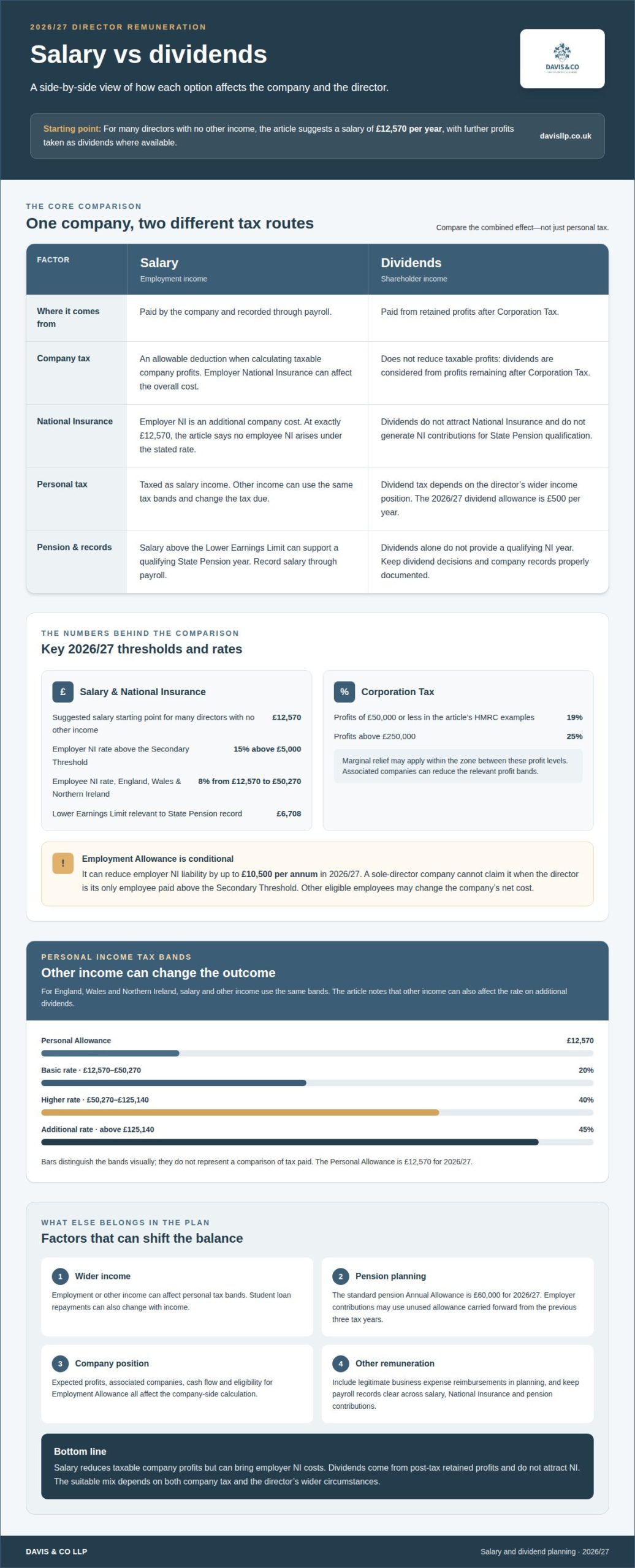
For many UK limited company directors with no other income, a suitable starting point for 2026/27 is a salary of £12,570, with further profits taken as dividends where available.
It’s understandable to focus on take-home pay, but a useful comparison also accounts for Corporation Tax, personal tax and the company’s eligibility for allowances. Salary is deductible when calculating Corporation Tax, while dividends come from retained profits after tax and do not attract National Insurance. The right balance is not simply whichever option has the lower personal tax rate.
This article explains how salary and dividends affect the company and your personal income, sets out the employer National Insurance calculation on a £12,570 salary, and considers when a different salary may suit your circumstances in 2026/27. You’ll also see how dividend tax and other income can change the overall take-home figure.
Key Takeaways
- Compare salary and dividends across both company and personal tax to understand their combined effect on take-home pay.
- Assess employer National Insurance alongside any Employment Allowance when weighing different salary levels.
- Factor pension contributions and legitimate business expense reimbursements into your remuneration planning.
- Keep dividend decisions and company records properly documented, with company secretarial support where it helps.
Is salary better than dividends for a company director?
For 2026/27, the better choice depends on company profits and the director’s wider income position. HM Revenue & Customs gives a 19% Corporation Tax rate where annual company profits are £50,000 or less in its 2026/27 examples.
Corporation Tax Relief on Director Salary
A director’s salary is an allowable company deduction when calculating profits subject to Corporation Tax. For example, a £12,570 salary reduces the profit figure used in that calculation, although employer National Insurance can affect the overall cost. The salary must be recorded through payroll, and the company’s tax position depends on its remaining taxable profits. A sole director should consider both the deduction and the related payroll costs, rather than treating the salary as tax-free company income.
Salary and Dividends in Corporation Tax Calculations
Salary reduces taxable company profits, whereas dividends are paid from retained profits after Corporation Tax. That changes the order of the calculation: the company accounts for salary before calculating taxable profit, then considers dividends from the profits remaining after tax. A director with other income, such as employment income, must also consider how it affects their personal tax position. Student loan repayments can change with income, and multiple shareholders can affect how available dividends are divided. As a result, the same company profit can produce different personal outcomes.
Associated Companies and Marginal Relief
For 2026/27, Corporation Tax is 25% on profits above £250,000. Companies within the marginal relief zone may have a Corporation Tax charge that varies with their circumstances. These thresholds can be reduced where a company has associated companies, so the relevant profit bands may be lower. Marginal relief adjusts the tax charge across the zone; it isn’t a separate deduction from salary. Before comparing extraction options, assess the company’s associated-company position and expected profits together, since both can affect the Corporation Tax calculation.
How much employer National Insurance is due on a £12,570 director’s salary?
The company’s final cost depends on whether it qualifies for the allowance and on the director’s other earnings.
Employee and Employer National Insurance
Employee National Insurance is deducted from a person’s earnings, while employer National Insurance is an additional company cost. At a salary of £12,570, the employee is at the 2026/27 Primary Threshold, while the employer calculation uses a lower threshold. This distinction matters: a director can have no employee contributions at that salary while the company still owes employer contributions.
National Insurance Thresholds and Rates
HM Revenue & Customs gives the employer National Insurance rate as 15% on the part of salary above the £5,000 Secondary Threshold. For employees in England, Wales and Northern Ireland, the rate is 8% on earnings between £12,570 and £50,270 in 2026/27. At exactly £12,570, no employee contribution arises under that rate.
An Employment Allowance can reduce a company’s employer National Insurance liability by up to £10,500 per annum in 2026/27. However, a sole-director company cannot claim it when the director is its only employee paid above the Secondary Threshold. A company with other eligible employees may therefore have a different net cost. The allowance affects the company’s liability, not the employee’s deductions, so keep the two calculations distinct when comparing salary and dividends.
Employer pension contributions are another part of remuneration planning, separate from salary and dividends. For 2026/27, the standard pension Annual Allowance is £60,000, and employer contributions may use unused allowance carried forward from the previous three tax years. Consider contribution levels alongside salary, company profits and available allowances; each affects the overall allocation of business funds. Payroll records should distinguish salary, National Insurance and pension contributions clearly.
What is the optimum limited company salary for 2026/27?
For many directors with no other income, a salary of £12,570 per annum is the suggested starting point for 2026/27. The suitable amount can change with State Pension qualification, other income, pension planning and company cash flow.
Income Tax Bands and Personal Allowance
Income tax bands determine the rate applied to taxable salary and other income, so they affect the personal cost of remuneration. According to HM Revenue & Customs, the Personal Allowance is £12,570 for 2026/27. In England, Wales and Northern Ireland, the basic rate is 20% between £12,570 and £50,270; the higher rate is 40% between £50,270 and £125,140; and the additional rate is 45% above £125,140.
Other income uses some or all of the same bands, potentially changing the tax rate on additional salary or dividends. The dividend allowance is £500 per year in 2026/27, so include it when modelling the overall amount received.
Lower Earnings Limit and State Pension Qualification
The Lower Earnings Limit is the salary level relevant to whether earnings qualify towards a State Pension record. In 2026/27, it is £6,708, and a director must be paid above this level for the year to qualify towards the State Pension. A lower salary may therefore affect entitlement, even if it reduces the company’s payroll cost.
Compare the proposed salary with the director’s existing National Insurance record and other earnings. Dividends do not generate National Insurance contributions, so they cannot replace salary for this qualifying purpose.
Salary, Dividends and Pension Entitlements
Salary and dividends affect pension planning differently: salary is employment income, while dividends are shareholder income. Salary above the Lower Earnings Limit can support a qualifying State Pension year; dividends alone do not provide this National Insurance basis. Consider personal and employer pension contributions alongside the chosen salary.
If the director has other income, it may already use some of the available tax bands and personal allowance. This can change the relative value of additional salary and dividends.
Pension Contributions and Expense Reimbursements
Pension contributions and expense reimbursements are separate from salary and dividends. An employer pension contribution can form part of remuneration planning, while reimbursement records should distinguish business costs from personal extraction. This helps the company separate business expenditure from amounts paid as income.
Keep receipts and accounting records for business expenses, and record salary through payroll. Then assess pension funding against the director’s income, company profits and available allowance before deciding on the overall remuneration mix.
Salary and dividend extraction for UK limited company directors
For 2026/27, compare the company’s available post-tax profits with your personal income tax position. The extraction method affects what reaches you and which records support each payment.
Dividend Rules and Distributable Profits
A dividend is a payment to a shareholder from a company’s retained profits after tax. It must be supported by distributable profits, not simply by cash in the bank. Prepare a board minute and dividend voucher for each payment. These records show the decision, amount and recipient, and distinguish a dividend from salary or another payment in the company accounts.
Dividends When Profits Are Insufficient
A company can pay dividends only from retained profits after tax. If it has a loss or insufficient profits, there is no distributable amount for a dividend. Cash availability alone does not change this. Do not treat a transfer as a dividend when profits are insufficient; record it according to what it represents and review the company’s accounts before making further distributions.
Salary and Dividend Records and Filings
Salary is processed through payroll, while dividend payments need their own board minutes and vouchers. PAYE registration is required once any employee earns £6,708 a year or more. Keep payroll information and dividend records distinct, and ensure the company’s accounting records capture both accurately. Dividend income above £10,000 requires a Self Assessment tax return, so directors should include that obligation in their personal tax planning.
Take-Home Pay and National Insurance
According to HM Revenue & Customs, the Personal Allowance is £12,570 for the 2026/27 tax year, and the dividend allowance is £500 per year in 2026/27. HM Revenue & Customs sets the basic-rate dividend tax rate at 10.75% in 2026/27 and the higher-rate dividend tax rate at 35.75% in 2026/27. Salary can also create employer National Insurance, while dividends don’t attract National Insurance. Your combined income determines the applicable tax rate and take-home amount.
For help aligning dividend records, payroll and personal tax calculations, speak with Davis & Co LLP.
Davis & Co LLP: Company Secretarial Services
Davis & Co LLP provides Company Secretarial Services to support company administration and records. This can help when formalising dividend decisions, maintaining company records or coordinating administration alongside salary and tax planning.
Clear records keep shareholder decisions and financial reporting distinct from payroll and personal tax calculations. If decisions about extracting profits also affect wider business priorities, Davis & Co LLP can bring International Tax Planning, Cash Flow Management or Business Growth Acceleration into the discussion. The focus depends on the company’s circumstances and the decisions its directors need to make.
For support with company administration and related planning, contact Davis & Co LLP.
Plan your next remuneration decision with clarity
A salary-versus-dividend decision for a limited company director in 2026 is best considered alongside the company’s plans, available cash and your personal tax position. Rather than treating extraction as a one-off calculation, review it when business circumstances or personal income change. That creates space to consider how remuneration choices support both your current needs and the company’s next stage.
Davis & Co LLP can bring International Tax Planning, Cash Flow Management and Business Growth Acceleration into the wider discussion. The aim is to relate financial decisions to your circumstances and business priorities, rather than view each payment in isolation.
If you’re ready to discuss your company’s position and possible next steps, contact Davis & Co LLP. A considered plan can help you approach future decisions with greater confidence.
Davis & Co LLP can help you choose how to take income
Davis & Co LLP provides Personal Tax Services, Payroll Services and Company Secretarial Services for limited company directors considering salary and dividends. These services can help you understand the tax and administrative implications of your choices.
Turn to Davis & Co LLP for advice tailored to your circumstances or a review of your income arrangements. The firm also offers Cash Flow Management and Management Accounts to help you understand how director pay fits your business finances.
Frequently Asked Questions
How much tax do I pay on dividends in 2026/27?
Dividend tax depends on your total taxable income and the tax band that applies to it. The first £500 of dividend income falls within the annual dividend allowance; tax may apply to dividends above that amount. Salary, employment income and other taxable income can affect which dividend rate applies. To estimate your liability, assess all income for the tax year together rather than calculating dividends in isolation.
What is the most tax-efficient director salary for 2026/27?
For a director with no other income, £12,570 per annum is a suggested salary for 2026/27. It’s a starting point, not a universal answer: other earnings, pension arrangements, company profits and eligibility for Employment Allowance can change the comparison. For a salary-versus-dividend decision for a UK limited company director in 2026, model both company costs and personal tax before settling the amount.
What was the optimum director’s salary for 2023/24, 2024/25 and 2025/26?
The suggested salary figures differ across these tax years. A £9,100 salary was identified as tax-efficient for 2023/24 and 2024/25 where minimal administration was the aim; the recommended figure for 2025/26 was £12,570. These are historical reference points, not a substitute for reviewing the director’s income, company circumstances and applicable rules for the specific tax year.
Why not pay a £nil salary?
A £nil salary means no earnings from that company to support a National Insurance qualifying year. For 2026/27, the Lower Earnings Limit is £6,708, and a director must be paid above that level for the year to qualify towards the State Pension. Dividends don’t provide the same National Insurance record. Consider existing qualifying years and other earnings before deciding that no salary is appropriate.
Do I need to register for Self Assessment if I take dividends?
Dividend income above £10,000 requires a Self Assessment tax return. Taking dividends below that amount does not, by itself, establish whether you must file; other income or circumstances may also matter. If you do need to report dividend income, include it in your return for the relevant tax year. Any dividend tax due is payable by 31 January following the end of that tax year.
What are the 2026/27 dividend tax rates and dividend allowance in the UK?
According to HM Revenue & Customs, the dividend allowance is £500 per year in 2026/27, the basic-rate dividend tax rate is 10.75%, and the higher-rate rate is 35.75%. The additional-rate dividend tax rate is 39.35%. Your applicable rate depends on total taxable income and the tax band it falls within, so other income can affect the tax due on dividends.