A P11D records taxable benefits and expenses an employer has provided to an employee; it doesn’t calculate the employee’s tax bill. With P11D benefits in kind explained clearly, the key distinction is between the benefit’s cash-equivalent value, which is used to work out the employee’s tax, and the employer’s separate Class 1A National Insurance liability.
It’s understandable to focus on the form, but the figures behind it matter just as much. A company car, private medical insurance or an interest-free loan can each have a different taxable value, and the method depends on the type of benefit. According to HM Revenue & Customs, the usual deadline for filing P11D and P11D(b) forms is 6 July after the tax year being reported.
This guide explains what a P11D covers, which benefits may be taxable and how cash-equivalent values are determined. It also outlines how company car tax is calculated, when Class 1A National Insurance applies, and what employers need to know about reporting and payment deadlines.
Key Takeaways
- Identify which employer-provided perks are taxable and which may qualify for an exemption before preparing benefit records.
- HM Revenue & Customs says an employer-provided loan is typically reported on a P11D if it exceeds £10,000 and is charged no or low interest.
- Company car tax depends on factors including the vehicle’s list price, CO₂ emissions, fuel type and registration date.
- HM Revenue & Customs sets the Class 1A National Insurance payment deadline at 22 July, or 19 July when paying by cheque.
- A trivial benefit may be exempt from tax and National Insurance contributions if it costs £50 or less and meets the qualifying conditions, according to HM Revenue & Customs.
What counts as a benefit in kind?
Employees pay income tax on taxable benefits through PAYE when an employer reports their value in payroll. If the employer uses a P11D instead, HMRC can adjust the employee’s tax code to collect the tax from salary. Employees who must complete a tax return normally pay tax due by 31 January following the tax year. P11D benefits in kind explained clearly help employees understand why a benefit can affect tax without appearing as cash pay.
A benefit in kind is something an employer provides in addition to salary, rather than as cash. Common examples include private medical insurance, vouchers, and goods or services for an employee’s personal use. The distinction matters: an item that supports work may be exempt, while private use can create a taxable benefit.
Some benefits are exempt, including certain pension contributions, work-provided mobile phones, training and staff welfare services. Qualifying staff parties and some childcare support may also be exempt. Genuine reimbursed business expenses have been exempt since 6 April 2016. A benefit’s treatment depends on what the employer provides and whether the employee receives personal value from it.
Employers have been able to payroll most benefits in kind since April 2016. Under payrolling, the employer adds the taxable value to payroll so PAYE can collect the employee’s tax across the year. The employer must tell HMRC before 6 April if it intends to payroll benefits in the coming tax year. Payroll software needs accurate benefit values and employee records to calculate deductions correctly.
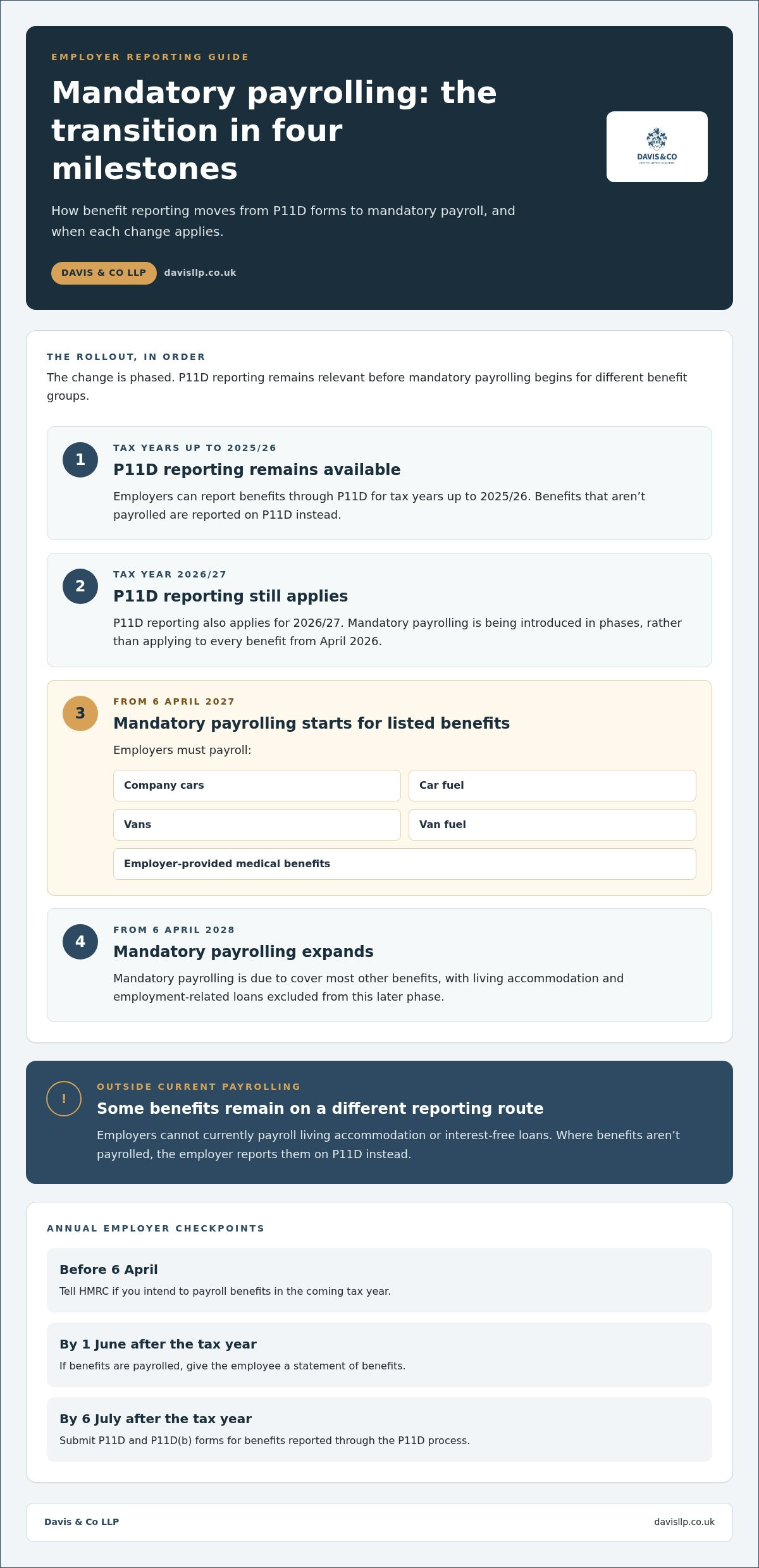
Mandatory payrolling is being introduced in phases, rather than applying to every benefit from April 2026. Employers can report benefits through P11D for tax years up to 2025/26, and P11D reporting also applies for 2026/27. From 6 April 2027, employers must payroll company cars, car fuel, vans, van fuel and employer-provided medical benefits. From 6 April 2028, mandatory payrolling is due to cover most other benefits. Living accommodation and employment-related loans are excluded from that later phase.
Some benefits remain outside current payrolling. Employers cannot currently payroll living accommodation or interest-free loans. Where an employer uses payrolling, it must give the employee a statement of benefits by 1 June following the end of the tax year. Where benefits aren’t payrolled, the employer reports them on P11D instead. Keeping P11D benefits in kind explained within the wider payroll process helps clarify how reported values and deductions relate.
What a P11D reports
A P11D records taxable expenses and benefits an employer provided to an individual employee but didn’t payroll. Its figures help HMRC assess the employee’s taxable benefit and income tax, while the employer reports Class 1A National Insurance separately.
Benefits and expenses reported
A P11D lists taxable benefits and expenses provided outside payroll, such as private medical insurance, vouchers, goods or services, and certain employer-provided loans. It matters because the reported cash value can affect an employee’s tax code and the employer’s National Insurance obligations.
HM Revenue & Customs says an employer-provided loan is typically reported on a P11D if it exceeds £10,000 and is charged no or low interest. A staff function costing more than £150 per person makes the employee taxable on the full cost, not only the excess. These examples show why employers need to assess each benefit’s treatment, rather than report only obvious cash payments.
Taxable employee expenses and benefits
Employers report taxable employee expenses and benefits that weren’t payrolled, using a separate P11D for each relevant employee. This enables the employee’s tax position to reflect the value received, while the employer can calculate the related Class 1A National Insurance through its P11D(b).
Genuine reimbursed business expenses are exempt from reporting under the exemption that has applied since 6 April 2016. However, a taxable expense or benefit must still be reported through payroll or at the end of the tax year. Identifying which category applies prevents personal benefits from being confused with business costs.
Employers must submit P11D and P11D(b) forms online. Businesses with fewer than 500 employees can use HMRC’s PAYE Online service; those with 500 or more must use payroll software. The forms are due by 6 July following the tax year being reported, according to HM Revenue & Customs. Employees should receive their P11D by that date when their employer uses the P11D method.
A late P11D return can incur a penalty of £300 per 50 employees, or part thereof, for each month late, up to 12 months. A late P11D(b) can incur £100 per 50 employees for each month or part month late; inaccurate information that leads to underpaid tax or over-claimed relief can also result in a penalty.
If you suspect an error, raise it with your employer, who is responsible for calculating the benefit figures. The employer can correct the report. You should also review your tax code, as HMRC may use it to collect tax due on benefits.
Class 1A National Insurance rates and payments
Class 1A National Insurance is an employer contribution on taxable benefits in kind. The P11D(b) records the amount due, separately from the employee’s income tax.
P11D(b) forms
A P11D(b) is the employer’s return confirming Class 1A National Insurance due on expenses and benefits. Its figures bring together the benefits reported for employees and establish the employer’s payment obligation.
Employers may still have year-end reporting obligations when benefits are payrolled. In that case, they don’t need to report those items for that employee at year-end, but the P11D(b) remains necessary to confirm Class 1A contributions.
Where benefits aren’t payrolled, employers submit P11D forms for employee reporting and a P11D(b) for employer contributions. This distinction separates the employee’s taxable benefit from the employer’s National Insurance charge.
Employer Class 1A contributions
Class 1A is paid by the employer, not deducted from the employee’s salary as ordinary employee National Insurance. HM Revenue & Customs sets the Class 1A National Insurance rate on benefits in kind at 15% for tax years 2025/26 and 2026/27.
The contribution is calculated using the taxable value of relevant benefits. Employers should reconcile those values against payroll and P11D records, so the P11D(b) total reflects benefits provided during the tax year.
For payment timing, HM Revenue & Customs requires employers to pay Class 1A National Insurance by 22 July, or by 19 July if paying by cheque. These deadlines follow the end of the tax year, so employers should allow time to finalise records and arrange payment.
The filing deadline and payment deadline are separate obligations. P11D and P11D(b) forms are usually due by 6 July following the tax year being reported, while the Class 1A payment is due later in July. A completed return doesn’t itself settle the contribution.
Employers paying electronically should use the Class 1A payment reference and allow enough processing time for HMRC to receive payment by the due date. Late payment incurs interest from the payment due date, so a delay can increase the amount owed.
Corrections also require care. When correcting a P11D(b), the employer reports the total Class 1A National Insurance due, not only the difference from the previous submission. In an HMRC example, the corrected total was £10,500 after £500 had been omitted from an original £10,000 amount.
Examples of company car benefit taxation
Company car tax depends on the vehicle, whether it is available for private use and whether fuel is provided. An employer may therefore report different taxable values for a car, private fuel and a van.
Company car tax factors
A company car’s taxable value reflects its list price, CO₂ emissions, fuel type and registration date. These factors matter because the car benefit is calculated using the vehicle’s value and its applicable emissions-based percentage.
Accessories costing more than £100 should be included in the car’s listed price. Private availability also matters: a car available to an employee for personal use can create a benefit, even if business journeys make up much of its use. For the 2026/27 tax year, the stated company car percentage ranges from 4% to 37% of list price.
Company car and fuel calculations
For 2025/26, the company car calculation uses the car’s list price and applicable percentage, with emissions, fuel type and registration date informing the percentage. These details help determine the taxable value to report, rather than the employer’s purchase price alone.
Free fuel for personal use creates an additional taxable benefit, separate from the car benefit. The fuel calculation depends on the applicable fuel benefit multiplier and the car’s percentage. Business fuel alone does not create this private-fuel benefit.
Company vans follow a different treatment. A van is generally a benefit when used for private journeys beyond travel between home and work. For 2024-2025, the van benefit charge was £3,960, and the van fuel benefit charge for private fuel was £757. Free or subsidised private fuel can therefore add a distinct taxable amount.
Directors are included in the reporting rules alongside other relevant employees. An employer files a separate P11D for each director or employee who received benefits. For example, a director with a company car and private fuel has two benefit elements to consider, even if both relate to one vehicle.
For a practical 2025/26 assessment, identify the vehicle’s list price, emissions, fuel type and registration date, then establish whether private use or fuel was available. Record car and fuel benefits separately. Private medical insurance is another distinct benefit, so it shouldn’t be confused with the vehicle calculation.
These figures represent taxable benefits, not necessarily the employee’s final income tax bill. The employee’s tax position depends on their circumstances and tax code, while the employer must submit the relevant benefit information. Accurate records of the vehicle and its availability help support the figures reported for each tax year.
Benefits in kind and cash-equivalent values
The cash-equivalent value is the amount used to report a taxable benefit on a P11D form or through payroll. It also provides the basis for calculating the employer’s Class 1A National Insurance charge, so identifying the correct valuation method matters.
For most benefits other than company cars and vans, the starting point is what it cost the employer to provide the benefit. This can include goods or services supplied for an employee’s personal use. The taxable amount is not automatically what the employee would have paid themselves; reporting rules determine the cash equivalent.
For example, if an employer makes a non-land asset available for an employee’s private use, its annual benefit cost starts at 20% of the asset’s market value. This method recognises the value of access, rather than treating the asset’s full purchase price as the employee’s benefit. Records of the asset’s value and private availability help support the amount reported.
Salary sacrifice can change the calculation. Under Optional Remuneration Arrangement rules, the taxable value is generally the higher of the salary the employee gave up and the benefit’s taxable value. This means foregone salary does not reduce the taxable amount below the value of the benefit provided.
Living accommodation has its own valuation rules, including an additional charge for properties over £75,000. Employers should distinguish accommodation from ordinary goods or services, because the specific accommodation calculation can affect the cash equivalent and Class 1A charge.
Some low-value items may qualify for an exemption instead of being reported as taxable benefits. According to HM Revenue & Customs, a trivial benefit in the UK is exempt from tax and National Insurance contributions if it costs £50 or less and meets the qualifying conditions. It must not be cash or a cash voucher, arise from salary sacrifice or a contractual obligation, or reward services performed. Reimbursing an employee’s expense is treated as a cash payment, so it doesn’t qualify.
For a close company director or office holder, the trivial-benefits exemption for them and their family or household is capped at £300 per tax year. This makes it important to distinguish a genuine small gift from a payment linked to work. A qualifying staff party has separate rules, so it shouldn’t be treated as a trivial benefit.
Apply the valuation method to each item before reporting it: establish what was provided, identify any private use or salary sacrificed, then record the resulting cash equivalent. This creates a clearer basis for reporting the employee’s taxable amount and the employer’s Class 1A liability. For support reviewing benefit records and reporting controls, discuss your tax reporting requirements.
Davis & Co LLP: International Tax Planning
Davis & Co LLP provides International Tax Planning and Personal Tax Services for individuals and businesses managing connected tax considerations. If employee benefits form part of cross-border arrangements, or affect your personal tax position, a coordinated review can help clarify how the relevant obligations fit together.
For businesses, Davis & Co LLP also offers Business Growth Acceleration and Cash Flow Management. These services can support wider planning when employment benefits are part of a broader business decision. The right focus depends on whether your immediate concern is personal tax treatment, international planning or business finances.
For guidance tailored to your circumstances, contact Davis & Co LLP to discuss your tax planning needs.
Make benefit decisions part of wider planning
For readers searching for “p11d benefits in kind explained,” the next step is to consider how benefit decisions connect with wider personal and business tax planning. That perspective can help employers assess the implications of proposed employee packages before changing arrangements.
Davis & Co LLP offers International Tax Planning, Business Growth Acceleration and Cash Flow Management. A discussion of “p11d benefits in kind explained” can help frame questions about how employee benefits fit alongside broader tax and business priorities.
If you’re reviewing benefit arrangements or considering their place in your plans, contact Davis & Co LLP to discuss your circumstances. A considered next step can help you approach future decisions with greater clarity.
Frequently Asked Questions
What is a P11D?
A P11D is an employer’s report of taxable expenses and benefits provided to an individual employee and not payrolled. It gives HMRC information used to assess the employee’s tax, rather than collecting payment itself. For example, if a worker receives a benefit outside payroll, the P11D records its taxable value. The form applies to the relevant employee, not as one combined return for the entire workforce.
Are there any exemptions?
Yes. Some benefits are exempt if they meet the qualifying conditions, including certain employer pension contributions, work-provided mobile phones and work-related training. A trivial benefit may also be exempt if it meets the rules. According to HM Revenue & Customs, it must cost £50 or less and meet the qualifying conditions. Cash, cash vouchers, contractual rewards and salary-sacrifice benefits don’t qualify as trivial benefits.
Do I need a P11D if I reimburse an employee’s travel?
Not for a genuine reimbursed business expense that qualifies for the exemption. The UK exemption for genuine reimbursed business expenses has applied since 6 April 2016. Keep records showing the journey’s business purpose and the amount reimbursed, so the payment can be distinguished from personal travel. A payment covering private travel is not automatically exempt simply because it was described as travel reimbursement.
Do directors of small companies need to file P11D forms?
Yes, if a director received taxable expenses or benefits that weren’t payrolled. Company size doesn’t remove the reporting obligation; the employer submits a separate P11D for each director or relevant employee who received reportable items. For example, a director’s personal use of a company asset may need to be assessed. If the company provided no taxable benefits in the tax year, it doesn’t file a P11D.
Does a sole trader file a P11D?
A sole trader doesn’t file a P11D for themselves, because the form reports benefits an employer provides to an employee. A sole trader who employs staff may need to file P11Ds for employees receiving taxable benefits that weren’t payrolled. For example, providing an employee with private medical cover may create a reporting obligation. The relevant question is whether the business acted as an employer and provided a taxable benefit.
How do you tell HMRC about benefits?
Employers report taxable benefits through payroll where applicable, or file P11D forms for employees whose benefits weren’t payrolled. P11D and P11D(b) submissions are made online using HMRC’s PAYE Online service or payroll software. HM Revenue & Customs sets the usual filing deadline at 6 July following the tax year being reported. Employers should keep payroll and benefit records aligned so the reported figures agree.
What benefits are exempt from P11D reporting?
Qualifying exempt benefits generally don’t need to appear as taxable benefits on a P11D. Examples include certain pension contributions, work-provided mobile phones, training and staff welfare services. Some childcare support and qualifying staff parties can also be exempt. The conditions matter: a staff event, for instance, must meet the rules for the annual function exemption. Assess each item’s purpose and circumstances rather than relying on its label.
What happens if the P11D is filed late?
A late P11D return can lead to a penalty of £300 per 50 employees, or part thereof, for each month it is late, up to 12 months. A late P11D(b) has a separate penalty of £100 per 50 employees for each month or part month. Late payment of Class 1A National Insurance can also attract interest from the payment due date, so filing and payment need separate attention.