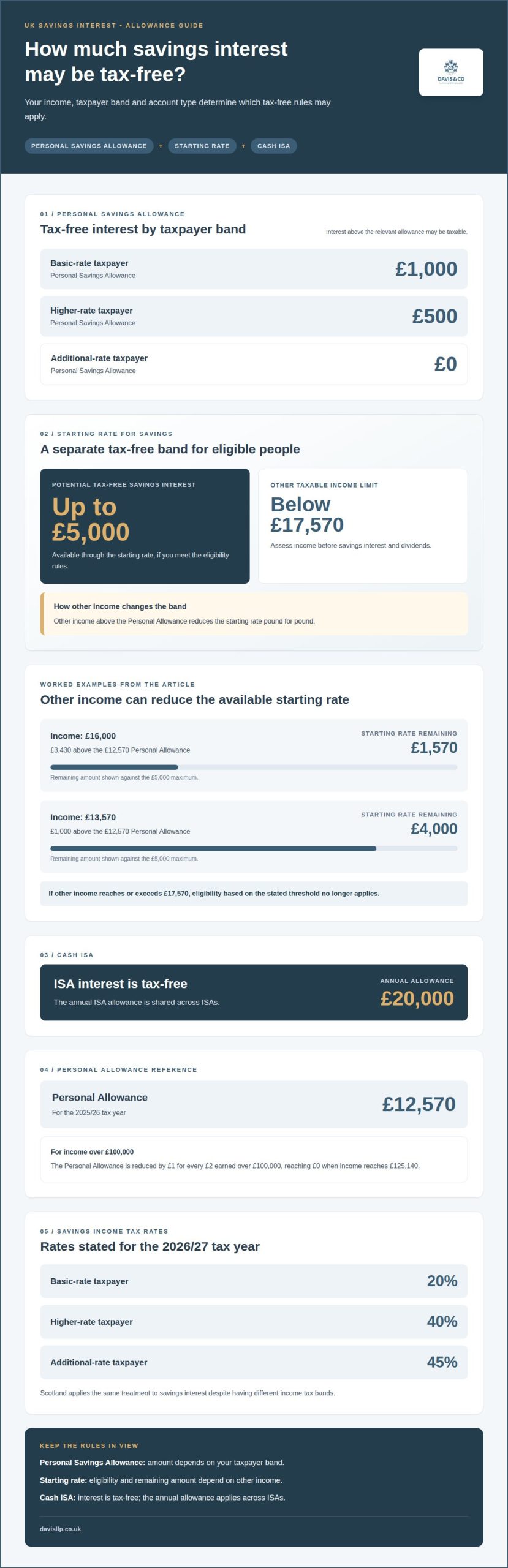
Tax on savings interest in the UK depends on your income and available allowances: a basic-rate taxpayer can receive up to £1,000 in savings interest tax-free, while the limit is £500 for a higher-rate taxpayer and £0 for an additional-rate taxpayer. Eligible people with low non-savings income may also benefit from a starting rate of up to £5,000, according to HM Revenue & Customs. Interest earned in a cash ISA is tax-free, and HM Revenue & Customs sets the annual ISA allowance at £20,000 across ISAs.
It’s understandable to wonder whether savings interest is always taxable or always covered by an allowance. In practice, tax on savings interest in the UK depends on how your interest interacts with your other income. A cash ISA can keep interest tax-free.
This article explains when savings interest may be taxable, how the Personal Savings Allowance and starting rate work, and how cash ISA interest is treated. It also shows how the allowances fit together, so you can identify which rules are relevant to your circumstances.
Key Takeaways
- Work out your total savings interest across accounts, then consider it alongside your other taxable income to understand whether tax may be due.
- Interest is generally counted when it is credited to an accessible account, so the timing can affect the tax year in which it falls.
- Other income can reduce the starting rate for savings, making your Personal Allowance relevant when assessing how much interest may remain tax-free.
- Understand when savings interest needs to be reported to HMRC and how tax due may be collected, particularly if you do not usually complete a tax return.
Do you pay tax on savings interest?
Whether savings interest is taxable depends on your total income and available allowances. UK banks and building societies generally pay interest gross, without deducting tax at source. HMRC receives information from financial institutions after 5 April each year and may use it to work out whether tax is due. Interest is normally counted in the tax year it is credited to an accessible account, even if you leave it untouched.
HM Revenue & Customs says people earning over £10,000 in savings interest annually must file a Self Assessment tax return, even if they do not usually file one. If you do not normally submit a return and your interest is below that threshold, tell HMRC about taxable interest by 5 October after the tax year in which it arose. This helps HMRC assess the amount due.
For the 2026/27 tax year, savings income is taxed at 20% for a basic-rate taxpayer, 40% for a higher-rate taxpayer and 45% for an additional-rate taxpayer. Scotland applies the same treatment to savings interest despite having different income tax bands. Interest in ISAs and some National Savings and Investments products is usually not taxable.
Does the UK tax savings interest from overseas accounts? Overseas interest can affect your UK tax position, but the treatment depends on your tax residence and circumstances. Include it when assessing your total savings income.
How are savings interest and tax handled for joint accounts? HMRC generally splits joint-account interest equally between account holders, unless it believes a different split applies. Each holder should consider their share alongside their own income and allowances.
HMRC adds together interest from your savings accounts to calculate your total. It may send a tax calculation and usually collects any tax due by changing your tax code. Interest credited to an accessible account can count in that tax year even if you do not withdraw it. Check the calculation against your account information: the total interest and your tax position determine the amount payable.
What are tax-free savings allowances?
Two allowances can affect how much savings interest is taxable: the Personal Savings Allowance and the Personal Allowance. Your income and taxpayer band determine how they apply. Understanding both helps you assess tax on savings interest in the UK alongside your other income.
Personal Savings Allowance
The Personal Savings Allowance lets you receive a set amount of savings interest without paying tax on it. It is up to £1,000 for a basic-rate taxpayer, £500 for a higher-rate taxpayer and £0 for an additional-rate taxpayer. Interest above the relevant allowance may be taxable. Knowing your band helps you assess how much interest can remain tax-free before applying the rate for savings. This is a central part of working out tax on savings interest in the UK.
Personal Allowance and Savings Interest
The Personal Allowance is the amount of income you can receive before income tax applies. HM Revenue & Customs sets the UK Personal Allowance at £12,570 for the 2025/26 tax year. A savings-interest calculator should account for this allowance alongside your other taxable income and tax band. If you enter an assumed allowance that differs from your circumstances, its estimate may not reflect how your income affects the available tax-free amount.
For 2026/27, savings income is taxed at 20% for basic-rate taxpayers, 40% for higher-rate taxpayers and 45% for additional-rate taxpayers. The Personal Savings Allowance varies by band, so the taxable amount depends on both your interest and total income.
Income can also reduce the Personal Allowance. For 2025/26, it is reduced by £1 for every £2 earned over £100,000, reaching £0 when income reaches £125,140. This taper can affect the assumptions used to work out taxable income and savings interest, particularly for higher earners.
For an individual assessment of how allowances apply to your circumstances, personal tax support can help bring your income and savings into the same calculation.
What is the starting rate for savings?
The starting rate can make some savings interest tax-free if you have low non-savings income. Eligibility depends on your income before savings interest and dividends.
Eligibility for the Starting Rate
The starting rate for savings is a tax-free band available to eligible people with low non-savings income. HM Revenue & Customs says it can cover up to £5,000 of savings interest. To qualify, your other taxable income, excluding savings interest and dividends, must be less than £17,570. This matters because a low salary or pension may leave room for savings interest to fall within the starting band.
How Other Income Affects the Starting Rate
Other income above your Personal Allowance reduces the starting rate pound for pound. For example, wages of £16,000 exceed the £12,570 Personal Allowance by £3,430, reducing the starting rate by the same amount. The remaining starting rate is £1,570. This calculation shows why your income, not simply your savings balance, affects how much interest may be tax-free.
The starting rate is assessed alongside income tax rules and other savings allowances. A person with income of £13,570 and a £12,570 Personal Allowance has £1,000 of other income above the allowance. That leaves £4,000 of the starting rate available for savings interest. The example illustrates how an annual income figure can change the amount of interest sheltered.
For a low-income taxpayer, the starting rate can apply before interest above that band is considered under the relevant savings allowance and tax rate. If other income reaches or exceeds £17,570, eligibility based on the stated threshold no longer applies. A tax return or HMRC calculation may take account of the income figures, so accurate records of wages, pensions and interest help explain the result.
Using a cash ISA to keep savings interest tax-free
A cash ISA keeps its interest separate from ordinary savings interest for tax purposes. Interest earned in a cash ISA is tax-free and does not count towards your Personal Savings Allowance. This can be useful if interest from other accounts is approaching the allowance for your taxpayer band. The key distinction is whether the interest is earned inside an ISA or in a standard savings account.
HM Revenue & Customs sets the annual ISA allowance at £20,000 across ISAs. That is the overall amount you can save into ISAs within the allowance, rather than an amount that applies separately to each account. If you hold more than one ISA, consider the contributions across them when estimating how much allowance remains. The relevant question is how your planned contributions fit within the shared limit.
A cash ISA may help keep savings interest outside your taxable income calculation. If interest from ordinary savings accounts would otherwise exceed your available allowances, interest earned in a cash ISA remains tax-free. This makes interest from non-ISA accounts easier to assess, although your wider income still matters for tax calculations.
From 6 April 2027, the cash ISA allowance will be £12,000 per tax year for individuals under 65 at that time. HM Revenue & Customs’ annual ISA allowance across ISAs remains a separate overall limit in the current stated rules. This change means age and timing matter when planning future contributions. People aged 65 or over on that date can continue to save up to £20,000 in a cash ISA each tax year.
To estimate the potential tax effect, distinguish cash ISA interest from interest earned in other accounts, then consider your allowances and taxable income together. Pension income may also be relevant to your wider income position. For guidance on how savings interest fits your circumstances, discuss your tax position.
Davis & Co LLP
Davis & Co LLP can help you understand how savings interest fits into your wider tax position. If income from savings, employment, pensions or other sources makes your allowances harder to assess, Personal Tax Services can bring those details together and clarify the tax treatment. International Tax Planning may also be relevant when overseas accounts are involved.
Consider seeking advice if you are unsure how interest affects a tax calculation or interacts with other taxable income. A clear assessment can help you understand the figures and any reporting obligations that apply to you. Contact Davis & Co LLP to discuss your circumstances.
Make your next tax decision with clarity
Once you understand how tax on savings interest in the UK applies to your circumstances, consider how that fits with your wider financial plans. Savings choices can intersect with overseas income, business priorities and personal cash flow, so it may help to consider them together rather than in isolation.
Davis & Co LLP offers International Tax Planning for cross-border tax matters. Business owners can also use the firm’s Business Growth Package and Managing Cash Flow & Profits services to support commercial planning alongside personal financial decisions. The right focus depends on your circumstances and the questions you need resolved.
If you would like advice that takes your savings interest and broader position into account, contact Davis & Co LLP for advice. A considered discussion can help you decide on a clear next step with confidence.
Davis & Co LLP can help with your tax planning
Davis & Co LLP provides Personal Tax Services and International Tax Planning. If questions about tax on savings interest lead you to review your wider tax affairs, the firm can help you consider your personal tax position.
Davis & Co LLP also offers Trust Tax Return Services, Managing Cash Flow & Profits and Compliance & Record-Keeping. These services can support related needs alongside your savings interest tax considerations.
Frequently Asked Questions
How does tax on savings work?
Savings tax is calculated on interest, not on the balance you have saved. A bank may pay interest without deducting tax, so receiving the full amount does not necessarily mean it is tax-free. Your tax position depends on your income, allowances and the tax year in which interest becomes accessible. Interest from different accounts may all affect the same calculation.
How much can I save tax free?
There is no single limit on how much cash you can hold before savings tax applies. The key question is how much interest your savings earn and whether allowances cover it, or whether it is held in a tax-free ISA. For example, a large balance in a low-interest account may earn less interest than a smaller balance in an account paying a higher rate.
What is the Personal Allowance?
The Personal Allowance is the amount of income you can receive before income tax is usually charged. HM Revenue & Customs sets it at £12,570 for the 2025/26 tax year. It applies to income overall, rather than being a separate savings-interest allowance. If your income is high enough, the allowance can be reduced, which may affect your wider tax calculation.
How is savings interest taxed in the UK?
Savings interest is considered alongside your other taxable income, with the applicable rate depending on your taxpayer band and remaining allowances. For 2026/27, the rates for savings income are 20% at basic rate, 40% at higher rate and 45% at additional rate. This means two people earning identical interest may owe different amounts if their other income differs.
What is the UK Personal Savings Allowance for 2026/27?
The Personal Savings Allowance is up to £1,000 for a basic-rate taxpayer, £500 for a higher-rate taxpayer and £0 for an additional-rate taxpayer. It applies to interest from taxable savings, not interest earned in a cash ISA. The allowance is not a limit on your savings balance: it concerns the amount of interest that can be received tax-free.
How does the starting rate for savings work in the UK?
The starting rate can make savings interest tax-free for people whose other taxable income is below the eligibility threshold. HM Revenue & Customs says it can cover up to £5,000 of interest, but other income above the Personal Allowance reduces the available amount pound for pound. It is assessed separately from the Personal Savings Allowance, so both may affect the final calculation.